




To understand what a trading style is, it helps to start with an entirely separate activity from trading by associating it with football, as an example. In a football match, a team’s ultimate aim is to win. But teams can use many different styles of play to try and achieve that aim, ranging from ultra-defensive, lockdown approaches (‘park the bus’) to fluid, dynamic ones (‘tiki taka’).
Similarly, the ultimate aim of trading is to generate profits. But not all traders pursue that common aim in the same manner. Like in football, a trader’s style can be understood as the overarching manner in which they approach the activity, used as a guiding philosophy for navigating the market.
Classically, trading styles have been viewed as falling into one of four categories: scalping, day trading, swing trading, and position trading. Each of these categories covers a distinct holding period for traders, ranging from just a few seconds to several years. But while this temporal dimension is a key element in differentiating trading styles, it is far from the only factor that matters.
In the modern trading environment, it’s also important to consider two other dimensions: methodology and analysis. Together, these three dimensions (temporal, methodological, and analytical) can be used to effectively define a trader’s specific style. In the following sections, we’ll review each of these dimensions and see how they interact with each other to create a precise trading style.
Scalping
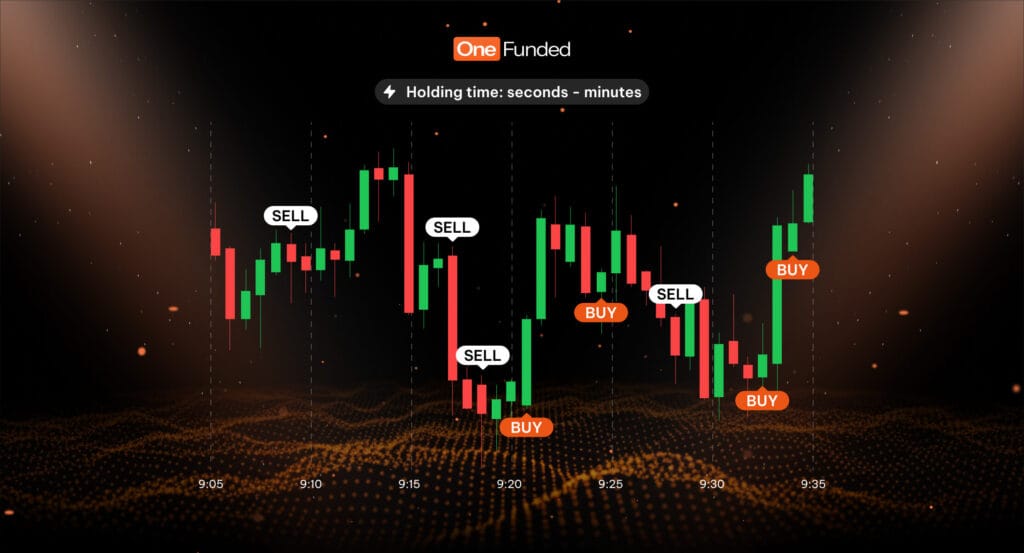
Scalping is the shortest-term style of trading, referring to the practice of holding positions for as little as a few minutes or a few seconds. Scalp traders are rarely looking for big wins. Instead, they prefer to ‘scalp’ small profits from the market throughout the day, generally capitalizing on short movements and tick-by-tick trends.
For example, a scalp trader may identify an uptrend occurring over the past minute through the use of order flow analysis. By placing a market buy for the asset, a scalp trader can secure a quick fill and take a long position. This trader may hold the position for just a few more ticks before liquidating rapidly through a market sell.
- Timeframe: Seconds to a few minutes.
- Risk/Reward: Small gains per trade, low per-trade risk, but very high trade frequency.
Day Trading
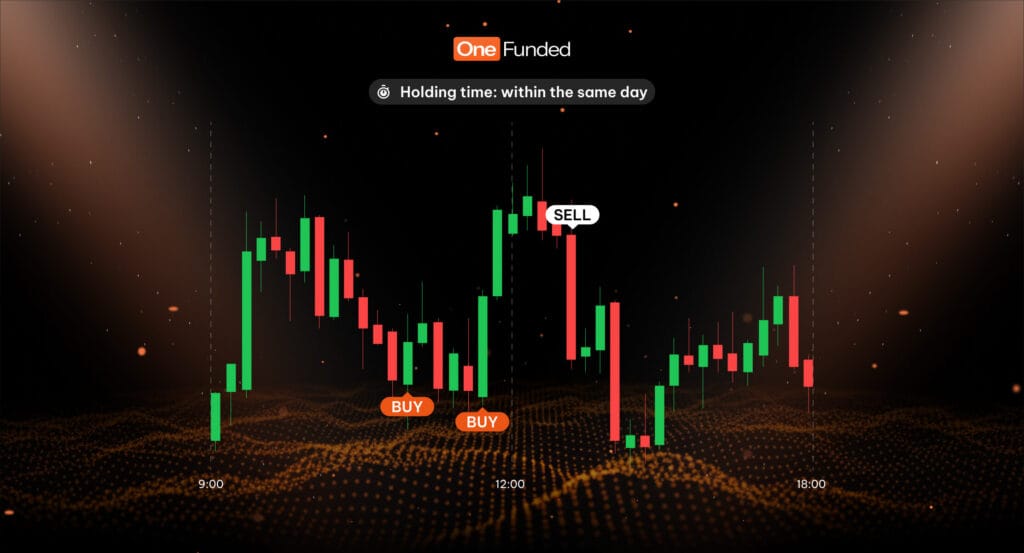
As the name suggests, day trading is a style in which traders only hold positions during the trading day – never after hours. This prevents overnight news or after-market volatility from unexpectedly impacting a trader’s position. While scalping might technically fall under this category, the term ‘day trading’ typically refers to a slightly longer holding period, potentially up to several hours.
- Timeframe: Minutes to several hours (never overnight).
- Risk/Reward: Moderate profits per trade, medium trade frequency, risk contained within the day.
Swing Trading
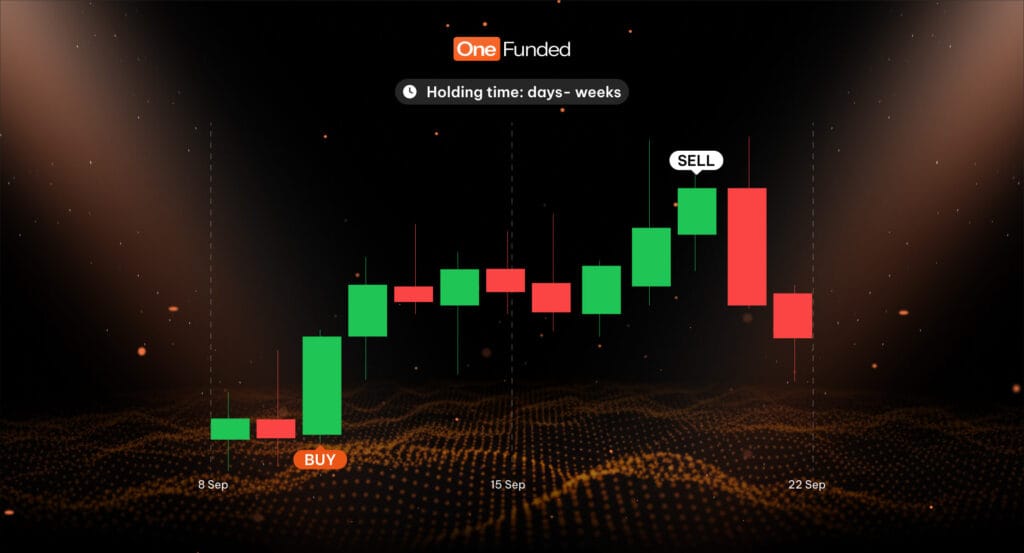
Unlike day traders, swing traders are comfortable holding positions after the market closes. This style involves taking a longer-term view on asset prices, maintaining a long or short trade for several days or weeks. While holding positions this long can expose swing traders to the risk of larger losses, it can also allow them to capitalize on trends that play out over the course of multiple trading days.
Many of the techniques of swing trading are similar to those of day trading, but are utilized over a longer time scale. Moreover, swing traders often make greater use of limit orders. That’s because swing traders are often more interested in taking positions at a specific price, and less interested in rapidly entering or exiting trades.
- Timeframe: Several days to a few weeks.
- Risk/Reward: Higher profit potential per trade, lower trade frequency, larger position risk.
Position Trading
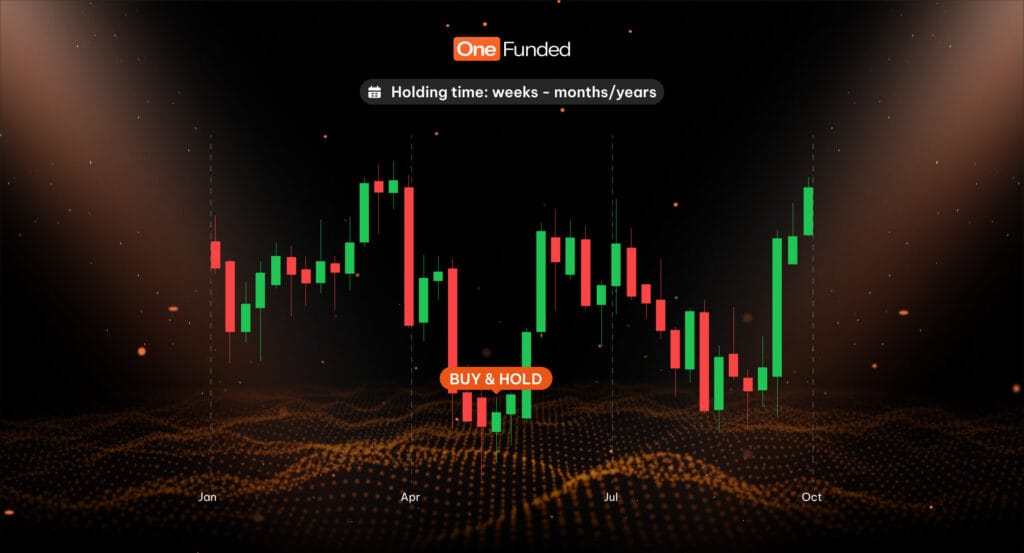
Position trading is the most long-term oriented style, with traders holding assets for months or even years. At the most extreme end, buy-and-hold investing can be considered a form of position trading. Typically, position traders are seeking to capitalize on major, slow-moving trends such as growth in a company’s earnings or the outperformance of a particular national economy.
- Timeframe: Weeks to months (sometimes years).
- Risk/Reward: Large profit potential per trade, very low frequency, requires patience and strong conviction.
Trading Styles Comparison
Different trading styles vary mainly by holding time, frequency of trades, risk tolerance, and expected profits. Understanding these differences helps traders choose the approach that best fits their personality, capital, and time commitment. Below is a breakdown of the four main styles:
| Trading Style | Typical Holding Time | Number of Trades | Risk per Trade | Profit Potential | Example Scenario |
|---|---|---|---|---|---|
| Scalping | Seconds – a few minutes | Very high (50–200/day) | Low (tight stop-loss, e.g., 0.1–0.3%) | Small per trade, adds up with volume | A scalper buys EUR/USD after spotting a quick order flow imbalance and exits within 30 seconds for a $50 gain. Repeats this dozens of times. |
| Day Trading | Minutes – hours (never overnight) | High (1–20/day) | Low–Medium (0.3–1% per trade) | Moderate, several trades can accumulate | A day trader shorts Tesla stock at market open, holds for 3 hours, and closes before the bell for a $300 profit. |
| Swing Trading | Days – weeks | Moderate (5–15/month) | Medium–High (1–3% per trade) | Larger moves captured, higher profit potential | A swing trader goes long on GBP/USD ahead of central bank news, holds for 2 weeks, and profits $2,000 from the trend. |
| Position Trading | Weeks – months/years | Low (1–5/year) | High (3–10% per trade) | Very high if the trend continues | A position trader buys Bitcoin at $30,000, expecting macro growth, holds for 8 months, and exits at $55,000 for a $25,000 gain. |
The Analytical Dimension: Three Categories
Finally, the analytical dimension serves as the last key differentiator for various trading styles. This dimension captures the type of research that traders employ to identify profitable opportunities and inform their trading decisions (or the decisions of their program, in the case of algorithmic trading). There are three key categories within this dimension, ranging from analytical frameworks that rely on the study of real-world economic activity to those that depend solely on data.
Fundamental Analysis
Fundamental analysis is the category most closely focused on actual businesses and economies. Common forms of fundamental analysis include studying financial statements, building valuation models, and researching macroeconomic data. The overarching goal of fundamental traders is to use their analysis to determine the fair value of some underlying asset, going long underpriced assets (and sometimes shorting overpriced ones).
While there are many different tools of fundamental analysis, discounted cash flow modeling is a popular way to model the fair value of a debt or equity security. In the currency markets, covered interest rate parity and balance of payment models are also used by fundamental researchers to estimate fair value, typically incorporating macroeconomic data like interest rates and inflation. Although digital assets sometimes fall outside the traditional framework of fundamental research, building models of supply and demand for tokens can still provide useful insights.
Technical Analysis
In contrast to fundamental analysis, technical analysis is far less concerned with real-world economic phenomena. Instead, technical analysis is focused on forecasting future price activity from historical trends. This can make technical analysis far more versatile than fundamental analysis, since it does not require building a unique valuation model for every new tradable market.
Many key trading concepts are ultimately rooted in technical analysis, including momentum, resistance, and reversals. Traders employing technical analysis often use these concepts in conjunction with tools like chart patterns and statistical indicators to identify trading opportunities. For instance, the ‘Morning Star’ candlestick pattern can be a sign of a bullish reversal during a downtrend.
Quantitative Analysis
Quantitative analysis, the final category within the analytical dimension, is solely concerned with statistical analysis and data research. Quantitative analysis is sometimes viewed as an extension of technical analysis. But while the two categories do have some overlap, quantitative analysis is distinct for its focus on raw data sets and ground-up mathematical models.
For example, a simple form of quantitative analysis could be constructing a multivariable linear regression model for the daily performance of one asset based on several other related markets. As these models become more advanced, quantitative analysis frequently employs insights from fields like probability theory, Bayesian statistics, and signal processing. At an advanced level, quantitative analysis at leading hedge funds and institutions can closely resemble machine learning research.
Developing Your Trading Style: A Practical Framework
Now that we’ve covered the theoretical foundations of trading styles and the trade-offs between them, you can begin working to establish your own unique trading style. Developing an effective style requires both an honest assessment of your skills and personality, as well as a healthy dose of experimentation.
Step 1: Self-assessment and style alignment
Determining your ideal trading style starts with an inward look at both your psychological approach to markets and your technical knowledge. For traders with limited programming experience and mathematical knowledge, algorithmic quantitative styles may not be practical. Similarly, without a deep background in financial modeling, fundamental research may prove challenging.
In terms of psychology, traders need to understand the level of risk they’re comfortable with and what style of work they can maintain over the long term. Cautious traders who are hesitant to make high-conviction bets may be better suited for short-term styles like scalping. However, most effective forms of scalping require a high level of mental discipline and focus to identify profitable opportunities throughout the trading day.
Step 2: Experimentation with paper trading
Whichever style of trading an individual’s self-assessment leads them to, the next step is to experiment with this style in a paper account. Paper accounts allow traders to simulate real trades and market movements without putting actual capital at risk. While it’s possible to start trading with a new style directly in a live account, it can be risky.
This paper account stage also allows traders to experiment with different strategies within a broader style. Recall that styles can only be put into practice with a practical trading strategy. By utilizing a paper account, traders can be more flexible with their strategic approach to discover what works for them.
Step 3: Gradual capital deployment with additional refinement
Once a trader has grown comfortable with trading in a paper account, they can begin gradually deploying capital in a live account. At this stage, traders can also begin effectively working with prop firms, which can provide greater capital limits to execute larger trades. Even as they deploy live capital, however, a trader’s style should not remain static – the best traders continually refine their styles and strategies over time.
Gradual capital deployment is particularly important for trading styles that may impact the price of the very asset being traded. For instance, scalpers working with thinly traded assets may push up the price when entering a market buy order. While price impact is generally less of a factor for smaller traders, it can only be discovered and managed through real-world experimentation.
Conclusion: Putting Your Style Into Practice
In this article, we covered the basics of trading styles, looking at the three key dimensions along which styles differ. We also discussed the trade-offs between different styles, as well as the crucial distinction between styles and strategies. Finally, we looked at one of the most important elements – how traders can discover and deploy their own style.
For traders at the beginning of their journey, the maze of possible styles that can be used to generate profits might seem overwhelming. With an honest self-assessment and adequate experimentation, however, traders can effectively navigate this maze and discover the trading approach that works for them. Once you’re ready to put your style into practice, OneFunded’s virtual account options can be a strong choice for competitive traders.
Prop traders with OneFunded accounts can access greater amounts of capital, with virtual account sizes up to $200,000. This can allow traders to pursue styles and strategies that may not be practical with lower capital levels. Ready to get started? Prove your skill with the OneFunded trading challenge today.