



What Is a Funded Trading Account? How Prop Firm Payouts Work
The average experienced trader understands the basics of prop trading and what a funded trading account is, but not everyone has a full picture of what happens after passing a challenge. There are often questions around payouts, profit splits, and funded account rules, especially for traders who need answers before purchasing their first challenge.
In this guide, we’ll take a look at how a funded account works, the difference between challenge and funded accounts, the basics of profit split systems, and how OneFunded distributes profits through weekly and bi-weekly payouts.
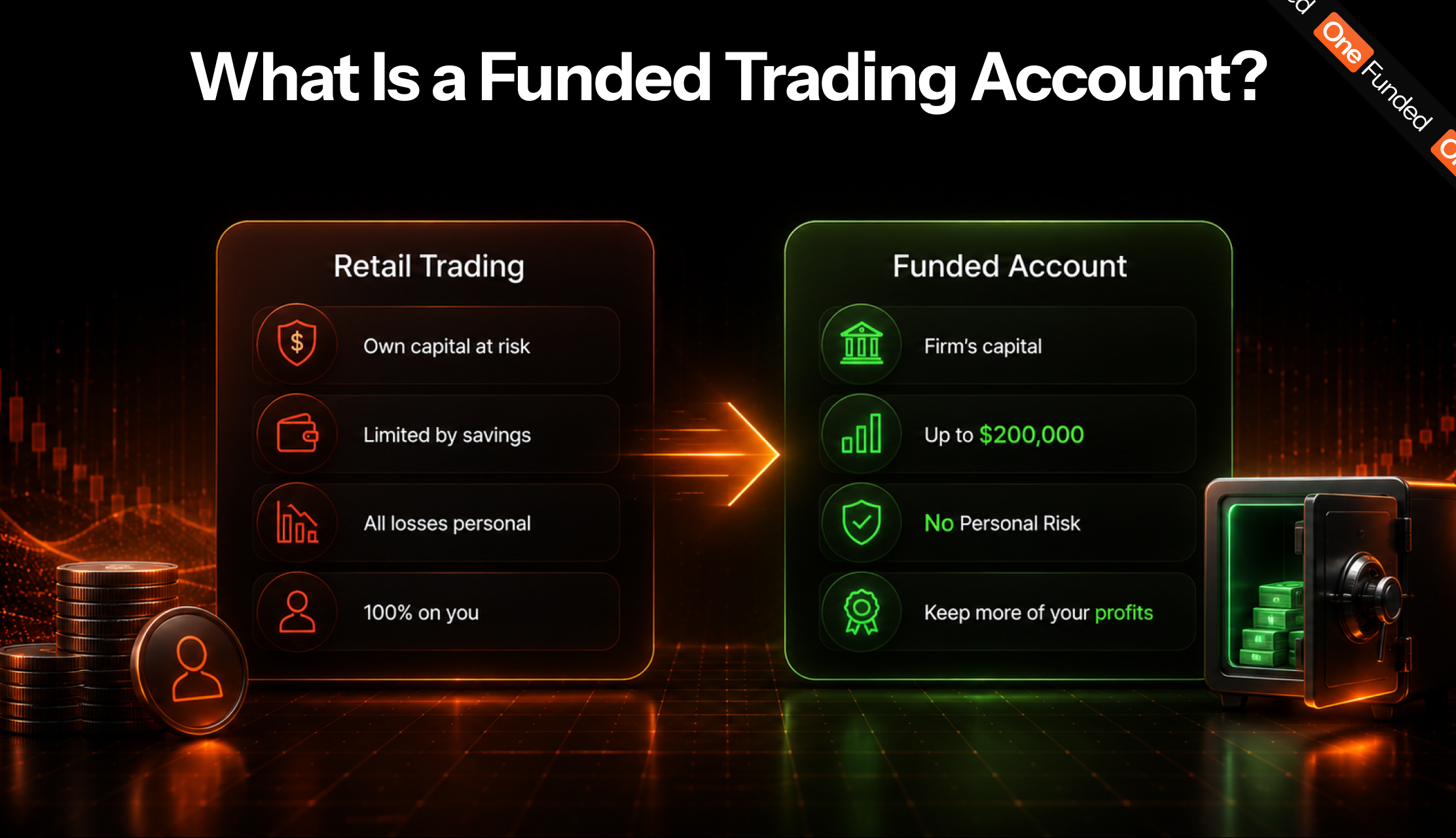
A funded trading account is an account that allows you to operate with a prop firm’s capital and receive a percentage of the profits you make after trading.
Instead of risking substantial personal funds, prop firms like OneFunded allow traders to prove their consistency through an evaluation process. After meeting the required targets and complying with the provided risk limits, they receive access to a funded account and can begin earning through payouts.
At OneFunded, traders can access funded account sizes ranging from $5,000 to $200,000. You’ll also find different challenge formats that give traders the flexibility to choose what structure works for them.
The major difference between traditional retail trading and using funded accounts is that funded firms allow traders to access more capital instead of solely relying on personal funds.
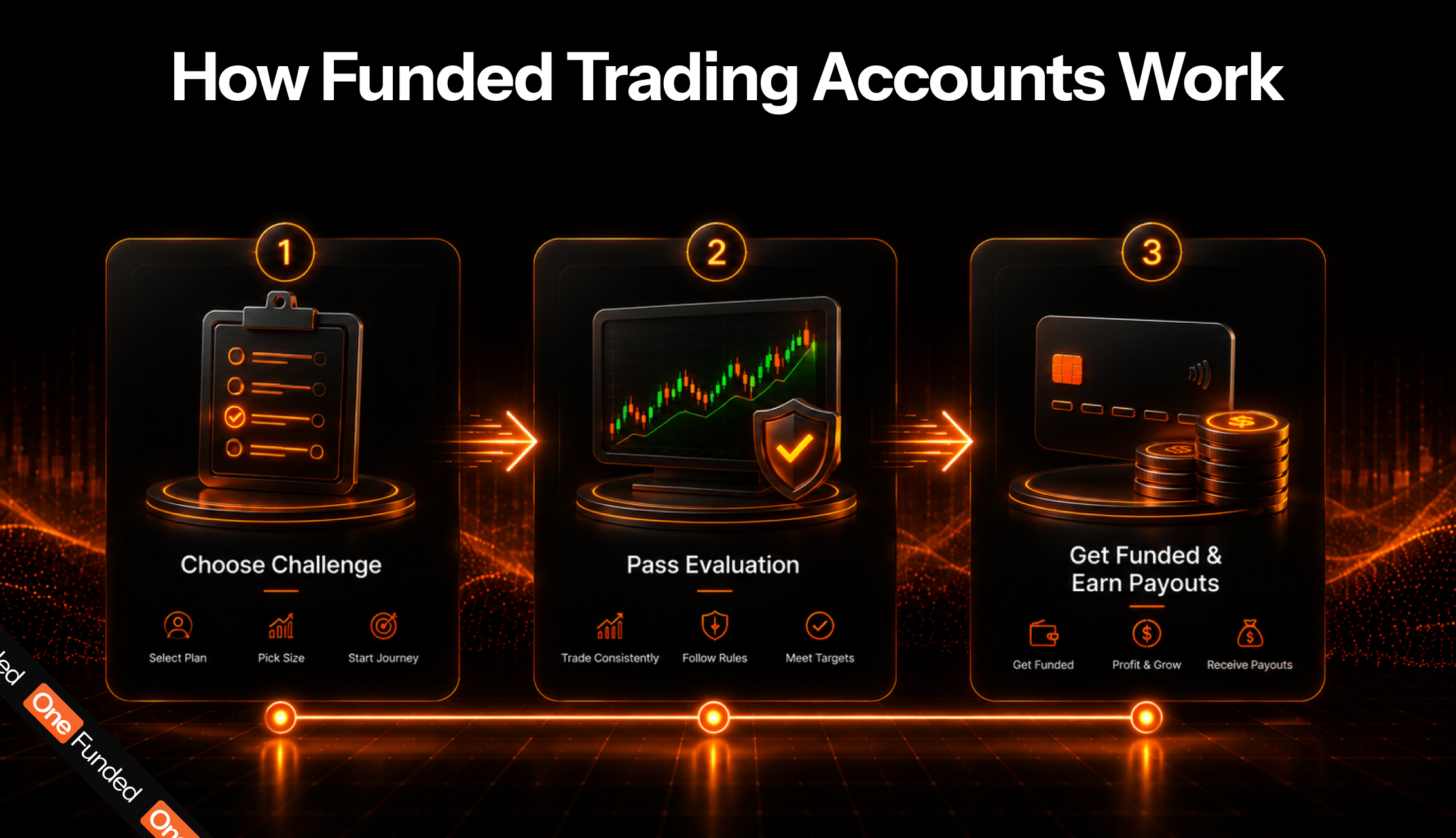
Before using a funded trading account, here are the steps to follow:
Whether you want a low-entry cost, quicker access to a funded account, or immediate capital without an evaluation, OneFunded has a challenge for you.
The OneFunded Value challenge is a two-step model. It is a good option if you are big on discipline and looking for small upfront costs. The challenge starts at $29 and offers between $5,000 to $100,000 in funding.
The Core Challenge on OneFunded starts from $35. It is ideal if you want a combination of rules and the option of a 100% refundable fee. You need three minimum trading days for this challenge, while the 5% daily drawdown and 10% maximum loss limits are the best features.
Flash is a one-step challenge that starts from $56. It offers between $5,000 and $100,000 and a 100% refundable fee. This makes the challenge option ideal for you if you already have enough experience but need quick funding.
Instant Funding on OneFunded comes with no evaluation stage. It starts from $79, with account sizes from $5,000 to $25,000. Since funding is immediate, this model is recommended to pro traders who want to unlock capital in no time.
| OneFunded Challenge | Value | Core | Flash | Instant |
|---|---|---|---|---|
| Evaluation Steps | 2 | 2 | 1 | No |
| Starting Price | $29 | $35 | $56 | $79 |
| Profit Target | 9% / 6% | 8% / 5% | 10% | No |
| Maximum Daily Loss | 4% | 5% | 4% | 3% |
| Maximum Overall Loss | 8% | 10% | 6% | 6% |
| Minimum Trading Days | 4 | 3 | 5 | No |
| Fee Refund | No | 100% | 100% | No |
| Best For | Disciplined traders | Most traders | Fast-track traders | Experienced traders |
It’s important to note that all challenges on OneFunded support top trading platforms, including MetaTrader 5, cTrader, and TradeLocker.
Many new traders use the terms interchangeably, but challenge accounts and funded trading accounts are different. A challenge account tests your ability to follow rules and produce consistent results. Meanwhile, a funded account allows you to earn payouts from your trading performance.
More details in the table below:
| Account Type | Challenge Account | Funded Account |
|---|---|---|
| Purpose | Evaluation | Profit generation |
| Profit Target | Yes | No |
| Minimum Trading Days | Yes | No |
| Withdrawals | No | Yes |
| Profit Split | No | Standard 80% (scalable to 90%) |
The evaluation stage is all about trading consistently while respecting risk. Every OneFunded challenge follows this principle, although each model uses different requirements.
Because OneFunded imposes no deadlines, traders can build a quality trading approach instead of forcing trades.
Passing a prop firm challenge is only one phase of your trading journey. Once you become funded, profit targets disappear, and the new focus is capital preservation.
Funded traders at OneFunded continue to operate under clearly defined risk parameters, but they no longer need to achieve a profit target to maintain their accounts. Instead, they are expected to generate sustainable profits while protecting capital.
They can also access top trading platforms, including MetaTrader 5 (MT5), cTrader, and TradeLocker. Depending on your strategy, you can trade different assets, including:
When using prop trading platforms, you don’t need to deplete your capital because the companies offer enough capital to fund the accounts you trade with. However, these funds aren’t exactly free, as you’re expected to share a portion of your trading profits with the provider.
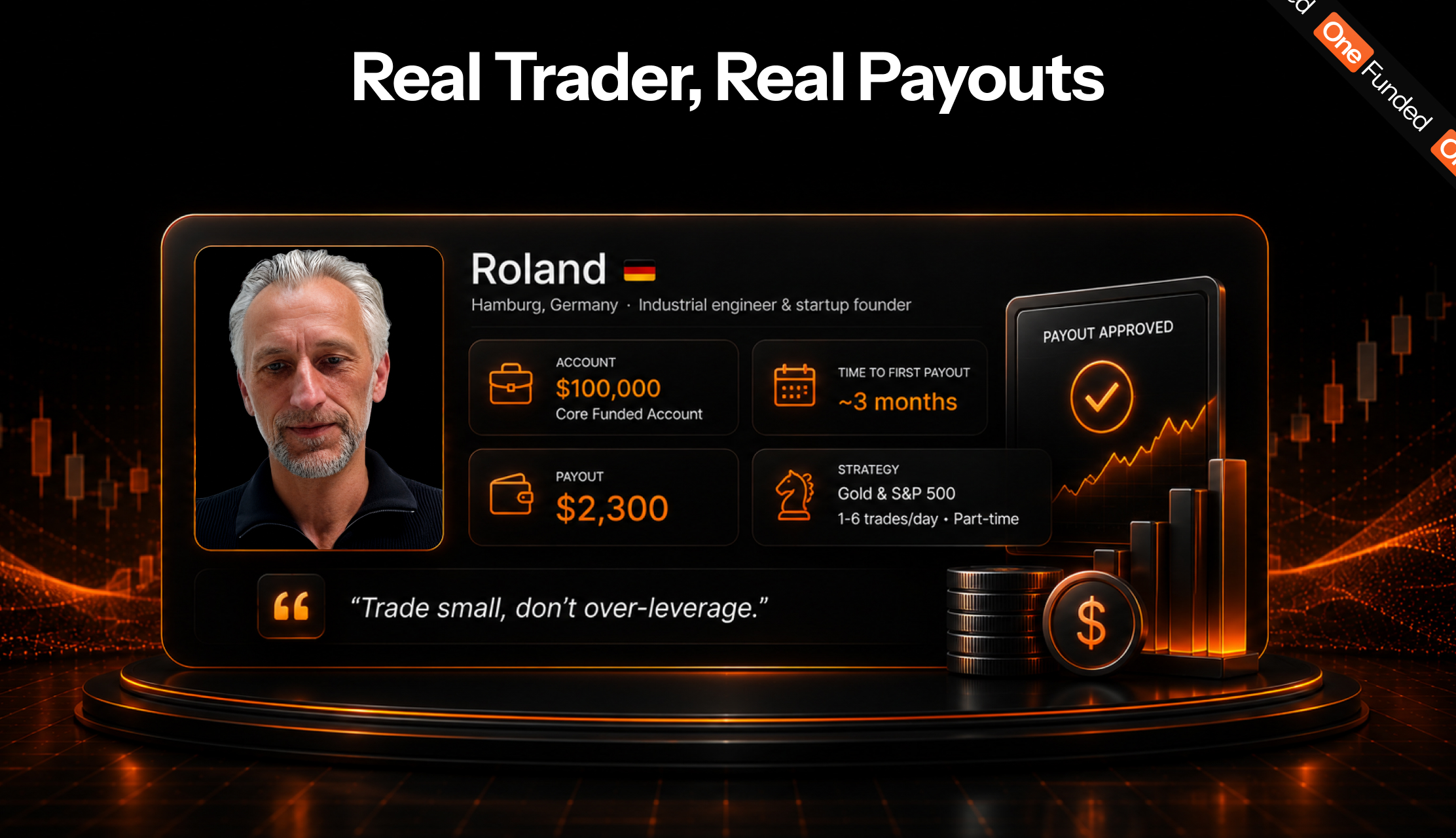
At OneFunded, there’s a standard 80/20 sharing formula. One example of how this plays out in practice comes from Roland, an industrial engineer and startup founder from Hamburg, Germany, who refined his manual trading strategy over two to three years before joining OneFunded.
Roland passed the challenge, received a $100,000 Core funded account, and within roughly three months had secured two four-figure payouts — trading primarily gold and the S&P 500, one to six trades per day. His second payout came to $2,300 under the standard 80/20 split, meaning he generated around $2,875 in profit on that cycle, keeping $2,300 and returning $575 to OneFunded. He continues to trade and grow his account. Trading is his hobby, not his full-time job.
“You need to have a rulebook, and you have to stick to it. The most strategies work — but traders can’t turn profitable because of human nature. You start to get greedy, you don’t stick to your rules.”
Roland, OneFunded $100,000 Core funded trader
On risk management, he’s equally direct: “Trade small, don’t over-leverage. It’s not important to make big gains in the first couple of days or weeks. It can take months — that’s fine. But when the strategy works, it works.”
Roland’s experience shows that consistent, part-time trading with a proven system and strict risk management can generate recurring payouts — without being a full-time trader or monitoring dozens of markets at once.
Many traders compare challenge prices and profit targets without examining how payouts actually work. However, payout mechanics often have a greater impact on long-term earnings than the difference between a $29 and a $56 challenge due to three factors.
An additional 10% profit share can translate into thousands of dollars over time. This is why some traders opt for add-ons to scale their accounts. Traders can purchase this add-on when buying a new trading account with OneFunded.
Weekly payouts provide faster access to profits and greater flexibility for active traders. OneFunded offers a Weekly Payout Add-on for traders who want faster access to their profits.
Fast withdrawals improve cash flow and reduce uncertainty. At OneFunded, approved withdrawals are processed within an hour, giving traders faster access to their funds.
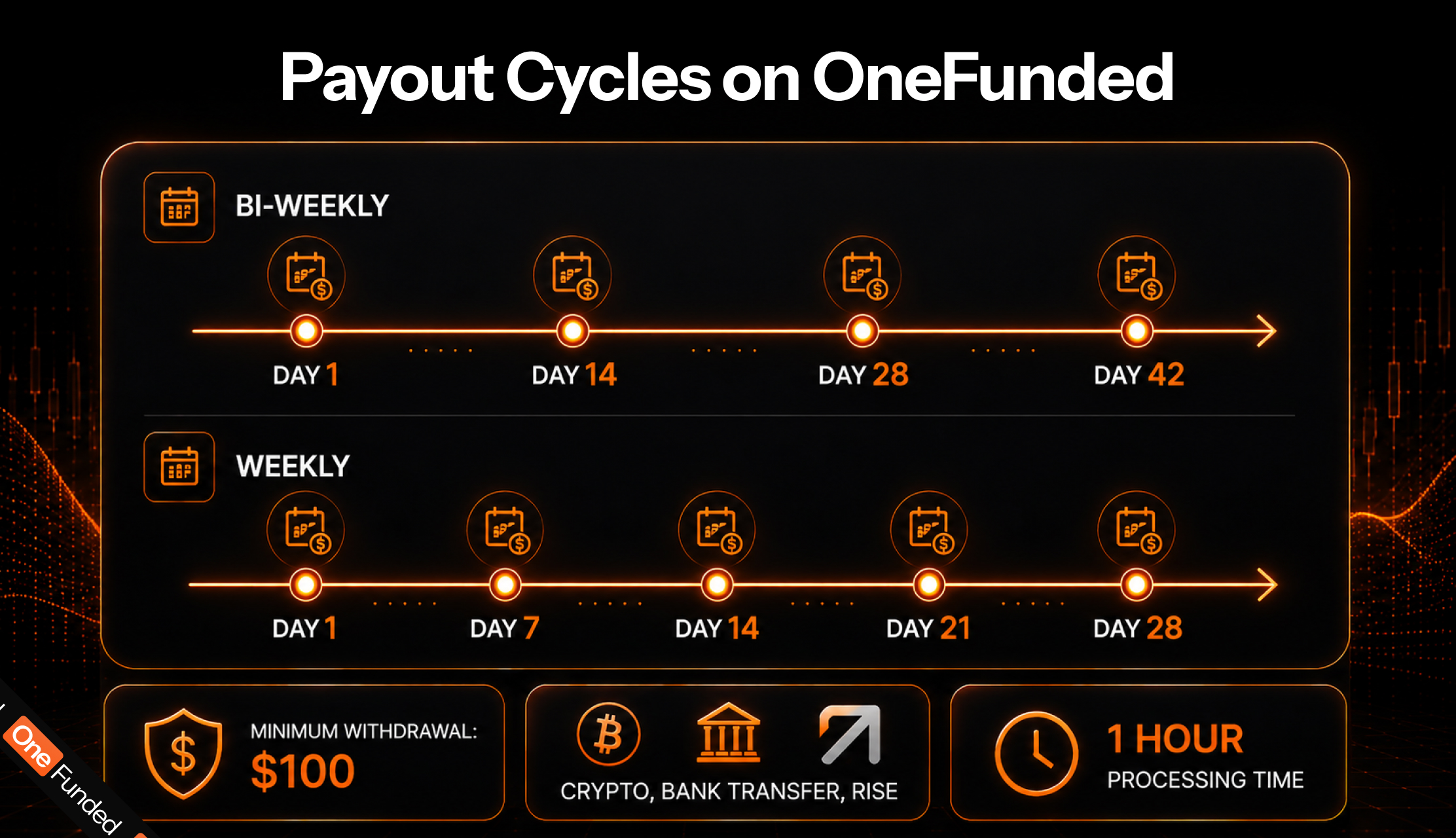
OneFunded withdrawals are pretty straightforward and predictable because they are processed weekly or bi-weekly.
The minimum withdrawal amount on OneFunded is $100, and the supported payment methods include:
These options are flexible, as they allow traders to process payouts anywhere in the world.
One of the standout features of OneFunded is its fast withdrawal speed. Once your payout request is approved, withdrawals are processed in about one hour.
Typically, you must submit a request, complete internal reviews, and get approval. The funds are then sent to your preferred payment channel.
OneFunded also publishes payouts on its website and public Discord community, allowing traders to monitor payment activity and observe the firm’s ongoing payout performance.
OneFunded has processed over $800,000 in payouts for 25,000+ traders across 168 countries.
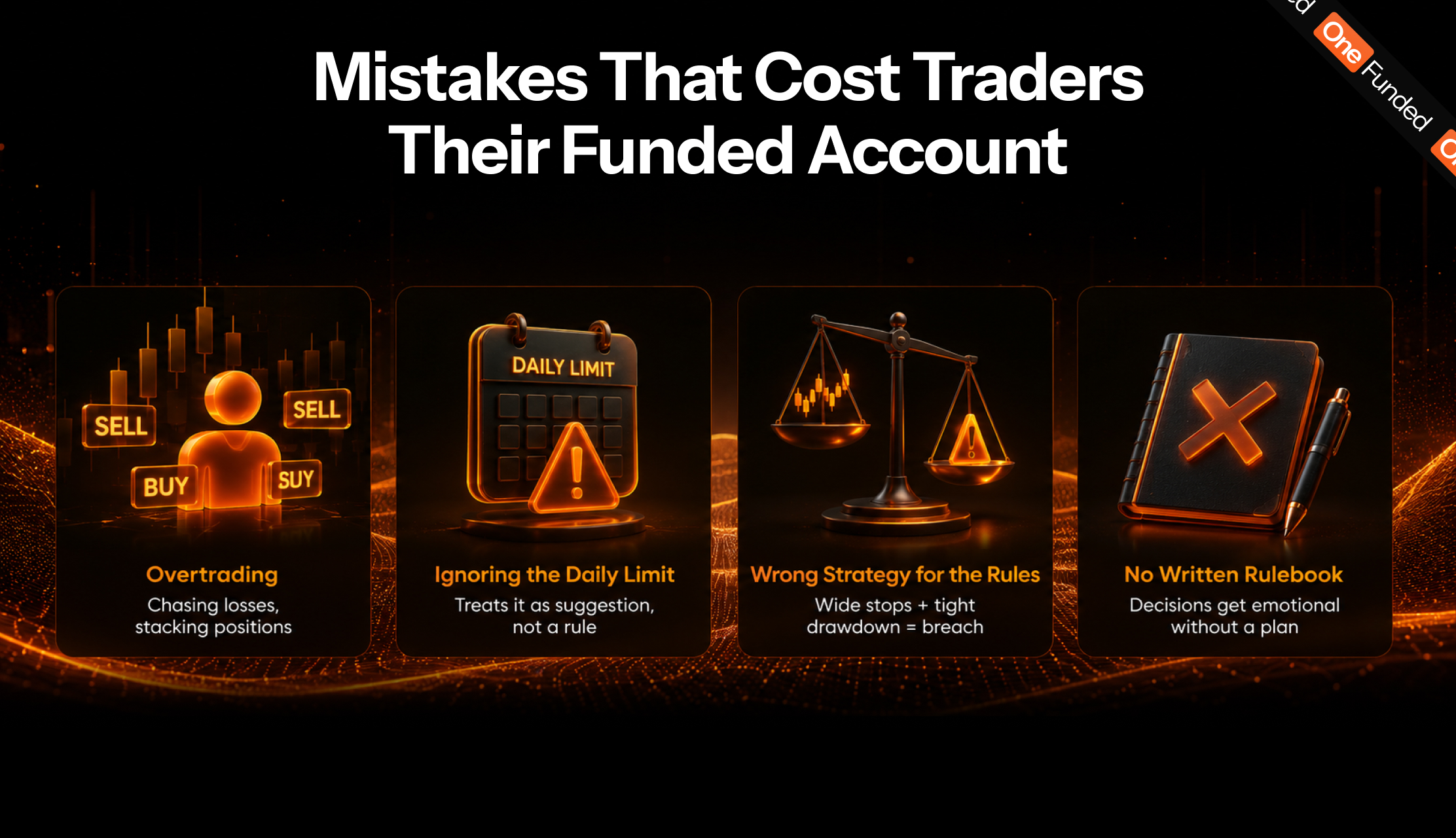
Passing the challenge is one thing. Keeping the funded account is another — and that is where many traders run into trouble.
Here are common mistakes to look out for:
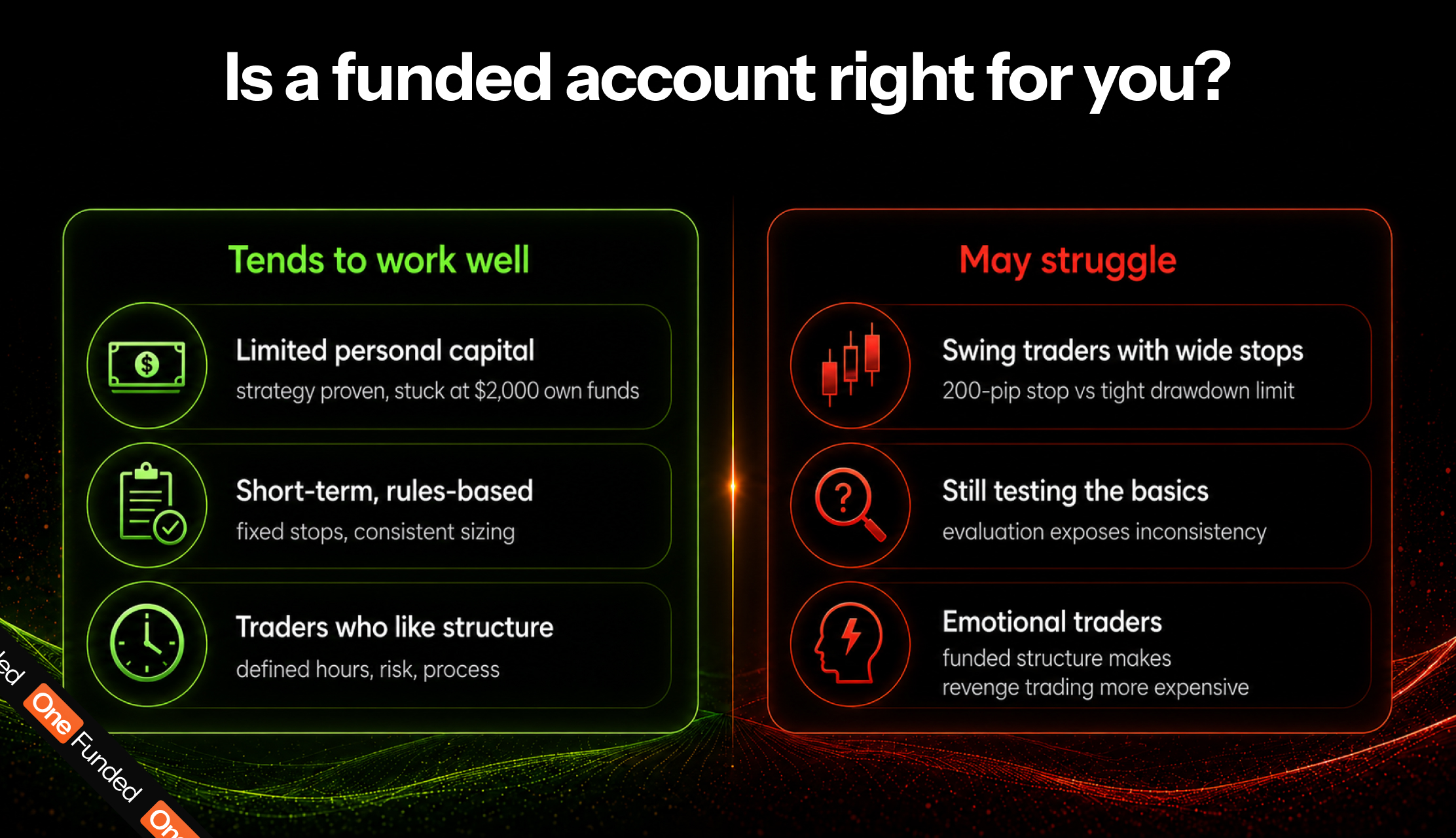
Funded accounts are not for everyone. They work well for some traders and create unnecessary friction for others. Here is an honest breakdown.
A funded account lets a trader work with larger virtual capital under a firm’s rules, instead of risking their own savings on a big personal account. You get structure, limits, a profit split, and a clear path from evaluation to payout.
The positives are clear: more capital, shared risk, better tools, and often a helpful community.
OneFunded trading challenges, profit splits of up to 90%, weekly and bi-weekly payout options, and one-hour payout time are some of the perks traders get on the platform.
A funded trading account from OneFunded also gives you access to up to $200,000 capital to start your trading journey. However, before purchasing a challenge, take the time to understand the different options and choose the model that best matches your trading style, experience level, and long-term goals.


Join our mailing list today!
A funded trading account gives traders access to a prop firm's trading capital after they meet specific evaluation requirements.
Funded accounts work through a qualification process. Traders first complete a challenge by meeting profit targets and respecting drawdown rules. After passing, they receive a funded account and become eligible for payouts.
A challenge account evaluates performance and does not provide withdrawals. A funded account allows traders to receive profit payouts and doesn't require profit targets.
Standard payouts occur every 14 days, while the Weekly Payout Add-on enables withdrawals every seven days.
Withdrawals on OneFunded are processed in approximately one hour, provided a trader meets all the payout requirements.
If you’ve ever looked for prop firm challenges, you have probably seen two options: 1-step vs 2-step prop firm challenges....

Every prop firm challenge has a unique set of rules. This includes profit targets, drawdown limits, and consistency demands. Most...

You’ve made up your mind; you want to go into trading full-time in 2026. Great. But there are tens of...
 Set Preferred on Google