



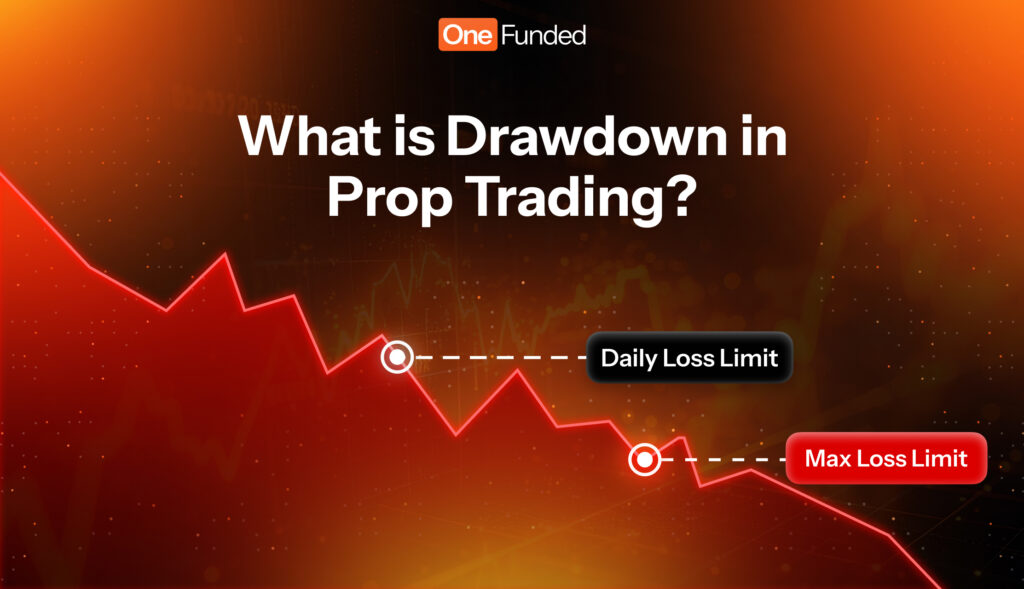
This article will cover what is drawdown in prop trading, how it differs between daily drawdown vs overall drawdown, drawdown types such as static and trailing ones, equity-based drawdown management, and how the evaluation programs of OneFunded incorporate drawdown limits for three types of challenges.
One of the OneFunded traders participating in the $50,000 Core evaluation exceeded the 5% daily drawdown limit forty minutes into the London session.
The trader entered positions in GBP/JPY for 2.5 lots when the currency pair gapped due to a surprise from the Bank of England, and negative P/L was -$2,600 before the trader could act. His profit target was 10%. No account and no evaluation fees survived.
Many evaluations ended because of it. The trader knew exactly what the profit target meant, but did not care much about drawdown. Drawdown ultimately decides whether a challenge is passed or failed, regardless of whether positions are closed or still open.
What is Drawdown in Prop Trading
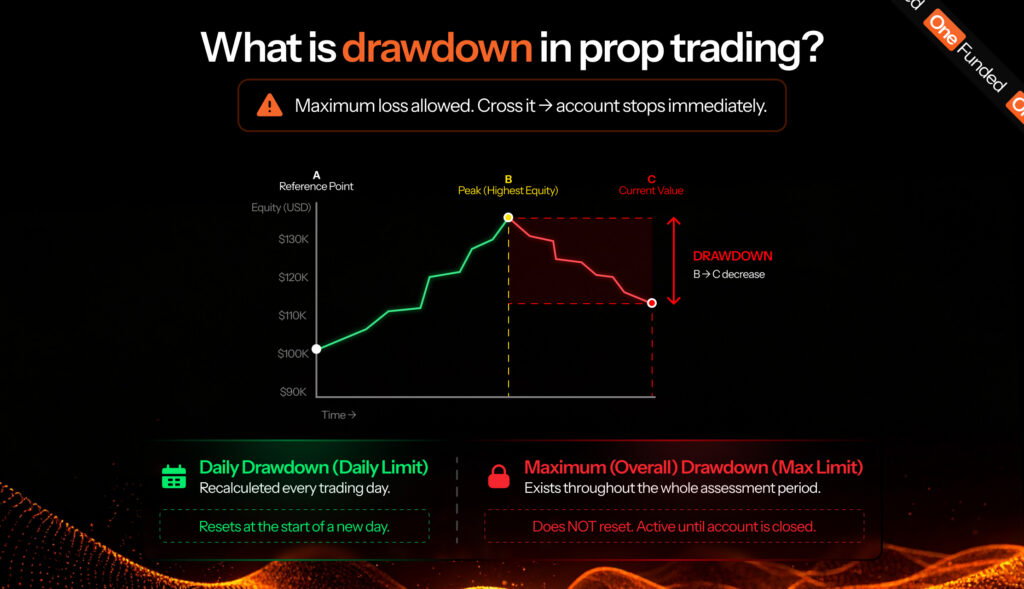
The drawdown is the amount by which the value of the trading account decreases in relation to a particular reference point, which may be the initial value, the maximum value achieved, or the opening equity value of the day. In proprietary trading, drawdown limits represent absolute boundaries for the maximum loss allowed. Crossing such limits means that your performance assessment or trading account will instantly be halted.
There are two types of drawdowns regulating all proprietary firms’ activities. The first type is a daily drawdown. It recalculates every trading day. The other one is a maximum (overall) drawdown, which exists throughout the whole performance assessment period. Both need to be observed simultaneously, without any exceptions, during each second the market is operating.
Paul Tudor Jones puts the underlying philosophy as cleanly as anyone has: “The most important rule of trading is to play great defense, not great offense. Every day, I assume every position I have is wrong. I know where my stop risk points are going to be. I do that so I can define my maximum possible drawdown”.
Proprietary trading makes this idea work through drawdown limits automatically. In proprietary trading, risk limits override personal conviction, regardless of how strong the analysis may seem.
Daily Drawdown vs Overall Drawdown: How the Two Limits Work Together
These two limits operate independently, but a single breach terminates everything. Here’s how they work:
How Daily Drawdown Works
Daily Drawdown represents the maximum allowable loss allowed for one trading day, based on that day’s equity balance. Both closed and open trades are included in this daily loss measure. The Daily Drawdown calculation resets each day at midnight server time, providing the trader with a clean slate for losses every day.
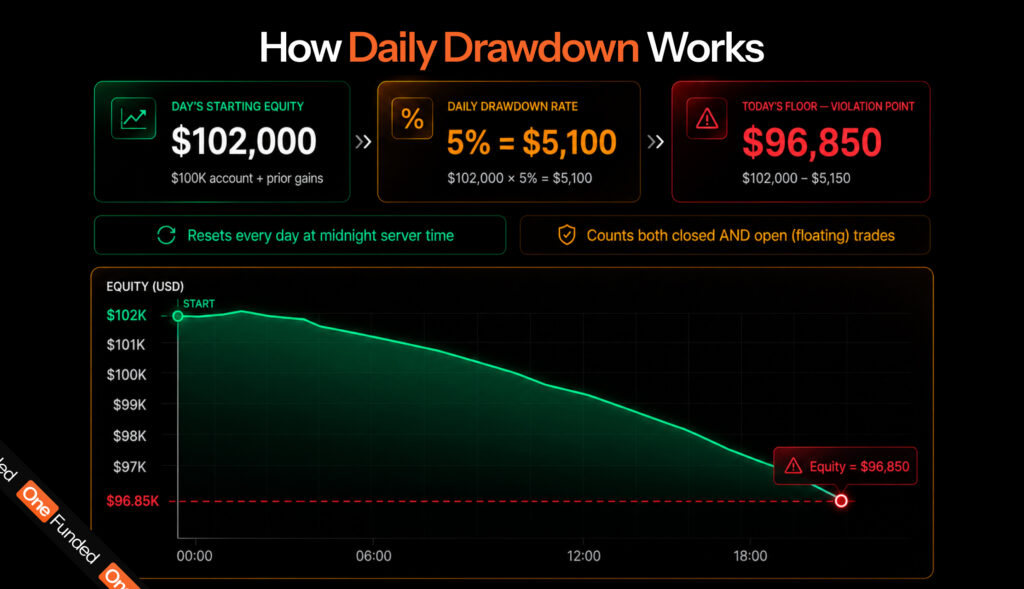
In an account balance of $100,000 with a 5% daily drawdown, if the trader made a gain of 2% previously, the starting balance for the trading day would be $102,000. For this particular account, the daily drawdown floor stands at $102,000 – $5,100 = $96,900. As soon as the equity balance falls under $96,900, the violation occurs.
Why Daily Drawdown Catches Traders Off Guard
The daily risk is less than most people realize, particularly when working with volatile currency pairs or during news events. With a 4% daily risk limit applied to a trading account of $50,000, that’s $2,000 in total drawdown throughout the day.
It’s easy to reach that drawdown figure with just one large position in XAUUSD on the NFP news event. About six out of ten failed Core evaluations at OneFunded had traders make such an oversight. The trading methodology was right, but the size of lots was just too large on one particular trading session.
Daily drawdown counts both floating (not yet realized) profits and losses. A trade may temporarily recover in floating P&L, but drawdown is calculated objectively and does not reflect short-term reversals.
How Overall (maximum) Drawdown Works
Maximum drawdown represents the total amount of money that can be lost during the whole assessment period. It can be calculated from the initial capital or the highest equity. It is unlike a daily drawdown since it never gets reset.
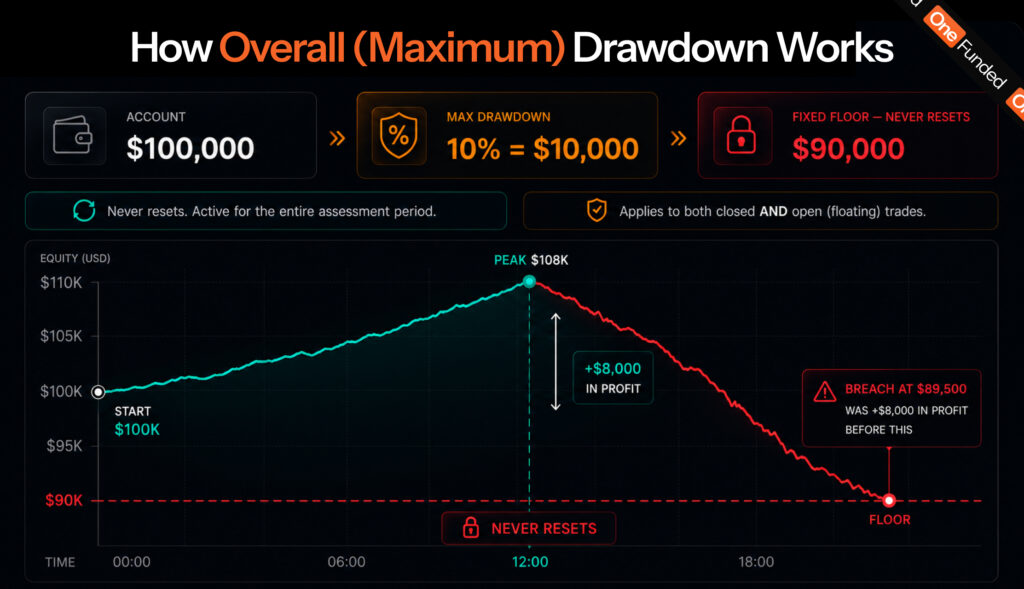
In a case where the trader has an initial account of $100,000 with a maximum drawdown percentage of 10%, this means the floor will remain at $90,000. If the account grows to $108,000 and then drops back to $89,500, the trader breaches the maximum drawdown even though the account was once $8,000 in profit.
How Daily and Overall Drawdown Interact
A trader may observe a daily drawdown each day of trading without violating the total maximum due to the accumulation of small losses over several days. This is also true vice versa: in one single disastrous trading day, a trader may violate both of the parameters.
Think of daily drawdown as the speed limit and overall drawdown as the fuel gauge. You can drive under the speed limit every day and still run out of gas.
Static Drawdown vs Trailing Drawdown: How the Calculation Method Changes Behavior
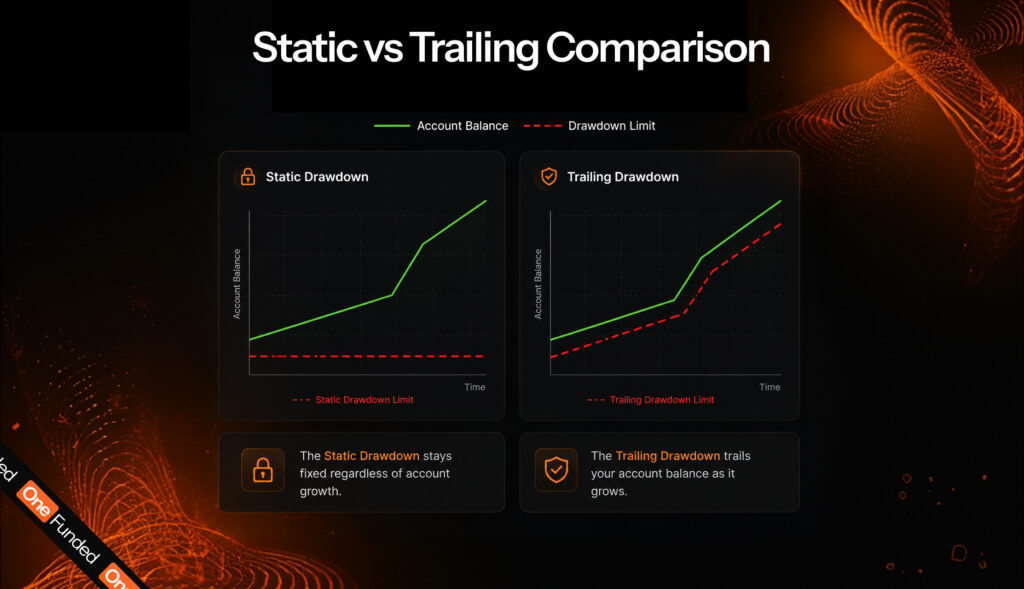
Here are the primary differences between the static and trailing drawdown for traders:
Static Drawdown
Static drawdown keeps the loss limit fixed at the initial account level. If there is an account worth $100,000 and a static drawdown of 10%, then the floor level will remain at $90,000 irrespective of the level of growth achieved. An increase to $120,000 means that the floor level will still be $90,000.
Trailing Drawdown
The floor is raised with a trailing drawdown as an increase in equity occurs to record new highs. For example, if we have an account worth $100,000 with a trailing drawdown of 10%, then when the equity rises to $105,000, the floor will be at $94,500, but once it increases to $110,000, the floor will rise to $99,000.
Trailing drawdowns mean that an account may fail even though it makes a profit if the gain falls off rapidly. The floor chases you upward, and there’s no way to lower it once it has moved higher.
Why This Matters for Challenge Selection
Static drawdown emphasizes consistency, which creates a buffer early on, making the rest of the assessment easier. Trailing drawdown penalizes drawdowns from peak levels. In other words, a great beginning is often punished should the strategy encounter a turbulent stretch ahead.
OneFunded applies the fixed (static) maximum drawdown based on the initial balance in all four challenges. This represents a definite advantage over companies that apply a trailing approach, especially for swing trading strategies that ride out several days’ drawdowns.
Equity-Based vs. Balance-Based Drawdown Monitoring
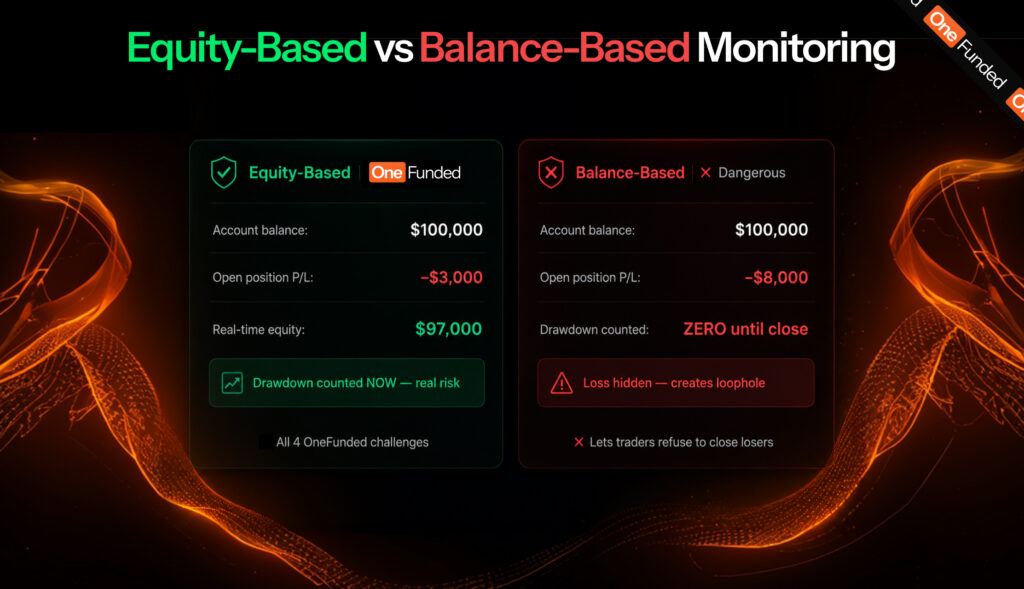
Here are the main differences between equity and balance-based drawdown monitoring:
Equity-Based Monitoring
The calculation of drawdown based on equity involves taking into consideration real-time equity, which consists of all the open positions with respect to their market value. So, if you have $100,000 in your trading account, yet $3,000 in floating loss, your equity is $97,000.
Balance-Based Monitoring
Drawdown calculation will only be recalculated after a trade exits the portfolio under the balance-based system. The same trader who has –$8,000 of floating drawdown under the balance-based method would not trigger a breach until he closes his position. Traders try to avoid closing losing positions at any cost to maintain their drawdowns.
Why Equity-Based Monitoring Is the Standard for Serious Firms
Equity-based monitoring is used across all four scenarios since it is more accurate regarding risk management. The balance-based monitoring creates loopholes in the system whereby traders manipulate drawdown figures by simply refusing to close their losing trades. This eventually leads to a margin call, which closes positions and results in account termination.
Traders must know that under the equity-based monitoring system, they need to size positions based on adverse excursions.
How OneFunded Structures Drawdown Across Its Challenge Programs
OneFunded features three individual challenges, namely Value, Core, and Flash, which have varying drawdown specifications that cater to different strategies. All challenges feature equity-based drawdowns with a static maximum drawdown. The following table provides more details:
| Challenge | Type | Daily Drawdown | Maximum Drawdown | Profit Target | Account Sizes | Drawdown Method |
|---|---|---|---|---|---|---|
| Flash | 1-step | 4% | 6% | 10% | $5K to $200K | Equity-based |
| Core | 2-step | 5% | 10% | 8% / 5% | $5K to $200K | Equity-based |
| Value | 2-step | 4% | 8% | 9% / 6% | $5K to $100K | Equity-based |
Choosing the Right Challenge Based on Drawdown Tolerance
- Core allows maximum flexibility: 5% per day and 10% overall. This setup supports more aggressive trading styles that allow for bigger intraday moves.
- The Value option allows the trader to cut down the daily limit to 4%, while keeping the overall limit at 8%. This option supports more disciplined trading styles with fewer intraday trades.
- The Flash program is the most conservative setup: 4% daily, only 6% overall, and a 10% profit target. This structure fits well with a low-risk, high-speed trading style.
The Psychology of Drawdown Limits
Drawdown limits do something that no amount of self-discipline can do on its own: they force a stop. Most traders hate stops, and there are well-understood psychological effects as the trader approaches the drawdown limit.
Here’s how it generally works:
The trader starts his week with a $50,000 Value at 2.8% down. He has only 5.2% of his drawdown left and a 4% daily limit. He does not trade her strategy, but instead, he cuts positions so drastically that his expected daily performance falls under 0.3%, ensuring that he never exceeds the drawdown limit, but he’ll also never make the 7.5% target. The evaluation runs out slowly instead of abruptly.
The flip side of this is even more common. The trader loses $1,500 on the day and realizes there are $500 of drawdown left on his $50,000 Flash. She then doubles down in a desperate attempt to make it back before time runs out.
The best traders view their drawdown limits the same way that pilots view their fuel limits. You do not want to risk flying into the red on fuel because you were hoping for a favorable wind. It is better to plan the trip such that you never come close to testing your limit. There is a reason why it is set, and those who view it in this way usually do better in evaluations.
Common Drawdown Mistakes That End Evaluations Early
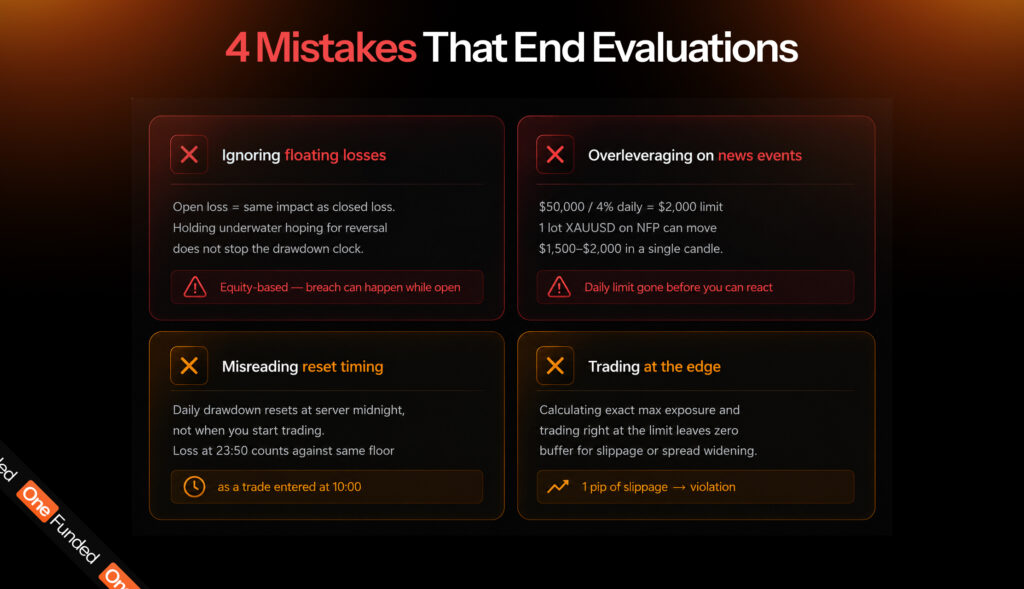
Some of the most common drawdown mistakes include:
Ignoring Floating Losses
In terms of equity-based risk management systems, a floating loss has the same negative effect on drawdown as a closed loss. Maintaining a position that is significantly underwater in the hopes that it will eventually recover does not prevent the drawdown process. We have encountered many cases where failed tests have breached their drawdown level through floating losses only.
Overleveraging on News Events
News releases such as the NFP or central bank announcements cause sudden spikes in volatility, which could break through your daily drawdown within seconds. With a maximum daily risk of 4%, based on a $50,000 account, the risk would be $2,000 per day. One standard lot on the XAUUSD instrument during NFP news event can easily spike to a loss of $1,500 to $2,000 per candle.
For news-sensitive strategies, see our guide on trading the economic calendar.
Misunderstanding Reset Timing
The daily drawdown is reset by server midnight, not the time you actually begin trading. If a trader suffers a significant loss at 23:50 server time and hopes to receive a new drawdown allocation at the opening of the market, they will be mistaken. This loss will be counted against their same daily drawdown floor as if they had traded at 10:00.
Trading to the Edge Versus Trading Away From the Edge
Certain traders figure out their exact maximum exposure amount, the point at which they would hit their daily drawdown floor, and trade at this level. Even one pip more on slippage or widening of spreads causes the violation of this limit. We advise trading for adverse excursion rather than the stop level.
Risk Management Adaptations for Drawdown Constraints
Some of the risk management adaptations to note for drawdown constraints include:
Position Sizing Rules
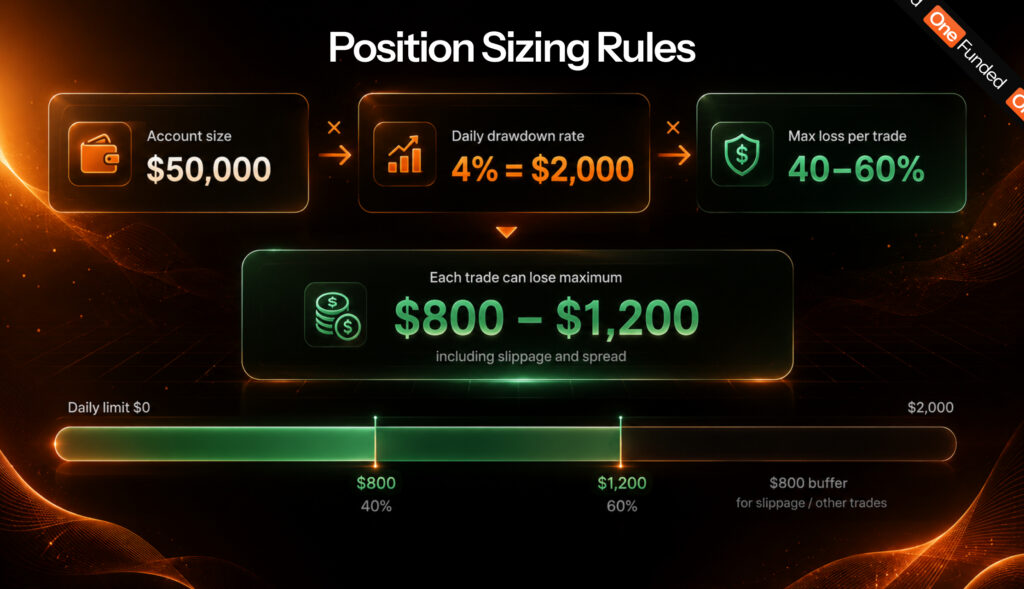
The size is scaled to ensure that the worst-case drawdown per trade is kept below 40-60% of the total daily drawdown amount. In an account worth $50,000 with 4% drawdown per day ($2,000), each trade can lose only $800-$1,200 at its maximum loss point, including slippage and the spread.
Multi-Position Management
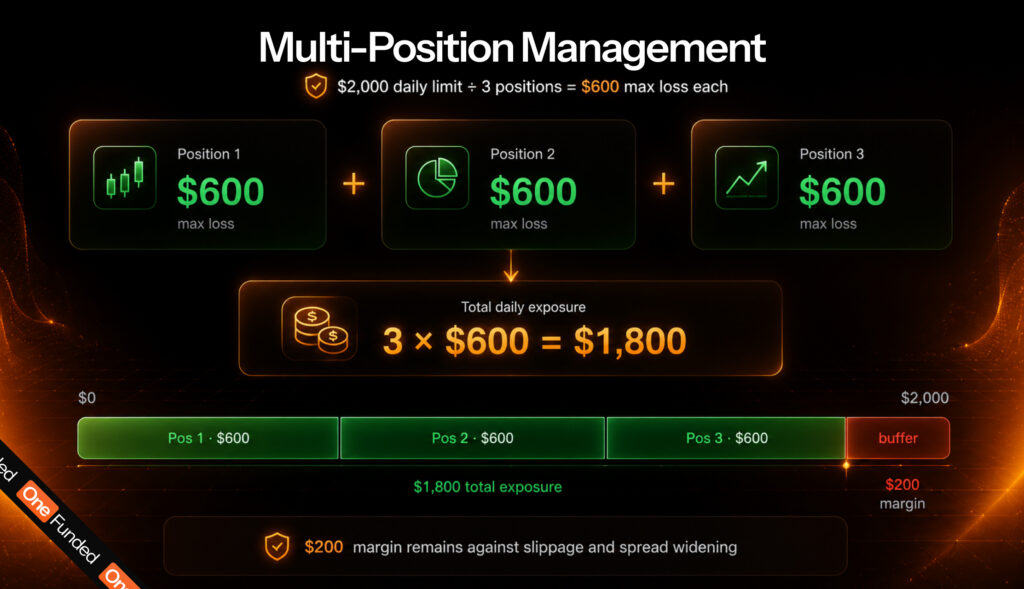
Taking up three positions simultaneously ensures that the daily drawdown limit is equally divided among the three positions. This implies that for three positions to be able to have a daily maximum loss of $600, the total daily exposure would be $1,800 compared to a daily risk limit of $2,000, which is a margin of $200.
Time-Based Adjustments
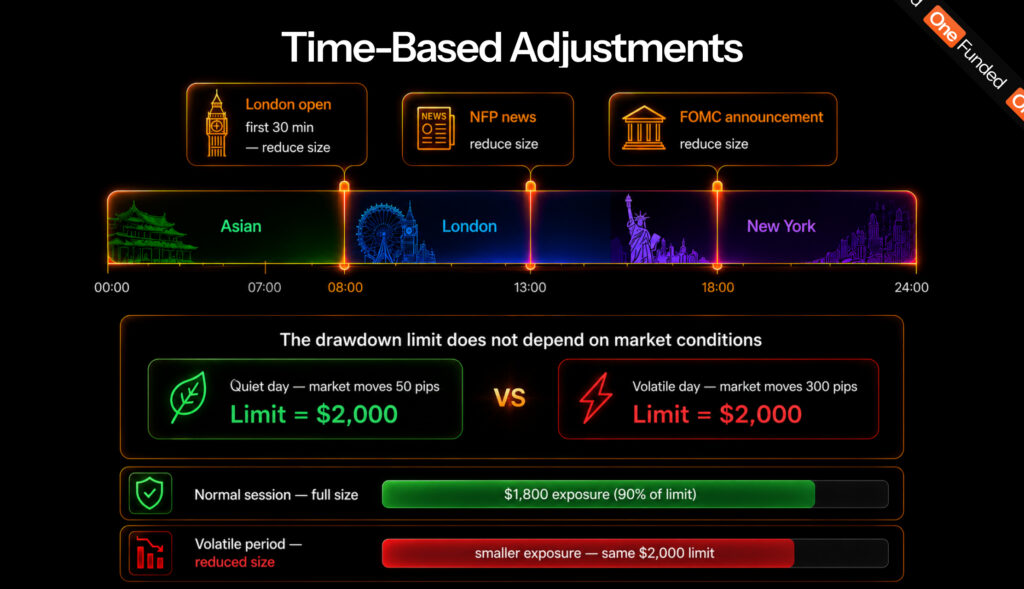
Reduce your position sizes on volatile periods (the first 30 minutes of London, NFP news, and FOMC announcements). You must remember that the daily drawdown level does not depend on the market conditions since regardless of whether the market makes 50 or 300 pips a day, the drawdown level remains $2,000.
For more on managing emotion-driven risk decisions, see our guide on trading psychology in funded accounts.
How to Turn Drawdown Rules Into Your Path to Sustained Funding
Drawdown is not the obstacle to passing a prop firm challenge, but a fundamental test that traders need to pass. Everything else, including profit targets and scaling, happens within the bounds of drawdown. Choose a challenge that suits your trading style, not the one that offers you the least restrictive numbers. Think of the drawdown ceiling as your way to survive long enough to scale.