



How to Pass Prop Firm Challenge: Strategy, Mindset, and Risk Management Tips
 Add as a preferred source on Google
 Add as a preferred source on Google
Proprietary trading, commonly known as ‘prop’ trading, can be a powerful model. Instead of trading with their personal money, traders get access to a financial firm’s capital, enabling more opportunities and larger position sizes. For successful traders, prop trading can dramatically enhance their profit potential.
However, prop firms are selective about which traders they fund. To access a prop account, traders need to pass a dedicated challenge, proving their profitability and consistency. While these challenges aren’t impossible, they’re designed to be hard, allowing the best traders to stand out from the crowd. Thankfully, smart preparation can help traders improve their odds of success.
In this article, we’ll cover the basic components of these challenges, explaining how they work in practice and how to pass prop firm challenge. We’ll also look at the three pillars that traders should focus on as they gear up for their first prop challenge: strategy, mindset, and risk management. Master these fundamentals, and you’ll be well-positioned not just to pass a prop challenge but to thrive as a fully funded trader.
Prop firms offer traders the opportunity to increase their profit potential. By deploying the firm’s capital, not just their personal resources, traders can scale up their position sizes and take advantage of more opportunities. To reduce risk, however, prop firms need to be selective about what traders they work with – funding unskilled traders can risk the firm’s capital and profitability.
That’s where the prop firm challenge comes in. Prospective traders sign up for these challenges to prove their skills through a standardized evaluation. Prop firms set specific profitability criteria for traders to achieve, typically with strict risk limits attached.
To ensure that traders are serious about dedicating their time to the markets, prop firms charge a fee to start a trading challenge. If a trader successfully completes the challenge, their fee is generally refunded, and they unlock the ability to trade with prop firm capital. If the trader fails, however, they sacrifice their challenge fee and will be unable to open a funded account.
Prop firm challenges come in many different shapes and forms. Depending on your unique trading style, you may find that a particular firm’s challenge is a better fit than another. Below, we break down the major differences between various types of trading challenges.
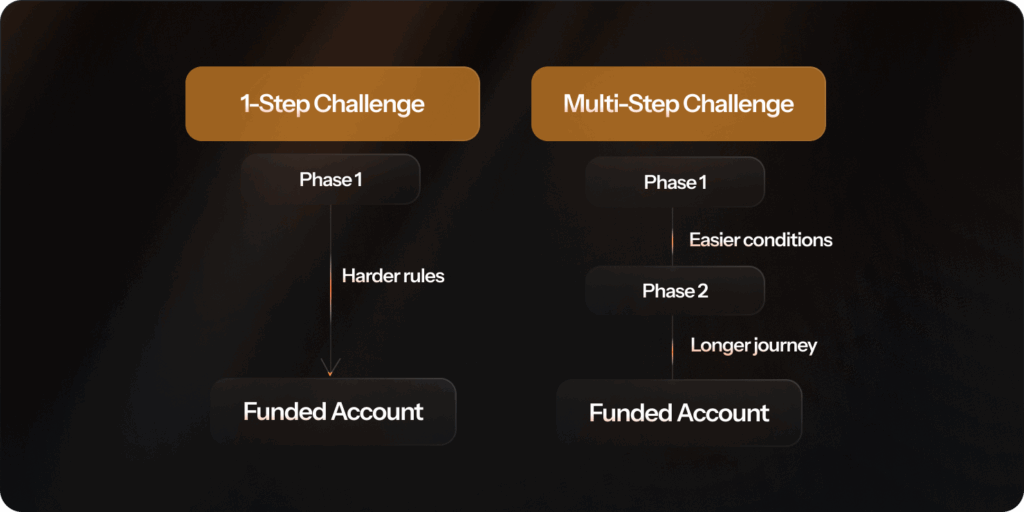
Traders working with a one-step challenge prop firm only need to pass a single evaluation stage before unlocking their full account. In contrast, some firms have multiple steps, requiring that traders demonstrate consistency by achieving profitability goals across several stages. It’s also possible for firms to offer both, allowing traders to choose the option that best suits them.
For traders with the choice between one-step and multi-step challenges, the main factor to consider is how the terms of the challenge align with their trading style. One-step challenges may have more aggressive targets, potentially requiring traders to generate more profits to succeed. In contrast, multi-step challenges can be a better fit for traders with a more consistent, steady style.
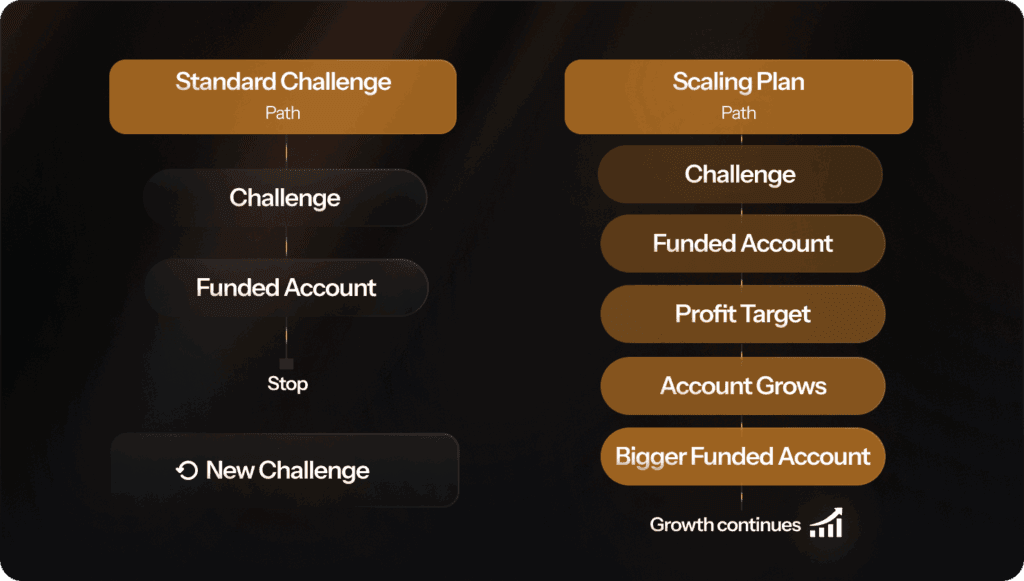
At some firms, trading challenges are the only way to earn larger account sizes. When traders pass an initial challenge, they unlock a funded account of a specific size. If they want to increase their capital limits in the future, they may have to pass an entirely new challenge.
Other firms operate with scaling plans, where traders can unlock larger accounts by achieving key milestones over time. This allows traders to progressively increase their accounts by demonstrating continued profitability, without needing to continually undertake fresh challenges. Some traders prefer the convenience of a scaling plan, while others prefer the focus of a specific challenge period.
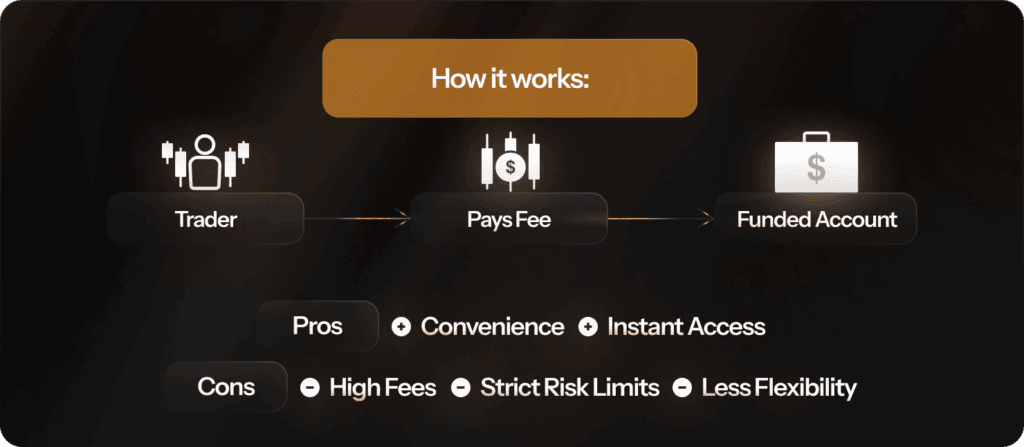
In recent years, some prop firms have been embracing a relatively new approach: abandoning the challenge phase entirely. At these firms, traders may be able to unlock funded accounts immediately by paying a fee, without needing to pass an initial evaluation. Although this may sound appealing, no-challenge firms (also known as ‘instant access’ prop funding) can come with significant drawbacks.
Typically, fees for these firms are far higher than those paid for challenges. Moreover, no-challenge prop firms often have stricter risk limits when it comes to retaining a funded account. Due to their expense and lack of flexibility, no-challenge prop firms aren’t always the best fit for many traders, despite their intuitive appeal.
To better understand how a prop firm challenge works in practice, an example can help clarify some of the key variables and terms that traders may encounter. In the following section, we detail the terms associated with OneFunded’s trading challenge. Remember that each prop firm sets specific criteria for their trading evaluation, and that traders should ensure they fully understand the terms before paying their challenge fee.
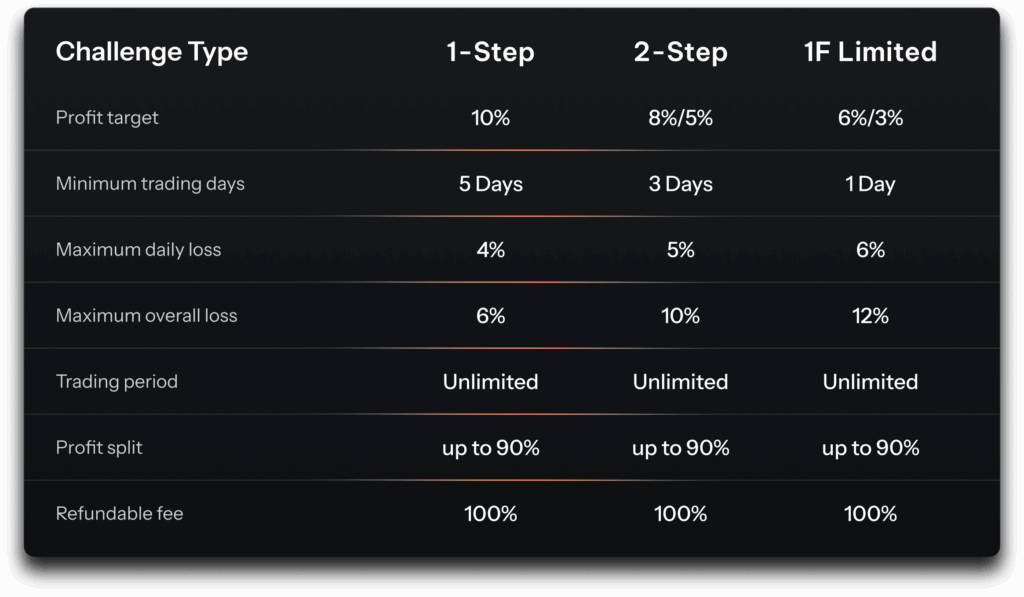
OneFunded’s trading challenge features no time limit, meaning that traders can take as much time as they need to hit profitability targets. What’s more, there are a variety of account sizes for traders utilizing different strategies. The key terms of the challenge are listed below:
Once a trader has passed a prop challenge, they’re on their way to unlocking a funded account and trading with the firm’s capital. Remember to carefully consider the profit split associated with a prop firm. Spending time and energy passing a challenge for a prop firm with a meager profit split may not be worth it – OneFunded features a competitive profit split up to 90% for successful traders.
While the terms listed above are accurate as of the publication of this article, they could be subject to change in the future. Nonetheless, this example offers practical insight as to how trading challenges work in the real world. When it comes to picking the right challenge, understanding terms like this is crucial.
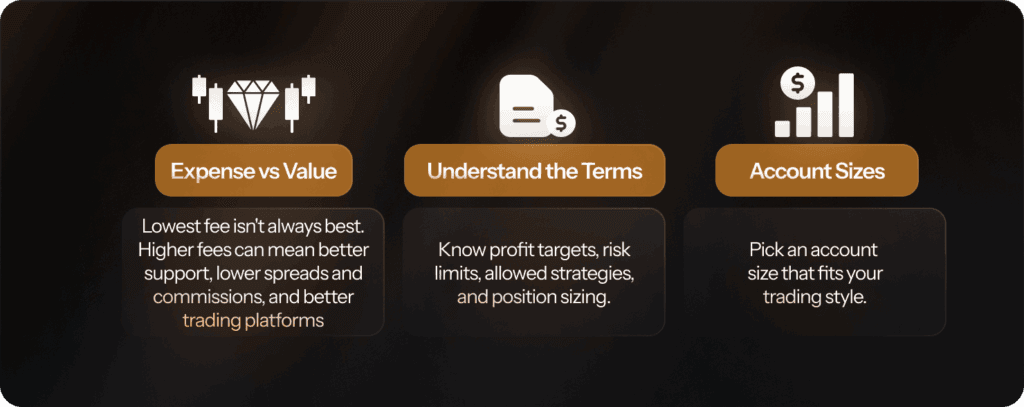
Given the diverse array of prop firm challenges available to traders, picking the right one can be difficult. To find the best fit for your trading style, several key factors to consider include:
Once a trader has identified, selected, and understood the prop firm challenge they want to undertake, their focus must shift to successfully completing the evaluation. Prop firm challenges typically aren’t easy, since they’re designed to eliminate unprofitable traders. With a diligent framework and approach, however, traders can give themselves the best chance of success.
In a narrow sense, passing a prop firm challenge is simply about executing profitable trades to achieve specific targets. Consistent profitability, however, requires a broader strategy and framework. In this section, we’ll look at how traders can maximize their possibility of passing a prop firm challenge through preparation and execution, followed by continuing success on the prop firm’s platform.
It can be tempting to dive straight into a trading challenge. After all, the sooner you pass the evaluation, the sooner you unlock a funded account. Pre-challenge preparation, however, can dramatically increase your odds of success:
Once you’ve completed your preparation, it’s time to start the trading challenge itself. Undertaking a new prop firm challenge can be a nerve-wracking experience. Incorporating a few of the practical tips below can help alleviate that stress and improve your chances of unlocking a funded account.
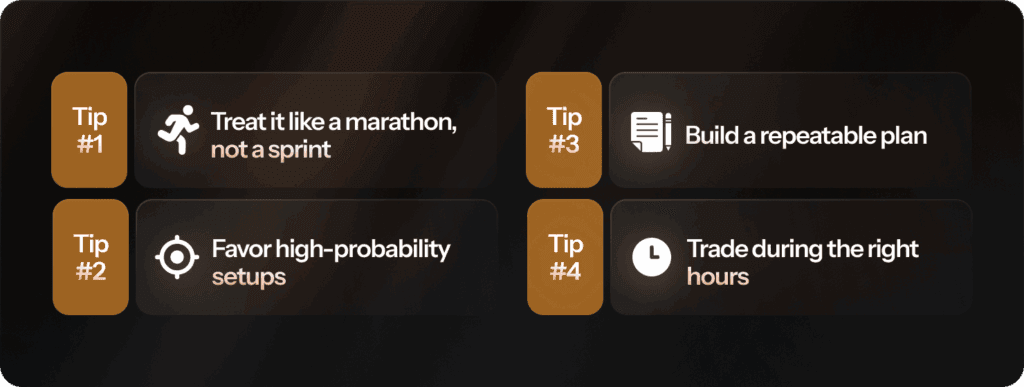
Time limits for a trading challenge can frequently be a month or longer, with some firms having no limit at all. That’s a clear indication that trading challenges should be treated like a marathon, not a sprint. Focus on gradually accumulating the necessary profits through intelligent trading, not trying to finish the challenge as quickly as possible with a few big wins.
When it comes to passing a trading challenge, it can make sense to ignore certain opportunities, even if they seem like a good trade. Some trading set-ups can offer high potential profits but with a low chance of success. While you may want to capitalize on those opportunities once you’ve unlocked a funded account, chasing low-probability home runs can easily lead to a failed trading challenge. Instead, prioritize steady, consistent gains backed by high-probability setups.
In line with the theme of marathon consistency, trading challenges are often far easier with a structured, repeatable plan. A trading challenge is not a time to be improvising or learning on the fly. At a minimum, a comprehensive trading plan for a prop firm challenge should include:
It can also be helpful to keep a dedicated trading journal during the challenge. This can help ensure that you stick to your pre-defined plan while also allowing you to reflect on future adjustments that need to be made.
If you’re taking a trading challenge seriously, it might seem like spending endless time in front of the computer is the right approach. In fact, prioritizing just a few key hours might be even better. In many markets, the most attractive opportunities can be contained in a relatively short window (such as the New York-London overlap in forex).
What’s more, overanalysis can lead to both data mining and trading on suboptimal opportunities. When you’re passing a challenge, focusing solely on the most attractive setups and hours can be more effective, even though it takes less time. Once you’ve passed the trading challenge, you can scale this commitment up or down as you see fit.
Passing a trading challenge can seem like a significant achievement – and in many ways, it is, reflecting the start of your prop trading journey. But when you’re trading with prop money, every day can be an evaluation. Aligning with a firm’s long-term trading goals and risk limits is key to keeping your funded account over time. Building good habits and strategies during the evaluation phase can pay dividends in the future.
In the previous sections, we looked at practical examples of prop firm trading challenges and key strategic tips for success. Here, we’ll dive deeper into one of the most essential tools for passing a prop evaluation: risk management. When it comes to prop firm challenges, managing risk is arguably more important than chasing profits.
A string of lower-than-expected gains might mean that a trader takes longer than anticipated to pass a trading challenge. But a string of higher-than-expected losses can lead to immediate failure. For this reason, risk management should be a key focus for traders during a prop evaluation, beginning with a strong understanding of the challenge’s risk rules.
While every prop challenge differs, most evaluations come with two main risk rules:
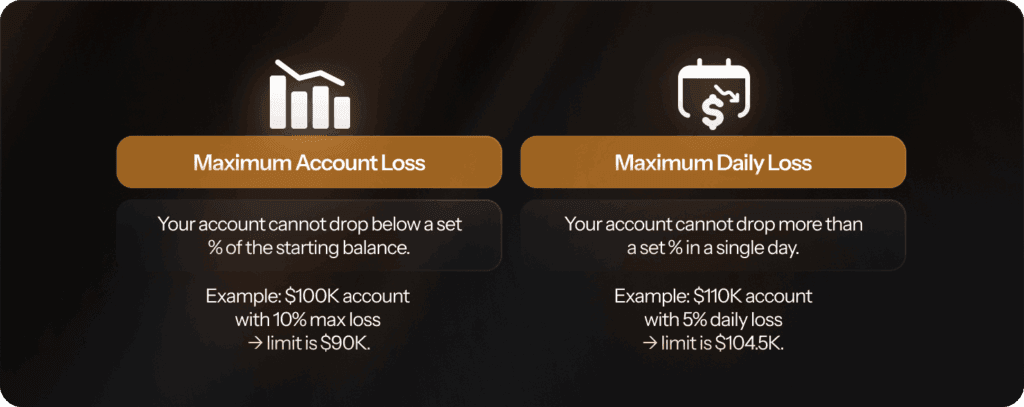
It’s especially important to understand these limits for traders who use leverage. Utilizing leverage can result in big swings to the equity value of a trader’s account. That can lead to unexpectedly triggering risk limits and failing a challenge.
Risk limits generally apply to both realized and unrealized losses. If a stock or currency dips sharply, it could be enough to trigger failure, even if you think the asset will recover later on.
Position sizing is an essential aspect of risk management. Even fairly low-risk trades can inadvertently blow up your portfolio if you’ve allocated too much capital to them. As a rule of thumb, traders should consider keeping the total risk on each individual position to less than 2% of their portfolio.
For example, suppose a trader has a $100,000 account and follows the 1% risk rule. This means the trader is willing to lose a maximum of $1,000 on a single trade. The actual dollar amount of the position doesn’t determine the risk — what matters is where the stop loss is placed. If the stop loss level is set so that, in case it’s hit, the trader loses $1,000 (which equals 1% of the account), then the trade fully aligns with proper position sizing principles.
At some prop firms, this position size rule is a formal part of the platform’s risk limits. Depending on the firm, this rule generally ranges from 0.5% to 2% of the account value. To be extra careful, it can be beneficial to trade even more conservatively than any formal position size rule.
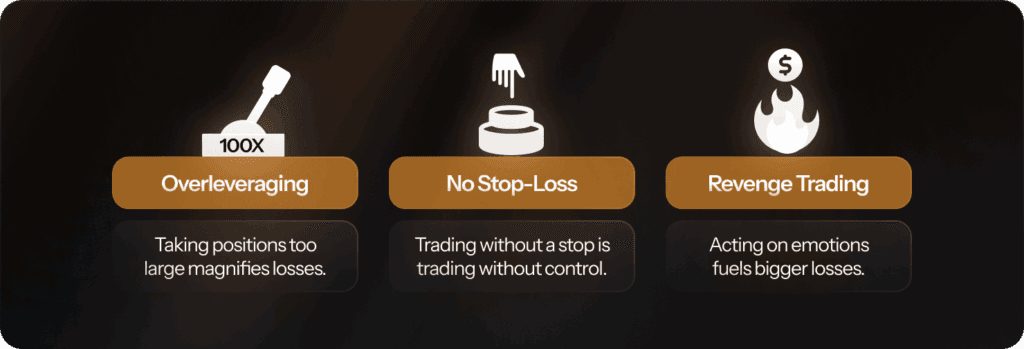
By staying aware of a firm’s risk rules and aligning their strategy with these limits, traders can give themselves the best chance of success in a prop firm challenge. But in many cases, risk management is easier said than done. These common risk management mistakes frequently trip up traders:
As you can see, many of these mistakes stem from poor decision-making following adverse trading outcomes. That hints at the importance of an appropriate mindset for successful trading. Trading psychology is an underappreciated factor that can make a significant difference in passing prop firm challenges.
Most prop trading advice is based on theory. The following is based on results — specifically, anonymised data from over 25,000 trader accounts on the OneFunded platform. The numbers tell a clearer story than any general framework can.
Across more than 25,000 accounts, the platform-wide pass rate sits at 11.8% for 1-step challenges and 7.0% for 2-step challenges.
Those numbers are deliberately honest. Prop firms need to fund traders who can manage risk under real pressure, not just in favourable conditions. What the data also shows, however, is that failures are not random. They cluster around a small number of predictable, avoidable mistakes.
Of all the insights the data provides, one stands out above the rest: challenge failures are not evenly distributed across rule types. They are overwhelmingly concentrated in a single category.
|
Failure Reason |
Share of All Failures |
|
Daily Loss Limit breached |
78.7% |
|
Overall Loss Limit breached |
15.0% |
|
Inactivity (insufficient trading days) |
6.3% |
Traders’ failed accounts trace back to one thing: a daily loss limit breach. Not a bad week, not a slow strategy — a single trading session that crossed the intraday drawdown cap. Whether triggered by an oversized position, a news spike, or a sequence of revenge trades after an early loss, the daily limit ends more challenges than every other rule combined — by a wide margin.
The overall loss limit accounts for a further 15% of all faded accounts. These are typically slower collapses: several losing days that gradually push account equity below the permitted floor. And 6.3% failures are purely administrative — traders who simply did not place trades on enough separate days to satisfy the minimum activity requirement. No bad trades. No blown limits. Just inactivity.
For 1-step challenges, average completion time across the 25,000+ account base:
|
Account Size |
Avg. Days to Pass |
|
$2,000 |
9.9 |
|
$5,000 |
14.4 |
|
$10,000 |
21.1 |
|
$25,000 |
10.2 |
|
$50,000 |
18.9 |
|
$100,000 |
17.0 |
|
$200,000 |
8.0 |
Platform average: 13.1 days
For 2-step challenges, the split is across both phases:
|
Account Size |
Phase 1 (avg. days) |
Phase 2 (avg. days) |
|
$2,000 |
12.3 |
13.3 |
|
$5,000 |
11.9 |
3.7 |
|
$10,000 |
13.5 |
6.6 |
|
$25,000 |
11.5 |
6.2 |
|
$50,000 |
8.3 |
13.8 |
|
$100,000 |
14.5 |
2.3 |
|
$200,000 |
11.5 |
3.7 |
Phase 1 average: 12.0 days — Phase 2 average: 8.5 days
Two things stand out. First, Phase 2 is completed faster than Phase 1 across most account sizes — traders who survive Phase 1 arrive at Phase 2 already calibrated, and close it out more efficiently. Second, completion time does not scale linearly with account size. The $10,000 1-step account takes more than twice as long as the $200,000 account on average, reflecting different trader profiles and how they size positions relative to their profit target.
When you sit down to create a trading plan, the process can seem highly rational: research and analysis followed by intelligent execution. But when you actually start to trade, you realize that trading also has a strong emotional component. While nothing can replace high-probability setups and sophisticated analysis, having the right psychological outlook can help avoid key mistakes that lead to challenge failure.
The most significant psychological challenge for traders is effectively dealing with drawdowns and losses. Reacting emotionally often leads to risk management errors in pursuit of higher profits to recover from past losses. These errors can include overtrading, aggressive position sizing, or deviating from self-imposed risk rules like stop loss limits.
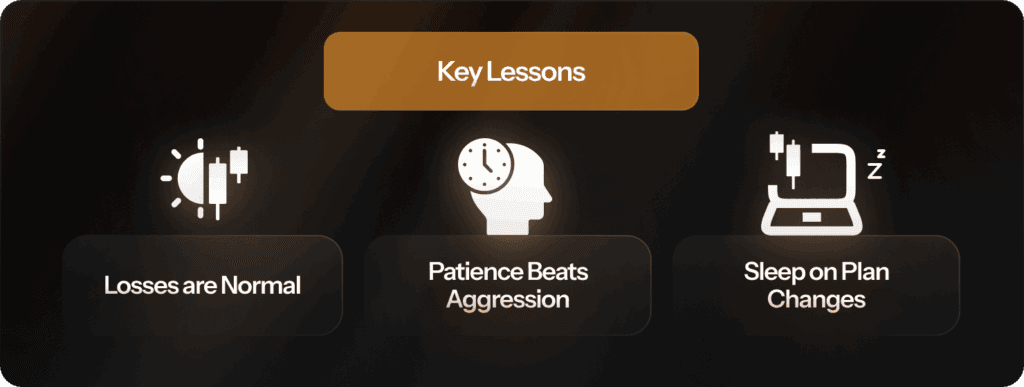
The key lesson for traders to understand? Losses are an integral and unavoidable part of the trading process. A set-up with a win rate of 80% is almost universally considered a ‘high probability’ opportunity – yet one out of every five of those opportunities is still expected to generate losses.
A higher-than-expected drawdown can also indicate that the current market environment may not be suited for a trader’s style. If that’s the case, continuing to trade would clearly be a bad idea. Stepping back until the environment becomes favorable is often more productive.
Overall, three lessons can effectively summarize what traders need to understand about handling losses psychologically:
Finally, traders shouldn’t ignore other aspects of their life that can impact emotional regulation, even ones that have nothing to do with trading. For example, sleep, diet, and exercise can all play a role in promoting mental clarity and emotional stability. Given the importance of psychology when it comes to passing a trading challenge, these are areas that traders can’t afford to ignore.
The last aspect of trading psychology worth mentioning is an intriguing paradox about a trader’s desire for success. Many traders care deeply about passing a prop challenge, generating profits, and unlocking a funded account. Surprisingly, however, this mental investment in their goal can actually be a drawback.
Traders who ‘care too much’ about achieving their goals can develop stress and anxiety when positions turn against them. That can make successful trading even harder. And this phenomenon isn’t exclusive to trading – academic research consistently finds that overinvestment in a desired goal can paradoxically harm performance due to added psychological pressure.
In fact, at Wall Street firms, it’s not uncommon for traders to treat their ongoing P&L like points on a scoreboard, rather than actual money. This mental trick can help traders alleviate stress relating to market swings that might impact their bottom line by thousands or even millions of dollars. For traders seeking to succeed at a prop firm, it’s vital to care enough to pass a prop challenge – but not so much that the goal ends up fostering harmful stress.
It’s no secret that passing a prop trading evaluation can be challenging. These tests are designed to separate the profitable traders from the unprofitable ones. But through disciplined preparation, traders can give themselves the best chance of success at unlocking a funded account.
In this article, we discussed the three key pillars of preparing to successfully pass a prop firm challenge: strategy, mindset, and risk management. Without a comprehensive strategy, traders will be left improvising and guessing. Without the right mindset, traders could crack under the pressure of short-term losses. And without effective risk management, traders can easily let bad habits get in the way of achieving their long-term goals.
To unlock a funded account, incorporating all three of these pillars is key. Once you’ve completed your preparation, nothing can replace action. That means finding the right challenge, paying the associated fee, and starting your journey to become a true prop trader.
At OneFunded, our prop firm challenge is designed to help profitable traders stand out from the crowd and prove their skills. With risk limits that can accommodate different trading styles and a refundable challenge fee after passing, we enable successful traders to unlock a funded account and enhance their overall profits. To get started, navigate to our Challenge page and select the best account size for you.


Join our mailing list today!
A prop firm challenge is a dedicated evaluation that prop firms establish to test potential traders. Traders who succeed may be able to unlock a funded account and access more capital, enhancing their overall profitability.
Prop firms provide their own capital for traders to utilize in the markets. Before risking their own capital, prop firms want to ensure that traders are capable of generating consistent profits without taking on too much risk.
If you fail a prop firm challenge, you will not unlock a funded account at that prop firm. What’s more, you will likely sacrifice the challenge fee that you paid. However, many firms offer the ability to retake an evaluation, although you may need to pay another fee.
What happens after you pass a prop firm challenge depends on the firm’s rules. Some firms immediately allow you to unlock a funded account and start trading, while others have a short cooldown period. Regardless, you’ll likely have ongoing risk limits attached to your account, although these may be less stringent than during the challenge period. Many firms offer a refundable challenge fee if you pass.
While it’s impossible to say for sure whether or not a trader is ready for a prop challenge, generating consistent profits in a live account with personal capital is generally a good sign. However, traders should ensure that they’re not taking on large risks to generate these profits, which can backfire during an evaluation.
Not necessarily. For some traders, continuing to utilize their personal capital may be a better route than prop trading. Other traders may find the stress of a challenge not worth it. For traders looking to unlock greater capital and enhance their profit potential, however, passing a prop challenge is a key part of the process.

Every prop firm challenge has a unique set of rules. This includes profit targets, drawdown limits, and consistency demands. Most...

You’ve made up your mind; you want to go into trading full-time in 2026. Great. But there are tens of...

What is a prop firm? Learn how do prop firms work, and how successful traders get funded accounts enjoy payouts...