




Discussing trading styles can be challenging, since there are almost as many different styles as there are individual traders. Due to differences in mindset, psychology, and risk tolerance, no two traders approach the market in quite the same way. Nonetheless, it’s possible to group traders into several different styles, each distinct in terms of their timeframe, analytical approach, and decision-making framework.
In this article, we explore the key dimensions along which trading styles differ, providing a guide for traders to begin defining and exploring their own approach to the market. For traders looking to embrace a new style, we also look at the key advantages each approach can offer. Although traders ultimately need to translate their style into an actionable strategy, identifying your preferred style is a crucial first step in developing a systematic and disciplined approach to trading.
Key Takeaways
- A trading style refers to the overarching framework a trader takes in approaching the market. Trading styles can be defined in terms of three key dimensions: temporal, methodological, and analytical.
- The traditional way to differentiate trading styles is in terms of time, ranging from scalping to position trading. In the modern trading environment, the distinction between algorithmic and discretionary trading also matters, as does the form of analysis a trader uses to identify profitable opportunities.
- Trading styles are distinct from trading strategies. While a trader’s style reflects their big picture outlook on the market, a trader’s strategy refers to the practical steps they take to generate profits.
- Each style comes with distinct advantages and trade-offs. Some traders might prefer to use algorithmic approaches to scalp small, consistent profits, while others may specialize in fundamentally researched high-conviction bets. Many traders also take a hybrid approach, blending styles in different aspects of their portfolio.
What Is a Trading Style?
To understand what a trading style is, it helps to start with an entirely separate activity from trading by associating it with football, as an example. In a football match, a team’s ultimate aim is to win. But teams can use many different styles of play to try and achieve that aim, ranging from ultra-defensive, lockdown approaches (‘park the bus’) to fluid, dynamic ones (‘tiki taka’).
Similarly, the ultimate aim of trading is to generate profits. But not all traders pursue that common aim in the same manner. Like in football, a trader’s style can be understood as the overarching manner in which they approach the activity, used as a guiding philosophy for navigating the market.
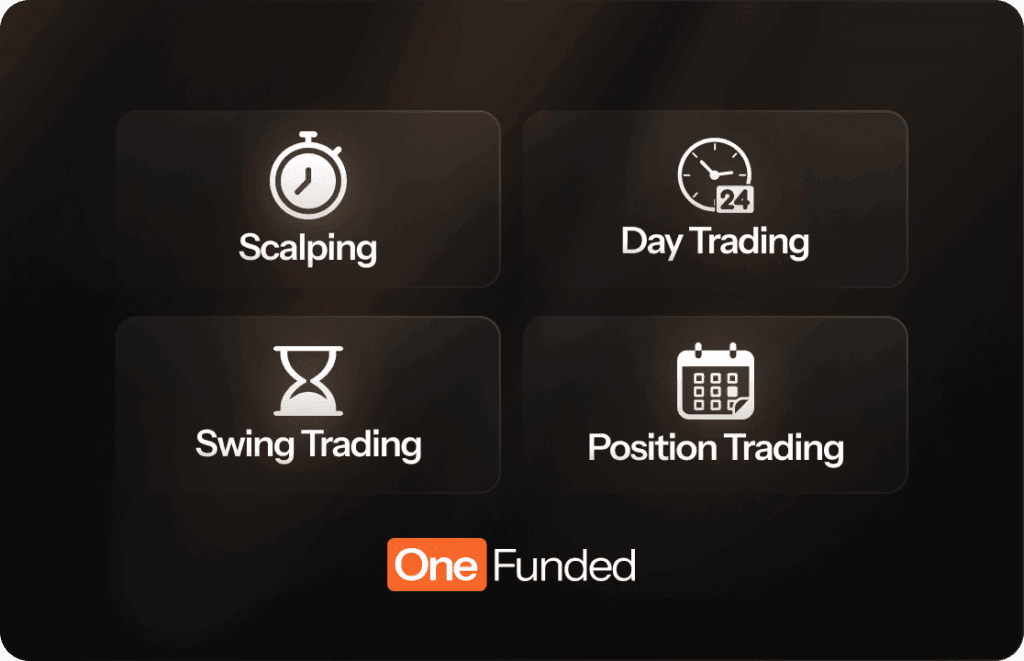
Classically, trading styles have been viewed as falling into one of four categories: scalping, day trading, swing trading, and position trading. Each of these categories covers a distinct holding period for traders, ranging from just a few seconds to several years. But while this temporal dimension is a key element in differentiating trading styles, it is far from the only factor that matters.
In the modern trading environment, it’s also important to consider two other dimensions: methodology and analysis. Together, these three dimensions (temporal, methodological, and analytical) can be used to effectively define a trader’s specific style. In the following sections, we’ll review each of these dimensions and see how they interact with each other to create a precise trading style.
The Temporal Dimension: Four Categories
Timing is one of the most significant elements in how traders choose to approach the market. While some traders prefer to rapidly enter and exit positions, holding trades for a short period of time, others like to bet on trends that can take months to play out. Trading styles can be grouped into one of the four key time-based categories below.
Scalping
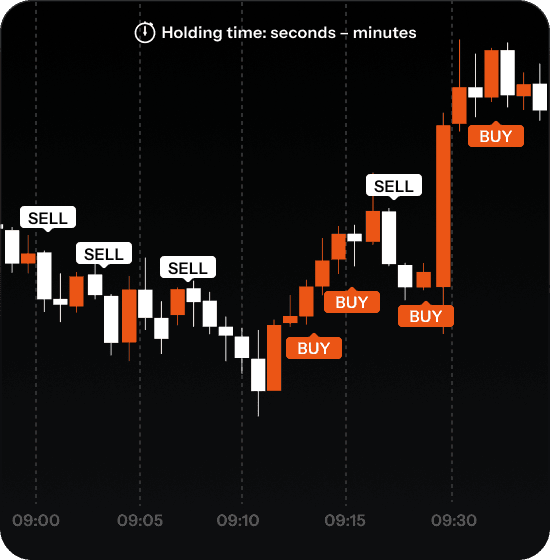
Scalping is the shortest-term style of trading, referring to the practice of holding positions for as little as a few minutes or a few seconds. Scalp traders are rarely looking for big wins. Instead, they prefer to ‘scalp’ small profits from the market throughout the day, generally capitalizing on short movements and tick-by-tick trends.
For example, a scalp trader may identify an uptrend occurring over the past minute through the use of order flow analysis. By placing a market buy for the asset, a scalp trader can secure a quick fill and take a long position. This trader may hold the position for just a few more ticks before liquidating rapidly through a market sell.
Timeframe: Seconds to a few minutes.
Risk/Reward: Small gains per trade, low per-trade risk, but very high trade frequency.
Day Trading
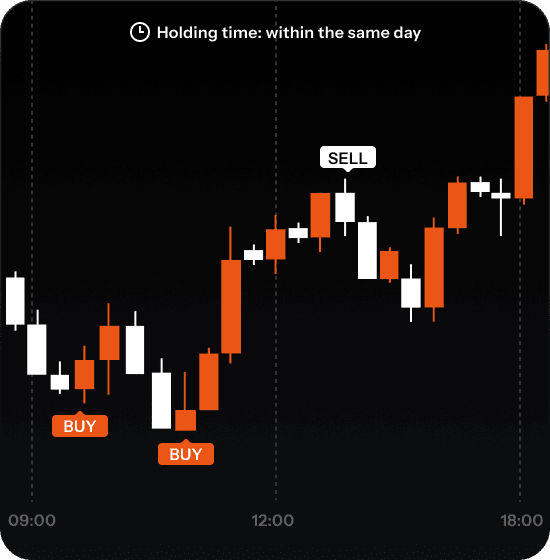
As the name suggests, day trading is a style in which traders only hold positions during the trading day – never after hours. This prevents overnight news or after-market volatility from unexpectedly impacting a trader’s position. While scalping might technically fall under this category, the term ‘day trading’ typically refers to a slightly longer holding period, potentially up to several hours.
Timeframe: Minutes to several hours (never overnight).
Risk/Reward: Moderate profits per trade, medium trade frequency, risk contained within the day.
Swing Trading
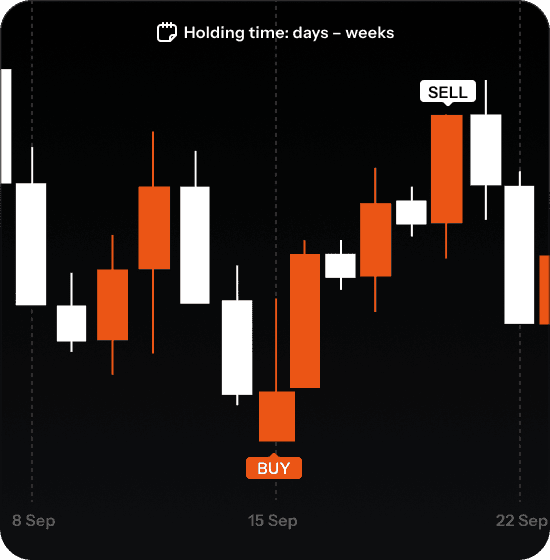
Unlike day traders, swing traders are comfortable holding positions after the market closes. This style involves taking a longer-term view on asset prices, maintaining a long or short trade for several days or weeks. While holding positions this long can expose swing traders to the risk of larger losses, it can also allow them to capitalize on trends that play out over the course of multiple trading days.
Many of the techniques of swing trading are similar to those of day trading, but are utilized over a longer time scale. Moreover, swing traders often make greater use of limit orders. That’s because swing traders are often more interested in taking positions at a specific price, and less interested in rapidly entering or exiting trades.
Timeframe: Several days to a few weeks.
Risk/Reward: Higher profit potential per trade, lower trade frequency, larger position risk.
Position Trading
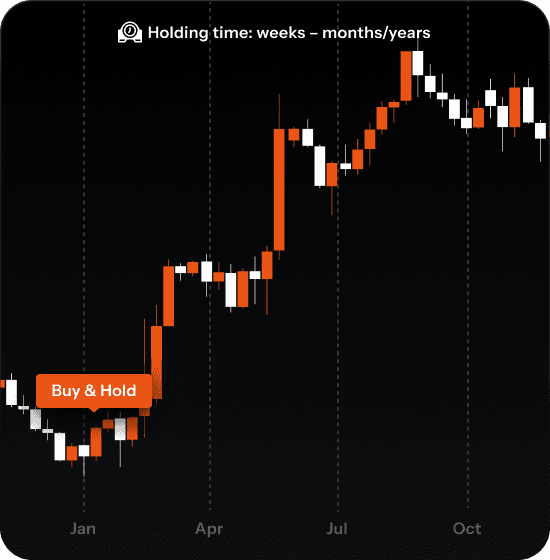
Position trading is the most long-term oriented style, with traders holding assets for months or even years. At the most extreme end, buy-and-hold investing can be considered a form of position trading. Typically, position traders are seeking to capitalize on major, slow-moving trends such as growth in a company’s earnings or the outperformance of a particular national economy.
Timeframe: Weeks to months (sometimes years).
Risk/Reward: Large profit potential per trade, very low frequency, requires patience and strong conviction.
Trading Styles Comparison
Different trading styles vary mainly by holding time, frequency of trades, risk tolerance, and expected profits. Understanding these differences helps traders choose the approach that best fits their personality, capital, and time commitment. Below is a breakdown of the four main styles:
| Trading Style | Typical Holding Time | Number of Trades | Risk per Trade | Profit Potential | Example Scenario |
| Scalping | Seconds – a few minutes | Very high (50–200/day) | Low (tight stop-loss, e.g., 0.1–0.3%) | Small per trade, adds up with volume | A scalper buys EUR/USD after spotting a quick order flow imbalance and exits within 30 seconds for a $50 gain. Repeats this dozens of times. |
| Day Trading | Minutes – hours (never overnight) | High (1–20/day) | Low-Medium (0.3–1% per trade) | Moderate, several trades can accumulate | A day trader shorts Tesla stock at market open, holds for 3 hours, and closes before the bell for a $300 profit. |
| Swing Trading | Days – weeks | Moderate (5–15/month) | Medium-High (1–3% per trade) | Larger moves captured, higher profit potential | A swing trader goes long on GBP/USD ahead of central bank news, holds for 2 weeks, and profits $2,000 from the trend. |
| Position Trading | Weeks – months/years | Low (1–5/year) | High (3–10% per trade) | Very high if the trend continues | A position trader buys Bitcoin at $30,000, expecting macro growth, holds for 8 months, and exits at $55,000 for a $25,000 gain. |
The Methodological Dimension: Two Categories
Trading styles are also distinct in terms of their decision-making methodology. Most traders use an entirely human-based decision process. However, algorithmic trading styles that leave trading decisions in the hands of a computer program are becoming increasingly popular.

Discretionary (Human-Based)
Under a discretionary trading style, traders use their judgment and intuition to make trading decisions, such as which opportunities to act on, in what size, and when to enter/exit positions. This human-based process is the most popular decision-making methodology for individual traders. Because discretionary trades ultimately need to be executed by a human, psychological factors like fear and greed play a greater role in the success of this trading style.
Algorithmic (Rule-Based)
In contrast to discretionary trading, algorithmic trading is a rules-based process that largely removes human judgment from immediate trading decisions. Instead, this style is characteriz доed by the fact that the trading process is managed entirely (or in large part) by a computer program. This trading style is less popular among individual traders, since it typically requires a high level of mathematical and technical sophistication to employ successfully.
At a basic level, a trader could construct an algorithm designed to buy and sell an asset whenever a key bullish or bearish trend occurs. More advanced algorithms frequently employ machine learning to discover statistical relationships that may be inscrutable to human eyes. Depending on the algorithm’s level of sophistication, traders may use a rules-based process to manage every aspect of their trading framework, or just key portions of it.
The Analytical Dimension: Three Categories
Finally, the analytical dimension serves as the last key differentiator for various trading styles. This dimension captures the type of research that traders employ to identify profitable opportunities and inform their trading decisions (or the decisions of their program, in the case of algorithmic trading). There are three key categories within this dimension, ranging from analytical frameworks that rely on the study of real-world economic activity to those that depend solely on data.
Fundamental Analysis
Fundamental analysis is the category most closely focused on actual businesses and economies. Common forms of fundamental analysis include studying financial statements, building valuation models, and researching macroeconomic data. The overarching goal of fundamental traders is to use their analysis to determine the fair value of some underlying asset, going long underpriced assets (and sometimes shorting overpriced ones).
While there are many different tools of fundamental analysis, discounted cash flow modeling is a popular way to model the fair value of a debt or equity security. In the currency markets, covered interest rate parity and balance of payment models are also used by fundamental researchers to estimate fair value, typically incorporating macroeconomic data like interest rates and inflation. Although digital assets sometimes fall outside the traditional framework of fundamental research, building models of supply and demand for tokens can still provide useful insights.
Technical Analysis
In contrast to fundamental analysis, technical analysis is far less concerned with real-world economic phenomena. Instead, technical analysis is focused on forecasting future price activity from historical trends. This can make technical analysis far more versatile than fundamental analysis, since it does not require building a unique valuation model for every new tradable market.
Many key trading concepts are ultimately rooted in technical analysis, including momentum, resistance, and reversals. Traders employing technical analysis often use these concepts in conjunction with tools like chart patterns and statistical indicators to identify trading opportunities. For instance, the ‘Morning Star’ candlestick pattern can be a sign of a bullish reversal during a downtrend.
Quantitative Analysis
Quantitative analysis, the final category within the analytical dimension, is solely concerned with statistical analysis and data research. Quantitative analysis is sometimes viewed as an extension of technical analysis. But while the two categories do have some overlap, quantitative analysis is distinct for its focus on raw data sets and ground-up mathematical models.
For example, a simple form of quantitative analysis could be constructing a multivariable linear regression model for the daily performance of one asset based on several other related markets. As these models become more advanced, quantitative analysis frequently employs insights from fields like probability theory, Bayesian statistics, and signal processing. At an advanced level, quantitative analysis at leading hedge funds and institutions can closely resemble machine learning research.
Trading Style vs. Trading Strategy: What’s the Difference?
To understand what trading styles are, we also have to understand what they are not. The concept of trading styles is often confused with trading strategies. However, styles and strategies are distinct, with many different trading strategies possible within the same style.
Recall that a trader’s style refers to the overarching manner in which they approach the market, including holding period, analytical approach, and decision-making framework – the ‘big picture.’ In contrast, a trading strategy is concerned with the smaller, practical details. A trader’s strategy refers to how they actually execute their style in practice to generate profits.
The range of trading strategies we can define is far wider than the scope of trading styles. Potential strategies include, but are not limited to:
- Momentum trading. Momentum traders seek to profit from existing bullish or bearish trends by taking a long or short position. Momentum trading is closely related to its inverse strategy, ‘mean reversion trading,’ where traders bet that a trend will fade out.
- Event-driven trading. Traders using an event-driven strategy take positions based on forecasts for specific events, such as corporate mergers or central bank decisions. For example, a trader may sell a company’s shares short in anticipation of a bankruptcy announcement.
- Market making. Market making is a specific strategy in which traders seek to profit by providing liquidity, rather than forecasting future price movements. Market makers earn the ‘spread’ that comes from selling at the (higher) ask price and buying at the (lower) bid price. This strategy requires careful inventory management but can earn small, steady profits over time.
- Relative value. While most trading strategies seek to profit from analyzing patterns for a single asset, relative value traders focus on relative patterns between two related assets. For instance, a relative value trader might recognize that two similar stocks have reacted in different ways to a particular news event. By going long the underperformer and short the overperformer, the trader can profit if the relative performance gap between the two stocks shrinks over time.
- Value investing. A strategy made famous by successful practitioners like Warren Buffett, value investing involves using disciplined financial modeling to identify underpriced securities. Value investors buy these securities in anticipation of the market eventually realizing their worth and their prices appreciating.
Of course, some strategies are more strongly associated with specific styles than others. For example, momentum trading is often intertwined with technical analysis. However, the fact that this strategy could be practiced over the course of hours (day trading) or weeks (swing trading) shows that styles and strategies remain structurally distinct. By combining the three dimensions we discussed with a trading strategy, traders can begin defining their own style and putting it into practice.
Putting it All Together: Trading Styles in Practice
In the previous sections, we covered the major dimensions along which trading styles differ. Using the categories in each dimension, we can now begin to define precise trading styles.
Any potential style involves the selection of one category from each of the three dimensions. In theory, this allows for up to 24 potential trading styles. This stems from the combination of 4 temporal categories, 2 methodological categories, and 3 analytical categories (4 * 3 * 2 = 24).
In reality, the range of logical styles is narrower. Not all category combinations allow for practical market approaches, and some can only be deployed with the use of highly specialized tools. Below, we cover some of the major styles traders might consider, along with a discussion of the strategies that allow them to be put into practice.
Style #1: Discretionary Technical Day Trading
This first style is one of the most popular among individual traders. Under this approach, traders analyze chart patterns and indicators to forecast future potential price movements, making decisions on which trades to execute. Moreover, traders seek to close all positions by the end of the day.
Both momentum trading and mean reversion trading are popular strategies under this style. Similarly, strategies like ‘gap trading’ (where traders seek to profit from swings between support and resistance levels) and ‘breakout trading’ (where traders seek to profit from beyond support and resistance levels) can also be utilized.
In practical terms, a trader using this style might begin their trading day by charting key price levels for their preferred assets and reviewing volume- and price-based indicators. Throughout the trading day, they may hold positions anywhere from several minutes to several hours, utilizing both market and limit orders. Finally, before the trading day ends, they would close out their book by liquidating their positions, starting fresh the next day.
Style #2: Algorithmic Quantitative Scalping
This second style is relatively more advanced than the first, incorporating programmatic trade execution based on statistical analysis. Moreover, positions may be held for as little as just a few seconds. In essence, this style refers to a trader who creates a computer program designed to automatically scalp tick-by-tick profits throughout the trading day.
For example, an FX trader conducting quantitative research may identify that when a spike in order flow volume occurs among two currency pairs, it typically leads to a follow-on spike for a third. Based on this analysis, the trader may program a scalping bot to automatically buy the third currency pair whenever the original volume spikes occur. Then, once the price has risen after a few more ticks, the bot will automatically exit the position.
One key aspect to understand about this style is that traders are rarely looking for foolproof indicators or profits on every trade. If a trader can identify a statistical pattern that leads to profits even 51% of the time, they can translate that edge into meaningful gains by executing a sufficient number of trades. That helps explain both the importance of automated execution and short holding periods, both of which can support higher trading volume. At the institutional level, algorithmic quantitative scalping is often known as ‘high-frequency trading.’
Style #3: Discretionary Fundamental Swing Trading
While the first two styles we discussed focused on intraday holding periods, this third style takes a slightly longer view, holding positions beyond the end of the trading day. Discretionary fundamental swing traders are those who perform deep fundamental research into specific companies or markets, placing bets on medium-term trends that play out over days or weeks. This style is far more focused on how real-world financial and economic phenomena drive prices than purely technical or quantitative considerations.
For example, a trader using this style might have identified a company with continual earnings growth over the past few quarters. When combined with a detailed study of the company’s market and the recent results of key competitors, this trader might believe that the company’s upcoming earnings results will be far stronger than the market expects. By taking a long position in the days leading up to the earnings announcement, the trader can benefit from the potential rise in share price.
Conversely, many ‘activist short sellers’ often practice this style as well. These traders might perform critical research into a company’s financial statements, trying to identify accounting discrepancies or any areas that might be misleading for investors. By taking a short position in the company’s shares and announcing their findings to the market, the activist sellers can benefit from a drop in the share price. Short traders have to be careful, however, since inaccurate research or misleading statements could result in litigation.
Hybrid Styles and More
Clearly, certain categories in one dimension align more strongly with certain categories in another. For example, due to the level of mathematical and programming sophistication required, algorithmic trading and quantitative analysis tend to pair strongly together. Similarly, fundamental traders may not be able to realize an edge over the short holding periods that scalpers and day traders use.
Still, unexpected combinations of styles can sometimes lead to uniquely profitable styles. For example, while fundamental research and algorithmic trading might seem at odds, a real-time news feed of corporate earnings announcements paired with automated execution could fall into this category. Similarly, while technical analysis is typically paired with scalping or day trading, position traders might incorporate this approach when evaluating long-term market cycles.
Moreover, while some traders stick to a tried-and-true style, others tend to blend categories together. For example, a trader might earn small, steady profits through scalping, while also holding high-conviction swing trading positions that they expect to play out over a longer term. Similarly, a trader can incorporate both fundamental and technical analysis when researching an opportunity. Whatever approach a trader uses, viewing trading styles along these three dimensions allows them to better understand their own style and communicate it to others.
Picking a Trading Style: Advantages of Different Categories
We’ve now reviewed the major trading styles and how they differ from trading strategies. In this section, we’ll look at the advantages each trading style has, and what factors traders should consider when picking their preferred style.
Although there is no single optimal trading style, some approaches may better suit certain traders due to their risk tolerance, technical sophistication, or other factors. In this section, we’ll walk through all three stylistic dimensions to review the trade-offs involved in each category.
Temporal Dimension
When it comes to timing, the main decision traders need to make is the level of risk they’re willing to accept based on the confidence they have in their strategies. Due to shorter holding periods, styles like scalping and day trading face less risk of significant volatility, which can lead to large losses. At the same time, traders sacrifice large, one-off profits in pursuit of steady, consistent gains.
Conversely, longer-term strategies like swing trading and position trading can potentially result in larger losses if a position moves against a trader for an extended period. But some trends, particularly those based on economic analysis and fundamental research, can take a longer time to generate profits. Ultimately, traders need to decide what level of risk they’re comfortable with, and pair the appropriate holding period with other aspects of their style.
Advantages of short-term styles (Scalping/Day Trading)
- Reduced risk of large, volatile swings due to short holding periods.
- Potential to generate steady, consistent gains over many trading days.
- Typically many opportunities to deploy capital throughout the trading day.
Advantages of long-term styles (Swing Trading/Position Trading)
- Allow traders to profit from trends that take days or weeks to play out.
- Can result in reduced transaction costs due to less frequent trading.
- Can be less stressful and time-intensive than trading in and out of positions intraday.
Methodological Dimension
Turning over decisions to an algorithm can make many traders wary. While a computer program may be able to execute trading decisions more rapidly and rigorously than a human could, algorithms can also lead to substantial losses in the case of flawed analysis or programming errors. Most famously, hedge fund Knight Capital lost $440 million in just 30 minutes in 2012 after the company’s trading systems went haywire.
In addition, algorithms may not be able to effectively perform in shifting market environments that don’t reflect their training data. On the other hand, building a profitable algorithm can potentially free traders from the need to micromanage every aspect of their portfolio throughout the trading day. For traders with the experience and technical sophistication to implement robust algorithms, this can be a significant advantage.
Advantages of discretionary trading
- Flexibility and adaptability of human judgment to new market environments.
- Risk management override to prevent catastrophic losses from programming errors.
- More accessible to traders without advanced mathematical and technical sophistication.
Advantages of algorithmic trading
- Removes human biases and emotions from profitable trading decisions.
- Can free up substantial amounts of time for human traders through automated execution.
- May be able to identify patterns and trends not discernible to human analysis.
Analytical Dimension
A trader’s choice of analytical style shapes every aspect of how they identify and evaluate trading opportunities. While some traders remain deeply rooted in real-world finance by performing fundamental analysis, others forecast future price trends based on historical data through technical and quantitative analysis. Each approach can offer distinct advantages, but the right choice depends on a trader’s area of expertise and how it fits into the rest of their trading style.
Advantages of fundamental analysis
- Potential for long-term edge by identifying economic trends or studying financial statements.
- Reduced market noise stemming from misleading price signals or short-term fluctuations.
- More accessible to individuals approaching trading from a traditional business and financial background.
Advantages of technical analysis
- Universally applicable across many markets, allowing for greater activity across asset classes.
- Can provide insight into collective market psychology, identifying turning points before fundamental factors become apparent.
- Quicker analysis than research-heavy fundamental approaches or math-intensive quantitative ones, allowing for faster decision-making.
Advantages of quantitative analysis
- Utilizes sophisticated mathematical models and data science to reveal trends that may not be identified by other analytical methods.
- Allows for rigorous backtesting to see how specific trading approaches would have worked in the past.
- Can more easily integrate with algorithmic styles to allow for the creation of automated trading systems.
Developing Your Trading Style: A Practical Framework
Now that we’ve covered the theoretical foundations of trading styles and the trade-offs between them, you can begin working to establish your own unique trading style. Developing an effective style requires both an honest assessment of your skills and personality, as well as a healthy dose of experimentation.
Step 1: Self-assessment and style alignment
Determining your ideal trading style starts with an inward look at both your psychological approach to markets and your technical knowledge. For traders with limited programming experience and mathematical knowledge, algorithmic quantitative styles may not be practical. Similarly, without a deep background in financial modeling, fundamental research may prove challenging.
In terms of psychology, traders need to understand the level of risk they’re comfortable with and what style of work they can maintain over the long term. Cautious traders who are hesitant to make high-conviction bets may be better suited for short-term styles like scalping. However, most effective forms of scalping require a high level of mental discipline and focus to identify profitable opportunities throughout the trading day.
Step 2: Experimentation with paper trading
Whichever style of trading an individual’s self-assessment leads them to, the next step is to experiment with this style in a paper account. Paper accounts allow traders to simulate real trades and market movements without putting actual capital at risk. While it’s possible to start trading with a new style directly in a live account, it can be risky.
This paper account stage also allows traders to experiment with different strategies within a broader style. Recall that styles can only be put into practice with a practical trading strategy. By utilizing a paper account, traders can be more flexible with their strategic approach to discover what works for them.
Step 3: Gradual capital deployment with additional refinement
Once a trader has grown comfortable with trading in a paper account, they can begin gradually deploying capital in a live account. At this stage, traders can also begin effectively working with prop firms, which can provide greater capital limits to execute larger trades. Even as they deploy live capital, however, a trader’s style should not remain static – the best traders continually refine their styles and strategies over time.
Gradual capital deployment is particularly important for trading styles that may impact the price of the very asset being traded. For instance, scalpers working with thinly traded assets may push up the price when entering a market buy order. While price impact is generally less of a factor for smaller traders, it can only be discovered and managed through real-world experimentation.
Conclusion: Putting Your Style Into Practice
In this article, we covered the basics of trading styles, looking at the three key dimensions along which styles differ. We also discussed the trade-offs between different styles, as well as the crucial distinction between styles and strategies. Finally, we looked at one of the most important elements – how traders can discover and deploy their own style.
For traders at the beginning of their journey, the maze of possible styles that can be used to generate profits might seem overwhelming. With an honest self-assessment and adequate experimentation, however, traders can effectively navigate this maze and discover the trading approach that works for them. Once you’re ready to put your style into practice, OneFunded’s virtual account options can be a strong choice for competitive traders.
Prop traders with OneFunded accounts can access greater amounts of capital, with virtual account sizes up to $100,000. This can allow traders to pursue styles and strategies that may not be practical with lower capital levels. Ready to get started? Prove your skill with the OneFunded trading challenge today.