




Most failed prop firm evaluations come down to the same small set of behavioral and structural mistakes, repeated across thousands of accounts. This article is for traders who have either failed a challenge already or want to avoid the most common breach patterns before starting one, and explains why traders fail prop firm challenges.
You’ll see what OneFunded’s own platform data shows about why challenges end early, the five mistakes responsible for almost every failure, and what to do differently before your next evaluation.
A trader on a $100,000 OneFunded Core account closes Friday at $107,200, just $800 away from the 8% phase one target. By Monday, the trader has three open positions, two at twice their usual lot size. By 14:00 UTC, equity has dropped to $101,500.
The max drawdown floor of $90,000 remains unbroken, but the trader has exceeded the daily drawdown level of 5% based on Start-of-Day Equity. So, the evaluation is over.
That is how most prop firm challenges fail. The problem is not always the strategy. More often, it comes down to risk management issues. Since its inception, OneFunded has been tracking prop challenges across all programs (Flash, Core, and Value). The failures generally follow a predictable path, which is mostly avoidable.
In this piece, we discuss the mistakes made during a prop firm challenge, the timing of these, and what traders should do differently for their next evaluation.
Why Traders Fail Prop Firm Challenges: The Core Pattern
The majority of the time, when people fail their evaluations, it is not due to just one losing trade but rather a series of events that unfold in a similar manner: an excellent beginning, lack of compliance with the rules, and then a big position that exceeds the limit before hitting the stop loss.
In the challenges offered by OneFunded, most of the breaches occur in two stages. First, during the opening session, where the traders are unaccustomed to equity-based drawdown, and secondly, close to the profit target stage, where they expand their positions to hit the target early. The middle of the evaluation usually sees fewer breaches because discipline is higher.
What OneFunded’s Failure Data Actually Shows
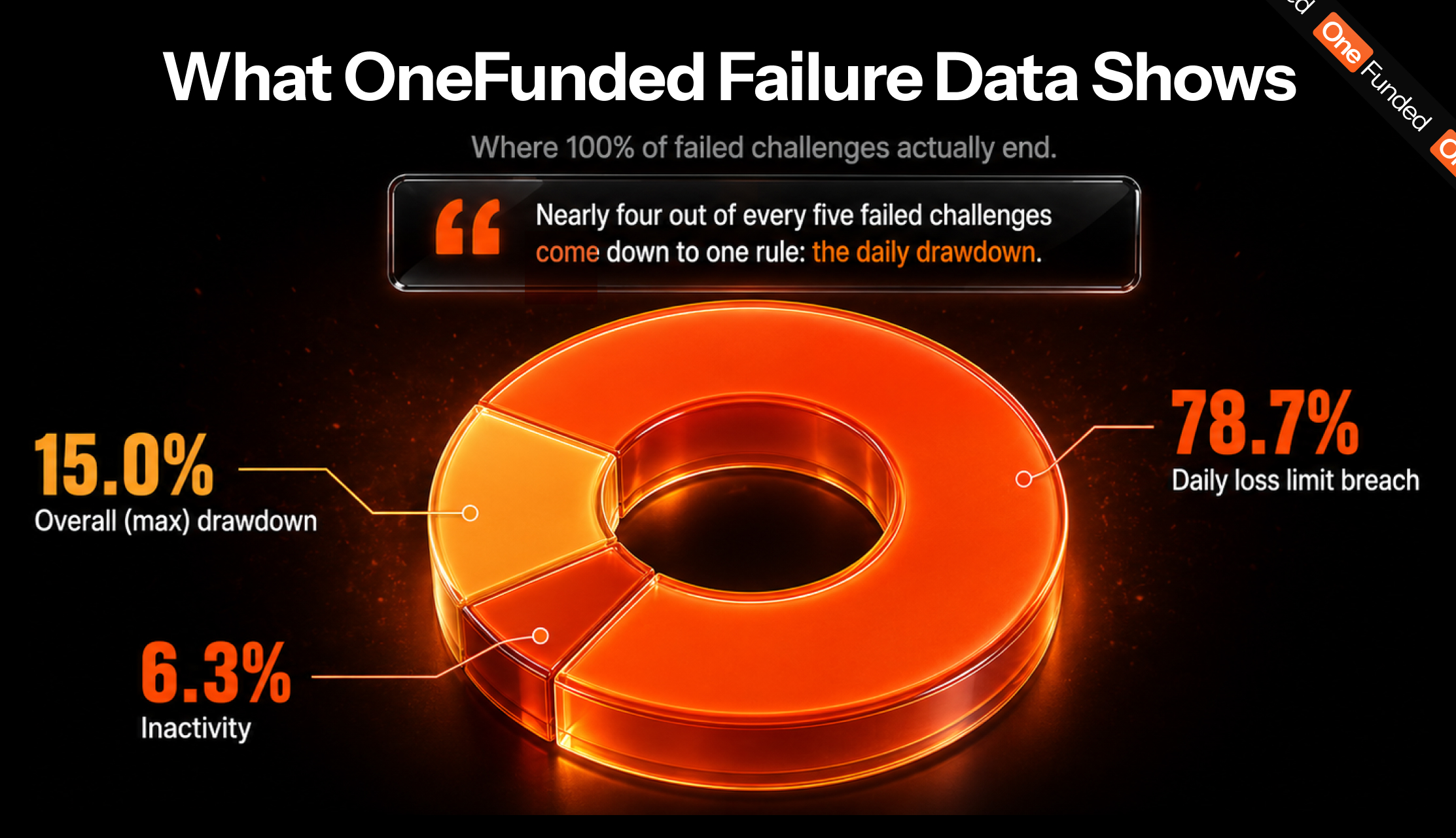
Here is how breaches break down across OneFunded’s platform:
- 78.7% of failed evaluations ended on a daily loss limit breach
- 15.0% ended on an overall (maximum) loss limit breach
- 6.3% ended due to inactivity and other risk rules
Nearly four out of every five failed challenges come down to one rule, which is the daily drawdown. That points the failure analysis squarely toward intraday risk management.
Top 5 Prop Firm Challenge Mistakes
Below are the top 5 reasons why traders fail prop firm challenges, ranked by how often each mistake leads to failed evaluations on OneFunded.
Five mistakes account for almost every failed evaluation:
- Breaking the daily drawdown limit
- Emotional and revenge trading
- Oversizing positions
- Misunderstanding the rules
- Lack of strategy preparation
Each mistake has a clear cause, and each one can be fixed before the next evaluation.
1. Breaking the Daily Drawdown Limit
This is the largest single prop firm challenge mistake that traders fail. 78.7% of all OneFunded challenge failures come from breaching the daily drawdown.
Every prop firm sets a maximum loss you can take within a single trading day, and crossing that line ends the evaluation. Many traders treat the daily limit as a soft warning and structure trades that leave no room for slippage, spread widening, or normal market noise.
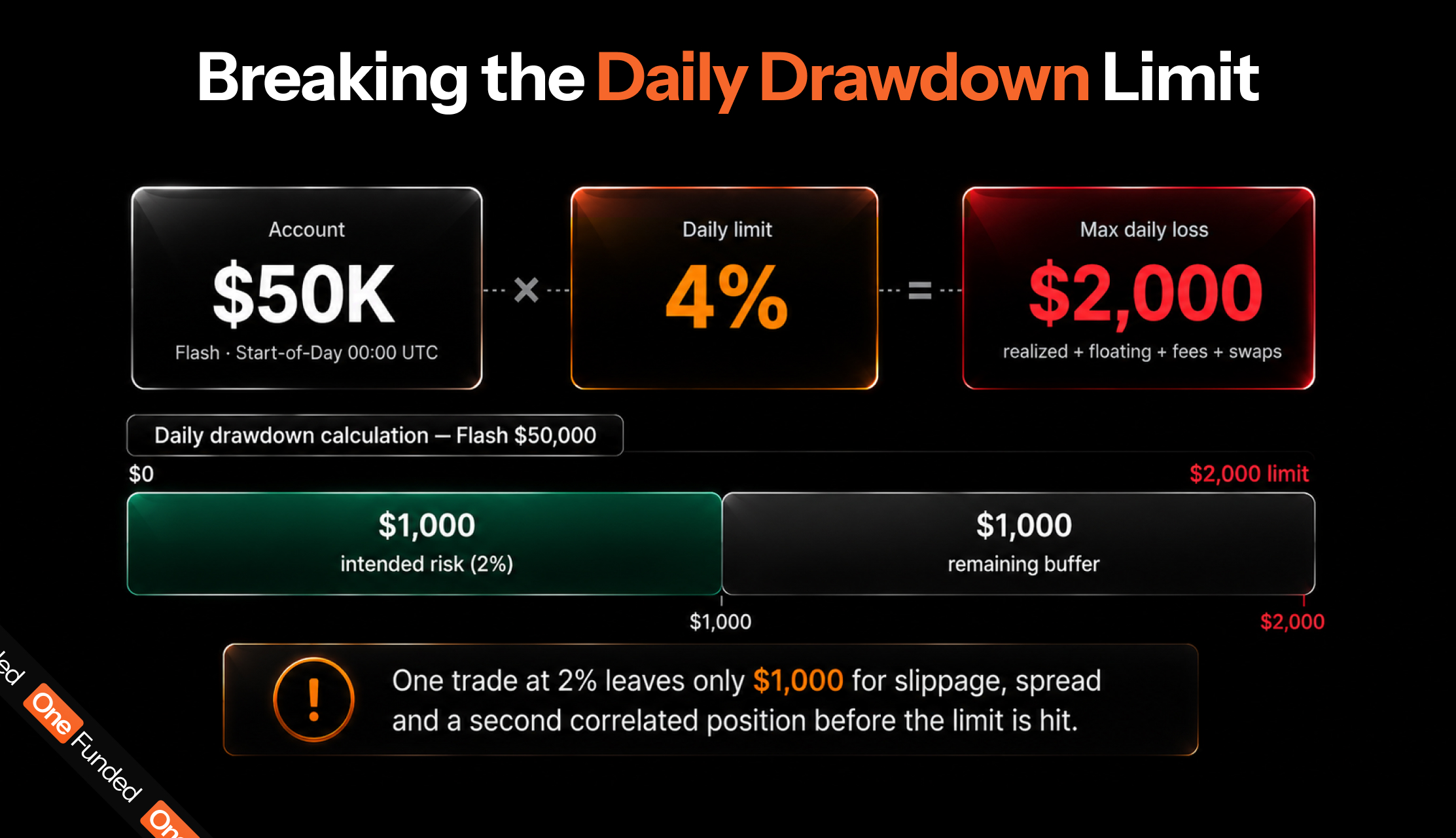
On OneFunded specifically, the daily drawdown limit is calculated by using the Start-of-Day Equity value at 00:00 UTC and accounting for all realized losses, floating losses, commissions, and swaps during the day. For a Flash account worth $50,000, the daily drawdown limit set at 4% amounts to a daily maximum drawdown of $2,000.
A trader accustomed to risking 2% on each trade might bring their normal trading discipline into the evaluation process. In such a case, on a $50,000 account, it would amount to $1,000 of intended risk per trade.
However, factors such as slippage, increased spreads, and an unfavorable market move prior to the stop loss triggering can result in a far greater floating loss. Should a trader add another correlated position, it could easily breach the daily limit threshold prior to both stop losses being triggered.
It doesn’t require closing the position to exceed the daily drawdown limit; it merely requires equity to fall below that mark.
Here’s what to do:
- Employ only half of your usual risk level.
- Remember that the daily maximum drawdown should be applied to the total of all open trades and not individual trades.
- Ensure that your maximum potential drawdown, taking into consideration slippage and spread expansion, is within both the daily maximum and OneFunded’s Max Exposure requirement of 3% per trade idea.
The first three sessions should be spent protecting yourself rather than making advances. If you do well enough in the first three sessions, not even getting close to the daily maximum, then the chance of passing the challenge is higher.
For a more detailed explanation of how the two drawdown limits work in practice, see our guide on what drawdown means in prop trading.
2. Emotional and Revenge Trading
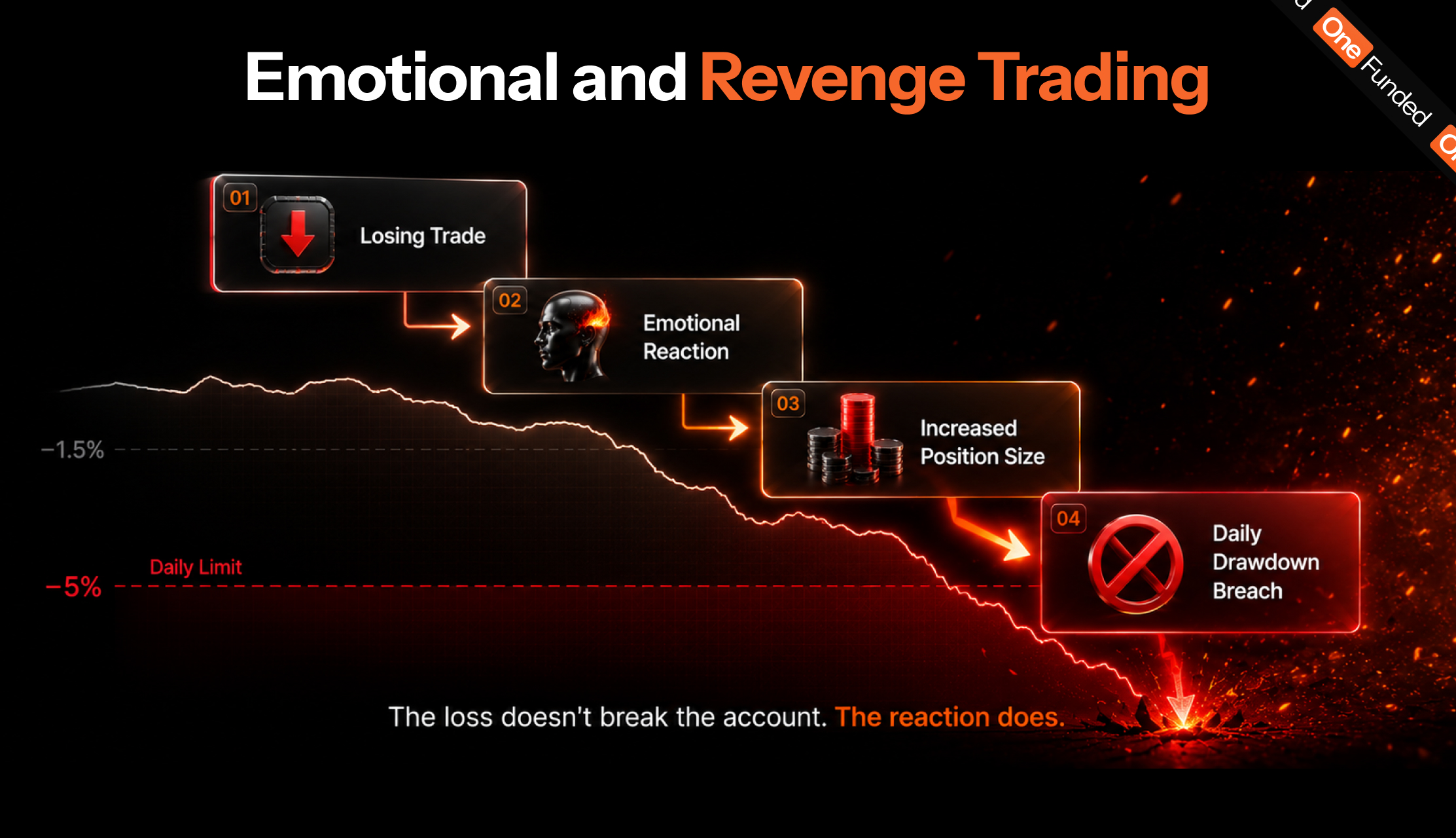
Emotional trading is the trigger behind most daily drawdown breaches. Few traders cross the daily limit on a single calm, well-sized trade. The breach usually arrives after a losing trade, when the next decision gets driven by the previous loss instead of the setup in front of the trader.
The pattern is consistent across prop firms. A stop loss gets hit, the trader treats the loss as a personal failure, and the next trade goes in at twice the usual size to “make it back.” On OneFunded, that one decision turns a manageable 1.5% drawdown morning into a 5% daily limit breach by lunchtime.
In such a case, a trader is faced with two options. Either wait for the reset of the daily drawdown back to zero at 00:00 UTC time or use an increased size to make up for the loss incurred on Tuesday morning.
Using increased sizes to cover the loss results in many one-day drawdown breaches in Core. Although the 5% limit gives traders some flexibility, that same flexibility may very easily become an additional risk.
“Loving to trade is very different from loving the process of understanding markets. If you need to trade to stay engaged in markets, you’ll inevitably overtrade.”
Dr. Brett Steenbarger, Ph.D., Clinical Associate Professor of Psychiatry and Behavioral Sciences at SUNY Upstate Medical University; performance coach for hedge funds and proprietary trading firms
A lost trade should always be considered a completed one. The subsequent trade must be taken only according to the setup, and not in order to cover losses.
What helps:
- Set a personal soft stop well below the platform limit. If OneFunded’s daily drawdown on Core is 5%, your own ceiling should be 2.5%. Hit it, and the trading day is over.
- Step away from the screen for at least 15 minutes after any losing trade before placing the next one.
- Keep sizing tied to the setup and the account, never to the outcome of the previous trade.
For traders working on this specifically, our article on trading psychology in funded accounts covers the behavioral mechanics in detail.
3. Oversizing Positions
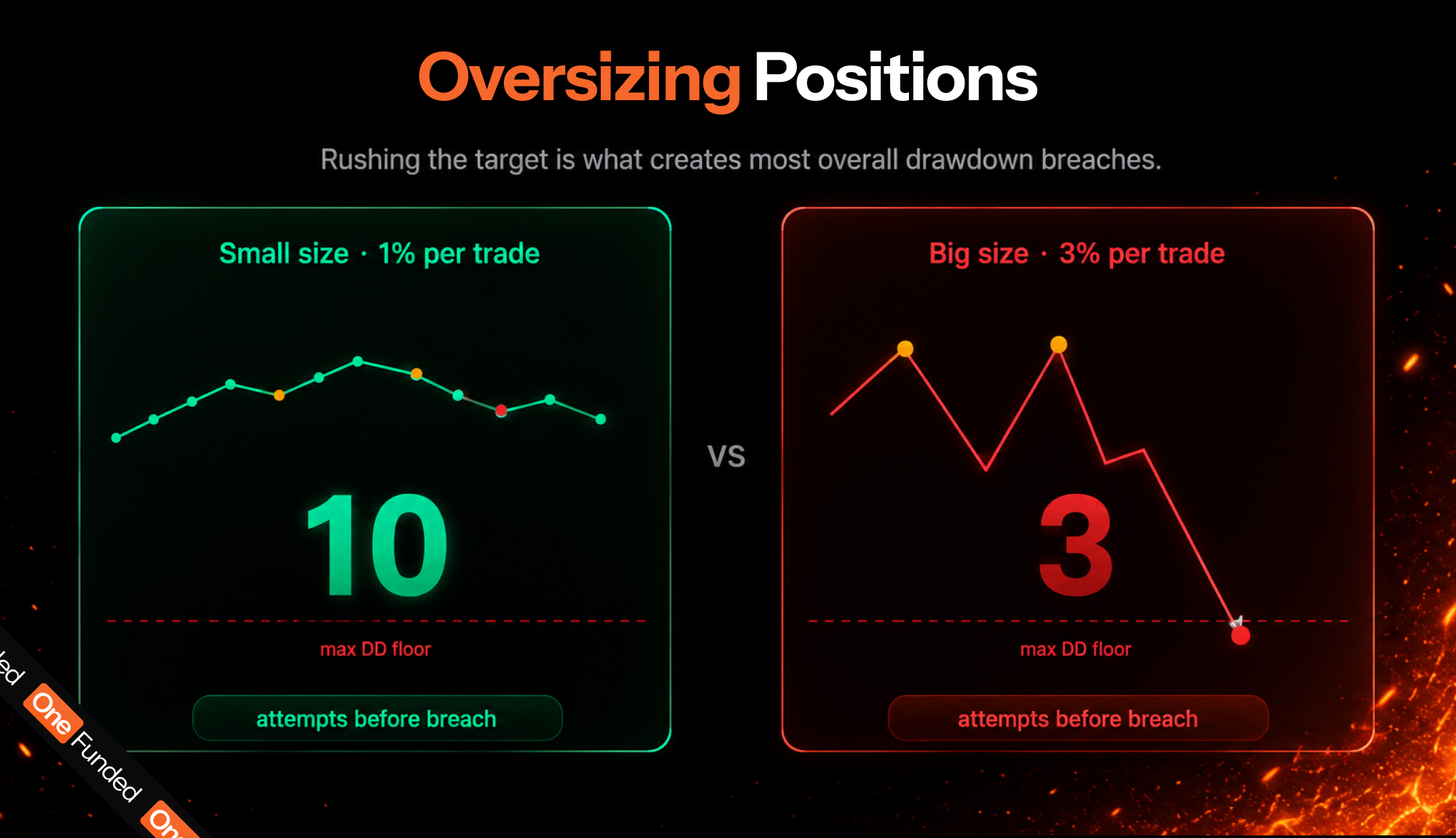
Oversizing accounts for the second-largest share of failures: the 15% of accounts that breach the overall (maximum) loss limit. The usual cause is rushing the target.
Profit targets feel close, the trader increases lot sizes to reach them faster, and the larger position then takes a larger loss when the trade reverses. On a $100,000 account with an 8% target, sizing at 3% per trade gives you roughly three attempts before breach. Sizing at 1% gives you ten.
On a Core account starting at $100,000, the trader achieves a 5% gain by Friday. The 8% first stage objective is just one good trading session away. On Monday, the trader makes six trades within the day, some outside his initial trading plan. At the end of the day, he suffers a loss of 2%, reducing his gains to losses from the 5%.
This phenomenon occurs for all account types.
After enjoying consecutive winning trades, the trader loosens his entry parameters. Some trades he would have passed on in the first few days of trading now appear attractive on the fifth day of trading. The size of trades also increases since he has gained a certain level of confidence by making a floating profit.
With a core account valued at $100,000, the max drawdown remains unchanged at $90,000. No matter the amount of floating profit, the maximum drawdown does not change. However, traders often see floating profit as extra room to risk.
To prevent this problem, the solution must be structural. Normally, the trader follows two key guidelines:
- Sizing comes from the starting balance, not equity. The OneFunded Exposure Loss Rule requires keeping an individual trade idea under 3% of the starting balance. Not going over the 3% means the trader doesn’t need to make any changes in sizing while evaluating.
- Stick with the maximum number of trades per day. If the trading plan allows three trades a day, then the fourth one isn’t made, even though it can be good. It’s important to keep the profit already obtained safe.
An evaluation for OneFunded doesn’t have a deadline. It is unnecessary to try to achieve 10% in profit within five days. Rushing the target is what creates most overall drawdown breaches.
4. Misunderstanding the Rules
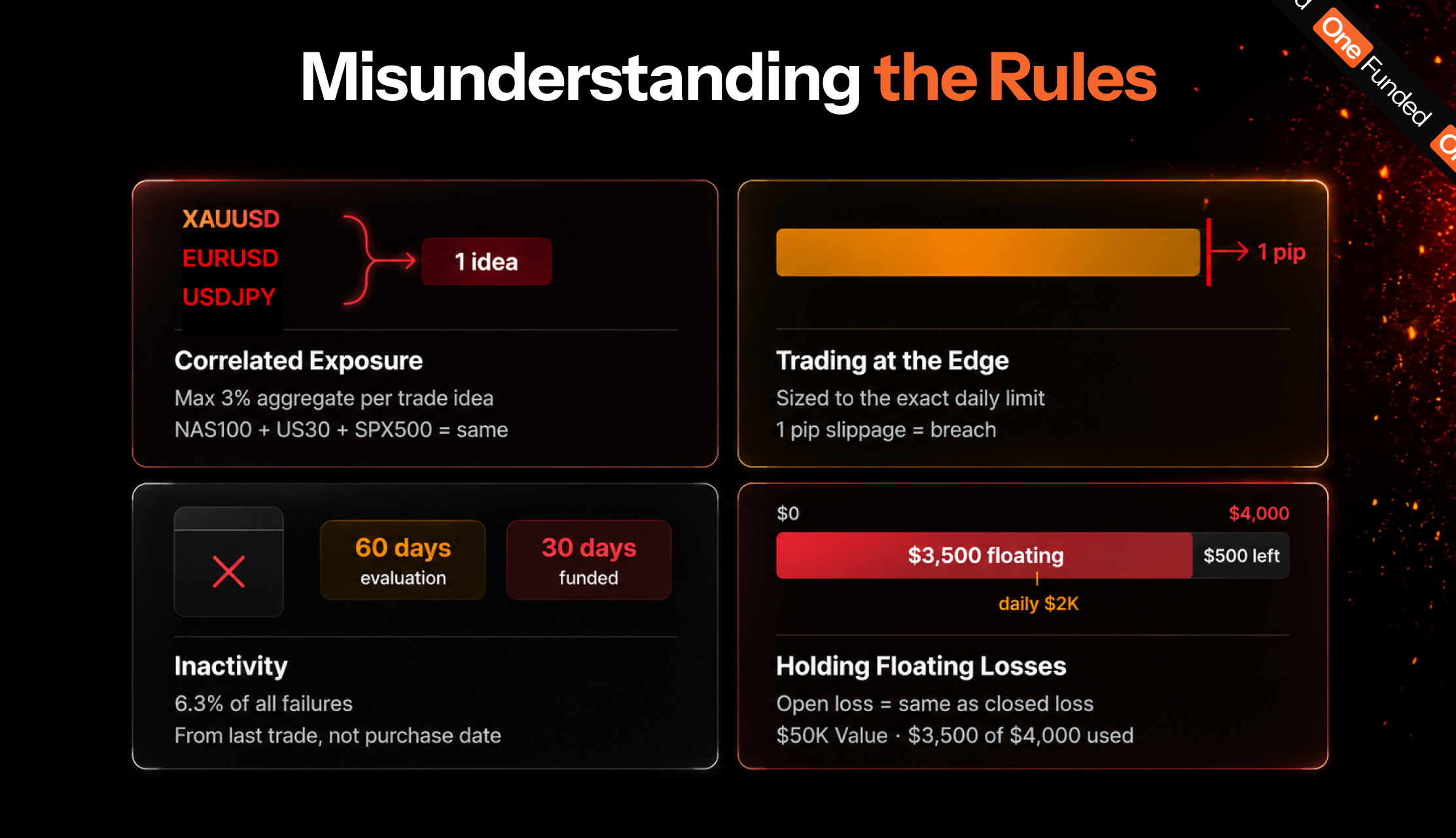
A surprising number of why traders fail prop firm challenges come from traders breaching rules they had not fully read. These cases cluster in three areas.
Correlated Instrument Exposure
Traders with long positions in XAUUSD, EURUSD, and short positions in USDJPY are engaging in one trade idea.
The OneFunded Maximum Exposure rule allows an aggregate of a maximum 3% floating loss as per the trade idea in relation to Start-of-Day equity. Correlated directional exposure will be aggregated in accordance with this rule.
The same goes for the indices. Dividing exposures across NAS100, US30, and SPX500 does not mitigate risk in any way; it is just spreading the trade idea under various names.
Trading at the Edge of the Drawdown Floor
Some traders will structure their trade in such a way that their maximum allowable loss will be equal to the daily limits. However, just one point of slippage, increased spreads, or even gaps in the market can cause the loss to exceed the set limit, which will result in the breach.
The trader needs to consider the stop loss margin, but not only that, when deciding on how large the trade must be.
Account Inactivity and Minimum Trading Days
Inactivity accounts for 6.3% of all platform failures. Accounts that are under evaluation expire after 60 days if there has been no trading activity. Accounts that are funded expire after 30 days of inactivity if there hasn’t been any trading done.
Inactivity starts from the date of the last trade, not from the purchase date. For traders who would like to begin trading at a later date, they should make note of this time frame and put it on their calendars.
Holding Floating Losses Instead of Taking Them
With equity-based risk management, floating losses will be counted on par with closed losses for purposes of determining whether the daily and maximum drawdown limits have been breached. Holding a losing trade does not delay a breach if losses continue expanding.
For instance, on a $50,000 Value account, the daily and maximum drawdown limits are set at $2,000 and $4,000, respectively. Floating losses amounting to $3,500 provide very little maneuvering room, irrespective of whether the trader has yet to close out the losing trade.
5. Lack of Strategy Preparation
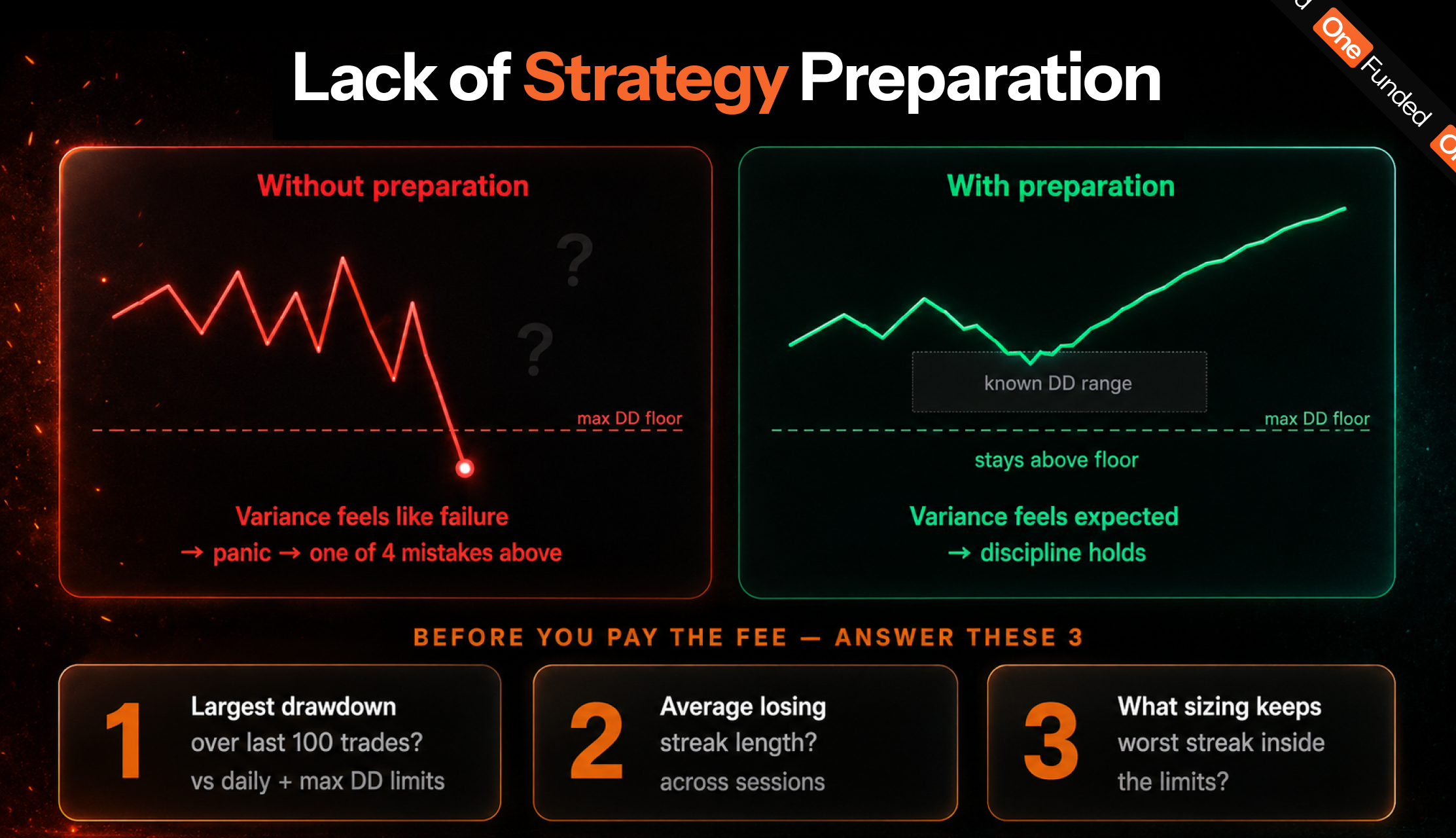
Many enter an evaluation without a backtested reference point for what “normal” looks like for their strategy: typical maximum drawdown over 30 trades, average losing streak length, and win rate across different sessions.
Without that reference point, ordinary variance starts to feel like a strategy failure, and the trader reacts to it as if a crisis is unfolding. The reaction then surfaces as one of the four mistakes covered above.
Before paying the challenge fee, run your strategy on historical data or on a demo account long enough to answer three questions:
- What is the largest drawdown your strategy has produced over the last 100 trades?
- How does that compare to the daily and maximum drawdown limits on the program you’re picking?
- What position sizing keeps your worst historical losing streak comfortably inside those limits?
If those answers are missing, every losing streak in the live evaluation will feel random, and that is when discipline tends to break.
Rules That Delay Your Pass (But Don’t End It)
The Consistency Rule often gets lumped in with failure causes, but it is not one. It does not breach the account or end the evaluation. It only delays the pass until the ratio drops back inside the cap.
On the fourth day, a trader operating a $100,000 Core account hits the 8% phase one target. Out of the $8,000 total profit, $6,000 was earned through the trade XAUUSD pair.
The maximum drawdown did not exceed its set level. The daily drawdown did not exceed its set level. However, the phase has not been passed due to the 75% Best Day Profit Ratio being higher than the 50% limit imposed by the Core’s Consistency Rule.
The Consistency Rule does not penalize the account. It simply delays the pass. The caps are:
- OF Core: 50%
- OF Flash: 50%
- OF Value: 40%
- Funded OneFunded Trader accounts: 30%
If the percentage exceeds the cap, the account is not closed. The trader will be required to increase the number of successful trading days until the ratio becomes less than the cap. This applies to funding payout calculations for funded accounts, too.
The rule targets traders whose success depends on occasional big setups. For instance, a Core trader who achieves an 8% target using three flat trading days and one $6,000 day will have to continue trading using the drawdown criteria until the ratio is reduced below 50%.
The fix is to plan for consistency from the start:
- Distribute the risk among several sessions rather than putting it into one single session.
- Think about the profit goal as an achievement of a series of good sessions rather than one big session. In Core, the best session should not go beyond 50% of the entire profit upon achieving the profit goal.
The Consistency Rule is updated daily at 00:00 UTC and is visible in the dashboard prior to reaching the profit goal or applying for a payout.
How OneFunded Challenges Are Structured
OneFunded’s programs use equity-based performance monitoring, where the Maximum Drawdown is calculated on a static basis from the starting balance. Daily drawdown is calculated from Start-of-Day Equity and resets at 00:00 UTC.
| Challenge | Type | Daily Drawdown | Maximum Drawdown | Profit Target | Best Day Cap |
|---|---|---|---|---|---|
| Flash | 1-step | 4% | 6% | 10% | 50% |
| Core | 2-step | 5% | 10% | 8% / 5% | 50% |
| Value | 2-step | 4% | 8% | 6% / 6% | 40% |
The maximum drawdown is independent of equity peaks. A successful start-of-the-week does not increase the drawdown floor, making the system more flexible for swing traders who may hold positions through multi-day pullbacks.
The account balances range from $200,000 for simulated capital, depending on the trading strategy. Profit sharing starts at 80% for regular accounts, rising to 90% when combined with the 90/10 Profit Split add-on. Payments occur biweekly (every 14 days), while the Weekly Payout add-on results in payments once a week. Every payout request is subject to minimum and maximum amounts of $100 and $10,000, respectively.
All fee details, profit split, and additional information can be found on the challenge programs’ page.
Deciding whether to select Flash, Core, or Value impacts the pass rate significantly. For instance, an intraday trader who requires daily volatility will be better suited for Core due to the daily 5% tolerance, allowing for greater room within intraday fluctuations.
On the other hand, a well-disciplined trader having a low number of positions, as well as small risk per trade, will be well-advised choosing Flash or Value, where the chances of success will be much higher.
Fixing the Pattern Before the Next Evaluation
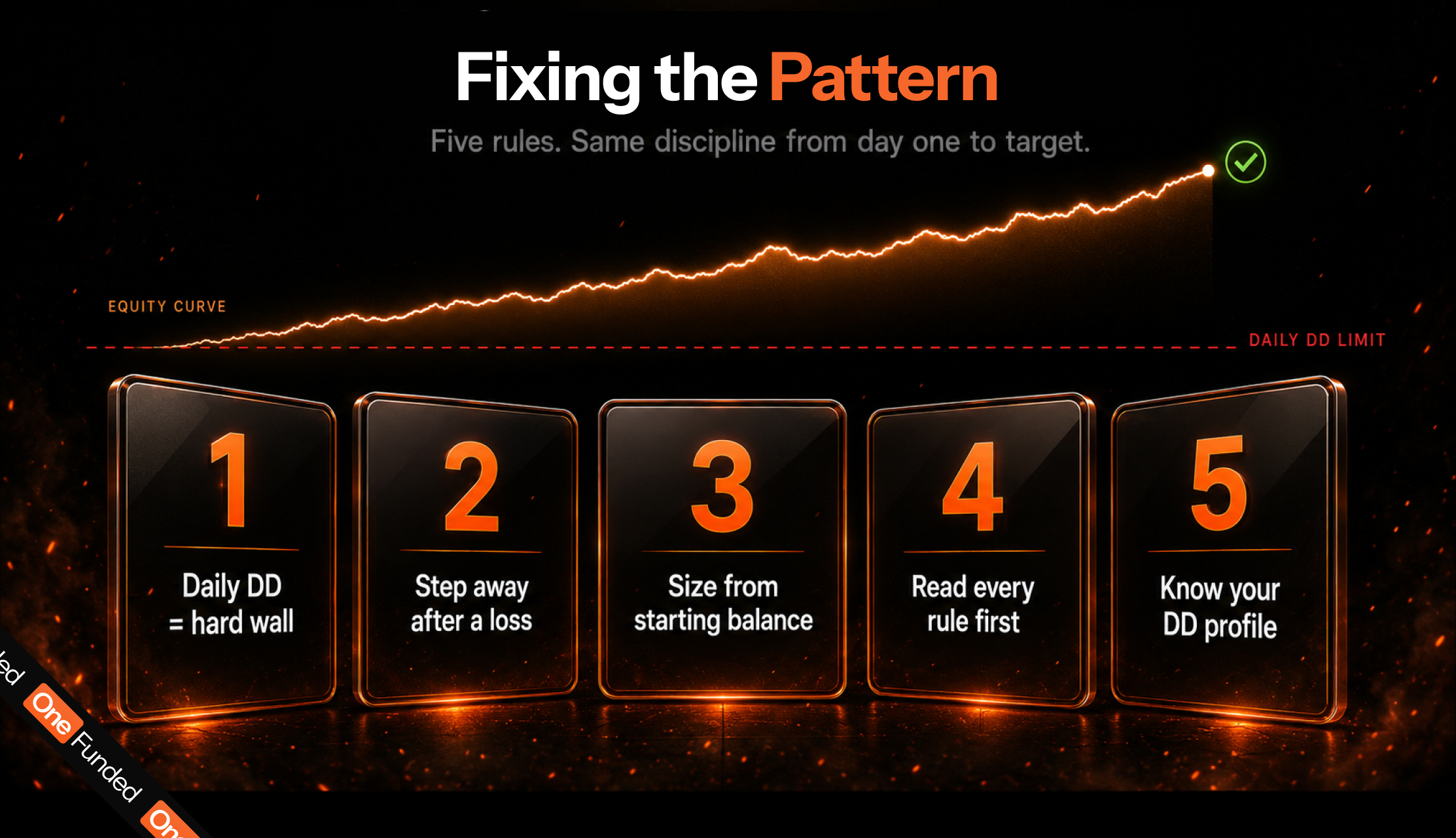
A failed prop firm test almost never involves a losing trade. The issue is rather a sizing choice that the trader wouldn’t have made at the beginning of the evaluation phase.
Traders who succeed do so by adhering to the discipline they had right from the first day through until their final target. There are five main principles that can prevent most failures:
- Treat the daily drawdown as a hard wall, and keep a personal soft stop well below it.
- After a losing trade, step away before placing the next one.
- Size your positions based on the initial balance only; never use the floating equity or exceed the 3% Position Sizing Consistency limit per trade idea.
- Read every rule before you start, including correlated exposure caps, inactivity windows, and minimum trading days.
- Know your strategy’s drawdown profile before risking the fee.
The traders who succeed are those who create an approach that fits perfectly within those limits.