




If you’re looking to start your trading journey in 2026, the options may seem endless. Between stocks, forex, crypto, and other markets, traders can work with a greater variety of assets and instruments than ever before. Having a structured process to approach this decision can offer valuable clarity through complexity.
In this article, we’ll take a look at how traders can decide where to start their trading journey. We’ll analyze a variety of market options through the lens of a new trader, identifying the advantages and disadvantages of each choice for practitioners early in their journey. Finally, we’ll outline a step-by-step approach that traders can use to make their final decision.
Importantly, where you start trading may not be where you finish trading. Traders frequently change markets as their skills, interests, and goals evolve. Nonetheless, picking the right choice to start can help build essential skills, establish good habits, and set the foundation for long-term success.
Key Points
- Understanding your trading profile: Your risk tolerance, available capital, and time commitment should guide your market selection. Certain traders are better suited to certain markets, so it’s essential to understand your trading profile.
- Each market has unique characteristics: Stocks offer accessibility, forex provides 24/5 trading, crypto features high volatility, and derivatives offer leverage. For traders, the key isn’t just to understand these unique characteristics, but to identify which ones best support their goals.
- No choice is permanent: Traders can transition between markets as their circumstances and goals evolve. Nonetheless, a trader’s early experience can shape their habits and skills, making their initial choice of market important.
- Start small and test: Beginning with modest positions allows you to validate your choice before committing significant capital. Over time, traders can scale up their positions to enhance their profit potential, potentially by working with a prop firm.
Understanding Your Trading Profile: How It Influences Your Decision
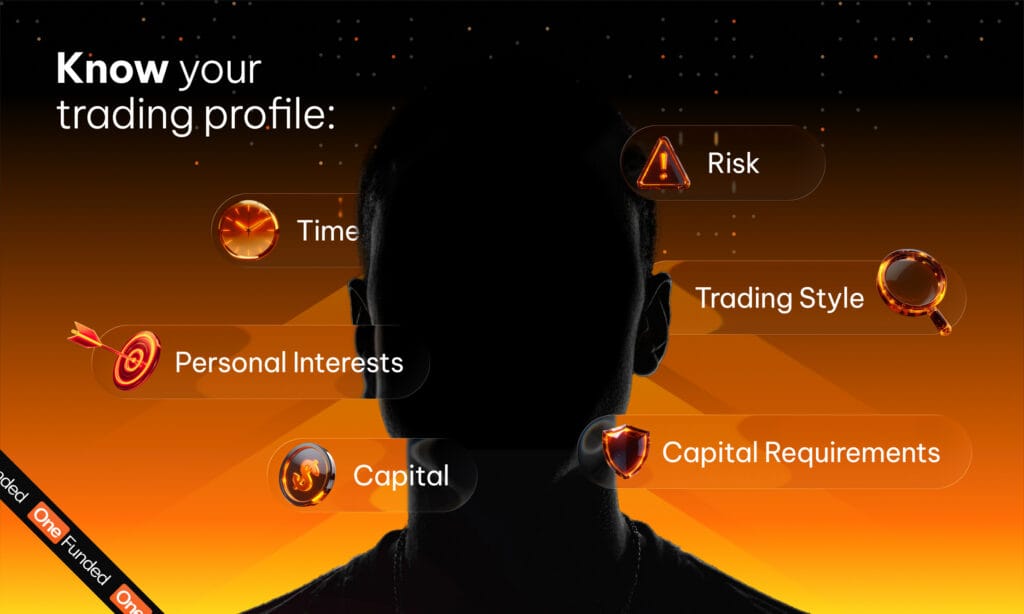
When deciding which market to trade, it’s natural to begin by comparing each asset class. But in fact, there’s an even better place to start: by understanding what kind of trader you are. Depending on your unique ‘trading profile,’ certain markets may suit you better than others.
In this section, we’ll walk through the key areas that make up your trading profile and how to think about them in terms of launching your trading journey.
Risk Tolerance Assessment
While almost every market can have volatile assets, some markets are generally riskier than others. For example, rapid capital swings are more likely to occur in crypto than in bonds. As such, you first need to understand your personal risk tolerance.
To assess your comfort with various levels of risk, questions to ask yourself include:
- Can you sleep at night with open positions? Some traders prefer to close out their positions at the end of each day – known as the day trading style. Others are comfortable with the potential volatility of overnight positions. That matters, since some markets are more conducive to day trading than others.
- How much capital can you afford to lose? If you’re trading personal capital that you might need for day-to-day living expenses, you may not be able to afford meaningful capital losses. As a result, steadier markets can make more sense.
- How would you react to a significant drawdown? While the previous question dealt with the financial reality of losing money, this one deals with psychology and emotions. Losing significant sums of money can drive emotional trading decisions in individuals without a strong risk tolerance.
Time Commitment and Lifestyle Considerations
The next component of your trading profile is the amount of time that you have to commit to markets. Certain instruments can be less conducive to limited availability. For example, futures markets may require traders to react almost immediately to changes in prices and margins throughout the business day.
This component also has to do with the time period during the day in which you can trade. Depending on your lifestyle, you may have all day to trade, a short time in the morning, or evenings after work. While certain markets (such as crypto and forex) are open nearly continuously, others (such as stocks and options) have limited trading hours.
Capital Requirements
In certain markets, traders who lack enough capital may struggle to make significant profits. But in others, the potential for increased leverage can magnify a small amount of capital into much larger swings in a trader’s P&L. As such, your trading profile will be influenced by your capital requirements and profit goals.
Another factor involved in this decision is that of prop trading vs. self-funded trading. Prop firms, which allow traders to access additional capital to scale up their profits, don’t always operate across every market. Therefore, traders with limited capital who are pursuing prop trading need to align their desired market with a prop firm that offers it.
Looking to start your prop trading journey? Start your OneFunded challenge today to unlock funded accounts up to $200,000 across FX, crypto, indexes, and more.
Learning Curve and Market Affinity
Some markets can be trickier to learn than others. For example, trading in options markets can sometimes involve complex math to value different assets. In contrast, crypto calls for a completely different form of analysis, often based on social inputs and sentiment.
Depending on a trader’s time and willingness, learning the ins and outs of complex markets may not be feasible. As a result, traders should carefully consider how much time they have to learn about the market structure they’re seeking to trade in. Moreover, your professional and educational background may impact the learning curve of various markets as well.
Anticipated Trading Style
Although trading styles are rarely limited to one market, it’s no secret that some styles work better with certain instruments than others. For example, high-frequency order flow strategies can often benefit from markets with high liquidity and tight spreads, like forex majors. Meanwhile, traders focused on long-term fundamental analysis typically gravitate toward equities. While these patterns aren’t absolute rules, understanding how your preferred style aligns with different market structures can help narrow your options.
Personal Interests
Finally, it’s important not to ignore the role of personal interest in deciding which market to operate in. Traders who love to follow geopolitics and the latest international developments may be drawn to commodity markets like oil and gold. In contrast, a trader who is on the cutting edge of digital technology might be drawn to crypto. This type of personal interest can help keep a trader motivated during down periods and help them stick with the discipline of trading over the long term.
Stock Trading: The Traditional Foundation
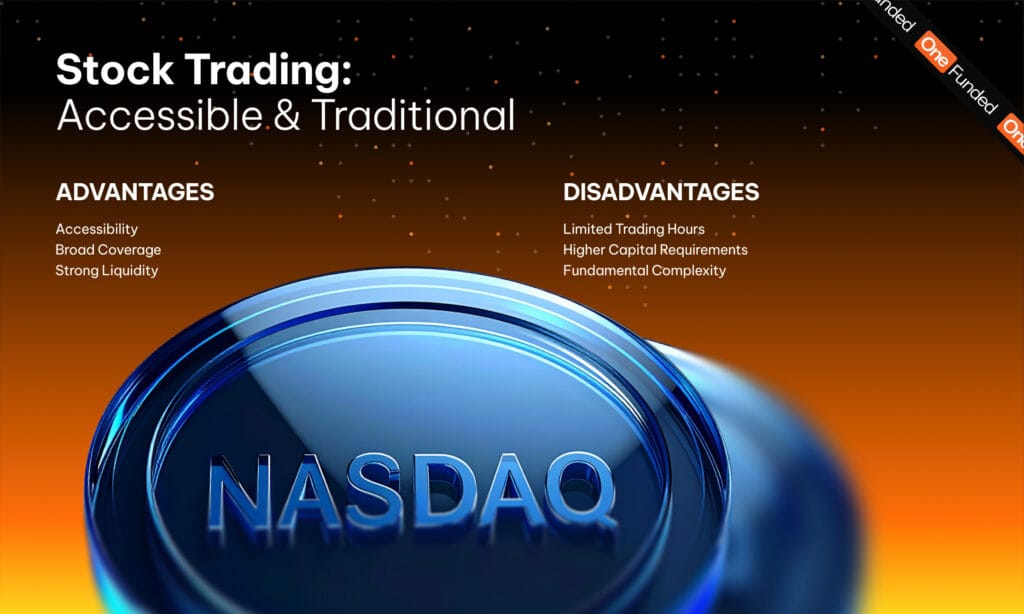
The stock market is usually considered the traditional starting point for prospective traders. Not only are equities highly accessible for individuals, but the learning curve to start trading is generally low. Moreover, intuitions developed in the stock market often carry over well to other asset classes.
Stock exchanges typically trade during local business hours, closing overnight and during the weekends. However, many brokers now offer pre-market and after-hours trading as well. The largest stock exchanges in the world are the New York Stock Exchange and the Nasdaq, followed by the Tokyo and Shanghai Stock Exchanges.
Key Advantages
- Accessibility: Stocks are generally highly accessible for individual traders, with many brokers offering fractional share purchases, lowering the minimum investment to $1 or less. Getting started with stock trading can often be done by registering with a brokerage via a mobile app.
- Broad Coverage: Stock movements are widely reported on in the business news. As a result, most people have some understanding of how stock trading works, leading to an easier learning curve.
- Strong Liquidity: While not all stocks are equally liquid, many popular shares are some of the most highly traded assets in the world. Top stocks can easily trade tens of billions of dollars in daily volume, meaning that market liquidity issues are usually not a concern.
Key Disadvantages
- Limited Trading Hours: Because stock exchanges are typically open during the business day, opportunities to trade outside of those hours are limited. That makes stocks one of the asset classes with the shortest trading hours.
- Higher Capital Requirements: Even though purchasing stocks is accessible, traders still need to navigate capital requirements to trade them. In the US, the Pattern Day Trading rule requires that traders have at least $25,000 in their account to move in and out of positions frequently. Moreover, leverage is typically limited and expensive.
- Fundamental Complexity: Stock prices are often influenced by ‘fundamentals,’ such as corporate earnings and management decisions. Analyzing these fundamentals can be complex, requiring traders to know how to navigate financial statements and corporate reports.
Who Is Stock Trading Right For?
Stock trading is likely a good fit for traders who can navigate high capital requirements, are available during the working day to trade, and stay up-to-date on the global business and corporate environment. Even for traders who do not meet this criteria, however, the stock market can offer a useful way to experiment with trading before potentially moving on to other asset classes. Overall, stock trading is the traditional foundation for a reason – it can be suitable for investors of many different profiles.
Getting Started With Stock Trading
Getting started with stock trading typically involves creating an account with a digital brokerage (either through an app or website), funding that account, and purchasing shares. Stocks can be uniquely identified through their ‘ticker symbol,’ usually 2 to 4 letters. When it comes to prop trading, not all prop firms offer individual stock selection, although many allow traders to trade stock indexes.
Forex: The 24-Hour Global Market

Although the stock market is the traditional launching pad for newer traders, that’s a role being increasingly overtaken by foreign exchange – commonly known as forex, or FX. In the forex market, traders around the world buy and sell currency pairs, exchanging pounds, dollars, euros, and more.
Unlike stocks, the forex market has no centralized exchanges. Instead, this market is made up of a complex network of banks, brokerages, and individual traders spread around the world. Although that market structure can lead to some complexity, it has also made forex more accessible than many other markets.
Key Advantages
- 24/5 Market Access: As a globally connected market, forex doesn’t abide by any one country’s local business hours. Instead, this is a 24/5 market, generally open continuously throughout the business week. While not all time periods are equally liquid, this allows traders much more time to trade than some other asset classes.
- Low Capital Requirements: Many brokerages offer forex accounts starting as little as $50 to $100. And, importantly, the market comes with essentially no regulatory limitations on trading frequency, allowing a wider variety of strategies for newer traders.
- High Leverage Availability: In addition to having low capital requirements, FX providers also tend to offer high leverage availability – typically ranging from 1:10 to 1:50. However, maximum leverage limits usually differ by currency pair, with less-liquid pairs featuring lower limits.
Key Disadvantages
- Decentralized Market: Because the FX market is highly decentralized, there is no single data provider or exchange to publish authoritative quotes. Thus, traders should understand that liquidity conditions might differ depending on the brokerage that they work with, and that information can be more challenging to access than in centralized markets.
- Sophisticated Market Drivers: Currency pairs in the FX market can be driven by myriad different factors, including interest rate decisions, geopolitical tensions, and technical factors like market liquidity. As a result, forex traders often need to pay close attention to an array of market drivers, which can be challenging and time-intensive.
- Potentially High Risk: Although the FX market isn’t inherently risky, the combination of high leverage with the potential for sharp, sudden movements can create a unique risk profile. With that said, it’s typically possible to minimize risk by sticking with major pairs and lower leverage levels.
Who Is Forex Right For?
Forex could be good for newer traders with lower levels of capital who are still looking to employ sophisticated strategies. Without a sufficiently large portfolio, day trading and other higher-frequency approaches can be challenging in the stock market. Moreover, forex can be good for traders seeking to utilize leverage to boost their profits, due to the higher limits.
Finally, it’s worth mentioning that many currency pairs exhibit distinct characteristics. Major pairs, such as EUR-USD, are typically less volatile and more impacted by factors like interest rates. Exotics, such as USD-TRY, typically show more fluctuations and have strong exposure to political uncertainty. As such, this one market can offer a surprisingly diverse number of opportunities.
Getting Started With Forex Trading
Getting started with forex trading involves creating an account with a regulated forex broker and trading currency pairs. Currency pairs can be identified through their unique six-letter symbol, such as EUR-USD or GBP-JPY. When it comes to prop trading, most prop firms actively support forex trading, as the FX market’s high liquidity and 24-hour availability align well with proprietary trading strategies.
Start your forex prop journey today with a OneFunded virtual account. Complete the challenge to unlock funded FX trading across dozens of popular currency pairs.
Cryptocurrency: The Digital Frontier
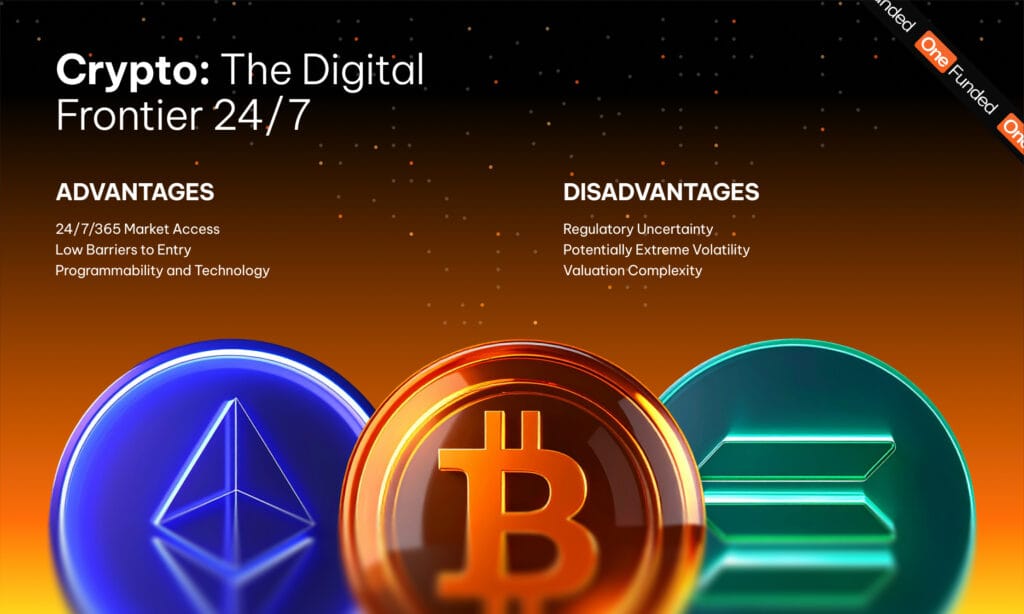
Compared to other asset classes, cryptocurrency is still young. The first Bitcoin was mined in 2009, but it took many more years for other coins to emerge and turn the market into a serious avenue for trading. But despite being less mature than other markets, cryptocurrency has several attributes that can make it highly attractive for newer traders.
Like forex, crypto lacks a centralized exchange or infrastructure. Moreover, in distinction to stock brokers, crypto brokers often serve many different roles at the same time – including brokerage, exchange, clearinghouse, and custodian. That means the choice of trading platform tends to be far more important in crypto than in other asset classes.
Key Advantages
- 24/7/365 Market Access: Crypto markets are open all day long, every single day of the year. Although liquidity conditions vary, as an online global market, traders can log in for a trading session at 3AM on a holiday or 9AM on a business day.
- Low Barriers to Entry: Crypto is globally accessible, has essentially no minimum account requirements, and very few limitations on who can participate. What’s more, tokens can typically be fractionalized to a dollar or less.
- Programmability and Technology: Many crypto brokers offer API access, in line with crypto’s vision of offering ‘programmable money.’ That can make automated trading strategies easier and cheaper to build than in traditional markets.
Key Disadvantages
- Regulatory Uncertainty: Crypto tokens typically have limited regulatory oversight when compared to stocks, bonds, or other traditional assets. As a result, traders have fewer protections from fraud or market manipulation and must be more thoughtful about their personal due diligence.
- Potentially Extreme Volatility: In crypto, it’s not uncommon to see prices of certain tokens double (or fall by half) in a single trading session. That potential for extreme volatility can make effective risk management challenging.
- Valuation Complexity: Rather than traditional fundamentals, crypto tokens are often valued based on sentiment analysis, correlations with other tokens, and complex ‘tokenomics.’ This makes it difficult for traders accustomed to traditional financial analysis to accurately assess whether an asset is overvalued or undervalued.
Who Is Crypto Trading Right For?
Crypto trading is likely suitable for tech-savvy traders comfortable with higher levels of risk, both in terms of elevated volatility and fewer regulatory protections. While these factors mean that newer traders need to conduct careful research and analysis, crypto’s digital capabilities and large price swings can also support uniquely profitable strategies. However, crypto is likely unsuitable for traders unwilling to put the time in to learn about the market’s novel structure.
Ultimately, every individual crypto asset comes with unique characteristics. Mature tokens like Bitcoin, for instance, may exhibit less volatility than ‘altcoins.’ Meanwhile, stablecoins seek to maintain a par value against a major currency. This means that traders should be selective about the crypto assets that they work with, choosing the ones that are most suitable for their strategy.
Getting Started With Crypto Trading
Getting started with crypto trading involves registering with an online broker, funding an account through either traditional means (bank/card/etc.) or stablecoin transfers. Once again, limited investor protections in this asset class mean that traders should be thoughtful about which platforms they sign up for. Tokens are typically identified with a name and a ticker symbol, although these symbols are not always standardized between platforms. Crypto access is an increasingly popular offering among prop firms, although still not universal.
Futures & Commodities: Leveraged Markets with Time Constraints
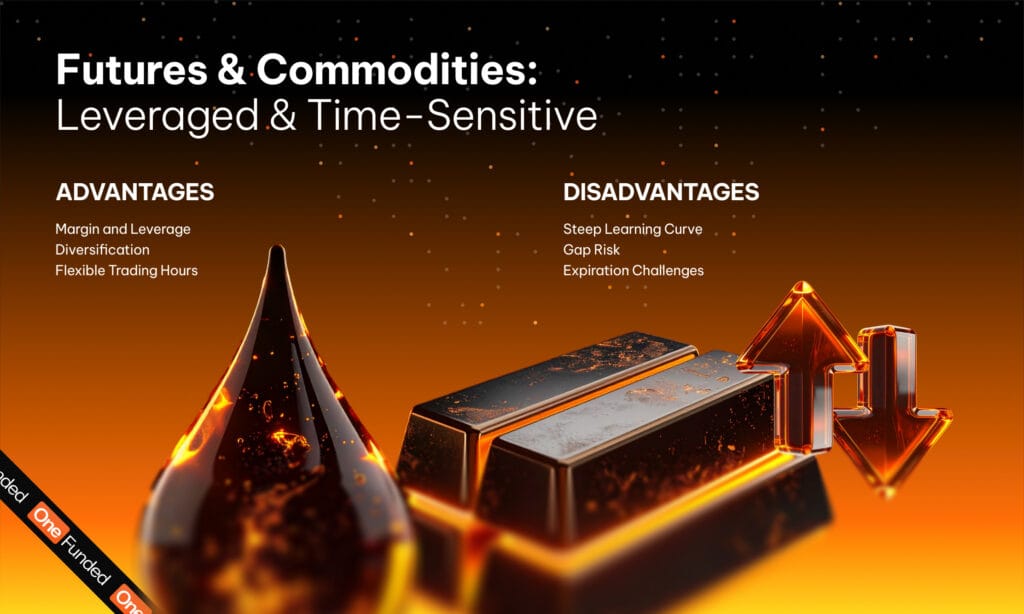
Futures and commodities markets are fundamentally distinct from crypto, forex, or stocks. That’s because assets in this world don’t last forever – instead, they have a defined lifespan. The fact that futures contracts naturally expire at the end of their term influences everything from the structure of these markets to the strategies that traders can employ.
In reality, commodities and futures are technically distinct. Not all futures contracts are related to commodities, and commodities don’t necessarily need to be traded through the futures market. Nonetheless, they have such a strong overlap that it’s worth discussing them together.
The world’s largest futures and commodities market is the Chicago Mercantile Exchange, which includes the Chicago Board of Trade and the New York Mercantile Exchange. Other important markets include the Intercontinental Exchange in Europe and the Shanghai Futures Exchange in China. Generally, futures brokers will offer access to all of these major exchanges, as well as specialized, smaller ones.
Although futures markets are not truly continuous, they operate on a nearly 24/6 schedule. The typical futures trading week starts on Sunday evening (in the US) and goes until Friday afternoon, with short breaks each day for maintenance. However, specific trading windows differ by exchange and contract.
Key Advantages
- Margin and Leverage. When you initially enter a futures position, you need to put down a small amount of capital as your ‘margin.’ However, you are exposed to the full value of gains and losses in the contract price, often creating significant leverage – and thus the potential for higher profits.
- Diversification. Commodities futures contracts are typically driven by distinct risk factors when compared to equities or forex, including weather risk, trade disruptions, or political uncertainty. For traders who already have an investment portfolio of ‘traditional’ assets, commodities and futures can offer the potential for uncorrelated returns.
- Flexible Trading Hours. The near-continuous nature of futures markets can be suitable for traders who need to conduct their sessions in the mornings or evenings. Bear in mind, however, that liquidity is usually highest during standard business hours.
Key Disadvantages
- Steep Learning Curve. Futures and commodities markets have a steep learning curve, requiring traders to educate themselves about topics like margin, contract specifications, expiration mechanics, contango/backwardation, and delivery procedures. For traders not used to futures markets, that might require a significant investment of time and energy.
- Gap Risk. Commodities have a tendency to ‘gap’ more than other asset classes, with contract prices often rising or falling by a large magnitude in a short period. That’s because contracts can be significantly influenced by the release of information like weather reports, crop production, or geopolitical events. This behavior can frequently cause risk management issues.
- Expiration Challenges. Finally, the fact that contracts expire can introduce novel challenges for many trading strategies. For instance, traders holding positions near expiration must either close their position or ‘roll’ it forward, which can incur additional costs and complexity in execution.
Who Is Futures & Commodities Trading Right For?
Futures and commodities trading could be right for traders eager to begin their journey with maximum leverage and who have the time to invest in surmounting a steep learning curve. Due to margin mechanics, it’s not uncommon for futures platforms to feature effective leverage limits as high as 1:30, 1:50, or even 1:100. Although that introduces novel risks, it can also maximize a trader’s profit potential with a small amount of capital.
Traders also need to be mindful of the market they select. Dynamics in the gold market, for instance, are profoundly different from those in the oil market. Thus, traders should research the fundamentals and basic dynamics of each individual market when deciding where to start.
Getting Started With Futures & Commodities Trading
Retail brokerages offering futures access fall into two categories: specialized platforms and general-purpose ones. Specialized platforms typically feature additional tools well-suited to the futures market, although they may be more complex to learn or have higher funding requirements. In contrast, general-purpose brokerages that offer futures trading typically lack many of the tools that serious futures traders require. When it comes to prop firms, futures trading is a relatively common – although by no means universal – platform feature.
Options Trading: Advanced Strategies for Sophisticated Traders
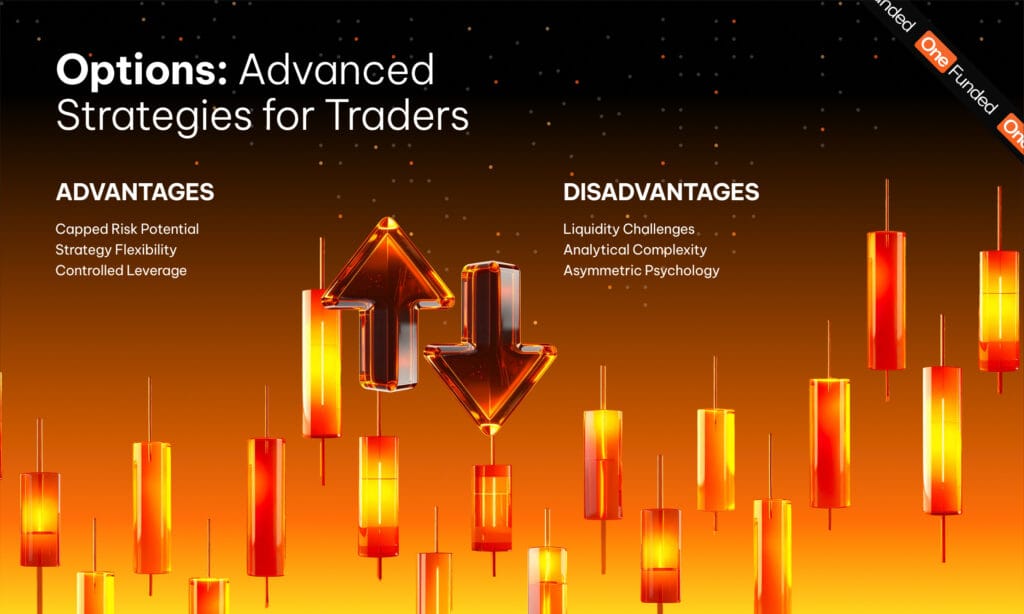
The options market is one of the last major choices worth considering when starting your trading journey. Options may not be suitable for everyone, as they combine complexity, leverage, and sophisticated analysis. Nonetheless, these contracts can offer high profit potential for traders who learn to navigate the options market successfully.
As the name suggests, options give traders the ‘option’ to purchase or sell an underlying asset at a fixed price. Depending on the asset’s current trading price, that option may be enormously valuable, worthless, or somewhere in between. Options trade on a variety of exchanges, but Cboe Global Markets is the largest single operator.
Key Advantages
- Capped Risk Potential. When traders purchase an option, their risk is capped – they can only lose up to the premium paid for the option. That can allow for more precise risk management strategies. (At the same time, this can also translate into uncapped risk potential for options sellers using certain strategies.)
- Strategy Flexibility. Options offer wide flexibility in terms of trading strategies. Traders can seek to profit from bullish or bearish trends, purchase ‘insurance’ against large moves, generate income like a fixed-income asset, and much more. This flexibility can be a draw for traders looking to use diverse approaches within a single asset class.
- Controlled Leverage. Because option premiums are relatively small and price movements are relatively large, long contracts function as if they have embedded leverage, scaling up potential gains. However, unlike traditional leverage, options buyers won’t face the risk of margin calls or forced liquidation.
Key Disadvantages
- Liquidity Challenges. Options trading on a particular asset can be spread between many different strike prices and maturity dates. As a result, both buyers and sellers may struggle to access sufficient liquidity for less-popular contracts.
- Analytical Complexity. ‘Options math’ can be dense and complex, incorporating differential equations, stochastic calculus, and more. While there are some analytical approaches that are less complex, traders will likely need at least a general understanding of concepts like the ‘Greeks’ to practice sound risk management.
- Asymmetric Psychology. Option buyers are often exposed to regular small losses, but might occasionally stumble on large wins. In contrast, option sellers often experience regular small wins, while occasionally losing big. Both of these asymmetric structures can create psychological challenges, including the pain of constant losses and the fear of massive ones.
Who Is Options Trading Right For?
While other markets may offer a simpler introduction to trading, options could be a good choice for traders prioritizing strategic flexibility and the ability to practice precise risk management. What’s more, grasping options math is easier for mathematically inclined traders. Nonetheless, entering the options market requires a commitment to continuous learning.
The vast majority of options that traders are likely to interact with are on shares of stock. However, certain exchanges also offer options on commodities, currencies, and interest rates. Stock options can provide a valuable introduction to a complex field before potentially expanding to specialized areas.
Getting Started With Options Trading
Many of the same retail brokerages that offer stock trading also offer options trading, making it a simple leap for traders who may have started in equity markets. Notably, it’s often possible to start buying options with a limited amount of capital, but selling options typically takes far more capital (required by brokers to manage the downside risk). Prop firms offering options trading are rare due to the complexities of risk management.
Deciding Where To Start Trading: A Step-By-Step Guide
Having covered the major markets and how they work, it’s now time to take a look at the practical process of deciding where to begin your trading journey. As we discuss below, one of the first steps is deciding which markets don’t work for your situation, before evaluating the remaining options.
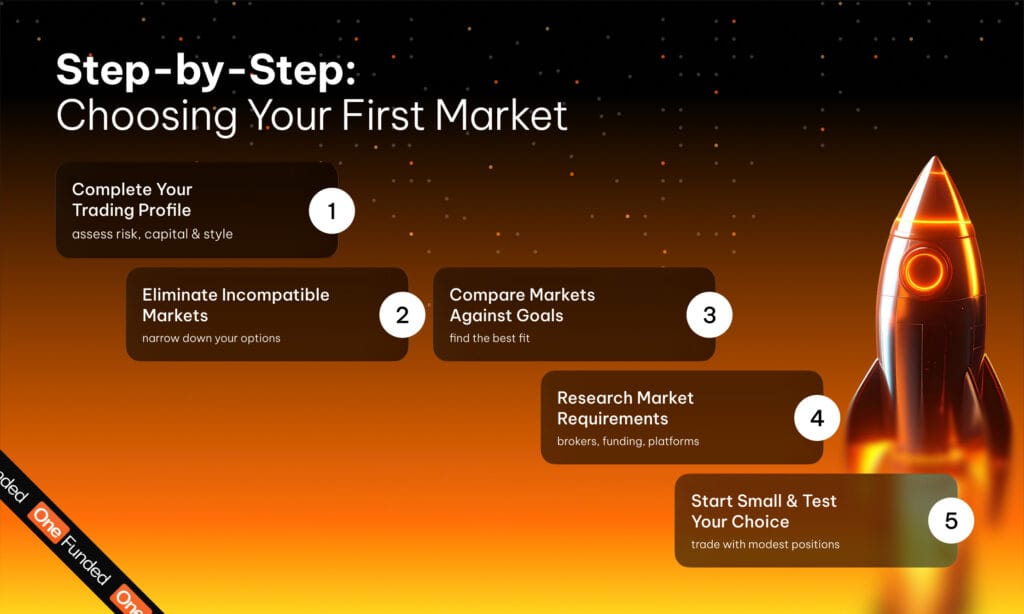
1: Complete Your Trading Profile Assessment
First, traders should complete their trading profile, as discussed above. This assessment is essential to understand factors like your risk tolerance, capital availability, and the time commitment that you can feasibly make. In particular, traders should spend time reflecting on which asset classes they feel a natural affinity for, which can often be a deciding factor.
2: Eliminate Incompatible Markets
Next, traders should eliminate incompatible markets. For example, the stock market is rarely a good option for traders unable to trade during the business day. Similarly, crypto may be off-limits for traders cautious of high volatility. Traders pursuing prop trading might also eliminate markets that are not offered by competitive prop firms.
3: Compare Remaining Markets Against Your Goals
Having eliminated incompatible markets, traders should next consider how various markets align with their goals. Suppose that a trader is choosing between forex and futures, for instance, seeking to implement a swing trading strategy focused on weeks-long patterns. The fact that futures markets come with ongoing contract expirations and day-to-day margin variation might make it unsuitable for that trader’s specific strategy goals.
4: Research Market-Specific Requirements
Having identified a specific market (like forex), the next step is to research the specific requirements involved to get started in that market. For example, traders might identify brokers and platforms that are suited to their goals, along with any minimum funding requirements and potential target assets. For prop traders, this stage also offers the opportunity to look more specifically at which prop firm might be the most competitive choice.
5: Start Small and Test Your Choice
Having selected a market, a platform, and target assets, traders can begin putting their strategy into action. At this stage, the key is to recognize that no choice is permanent – traders can always adjust their strategy, platform, or market as needed. Therefore, the best approach is to start small while testing your choice, being prepared to change gears as the situation demands it.
Conclusion: Your Trading Journey Begins Here
No matter what a trader’s aims are – big gains, strong risk management, steady growth – there’s likely a market suited to them. However, identifying that market requires a deliberate process of self-reflection and careful analysis. By implementing the guidance offered in this article, new traders can begin the process to identify where to start their trading journey in 2026.
For traders looking to make prop trading a part of their journey, consider launching your OneFunded trading challenge today. OneFunded offers the chance to magnify your profit potential, featuring refundable challenge fees and a competitive profit split of up to 90%. What’s more, traders can work across markets like forex, crypto, and commodities, giving you the flexibility to trade where your edge is strongest.