



For aspiring traders, the prop trading industry has effectively split into two distinct ecosystems. On one side are the specialized futures firms, offering direct access to exchange data and structured career ladders. On the other side are the modern multi-asset firms, prioritizing flexibility, diverse instruments, and lower barriers to entry.
This divide is perfectly illustrated by Earn2Trade and OneFunded. Earn2Trade is a veteran in the futures space, widely respected for its educational roots and its Trader Career Path scaling program. In contrast, OneFunded represents the new wave of firms with a focus on platform accessibility and maximum profit potential.
In this comprehensive guide, we’ll break down the pros, cons, costs, and rules of both firms to help you decide which path is right for your trading journey. While both firms offer a legitimate path to a funded account, they cater to fundamentally different types of traders. Making the right choice at the start of your journey is essential to developing long-term success.
Key Points:
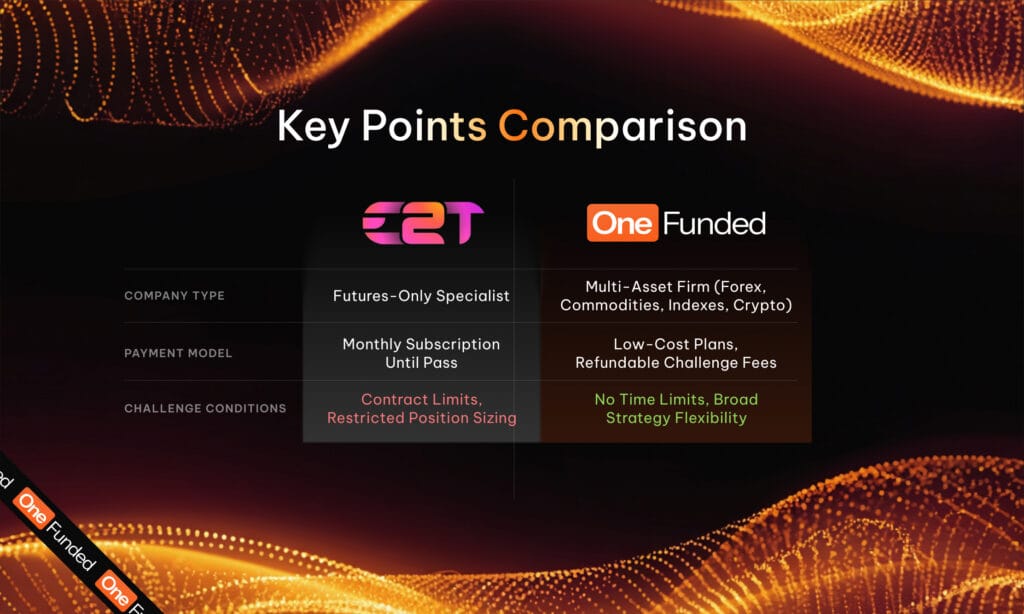
- Earn2Trade is a specialist firm focused exclusively on futures trading. OneFunded is a multi-asset firm that offers access to a diverse range of asset classes, including forex, commodities, indexes, and crypto.
- For traders seeking an accessible entry point to prop trading, OneFunded features low-cost plans and fully refundable challenge fees on eligible plans. In contrast, Earn2Trade operates on a monthly subscription model, requiring recurring payments until a trader passes their evaluation.
- OneFunded has no time limits on passing trading challenges and allows traders broad strategy flexibility within risk parameters. Earn2Trade’s contract limits can limit position sizing as traders progress through the firm’s scaling program.
- Both Earn2Trade and OneFunded are competitive prop funding platforms. However, OneFunded wins out for most traders in terms of asset class availability, evaluation accessibility, and long-term earnings potential.
Comparison at a Glance: The Tale of the Tape
Both Earn2Trade and OneFunded offer competitive options for prop traders. However, OneFunded wins out in terms of flexibility, profit split, and fee structure.
| Earn2Trade | OneFunded | |
| Primary Assets | Futures | Forex, Crypto, Indexes, Commodities |
| Cost Model | Monthly Subscriptions | One-Time Fees |
| Refundable Fee? | No (Sunk cost) | Yes (On Core & Flash plans) |
| Time Limit | Unlimited (with monthly subscription) | Unlimited |
| Profit Split | 80% | 80% (Up to 90%) |
| Lowest Entry | ~$150/month | $16 (One-time fee) |
| Platforms | NinjaTrader, Finamark, R | Trader Pro | cTrader, TradeLocker, MetaTrader 5 (Coming soon) |
| Largest Account Size | $400,000 | $200,000 |
| Funding Provider | Third-party partners | OneFunded (Direct funding) |
Earn2Trade: The Futures Specialist
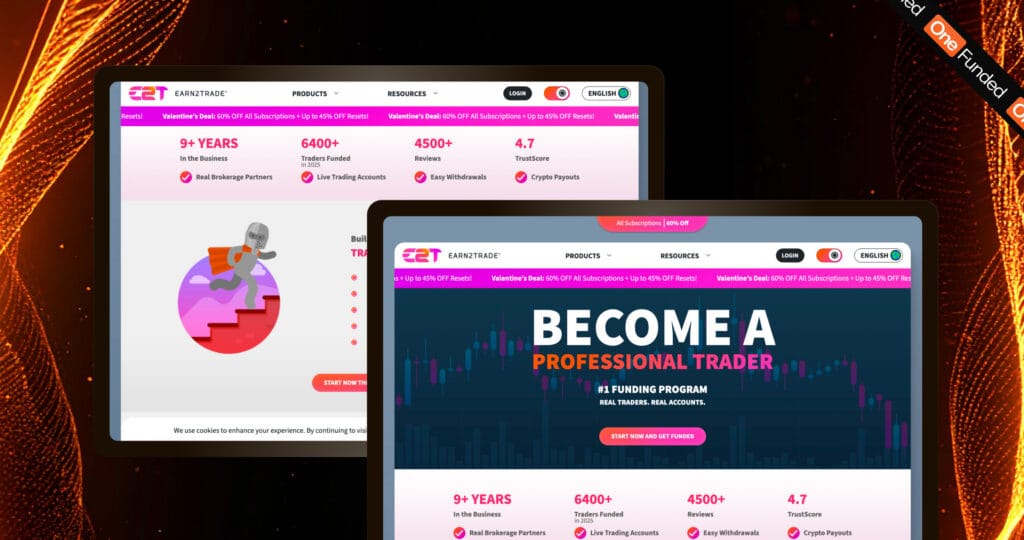
Founded in 2016, Earn2Trade (E2T) is a futures-focused prop trading firm with a heavy emphasis on education and trader progression. Based in the United States, they are known for their professional approach and strict adherence to challenge rules. E2T also stands out for the firm’s subscription-based fee model, which is unusual among competitors.
The firm further stands out for their indirect funding model. Traders who successfully pass Earn2Trade’s evaluations will be referred to the firm’s third-party funding partners to unlock their accounts. Again, this deviates from the traditional prop model, where the firm that offers the evaluation also provides the funding.
Earn2Trade was originally founded by a small group of traders and advisors, including Ryan Masten. Masten has navigated legal issues, including accusations of registration violations from the Commodity Futures Trading Commission. While reports indicate that Masten is no longer associated with Earn2Trade, this information may be important to review for individuals considering working with the firm.
Earn2Trade’s Subscription Model: Renting Your Challenge
Most modern prop firms charge a one-time fee to access trading challenges. In contrast, Earn2Trade operates on a subscription model. Traders pay a recurring monthly fee (typically ranging from $150 to $550, depending on account size) every 30 days until they pass the evaluation.
While this grants you as much time as you need to pass Earn2Trade’s challenge, traders pay for that unlimited shot clock. If it takes you four months to pass a $150/month evaluation, your total cost of entry becomes $600 – none of which is refundable. As a result, Earn2Trade’s costs can’t be directly compared to those of firms with a one-and-done evaluation fee.
To better understand Earn2Trade’s challenge structure, let’s look at their two distinct models: the Trader Career Path and the Mini Gauntlet. In both of these models, traders are entitled to a fixed 80% profit split, with no possibility for increase. Payouts are processed each Wednesday from prop firm partners, but traders need to manually submit a withdrawal request by e-mail on the Friday of the week before.
The Trader Career Path (TCP)
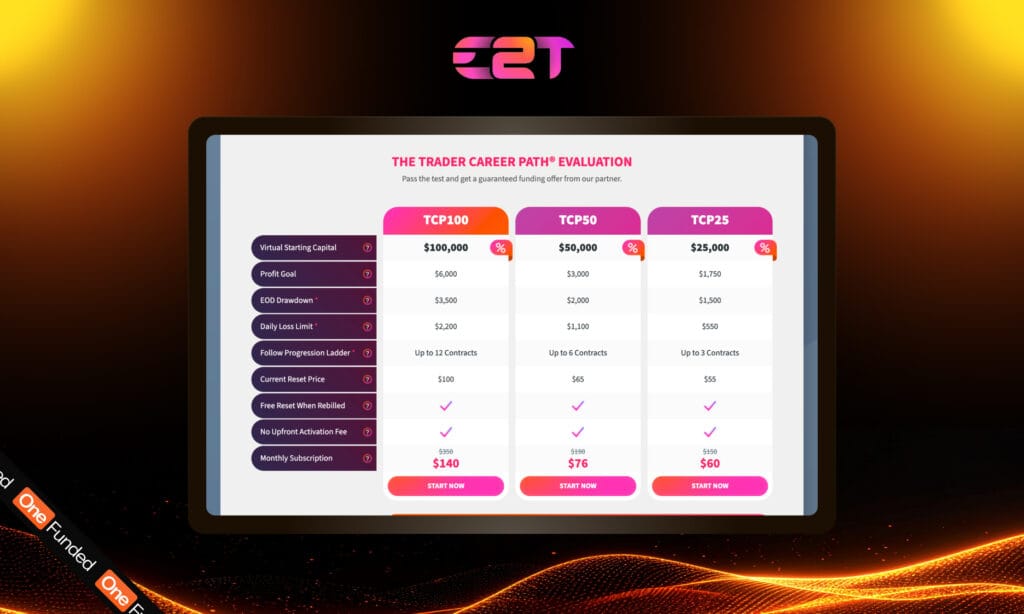
Earn2Trade’s flagship product is the Trader Career Path. This scaling program allows traders to start with a smaller account (e.g., $25,000) and build up to a $200,000 or $400,000 account by consistently generating and withdrawing profits. Initial account sizes range from $25,000 to $100,000, with increasing fee sizes. Notably, Earn2Trade charges an additional activation fee out of a trader’s first withdrawal.
While most prop firm challenges express risk limits and profit targets in terms of percentage changes, TCP uses dollar figures. Moreover, the firm has outstanding contract limits, preventing traders from holding too many open positions. A summary of the TCP challenge rules (and associated fees) is broken down in the table below.
TCP Rules Breakdown – By Account Size
| Initial Account Size | $25,000 | $50,000 | $100,000 |
| Profit Goal | $1,750 | $3,000 | $6,000 |
| Total Max. Loss (EOD) | $1,500 | $2,000 | $3,500 |
| Daily Max. Loss | $550 | $1,100 | $2,200 |
| Max. Open Positions | 3 Contracts | 6 Contracts | 12 Contracts |
| Monthly Subscription | $150 | $190 | $350 |
| Activation Fee | $139 | $139 | $139 |
| Min. Trading Days | 10 Days | 10 Days | 10 Days |
| Consistency Rule | 30% | 30% | 30% |
Once traders achieve and withdraw the profit target for one account, they are automatically upgraded to a larger account size. The TCP consistency rule means that a single trade cannot make up for more than 30% of a trader’s total profit at a particular account size. Finally, E2T’s focus on providing a professional experience means that traders may be subject to additional data or exchange fees compared to other firms.
The Gauntlet Mini
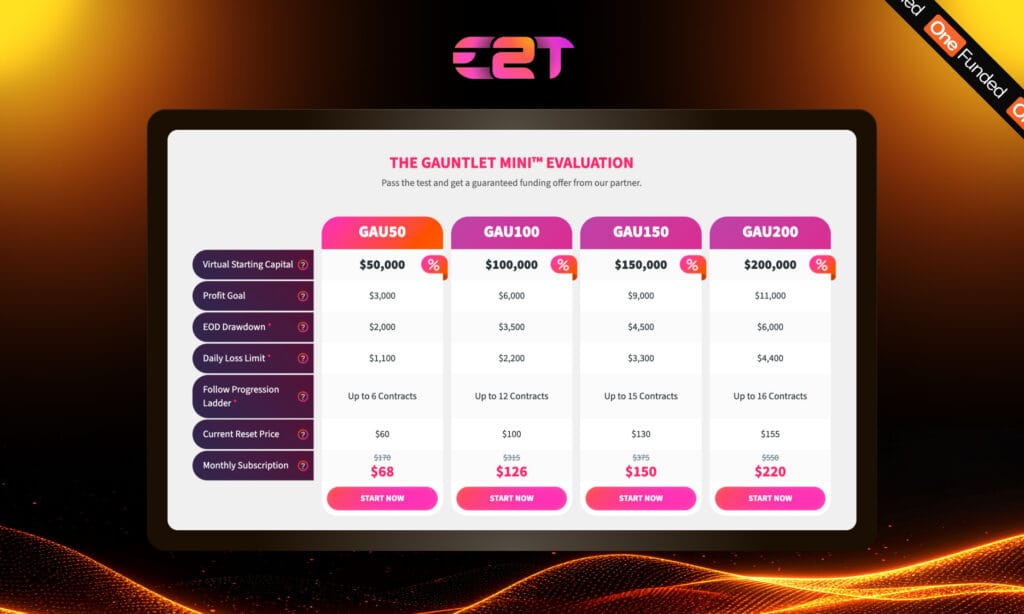
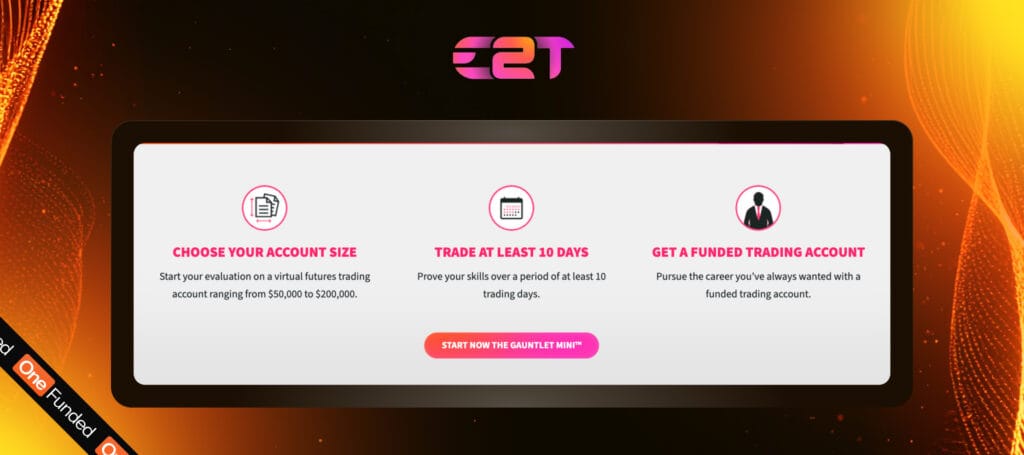
While the Trader Career Path is designed for scaling, the Gauntlet Mini is Earn2Trade’s standard “one-and-done” evaluation. This challenge is built for traders who want immediate access to larger capital without navigating a multi-step ladder. In this model, you simply choose your desired account size – ranging from $50,000 to $200,000 – and pay a monthly subscription until you pass.
Once you meet the profit target (and abide by E2T’s strict risk limits), you receive a guaranteed funding offer for that specific account size. Unlike the Career Path, the Gauntlet Mini does not include a built-in scaling plan to upgrade your account size later. Instead, it is a direct route to a specific capital level.
Gauntlet Mini Rules Breakdown – By Account Size
| Initial Account Size | $50,000 | $100,000 | $150,000 | $200,000 |
| Profit Goal | $3,000 | $6,000 | $9,000 | $11,000 |
| Total Max. Loss (EOD) | $2,000 | $3,500 | $4,500 | $6,000 |
| Daily Max. Loss | $1,100 | $2,200 | $3,300 | $4,400 |
| Max. Open Positions | 6 Contracts | 12 Contracts | 15 Contracts | 16 Contracts |
| Monthly Subscription | $170 | $315 | $375 | $550 |
| Activation Fee | $139 | $139 | $139 | $139 |
| Min. Trading Days | 10 Days | 10 Days | 10 Days | 10 Days |
| Consistency Rule | 30% | 30% | 30% | 30% |
Mini Gauntlet vs. Trader Career Path: Key Differences
The Mini Gauntlet is largely suited to traders with a proven market approach who know the level of capital they want and do not expect to need a reset. In contrast, the Trader Career Path might be a better fit for traders looking to grow, learn, and expand over time – potentially with some resets along the way. Ultimately, the right choice depends on a trader’s goals and mindset:
- Account sizes depend on goals: The TCP has larger total account sizes, with the possibility of unlocking up to $400,000 in total funding. However, the Mini Gauntlet has larger initial account sizes, with traders able to purchase a challenge to unlock $200,000 in funding immediately.
- The Mini Gauntlet has no free resets: Unlike the Career Path, the Gauntlet Mini does not include a free reset upon monthly renewal. If you violate a rule, you must pay a separate reset fee to continue, regardless of your subscription status.
- The Gauntlet Mini has no scaling: The Gauntlet Mini could be a good fit for traders seeking to deploy a specific volume of capital as part of their market approach. In contrast, the Trader Career Path is designed for traders looking to expand their capital base over time with steady performance.
- The Trader Career Path has withdrawal requirements: Under the TCP, traders must withdraw their profits in order to unlock the next account size. In contrast, the Gauntlet Mini allows traders to keep their profits invested and compound them toward greater growth.
Beginner Crash Course
While most prop firms focus exclusively on evaluation, Earn2Trade stays true to its roots as an educational company with its Beginner Crash Course. This is a standalone syllabus designed for traders who are ultra-new to the markets – those who need to learn the basics before they even consider taking a funding challenge.
The course consists of 60 short videos (6–10 minutes each) covering essential topics such as market mechanics, risk management, technical analysis, and identifying chart formations. Unlike disjointed YouTube tutorials, this is a structured curriculum with quizzes to ensure retention. While it’s not a proper funding evaluation, this product could be worth the price for newer traders, with Earn2Trade currently charging $99.60 for standalone access to the crash course.
Stop Renting Your Challenge. With OneFunded’s OF Core Plan, your fee is a one-time deposit that’s 100% refundable upon your first payout. Let your success cover the cost of entry.
Get Started with OneFunded Today
Asset Classes
Unlike multi-asset firms that feature trading on everything from crypto to individual stocks, Earn2Trade is a specialist. The firm focuses exclusively on futures contracts traded on the CME Group exchanges. While the futures market offers access to a diverse range of instruments, it’s not always the best place to start your trading journey, as futures come with unique market-specific mechanics.
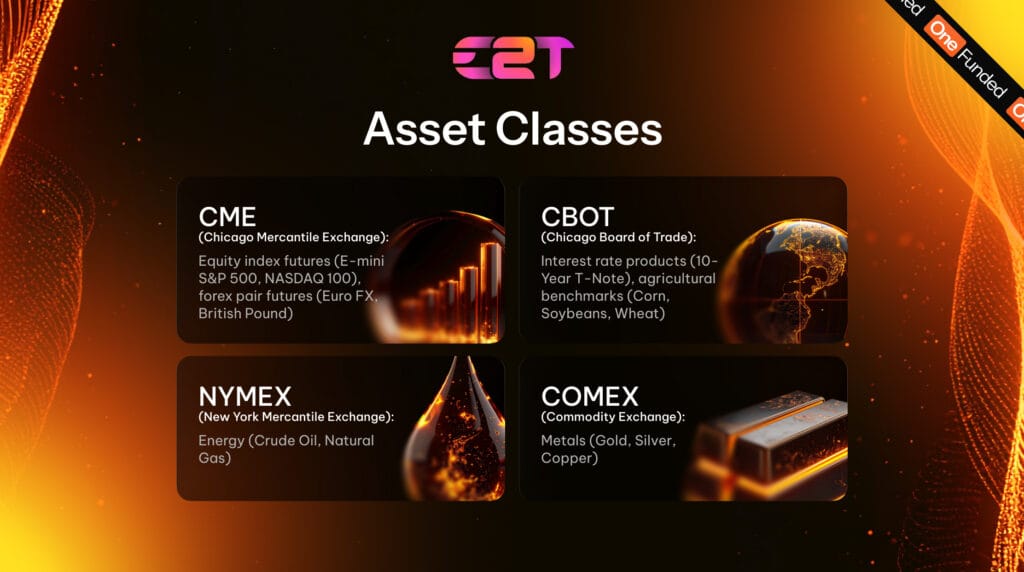
Nonetheless, futures contracts do have the advantage of trading on regulated, centralized exchanges. Specifically, Earn2Trade offers traders access to four primary exchanges:
- CME (Chicago Mercantile Exchange): Home to the most popular equity index futures like the E-mini S&P 500 (ES) and NASDAQ 100 (NQ), as well as forex pair futures (e.g., Euro FX, British Pound).
- CBOT (Chicago Board of Trade): Offers access to key interest rate products (like the 10-Year T-Note) and the world’s agricultural benchmarks (Corn, Soybeans, Wheat).
- NYMEX (New York Mercantile Exchange): Typically the go-to market for energy traders, featuring Crude Oil (CL) and Natural Gas (NG).
- COMEX (Commodity Exchange): Specializes in metals, including Gold (GC), Silver (SI), and Copper (HG).
Importantly, this means that you cannot trade spot forex, individual stocks (like Apple or Tesla), or spot crypto on Earn2Trade. While crypto futures do exist, Earn2Trade currently restricts trading them on live accounts due to the elevated volatility levels associated with these markets.
Trade Everything, All in One Place. With OneFunded, you can pivot from forex to crypto to global indexes on a single dashboard. Access over 135+ instruments and trade what the market is actually moving on.
Explore OneFunded’s Multi-Asset Challenges
Trading Platforms
Earn2Trade provides a professional environment by supporting industry-standard platforms. The firm’s primary platform is NinjaTrader, which is widely considered the gold standard for retail futures trading due to its advanced charting, order flow analysis tools, and automated strategy capabilities. However, not all traders appreciate the reliance on desktop platforms, which can be slower to get started with than web applications.
During a trader’s evaluation period, Earn2Trade provides a free license for NinjaTrader, saving you the typical subscription cost. In addition to NinjaTrader, Earn2Trade supports a wide ecosystem of other platforms, including:
- Finamark: A newer, cloud-based platform that is free during the evaluation. Earn2Trade offers a 90-day live license.
- R | Trader Pro: Often praised for its backend performance and customized order structuring. Free for traders.
- Sierra Chart, Quantower, and Motive Wave: Supported for traders who already own their own licenses and prefer specialized order-flow interfaces.
This “Bring Your Own Platform” flexibility is a major plus for experienced traders who have already built their workflow around specific software. But newer traders may find the setup process for these desktop platforms more complex than web-based tools. As such, Earn2Trade’s platform ecosystem can be seen as trading ease-of-use for professional sophistication.
Community and Education
Because Earn2Trade initially started as a company focused on trading education, its resources for trader development are significantly more robust than the average prop firm. These resources include:
- Beginner Crash Course: A comprehensive video course covering the basics of futures, technical analysis, and market mechanics. This is available for standalone purchase but is often included in a trader’s evaluation subscription fee.
- Webinars and Mentorship: The firm regularly hosts webinars with professional traders to discuss market conditions and strategies.
- Blog & Guides: Earn2Trade’s library of written content is extensive, covering both foundational and advanced topics.
While Earn2Trade does not have a massive, gamified community like some modern firms, their focus is on structured education. In line with the firm’s origins, E2T aims to help develop competent trading over time. This type of support could be particularly valuable for burgeoning traders focused on a robust futures education.
Final Verdict: Who Is Earn2Trade Right For?
Earn2Trade could be the right choice for a specific breed of trader: the dedicated futures specialist. If your strategy relies on the depth and liquidity of the CME and you value structured progression over asset diversity, Earn2Trade’s platform may offer a competitive foundation. With that being said, the firm’s subscription model creates a specific financial dynamic.
Earn2Trade is best suited for traders who are confident that they can pass evaluations efficiently, minimizing the sunk costs of recurring monthly fees. Additionally, prospective traders must be comfortable with the uncertainty of indirect funding – successful candidates are placed with third-party partners rather than being funded directly by the platform itself. Ultimately, for disciplined futures traders who prioritize education and a clear scaling roadmap, Earn2Trade can offer a professional (albeit rigid) environment for long-term growth.
OneFunded: The Modern Multi-Asset Prop Firm
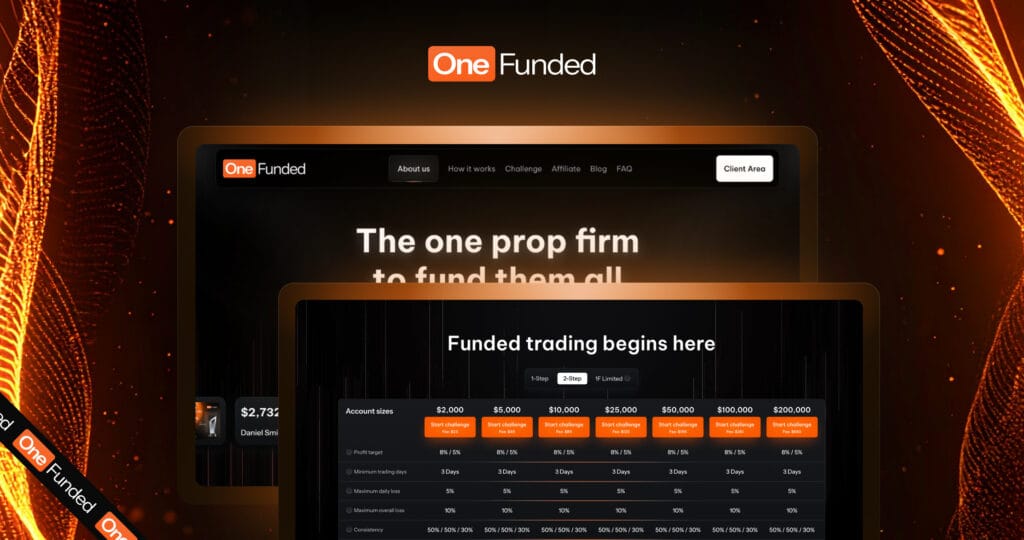
Based in the United Kingdom, OneFunded is a member of the new wave of trader-first prop firms focused on accessibility and flexibility. Launched in 2024 following the acquisition and rebranding of Prop365, the firm distinguishes itself by removing many of the friction points associated with traditional prop trading. Unlike firms that restrict traders to specific assets or enforce strict time limits, OneFunded offers a broad, multi-asset environment.
OneFunded also stands out for its straightforward funding model. Successful traders are funded directly by the firm, paid out from the firm’s own revenues based on their performance. Moreover, OneFunded offers evaluations with fully refundable fees upon successful completion.
The firm is led by CEO Anastasiia Kaplunenko, who brings a background in fintech and a philosophy centered on transparency. By offering clear rules and the promise of no hidden fees, OneFunded aims to provide an accessible prop trading environment for both new and experienced traders alike.
OneFunded’s Fee Model: The Refundable Advantage
While Earn2Trade relies on recurring subscriptions, OneFunded’s fee structure operates closer to a deposit-based model. Traders pay a one-time fee to access OneFunded challenges. Crucially, on the firm’s primary plans ( Core and Flash), this fee is 100% refundable once a trader successfully passes the evaluation and receives their first payout.
This fundamentally changes the risk profile for skilled traders. At subscription-based firms, fees are sunk costs. At OneFunded, successfully completing certain challenge types effectively costs $0. With that being said, it’s important to understand that failed challenges are not entitled to a fee refund.
To offer greater flexibility, OneFunded also offers challenges with non-refundable fees, which are priced even more competitively. The firm’s Value plan can be accessed for as little as $16. Finally, OneFunded also features the Flex plan, which has unique risk limits and offers the potential to unlock an additional challenge account for free.
To better understand OneFunded’s ecosystem, we’ll look at OneFunded’s four distinct challenge models below. In all models, traders can scale their profit split up to 90%, and payouts can be processed weekly with optional add-ons.
Core (2 Step)
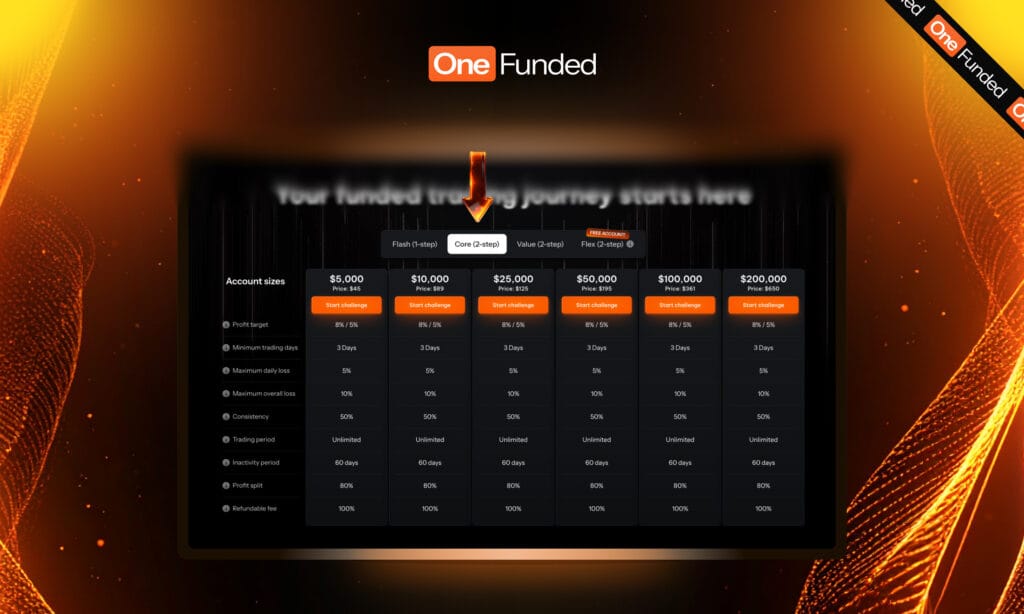
OneFunded’s flagship product is the Core challenge. Representing the classic prop firm evaluation, this 2-step challenge offers the widest range of account sizes and balanced risk rules. It is designed to be a standard choice for most traders, featuring attainable profit targets with balanced drawdown limits.
Core stands out for its 100% refundable fee, making it a low-risk option for traders confident in their abilities. The challenge’s two-step structure also allows traders to prove the sustainability of their trading skills. A summary of the Core rules is broken down below.
Core Rules Breakdown
| Profit Goal | 8% / 5% |
| Total Max. Loss | 10% |
| Daily Max. Loss | 5% |
| Trading Period | Unlimited |
| Refundable Fee? | Yes |
| Min. Trading Days | 3 Days |
| Consistency Rule | 50% |
Core also offers a wide range of account sizes, ensuring that traders can access the level of capital that they need. Each account size comes with a different challenge fee, as seen in the table below.
| Initial Account Size | $5,000 | $10,000 | $25,000 | $50,000 | $100,000 | $200,000 |
| Challenge Fee | $45 | $89 | $125 | $195 | $361 | $650 |
Once traders pass both phases, they move to a funded status where the consistency rule remains at 50% (meaning no single day can account for more than half of total profits). With no time limits on the evaluation, Core allows traders to progress at their own pace without the pressure of a ticking clock. And unlike Earn2Trade’s subscription-based model, OneFunded traders aren’t charged more just because they take more time to complete a challenge.
Flash (1-step)
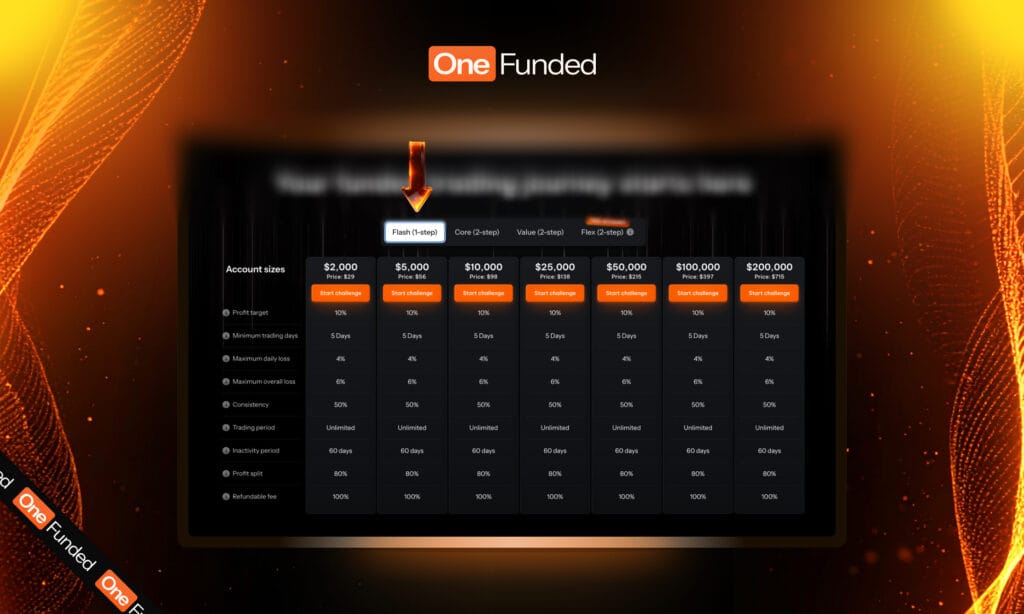
While Core is designed for balance, Flash is designed for speed. This is a 1-step evaluation model built for confident traders who want to bypass the lengthy 2-step process. Traders only need to hit one profit target to unlock their funded account.
To compensate for the faster funding speed, Flash comes with tighter risk parameters (a 6% overall loss limit compared to Core’s 10%). However, like the Core plan, the challenge fee is fully refundable upon success. Flash will likely be the right choice for traders who value fast funding and don’t mind stricter risk limits.
Flash Rules Breakdown
| Profit Goal | 10% |
| Total Max. Loss | 6% |
| Daily Max. Loss | 4% |
| Trading Period | Unlimited |
| Refundable Fee? | Yes |
| Min. Trading Days | 5 Days |
| Consistency Rule | 35% |
Notably, Flash offers the widest range of account sizes of any of OneFunded’s challenges. The refundable fee associated with each size is listed below.
| Initial Account Size | $2,000 | $5,000 | $10,000 | $25,000 | $50,000 | $100,000 | $200,000 |
| Challenge Fee | $29 | $56 | $98 | $138 | $215 | $397 | $715 |
Value (2-Step)
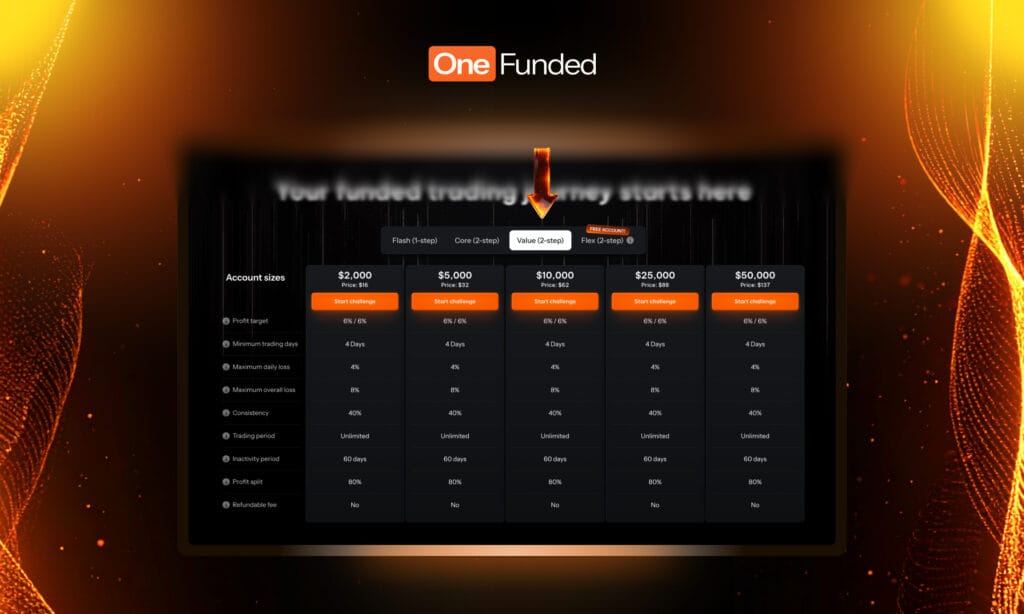
The Value plan is OneFunded’s most accessible entry point, designed specifically for traders who want to prove their skills without risking significant capital. With fees starting as low as $16 for a $2,000 account, Value ensures that prop trading isn’t limited only to those traders who have already accrued significant profits.
This plan follows a strict 2-step evaluation model similar to Core but with tighter risk limits. The biggest trade-off, however, is that Value’s fee is not refundable. The plan’s full details are listed below.
Value Rules Breakdown
| Profit Goal | 6% / 6% |
| Total Max. Loss | 8% |
| Daily Max. Loss | 4% |
| Trading Period | Unlimited |
| Refundable Fee? | No |
| Min. Trading Days | 4 Days |
| Consistency Rule | 35% |
Although Value’s fees are lower, the fact that they are not refundable may shift the calculation for some traders. Whether or not this model makes sense depends on a trader’s current capital levels and their confidence in passing an evaluation. Nonetheless, Value could serve as an ideal training ground for disciplined traders to build their track record at a minimal cost.
Value’s account sizes and fee structure are broken down below. This model caps out at an account value of $50,000, meaning that it may not be the best choice for traders seeking maximum funding power.
| Initial Account Size | $2,000 | $5,000 | $10,000 | $25,000 | $50,000 |
| Challenge Fee | $16 | $32 | $62 | $88 | $137 |
Your Path to Funding. Think prop trading requires hundreds of dollars in upfront capital? Think again. With the OF Value plan, you can begin your professional journey for as little as $16.
Claim Your $16 OneFunded Account Now
Flex (2-step)
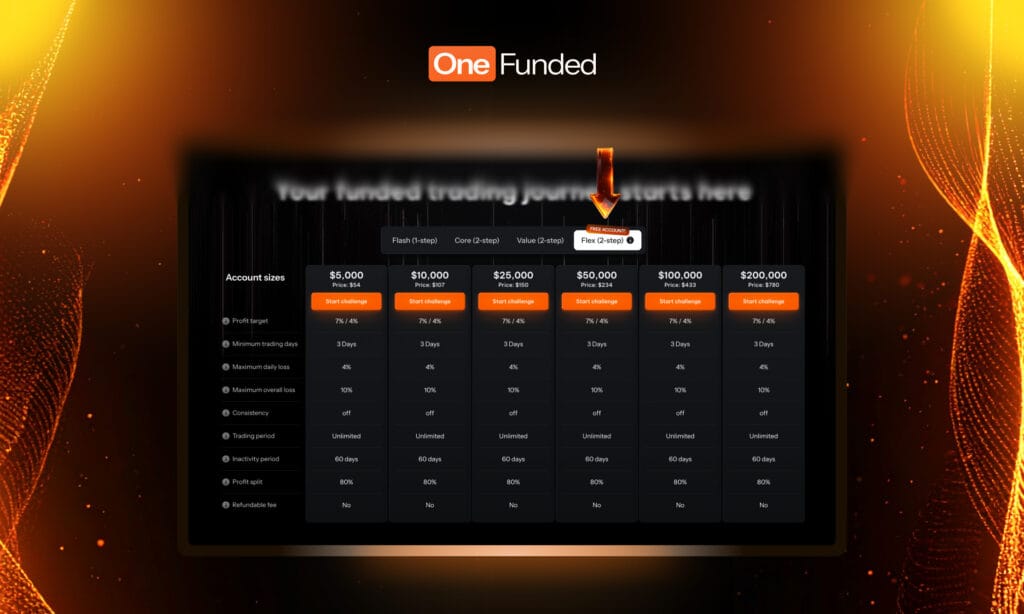
While Value prioritizes discipline, Flex prioritizes flexibility. This model is a premium offering designed for maximum freedom. Flex features a 2-step challenge that removes the consistency rule entirely, making it a strong choice for swing traders or those with high-variance strategies who might have one or two big winning days.
Instead of a cash refund, successful Flex traders are rewarded with a free challenge account upon completion. This unique incentive structure encourages traders to scale their operations immediately rather than just recouping their initial fee. The full details of Flex are broken down below.
Flex Rules Breakdown
| Profit Goal | 7% / 4% |
| Total Max. Loss | 10% |
| Daily Max. Loss | 4% |
| Trading Period | Unlimited |
| Refundable Fee? | No |
| Min. Trading Days | 3 Days |
| Consistency Rule | None |
Reflecting Flex’s premium positioning, this challenge comes with slightly higher fees. However, the possibility of unlocking a free challenge account can also boost a trader’s long-term profit potential.
| Initial Account Size | $10,000 | $25,000 | $50,000 | $100,000 | $200,000 |
| Challenge Fee | $107 | $150 | $234 | $433 | $780 |
OneFunded Rewards Center
Just as some firms offer educational courses, OneFunded incentivizes trader development through its Rewards Center offering. This is a loyalty program designed to enhance a trader’s long-term journey with OneFunded, giving users tangible value for their engagement on the platform.
By completing simple tasks – such as passing a challenge, verifying an identity, or reaching a payout – traders earn Reward Points. These points can be redeemed for significant benefits, including 15-50% discounts on new evaluations or even a completely free $5,000 challenge account. This feature reduces the long-term costs of trading and rewards consistent performance.
Asset Classes

OneFunded acts as a multi-asset generalist, a sharp contrast to firms that specialize in a single market. The platform allows for trading on over 135 total instruments. This provides traders with the ability to diversify their strategies across different sectors and asset classes within a single account.
OneFunded offers access to several primary asset classes:
- Forex: Over 58 pairs, including majors, minors, and exotics.
- Cryptocurrencies: 24/7 trading on major tokens like Bitcoin and Ethereum, as well as select altcoins.
- Indexes: Major global equity indexes, including the S&P 500, the Nasdaq, and the DAX.
- Commodities: Hard and soft commodities, including Gold, Silver, and Oil.
Importantly, this means OneFunded can be a suitable home for a wide variety of traders, including crypto traders and forex scalpers who would be excluded from futures-only firms. The ability to trade crypto on weekends or hold forex positions overnight offers a level of freedom not found in futures-focused models.
Trading Platforms
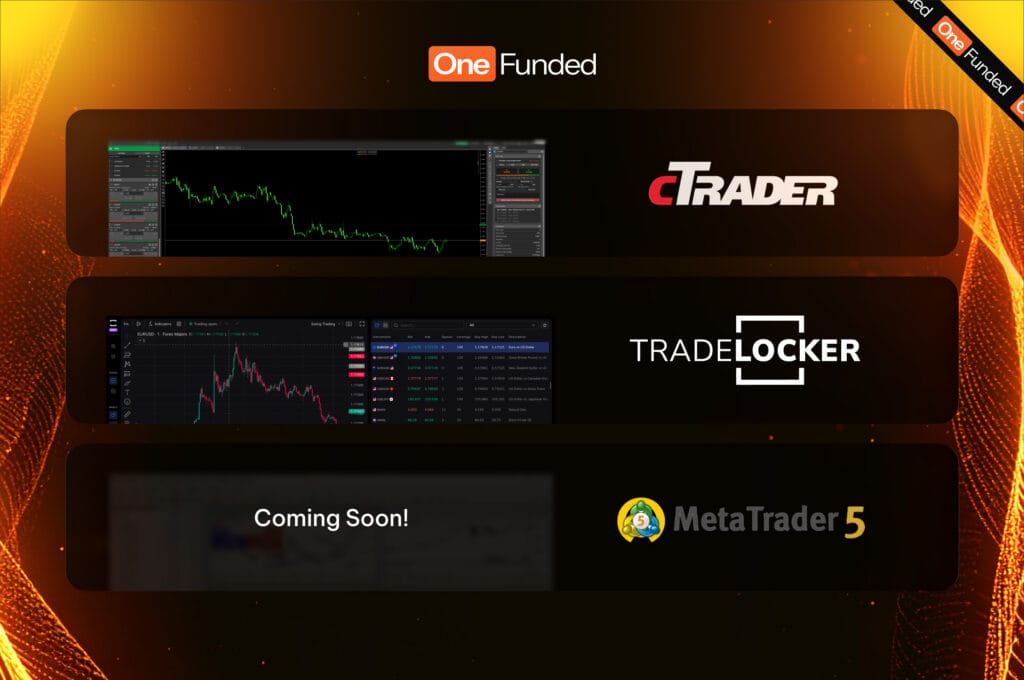
OneFunded prioritizes modern, accessible technology over complex desktop infrastructure. The firm offers two primary platforms: cTrader and TradeLocker.
- cTrader is widely respected among traders for its clean interface, advanced charting capabilities, and fast execution. It is a favorite for traders who need a balance of depth and usability.
- TradeLocker is a newer, next-generation platform built specifically for the modern prop trading landscape. It features TradingView charting integration directly in the interface, making it intuitive for traders already accustomed to web-based analysis.
In addition to these two primary platforms, OneFunded plans to offer access to MetaTrader 5 – another highly popular platform within the trading community – in the near future.
Community and Education
OneFunded creates a collaborative environment through its active digital community. The firm maintains a Discord server with nearly 5,000 members, serving as a hub for peer-to-peer support, strategy discussion, and direct communication with the support team. In terms of formal education, OneFunded provides a growing library of blog content covering essential topics like market liquidity, order flow, and risk management.
Final Verdict: Who Is OneFunded Right For?
OneFunded is the superior choice for the modern, multi-asset retail trader. If you value flexibility – such as the ability to trade Bitcoin on weekends or Forex overnight – and prefer a user-friendly experience without monthly bills, OneFunded offers a compelling proposition.
The firm is especially well-suited for traders who want to minimize their financial risk. The combination of low entry costs (starting at $16) and refundable challenge fees ensures that successful trading pays for itself. Ultimately, for traders who want freedom of choice and a simple, transparent path to funding, OneFunded provides a high-value, low-friction environment.
Earn2Trade vs. OneFunded: Head-to-Head Comparison
We have now explored the distinct models of both Earn2Trade and OneFunded in depth. To help you make the final decision, let’s compare them directly across the critical factors that impact your trading success: Cost, Assets, and Profit Potential.
1. The Cost Equation: Renting vs. Owning
The most significant difference between the two firms is their economic model. Earn2Trade largely operates on a subscription basis, while OneFunded largely operates on a deposit basis. To understand why this distinction matters, consider a scenario where a trader takes 3 months to pass a standard $50,000 challenge:
- Earn2Trade (Gauntlet Mini $50K):
- Monthly Fee: $170
- Total Cost (3 Months): $510
- Result: You pay $510 out of pocket. This money is non-refundable.
- OneFunded (Core $50K):
- One-Time Fee: $195
- Total Cost (3 Months): $195
- Result: Upon your first payout, you receive the $195 back. Net Cost: $0.
The refundable fee structure essentially de-risks the evaluation process for successful traders. In contrast, traders on the Earn2Trade platform have no way to recoup their evaluation fees – and can pay a high price for failing to pass an evaluation as soon as possible.
2. Asset Variety & Trading Style
Just as the two firms have different economic models, they also have different approaches to asset class availability. Earn2Trade focuses specifically on futures, while OneFunded caters to a much wider variety of traders:
- Earn2Trade (The Specialist): If your strategy relies on futures contracts like the S&P 500 E-mini (ES) or Crude Oil (CL), Earn2Trade could be the right choice. The platform’s funding partners provide capital specifically for futures trading. However, traders are strictly limited to CME Group products.
- OneFunded (The Generalist): If you want to trade Gold during the Asian session, Bitcoin on the weekend, and stock indexes during the US open, OneFunded is a more competitive option. The platform offers over 135 instruments across multiple distinct asset classes, providing flexibility that E2T cannot match.
When it comes to asset classes, OneFunded clearly wins out in terms of diversity and choice. However, futures market purists may find Earn2Trade suitable.
3. Profit Splits & Payouts
While both firms offer competitive rewards, OneFunded provides a higher ceiling for successful traders.
- Earn2Trade: Traders receive a fixed 80% profit split across all accounts. There is currently no option to increase this percentage, regardless of performance. Payouts are processed weekly on Wednesdays, but requests must be submitted by the previous Friday.
- OneFunded: The standard profit split also starts at 80%, but traders can scale this up to 90%. Additionally, traders can upgrade to weekly payouts with an optional add-on.
With a higher maximum profit split and flexible payout scheduling, OneFunded offers greater long-term earnings potential for profitable traders.
Final Verdict: OneFunded’s Fee, Asset, and Profit Advantage
While Earn2Trade is a respectable veteran in the futures niche, OneFunded takes the edge for the modern trader. The firm’s combination of refundable fees, diverse assets, and higher profit potential makes it the more compelling all-around choice for 2026.
| Earn2Trade | OneFunded | |
| Cost Model | Monthly subscriptions. | One-time deposits. |
| Asset Variety | Futures only. | Wide range of assets. |
| Profit Potential | Fixed 80% split. | Up to 90% split. |
Conclusion: Choosing Your Path
The choice between Earn2Trade and OneFunded ultimately depends on the path you want to take as a trader. Both firms offer legitimate, competitive pathways to professional capital, but they cater to fundamentally different market philosophies. Earn2Trade focuses on traders who want to develop deep futures specialization and funding growth over time, while OneFunded focuses on traders who want flexible access to distinct asset classes and maximum profit potential.
If you’re a dedicated futures specialist who thrives in a highly structured, institutional-grade environment, E2T could be the right choice. But if you’re like the vast majority of modern retail traders who value flexibility, accessibility, and asset variety, OneFunded wins out. The firm’s low-cost entry points and refundable challenge fees only enhance OneFunded’s value proposition.
Ready to trade without limits? Launch your OneFunded challenge today to access funded accounts up to $200,000, trade the markets you choose, and keep up to 90% of your profits. Prove your edge with the one firm designed to fund them all.