





In theory, there are thousands of potential forex currency pairs to trade, driven by the huge number of global currencies. In practice, however, fewer than 20 pairs account for the vast majority of FX market volume. Still, that leaves traders with plenty of options when deciding which pairs to trade.
Each market, from major options like EUR/USD to exotics like USD/ZAR, comes with its own list of unique factors and considerations. As a result, the best choice for any trader will depend on their individual style, strategy, and risk tolerance. Understanding these distinctions is essential for any trader looking to navigate the forex market successfully.
In this article, we’ll look at the different types of currency pairs and the key elements that characterize each market. We’ll also look at why some pairs are largely driven by monetary policy and economic conditions, while others are more affected by political stability and commodity prices. By the end of this article, traders will have a practical framework to help them decide which pairs to trade and a comprehensive understanding of the overall forex market.
Key Points:
- Unlike stocks or bonds, forex trading always involves two distinct assets, since currency performance can only be measured on a relative basis. Every pair consists of a base currency (which appears first) and a quote currency (which appears second).
- The forex market is dominated by seven major pairs (all of which include USD), complemented by minor pairs (crosses between non-USD majors), and exotics (featuring the currencies of emerging markets and small economies). Each category offers different levels of liquidity, volatility, and trading complexity.
- Sophisticated traders can explore minors like EUR/GBP and GBP/JPY for diversification and regional trend exposure, or venture into exotics like USD/TRY and USD/ZAR for specialized opportunities. While these markets come with unique characteristics and potentially higher rewards, they typically also have wider spreads, lower liquidity, and elevated volatility.
- For traders, selecting the right currency pair depends on five critical factors: trading style, risk tolerance, leverage needs, risk management, and time zone alignment. By weighing all five of these factors carefully, traders can find the currency pair that best suits their needs.
Understanding Currency Pairs: The Foundation
Compared to other asset classes, the foreign exchange market is somewhat unusual. If you’re trading stocks or bonds, it’s possible to trade just a single asset (such as Apple stock, for instance). But when it comes to forex, every trade has to involve at least two distinct assets.
To understand why, imagine that you’re looking to bet on the future strength of the US dollar. A month from now, the dollar may have appreciated significantly when compared to the euro, but remained steady when compared to the yen. Unlike other types of assets, traders can only measure currency performance on a relative basis, not an absolute one.
As a result, the forex market is described in terms of ‘currency pairs.’ Every pair has a ‘base’ currency (the first listed currency) and a ‘quote’ currency (the second). In the EUR/USD pair, for example, EUR is the base and USD is the quote. In fact, EUR/USD is one of the ‘major’ pairs that account for an overwhelming volume of FX trading.
One final note before we dive into key pairs: novice FX traders will likely benefit from familiarizing themselves with standard market quoting conventions. While the USD is typically the base against most currencies, you’ll find it serving as the quote against EUR, GBP, AUD, and NZD. These conventions are the result of historical precedent and common usage, but they’re still important to be aware of.

Types of currency pairs: Majors, minors, and exotics
The FX market is made up of a vast number of different currency pairs. However, not all these pairs are equally popular, and each market comes with its own unique dynamics. Forex pairs can be divided into three key categories:
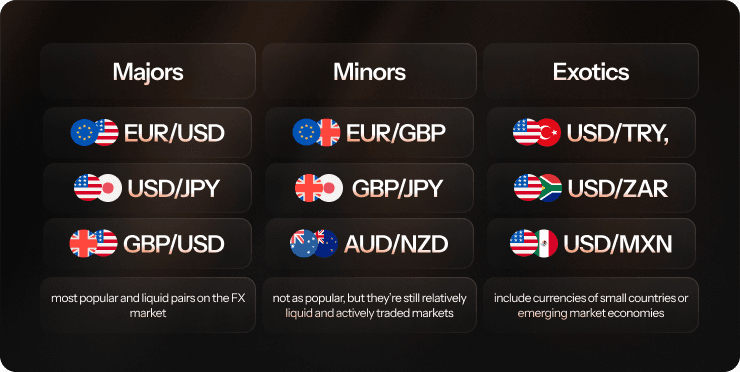
- Major currency pairs are some of the most popular and liquid pairs on the FX market. Classically, there are seven major pairs, each of which includes USD. The counter currencies reflect other influential global economies, including EUR, JPY, GBP, CHF, AUD, CAD, and NZD.
- Minor currency pairs may not be as popular as the majors, but they’re still relatively liquid and actively traded markets. While there’s no formal definition of the minors, this category is generally considered to contain pairs where non-USD majors are crossed. For example, minor pairings include EUR/CHF, AUD/NZD, and GBP/JPY.
- Exotic currency pairs include currencies of small countries or emerging market economies. These pairs almost always include a cross with USD, but sometimes another major currency fills that role. Exotic pairs include USD/MXN (Mexican peso), USD/TRY (Turkish lira), and USD/SGD (Singapore dollar).
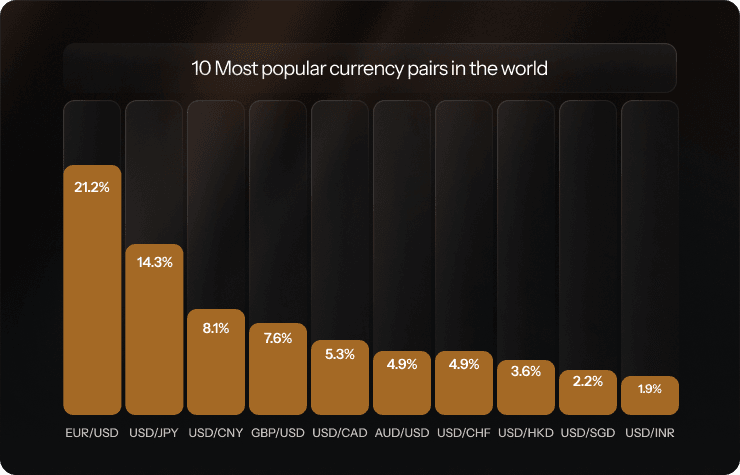
Source: BIS Triennial Central Bank Survey April 2025
As the data indicates, the US dollar is an essential part of the most popular currency pairs. Notably, despite being one of the most high-volume markets, the US dollar-Chinese yuan pair is not normally considered a major. That’s because China does not have an open capital market, meaning that foreign exchange dynamics are considerably different than in most advanced economies.
Shortly, we’ll explore individual major, minor, and exotic pairings in more detail. Generally speaking, trading the minors and exotics takes more experience and can also come with more risk. However, each currency market must be analyzed individually, with several factors creating unique dynamics for each pair.
Key factors that influence currency pairs: Volume, volatility, and sentiment
The performance of any currency pair will be strongly affected by economic conditions impacting both the base and quote currencies. For example, USD/JPY will be affected by the relative level of US and Japanese interest rates, inflation, and growth. Beyond these purely economic factors, however, several other financial elements can affect the behavior of currency pairs:
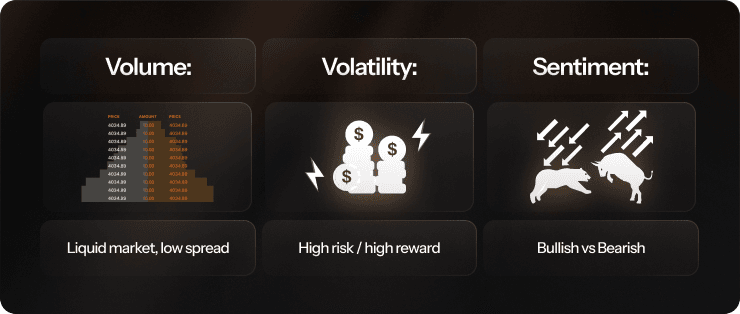
- Trading Volume: Pairs with high trading volume tend to have ample market liquidity and tight bid-ask spreads. Not only does this reduce trading costs, but it also tends to result in lower slippage and price impacts from large trades. Majors tend to have the greatest trading volume – in fact, estimates indicate that the US dollar is one leg of up to 90% of all foreign exchange transactions.
- Market Volatility: Some currency pairs tend to trade within a narrow band, while others experience significant volatility. Although this volatility can often stem from shifting economic fundamentals, political instability is another major source of currency volatility. Exotics tend to have the highest volatility, although some major and minor pairs can exhibit notable fluctuations as well. Volatility can increase risk, but may also present more dynamic entry and exit opportunities.
- Investor Sentiment: Like any financial market, forex is impacted by sentiment. Whether traders and investors are feeling bullish or bearish can have a profound impact on prices, even if fundamentals haven’t shifted. Some pairs are considered ‘risk-on,’ and tend to climb during optimistic periods. In contrast, others are considered ‘risk-off’ or safe haven currencies (notably including the Swiss franc).
For traders deciding which pair to trade, it’s key to understand not only underlying economic drivers, but also how these market-based elements can impact performance. Below, we study some of the most significant currency pairs in greater detail.
Major Currency Pairs: Detailed Analysis and Comparison
The seven major currency pairs are the first markets an FX trader should consider. Because these markets are so popular and liquid, they present opportunities for both experienced and novice traders alike. While the US dollar is a common element among all these majors, different corresponding currencies create unique factors in each market.
EUR/USD (Euro/US Dollar) – The Fiber

EUR/USD is the single most popular currency pair in the world. That should be no surprise – together, the US and the euro area make up about 40% of the global economy. This pair tends to come with tight spreads and ample liquidity, especially during the overlap between New York and London business hours.
This currency pair is sometimes known as the ‘fiber,’ with different traders offering different explanations why. Some claim that the historical and cultural ties between the US and Europe create a common ‘fiber,’ while others argue that the name references the fiber optic internet cables that run underneath the Atlantic.
Fiber tends to be strongly influenced by the relative level of interest rates set by the Fed and the ECB. Economic data releases from countries like the US, France, and Germany all play a role, too. Because this pair is so liquid, with narrow bid-ask spreads and low trading costs, it’s a popular choice for scalpers looking to earn a few pips in profit from each trade.
USD/JPY (US Dollar/Japanese Yen) – The Gopher

The USD/JPY relationship has evolved dramatically in recent years. Historically, it has been incredibly cheap to borrow Japanese yen, driven by the Bank of Japan’s ultra-low interest rates. As a result, USD/JPY has been strongly influenced by ‘Carry trade’ dynamics, wherein traders borrow in JPY, exchange into USD, and lend those dollars at a higher interest rate.
While the Carry trade continues, rising Japanese yields have made traditional economic factors like relative growth and inflation rates more important. Nonetheless, USD/JPY continues to be strongly impacted by evolving guidance and policy decisions from the Bank of Japan. Due to the pair’s often sharp, choppy movements, USD/JPY has earned the nickname the ‘gopher.’
GBP/USD (British Pound/US Dollar) – The Cable

Among the majors, GBP/USD – known as ‘cable’ after the transatlantic telegraph cable installed between the US and Britain in the 19th century – is known as one of the most volatile pairs. That’s in part due to the UK’s small economy compared to the US, which means that even minor adjustments to capital flows can have a significant impact. Moreover, the UK has experienced a number of political shocks in recent years, including Brexit, snap elections, and fiscal crises.
Due to cable’s volatility, this pair could be suitable for traders looking to take advantage of short-term technical opportunities. Notably, GBP/USD has exhibited strong correlation to EUR/USD, something that traders should be aware of when it comes to risk management.
USD/CHF (US Dollar/Swiss Franc) – The Swissie

The USD/CHF pair, known as the ‘Swissie,’ exhibits relatively unique behavior compared to other majors. The Swiss franc is known as one of the world’s leading safe-haven currencies, with investors often purchasing CHF during times of volatility or uncertainty. As a result, USD/CHF tends to fall during risk-off periods, such as a global equity market sell-off.
However, Swissie traders need to be mindful of actions undertaken by the Swiss National Bank to manage inflation or exchange rates. The SNB is known as one of the most interventionist central banks in the world, and its currency policy can dramatically influence USD/CHF. As a result, while the Swissie can be suitable for longer-term trading strategies, traders should still actively monitor their USD/CHF positions.
AUD/USD, USD/CAD, NZD/USD – The Commodity Currencies
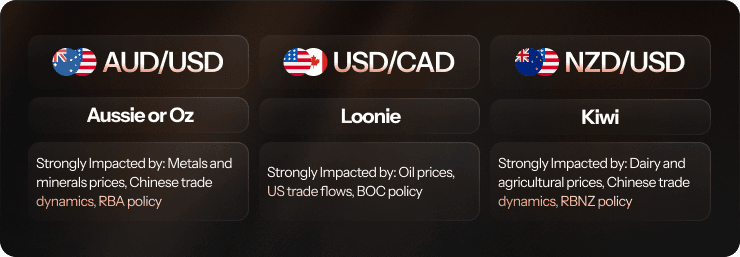
The last three majors – the ‘Aussie,’ the ‘Loonie,’ and the ‘Kiwi,’ respectively – are sometimes known as the commodity currencies. These pairs are strongly influenced by global metal and oil prices, reflecting the underlying national economies they’re linked to. For example:
- AUD/USD is heavily influenced by metal and minerals prices, such as iron ore, coal, and gold. These are some of Australia’s largest exports. When their price rises, the Aussie tends to rise as well.
- USD/CAD is affected by oil prices, since oil is one of Canada’s most significant exports. When oil rises, the Loonie is expected to fall (since CAD is the quote currency).
- NZD/USD is strongly impacted by agricultural products like meat, dairy, and wood. When the prices of these goods rise, the Kiwi tends to appreciate.
Of course, each pair is also impacted by broader economic conditions in the US and the three respective countries. However, because the commodity currencies tend to rise in bullish risk-on periods, they can offer a unique opportunity to trade expectations about global growth and inflation. Still, these majors may not be as popular as the first four options we discussed, potentially introducing higher transaction costs for traders.
The 7 Majors: Key Factors
| Currency Pair | Nickname(s) | Strongly Impacted By |
| EUR/USD | Fiber or Fibre | Fed/ECB actions, Eurozone economic data, European political stability |
| USD/JPY | Gopher or Ninja | US-Japan rate differentials, BOJ policy, Carry trade dynamics |
| GBP/USD | Cable | BOE policy, UK political developments |
| USD/CHF | Swissie | Global safe-haven appetite, SNB intervention |
| AUD/USD | Aussie or Oz | Metals and minerals prices, Chinese trade dynamics, RBA policy |
| USD/CAD | Loonie | Oil prices, US trade flows, BOC policy |
| NZD/USD | Kiwi | Dairy and agricultural prices, Chinese trade dynamics, RBNZ policy |
Minors and Exotics: When to Trade the Non-Majors
The major currency pairs are the most popular on the forex market and account for a significant chunk of global volume. But they’re certainly not the only pairs worth considering. In this section, we’ll cover minors and exotics, looking at when it can make sense to consider trading these non-major pairs.
For novice traders still learning to navigate forex markets, sticking with the majors might be a smarter play. But for sophisticated and experienced traders, stepping outside the main seven can open up entirely new opportunities. There are three key reasons that minors and exotics are worth considering:
- Diversification: All the major currencies include USD as one leg. That can make true FX portfolio diversification hard to access, increasing the correlation of a trader’s outstanding positions and making risk management more challenging.
- Regional Trends: Betting on relative regional trends may be cheaper or more practical by venturing into the minors and exotics. For example, expressing a view on the relative strength of the Swiss economy when compared to Europe is a natural fit for the EUR/CHF market.
- Unique Impacts: Finally, some exotics and minors are impacted by truly unique factors when compared to the majors. For instance, the strength of the Chilean peso is closely linked to copper prices – traders can express a view using the exotic USD/CLP market.
To begin our analysis of the minors, let’s look at some of the most important crosses with EUR, the biggest alternatives to USD-based pairs.
Understanding the EUR cross pairs
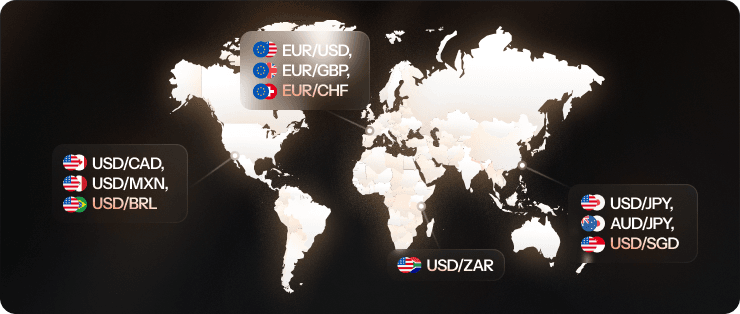
When it comes to euro cross pairs, three stand out as the most important: EUR/GBP, EUR/JPY, and EUR/CHF. Despite not being majors, all three of these markets are among the 20 most high-volume FX pairs in the world:
- EUR/GBP – This pair is commonly used to express views on the relative strength of the economies of Britain and the euro zone. As we saw before, the relatively small size of the UK economy can lead to elevated volatility, something that’s even more true in the EUR pairing. This market has been particularly active over the past decade, considering the continued economic fallout from Brexit.
- EUR/JPY – While certainly less popular than USD/JPY, this pair can sometimes have unique liquidity characteristics. London and Tokyo have a small overlap during the business day, while New York and Tokyo have none. Like its major counterpart, EUR/JPY is also strongly influenced by Carry trade dynamics.
- EUR/CHF – Like USD/CHF, this pair is impacted by the fact that the Swiss franc is historically a safe-haven currency. However, it can have unique dynamics, since there may be a greater overlap between SNB and ECB policy actions than with the Fed. In fact, between 2011 and 2015, the SNB partially pegged the franc to the euro, strongly impacting this pair.
In addition to these three primary crosses, the euro is also notable for actively trading with other independent European currencies. These can include the Polish złoty (PLN), the Norwegian krone (NOK), and the Hungarian forint (HUF). Still, while euro pairs are the most popular minor markets, other crosses are worth mentioning as well.
Other notable crosses: The true minors
Crosses that don’t include either the US dollar or the euro are sometimes known as the ‘true minors.’ These crosses are generally less popular, but still tend to have sufficient liquidity to make reasonable trading strategies possible. However, traders should be aware that bid-ask spreads may be higher, and liquidity can shift markedly along with regional business hours:
- GBP/JPY – This pair, fondly known as the ‘guppy,’ can be particularly popular with traders. Due to the yen’s historically sharp movements combined with the pound’s elevated volatility, the guppy tends to fluctuate significantly. For traders who thrive on volatility, GBP/JPY can be a compelling option.
- AUD/JPY – AUD/JPY can be an intriguing option because Australia and Japan are two advanced economies with relatively fewer links to Europe and America than many other countries. As a result, this is a cross that can be a genuinely strong source of diversification within a portfolio. This pair is often used by traders who want to express regional views on the strength of the Australian dollar and the yen.
- AUD/NZD – Because both of these commodity currencies tend to move together, trading them as a pair can often neutralize a substantial amount of the volatility a USD or EUR trader might experience. Since the economies of Australia and New Zealand are so tightly linked, AUD/NZD often trades in a narrow range with few major fluctuations. This minor pair might be a good choice for conservative traders or those looking to take risk off the table.
For truly differentiated markets, we need to turn to the ‘exotics.’ These pairs are almost universally traded against the US dollar, matched against the currency of an emerging market or other small country.
Exotic pairs: High risk, but potentially higher rewards
Exotics tend to have low average volumes and high transaction costs. Even in the interbank FX market, only a few specialists might work with these currencies. But for traders looking to make specialized bets on regional economies or certain commodity assets, exotic markets can offer some of the most intriguing opportunities in forex. Important exotics include:
- USD/TRY (US dollar/Turkish lira) – This exotic is heavily influenced by Turkish monetary policy. In recent years, Turkey has embarked on an unconventional interest rate experiment, cutting rates as inflation has climbed. Although Turkish inflation has somewhat moderated, USD/TRY remains a volatile exotic with the potential for swift adjustments depending on Turkey’s policy decisions.
- USD/ZAR (US dollar/South African rand) – This pair offers the chance to trade the dollar against Africa’s largest economy, which is heavily impacted by exports like gold, platinum, and diamonds. South Africa has also seen elevated levels of political uncertainty in recent years, contributing to even greater volatility for this pair.
- USD/SGD (US dollar/Singapore dollar) – Singapore is unusual in the fact that the country’s monetary policy is conducted through exchange rate adjustments rather than through the classic mechanism of interest rate adjustments. That can lead to significant changes to the USD/SGD pair, allowing traders to make sophisticated calls on the path of the Singaporean economy.
- USD/MXN (US dollar/Mexican peso) – This unique exotic is often used as a proxy for Latin American investment risk. During risk-on periods, when global capital flows are going to emerging markets, it’s common for the Mexican peso to strengthen. Notably, this region’s recurring financial crises can also lead to sharp reversals and high volatility.
- USD/BRL (US dollar/Brazilian real) – Brazil is a significant exporter of commodities like soybeans, coffee, and sugar. Like other commodity currencies, changes to any of these markets can impact the real’s valuation. And similar to many other exotics, Brazil’s elevated political dysfunction in recent years also poses increased risks.
All of these exotics can offer the potential to generate profit based on patterns that are largely distinct from majors or minors. Nonetheless, it’s important to approach these markets with caution. Exotics tend to have a steep learning curve and can be impacted by factors that traders may not expect. Below, we explore how traders can find the right pair for their own style, and when stepping into the world of exotics might make sense.
Picking the Best Pair: How Traders Can Choose the Right Forex Market
Unfortunately, there’s no cheat sheet or step-by-step guide for traders looking to pick the ‘right’ currency pair. That decision can rest on dozens of distinct factors, many of them hard to quantify. What’s more, traders rarely limit themselves to just one FX market in the long run.
Nonetheless, the five areas below can offer some helpful guidance to picking the right FX market – or at least the right category of pairs to start with. As we discussed previously, novice and inexperienced traders may find it advantageous to stick with liquid majors to learn how FX trading works in practice. However, for traders looking to branch out to other areas, consider the details below.
#1: Matching pairs to trading styles
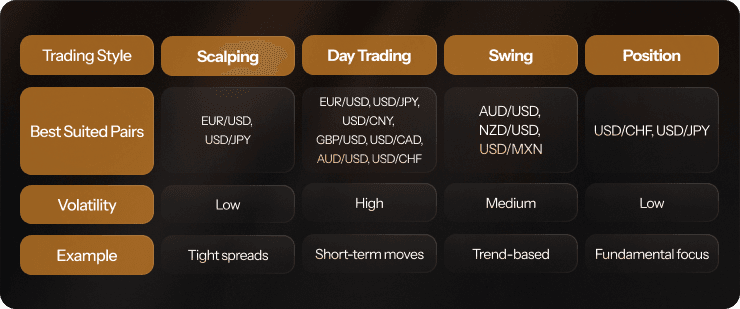
It’s no secret that certain trading styles are simply better suited to certain FX markets. An approach that might be highly profitable in one market could fail entirely in another. Here’s how to think about matching your trading style to particular markets:
- Scalping: Scalpers are typically looking to profit from relatively small market movements with frequent trading, making this style suitable for moderate volatility pairs with narrow spreads. Major pairs like EUR/USD and USD/JPY are strong contenders here.
- Day Trading: Day traders are often best-suited by sticking with major liquid markets, but sometimes elevated levels of volatility can open up the potential for enhanced profits. All seven major currency pairs are well-suited for day trading, offering high liquidity and tight spreads.
- Swing Trading: Because swing trading often looks to profit from sustained patterns over days or weeks, traders should consider markets impacted by long-lasting trends. These could be commodity currencies (such as AUD/USD or NZD/USD) as well as exotics that react to regional trends (like USD/MXN).
- Position Trading: Finally, since position traders look to profit from trends that can potentially take years to play out, markets strongly driven by economic fundamentals may be compelling. CHF pairs, for example, can be strongly indicative of global risk tolerance. USD pairs can also be used to play Fed policy against other central banks.
#2: Understanding your risk tolerance
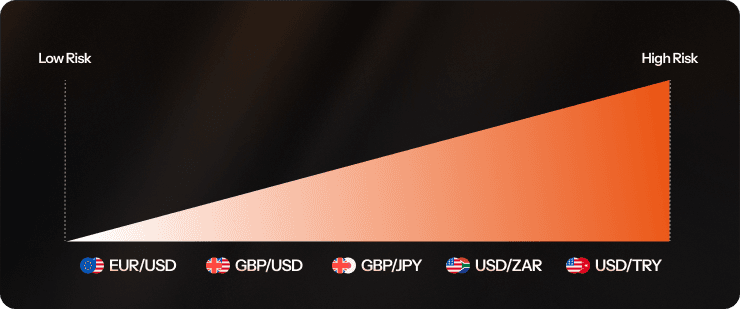
Even for traders who have the same style or strategy, differences in individual risk tolerance might mean that they select distinct pairs to focus on. Conservative traders looking to avoid major sell-offs or elevated volatility will likely stick to major pairs like EUR/USD or USD/CHF. Some minor pairs, like AUD/NZD, can also be a relatively lower risk option.
In contrast, other traders thrive on volatility and sharp movements. Within the majors, USD/JPY is notorious for occasional rapid adjustments, although day-to-day volatility tends to be modest. GBP pairs, especially GBP/JPY, can come with higher ongoing fluctuations. Of course, the highest risks are often found in exotic markets.
#3: Account sizes and leverage limitations
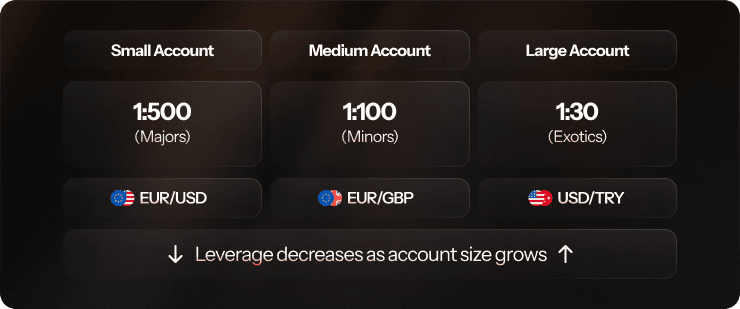
Surprisingly, a trader’s account size can potentially play a role in which FX market they select. Traders with smaller account sizes often rely on leverage to fuel profits. At many brokers, leverage limitations vary based on currency pair.
For instance, highly liquid major pairs may have aggressive leverage limits, allowing traders to place larger trades with smaller levels of equity capital. However, brokers may limit leverage for more volatile markets and exotics. As such, if a trader relies on leverage, they should ensure that they can still realize acceptable profits in their preferred market.
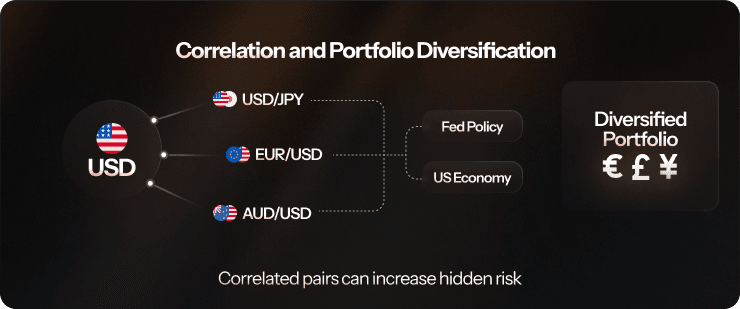
#4: Correlation and portfolio diversification
Diversification is a key aspect of risk management. If a trader runs a highly concentrated book, it only takes a few positions turning against them to strongly impact their P&L. However, traders who rely on correlated pairs may be taking on more risk than they expect.
For example, a trader could have three distinct positions in EUR/USD, USD/JPY, and AUD/USD. But since all three contain the US dollar, each pair will react to ongoing developments in Fed rate policy or US economic conditions. When selecting which pairs to trade, it’s important for traders to understand whether high positional correlation can make their book less diversified than it appears.
#5: Time zone and session considerations
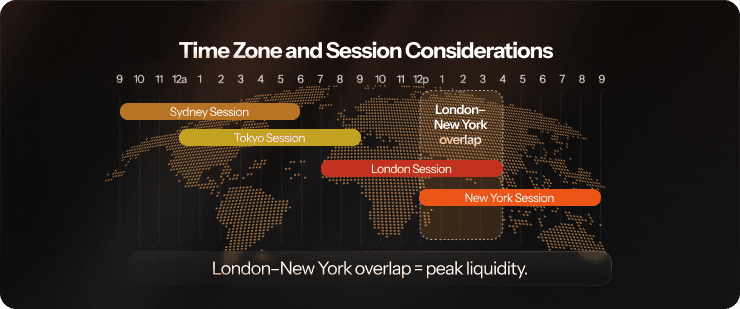
Finally, there’s one highly practical consideration that traders should think about – time zones. Clearly, if a trader lives in Europe but seeks to trade the AUD/NZD pair, they might miss out on the bulk of the market’s most liquid hours. That doesn’t necessarily mean that the trader should avoid the pair, but they should certainly understand how it might impact their overall transaction costs and profitability potential.
Generally speaking, the most liquid time for global FX markets is during the four-hour overlap between New York and London business hours. Regardless of where a forex trader is in the world, capturing at least a part of this session can be valuable when buying or selling large positions.
Ultimately, every FX pair comes with unique characteristics associated with general levels of volatility, overall trend behavior, key liquidity hours, and dozens of other factors. In this section, we covered five of the primary considerations traders should think about when weighing which pair to trade, but there could be many more. As always, the best approach is to have a trial-and-error mindset, conducting small experiments in distinct markets until a trader finds the pair that suits them best.
Conclusion: Finding Your Forex Edge
Once a trader has found the best pair for their style and developed a successful strategy, they might consider scaling up their profitability by taking on additional capital. That’s exactly when making the shift from self-funded trading to prop trading can make sense. By working with a prop firm, traders can hold larger positions and potentially generate greater profits across the forex market.
At OneFunded, we help successful traders navigate the forex market with larger account sizes and a profit split of up to 90%. What’s more, our platform offers access to pairs including majors, minors, and exotics, supporting a wide variety of trading styles. Ready to get started? Undertake the OneFunded challenge today to launch your prop trading journey.