



PipFarm vs OneFunded: Which Prop Firm Is Better for You?
For many traders, the decision to move beyond a self-funded approach and embrace prop trading is a pivotal one. For the first time, a trader may be trading outside capital with externally imposed risk limits and profit targets. A key part of that transition is selecting the right prop firm to work with.
While there are plenty of prop trading firms out there, this article will discuss two popular options: PipFarm and OneFunded. Both platforms can potentially offer a strong experience for traders, especially those looking for competitive payouts. However, OneFunded has several advantages, especially in terms of profit splits, challenge fees, and risk limits.
Today, we’ll look at both firms in depth, providing a comprehensive background and overview. In addition, we’ll compare each option side-by-side, assessing their similarities and differences. As a prop trader, the potential for success is in your hands – but the right platform can push the odds in your favor.
Looking to take your trading journey to the next level? Start your OneFunded challenge today, featuring no time limits and a refundable challenge fee.
Note: Information for this section was drawn from PipFarm’s official website and help center.
PipFarm is a prop trading firm offering virtual funded accounts to traders who complete a successful screening challenge. The firm was founded in 2023 and is based in Singapore. Like most other prop trading firms, PipFarm is not a financial institution, nor does the firm offer live money investment accounts.
PipFarm has a variety of challenge structures, with many different formats for prop traders to choose from. This can potentially benefit traders who value flexibility. However, it also comes at the cost of added complexity.
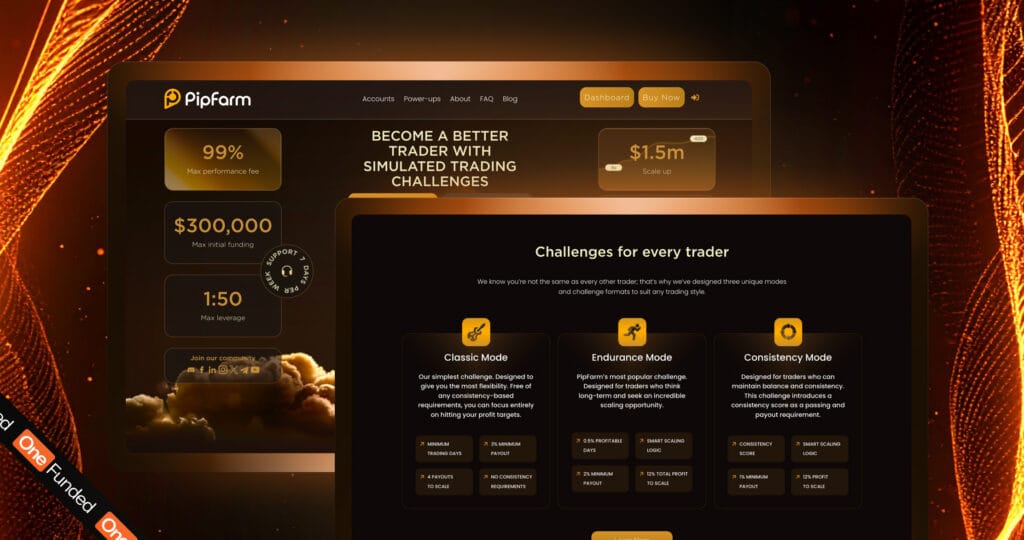
One important source of complexity is the difference between Endurance, Consistency, and Classic trading modes. Each mode comes with important nuances, impacting everything from minimum payouts to challenge fees. Below, we break down PipFarm’s challenges by type and how each of these trading modes comes into play.
All the risk limits listed below apply to both PipFarm’s trading challenges and funded accounts (with some exceptions due to the firm’s scaling program, which we discuss below). For any of PipFarm’s challenges, traders can choose between an account denominated in USD, GBP, and EUR. For simplicity, this article exclusively uses USD.
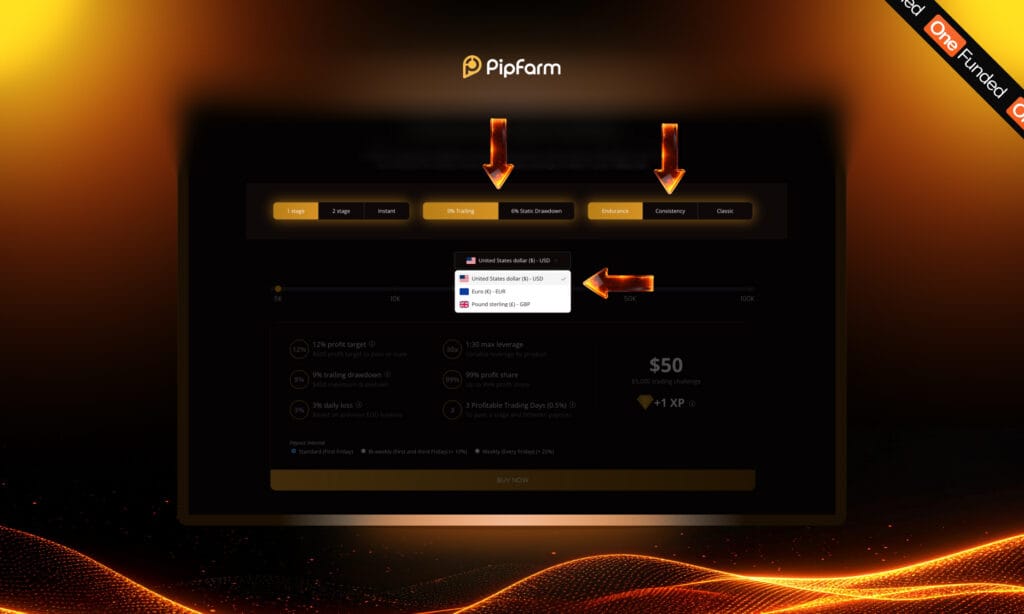
In PipFarm’s 1 stage challenge, traders have to achieve a single profit target to unlock a funded account. Account sizes ranging from $5,000 to $100,000 are available. Key terms of this challenge include:
| Profit Target | 12% |
| Max Drawdown | 9% trailing or 6% static |
| Max Daily Loss | 3% |
| Max Leverage | 1:30 with potential increases |
| Profit Share | Starting at 70% with potential increases |
| Time Limit | 365 days |
Importantly, traders have the choice between either a 9% trailing maximum drawdown (which is calculated based on your highest account value) or a 6% static maximum drawdown (which is calculated based on the initial account value). The right choice depends on your unique trading style – for instance, swing traders may strongly prefer the static drawdown, which offers more flexibility through pullbacks. Violating either the max drawdown or max daily loss will result in an immediate challenge failure.
PipFarm’s 1 stage challenges are available in Endurance, Consistency, and Classic modes. Here’s how each mode impacts the trading experience:
Clearly, Classic mode is the simplest, but it also comes with more expensive challenge fees. In contrast, Consistency mode is the most complex, but it is cheaper to access. Finally, Endurance mode sits between the two in terms of complexity and price.
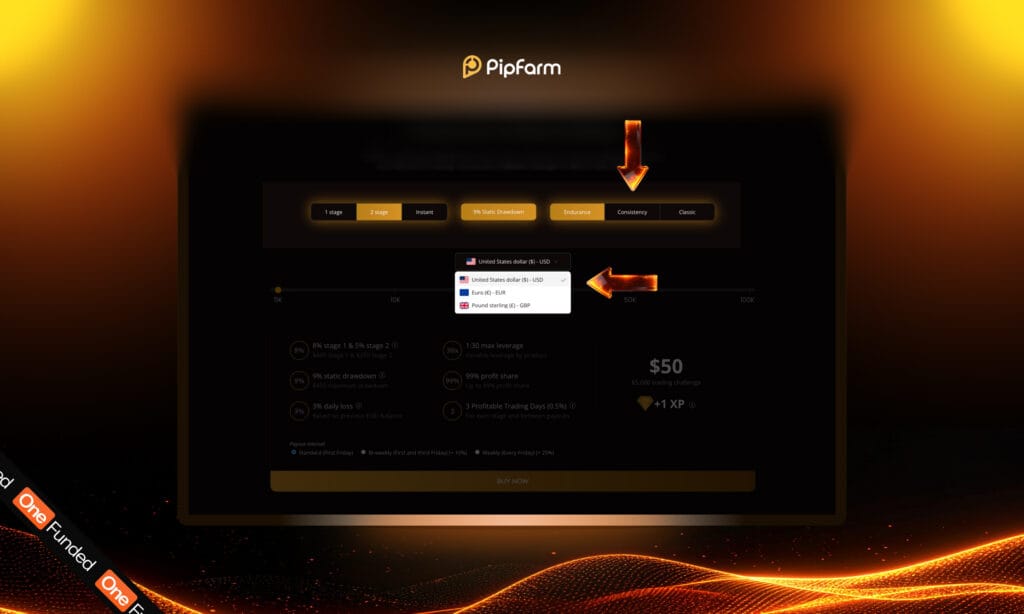
PipFarm’s 2 stage challenge is similar to the firm’s 1 stage challenge, except that traders need to achieve two separate profit targets. Again, accounts are available ranging from $5,000 to $100,000. Key terms of the 2 stage challenge include:
| Profit Target | 8% stage 1 and 5% stage 2 |
| Max Drawdown | 9% static |
| Max Daily Loss | 3% |
| Max Leverage | 1:30 with potential increases |
| Profit Share | Starting at 70% with potential increases |
| Time Limit | 365 days |
| Modes | Endurance: 3 profitable days (0.5%) for each stage |
| Consistency: 40% score for each stage | |
| Classic: 3 trading days for each stage |
Importantly, PipFarm’s 2 stage challenge does not include a trailing drawdown option, a notable difference from the 1 stage challenge. Moreover, each stage has a higher minimum score for traders in consistency mode.
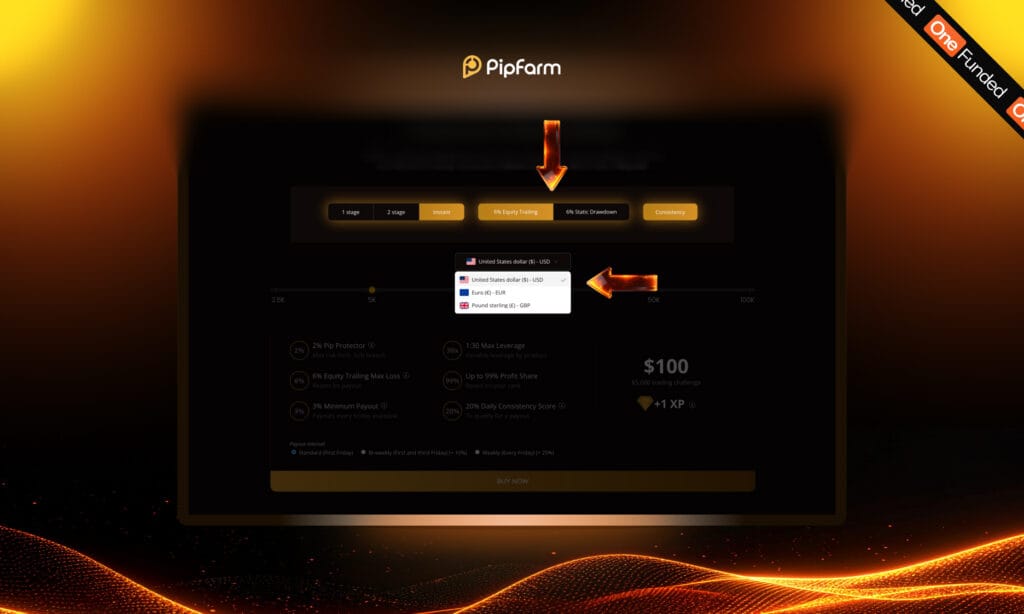
Unlike many other prop trading firms, PipFarm also includes an instant challenge option. Through this structure, prop traders get immediate access to a funded account without needing to pass a formal evaluation. While this could be a competitive option for prop traders looking to start trading larger account sizes immediately, it’s also notably more expensive than true trading challenges.
PipFarm’s instant challenge includes accounts ranging from $2,500 to $100,000. Moreover, the risk limits differ substantially from previous options:
|
Profit Target |
12% |
|
Max Leverage |
1:30 with potential increases |
|
Profit Share |
Starting at 70% with potential increases |
|
Max Drawdown |
6% static drawdown – This functions like the static drawdown in the 1 and 2 stage challenges. |
|
6% equity trailing drawdown – This trailing drawdown is based on the high watermark of your account equity. |
|
|
Pip Protector |
Instant accounts have a ‘pip protector’ that prevents traders from risking any more than 2% of their account value on a single trade idea. |
|
Consistency Mode |
Traders need to maintain a 20% consistency score throughout the life of their account. |

Traders on PipFarm can trade dozens of instruments across several key asset classes. These include:
For traders, the initial leverage provided differs by asset class. For metals, it’s 1:20; indexes, 1:20; forex, 1:30; oil, 1:20; and cryptocurrencies, 1:2.
PipFarm offers access to just one trading platform: cTrader. While cTrader is a widely renowned and popular trading interface, prop traders seeking other platforms will not be able to use them with PipFarm.
PipFarm’s profit share for traders starts at just 70%, which is generally below the industry standard (which sits around 80%). However, this is a share that can potentially increase with time. PipFarm has a sliding profit share that adjusts based on how much ‘XP’ a trader has earned.
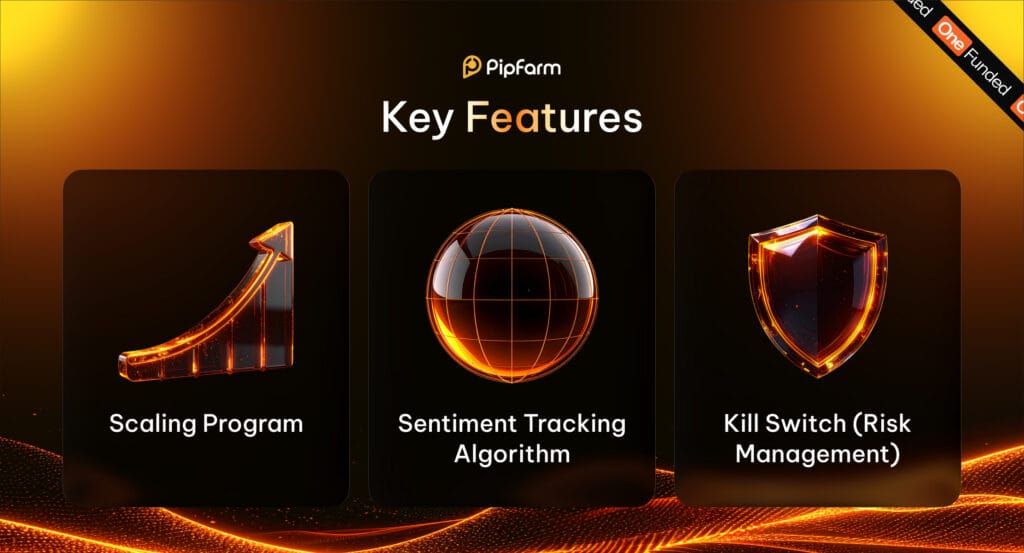
XP is a proprietary points feature on PipFarm. Traders can earn XP through actions such as passing challenges, receiving payouts, and achieving profit goals. Benefits of this scaling program can include:
In addition to these benefits, traders can also potentially access reduced commissions, enhanced leverage, and even a lifetime discount.
Outside of their sliding profit splits, PipFarm also has a variable payout schedule. All payouts are processed on Fridays. The standard payout schedule is once a month, but traders can pay extra to have those payouts processed weekly or biweekly. The minimum payout you can request is 1% of the starting balance for Consistency Mode, 2% for Endurance Mode, and 3% for Classic Mode – however, payouts are capped at $5,000.
PipFarm comes with several fees, and it’s important for prospective traders to understand how they work. The first major fee is the Challenge Fee, which traders have to pay to start any PipFarm trading evaluation. Importantly, this fee is not refundable, meaning that you pay it regardless of success or failure.
PipFarm has a varying fee structure based on the specific challenge that a trader selects. Fees are identical for the 1 stage and 2 stage challenges, although they differ for the instant challenge. These fees are summarized in the following tables.
PipFarm 1 and 2 Stage Account Challenge Fees
| Account Size / Mode | Consistency | Endurance | Classic |
| $5,000 | $40 | $50 | $60 |
| $10,000 | $80 | $100 | $120 |
| $20,000 | $150 | $175 | $200 |
| $50,000 | $275 | $325 | $375 |
| $100,000 | $390 | $490 | $590 |
PipFarm Instant Challenge Fees
| Account Size / Drawdown | 6% Equity Trailing | 6% Static |
| $2,500 | $50 | $50 |
| $5,000 | $100 | $100 |
| $10,000 | $175 | $150 |
| $20,000 | $300 | $250 |
| $50,000 | $600 | $500 |
| $100,000 | $1,200 | N/A |
In contrast to PipFarm’s non-refundable fees, OneFunded features fully refundable challenge fees if traders successfully complete their evaluation. Make the smart switch today by launching your OneFunded challenge, letting your trading performance cover the cost of your admission.
In addition to PipFarm’s challenge fees, traders also need to pay a commission on many instruments. These commissions are $6 per lot on instruments like forex and metals, although there is no commission on indexes, crypto, and oil. However, traders may be able to access reduced commissions through ranking up via XP.
For traders considering a prop firm, it’s important to know who’s in charge, both for matters of transparency and reliability. PipFarm is led by founder and CEO James Glyde, who was formerly an executive at cTrader and has over a decade of experience working in leadership roles in the online trading industry. James maintains an active presence on both LinkedIn and X.
One common way for prop firms to support their traders is with community networking and educational materials. PipFarm has some of these features, but they’re not a primary focus. Specifically, PipFarm has a dedicated Discord channel (which currently has about 8,500 members) and a blog with a small collection of educational content.
Like other prop firms, PipFarm has specific rules regarding which trading strategies are allowed during the challenge stage and in a funded account. Copy trading is not allowed, nor is using a trading bot purchased from a third party. The platform also bans several ‘exploitative’ trading strategies, including latency arbitrage, triangular arbitrage, and high-frequency trading.
Finally, when it comes to trader registration, PipFarm maintains a list of prohibited countries. While this list is rather short and mostly features high-risk locations like Iran and Syria, there is one notable exception: United States citizens cannot sign up for PipFarm, and will have to look elsewhere for a prop firm.
PipFarm has several key elements that set the platform apart from the competition. To understand what makes PipFarm distinct, these features are essential to note:
Based on online reviews, traders generally like PipFarm, although there are some notable complaints about the platform. Overall, the firm has earned a score of 3.9 out of 5 on Trustpilot based on 309 reviews. Positive reviews made specific mention of the XP system and the quality of trader support:
5/5 – Quoc, Nov 2025: “The trading experience with Pipfarm is quite good, the spread is reasonable. The Kill Switch function is quite useful, I no longer worry about unexpected fluctuations affecting my account with this function… The XP program at PipFarm makes you feel like you are really developing and receiving benefits such as increased sharing rate, increased margin.”
5/5 – Hasan, Dec 2025: “It’s simple and straightforward. Prove yourself and rewards follow you automatically. Customer service is great. Based on my experience and given their responses in the socials, I think they [have] a wonderful team.”
But at the same time, many negative reviews mentioned delayed payouts or even unfairly losing access to their accounts. While it’s challenging to review the authenticity of these reports, it’s important for prospective traders to weigh them carefully:
1/5 – JP, Oct 2025: “Compared to other platforms, there are many withdrawal refusals due to silent rules, which has become a problem on social media. Withdrawals are almost impossible on PipFarm.”
1/5 – Mohammad, Oct 2025: “In the past, they have delayed my payouts for weeks, often coming up with new excuses… In short, they seem to find ways to delay or deny payouts by misinterpreting their own rules.”
Note: Information from this section was drawn from OneFunded’s official site and help center.
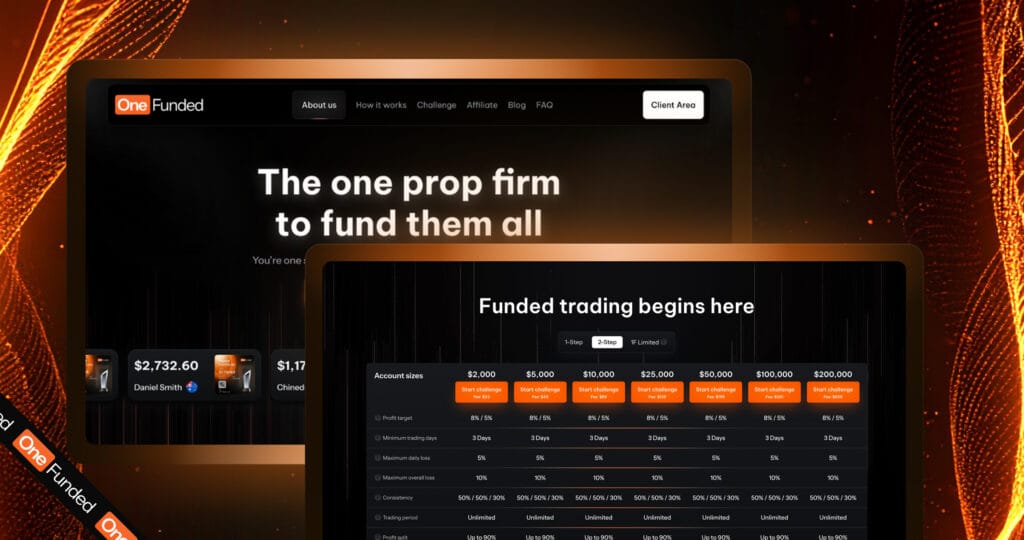
Like PipFarm, OneFunded is a prop firm providing virtual accounts to traders who pass a screening challenge. OneFunded was launched in 2025 following the acquisition and rebranding of Prop365. Since then, OneFunded has also acquired the prop platform FXCI, helping expand the firm’s operations. OneFunded is headquartered in the UK.
Looking to take your trading journey to the next level? Start your OneFunded challenge today, featuring no time limits and a refundable challenge fee.
OneFunded’s challenge structure balances simplicity and flexibility. While there are a variety of options for traders to consider, key terms are relatively consistent between these options. OneFunded offers three primary structures: a 1-Step challenge, a 2-Step challenge, and a 1F Limited challenge.
Notably, OneFunded does not offer instant funding, meaning that the platform is better suited to traders with the skill to pass a formal evaluation. All accounts are denominated in USD.
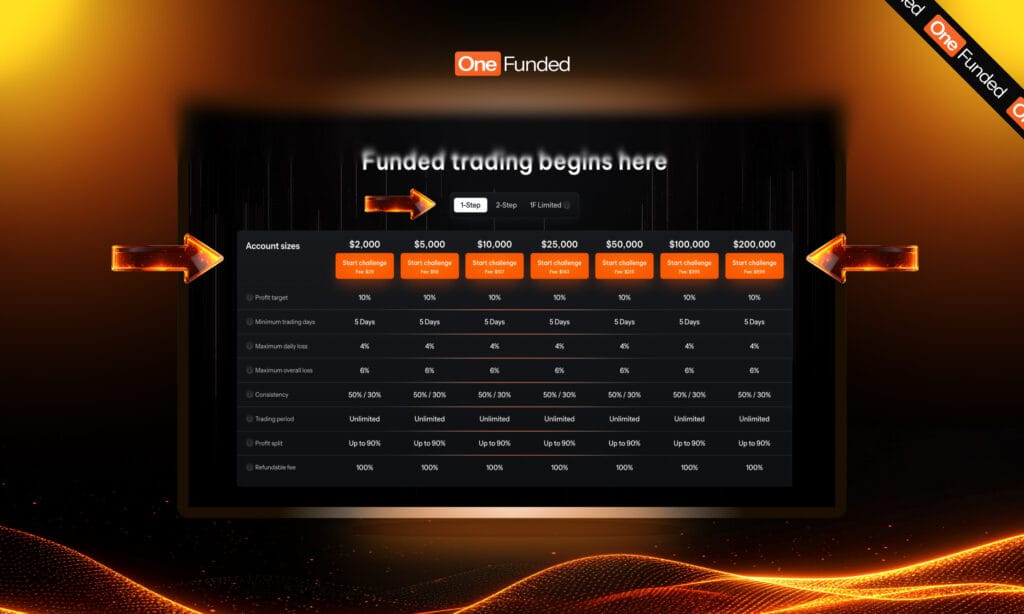
OneFunded’s 1-Step challenge has a single evaluation stage before traders are considered for a funded account. Account sizes range from $2,000 to $200,000. Key terms include:
|
Profit Target |
10% |
|
Max Drawdown |
6% static |
|
Max Daily Loss |
4% |
|
Minimum Trading Days |
5 days |
|
Profit Split |
Starting at 80% (up to 90%) |
|
Consistency Rules |
Best day profit less than 50% of total profit |
|
Time Limit |
Unlimited |
OneFunded’s lack of time limit is worth noting – traders can operate at their own pace without fear of running out of time to complete the challenge. While most risk limits remain the same once a trader unlocks their funded account, the consistency rules change slightly; a trader’s best day is required to be less than 30% of their total profit. This limit resets with each payout cycle.
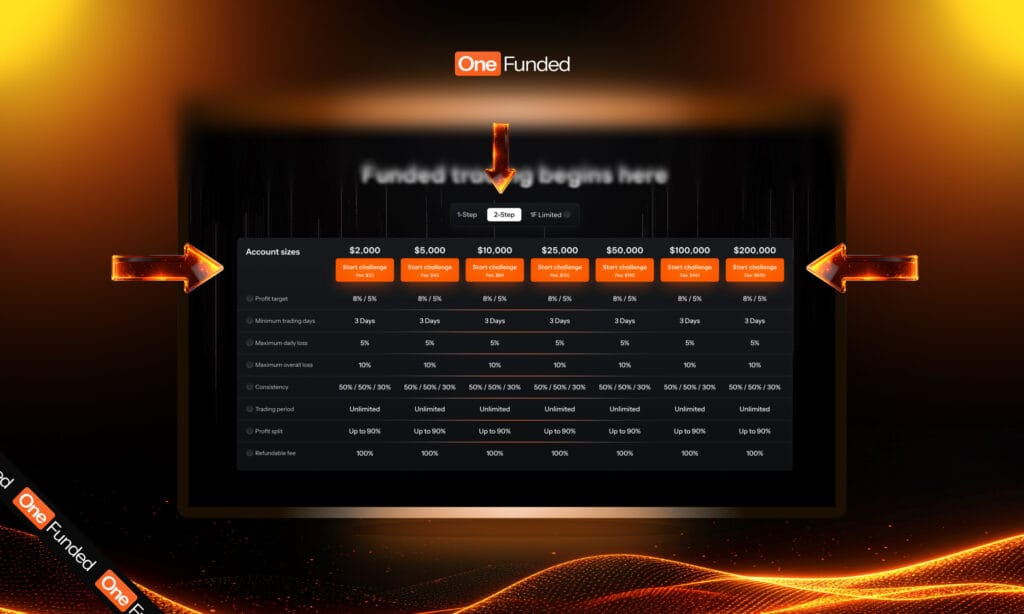
OneFunded’s 2-Step challenge functions similarly to their 1-Step challenge, except that traders need to achieve two separate profit targets to unlock a funded account. Again, account sizes range from $2,000 to $200,000. Key terms include:
|
Profit Target |
8% stage 1 and 5% stage 2 |
|
Max Drawdown |
10% static |
|
Max Daily Loss |
5% |
|
Minimum Trading Days |
3 days |
|
Profit Split |
Starting at 80% (up to 90%) |
|
Consistency Rules |
Best day profit less than 50% of total profit (per stage) |
|
Time Limit |
Unlimited |
Once again, this consistency rule falls to 30% if a trader unlocks a funded account.
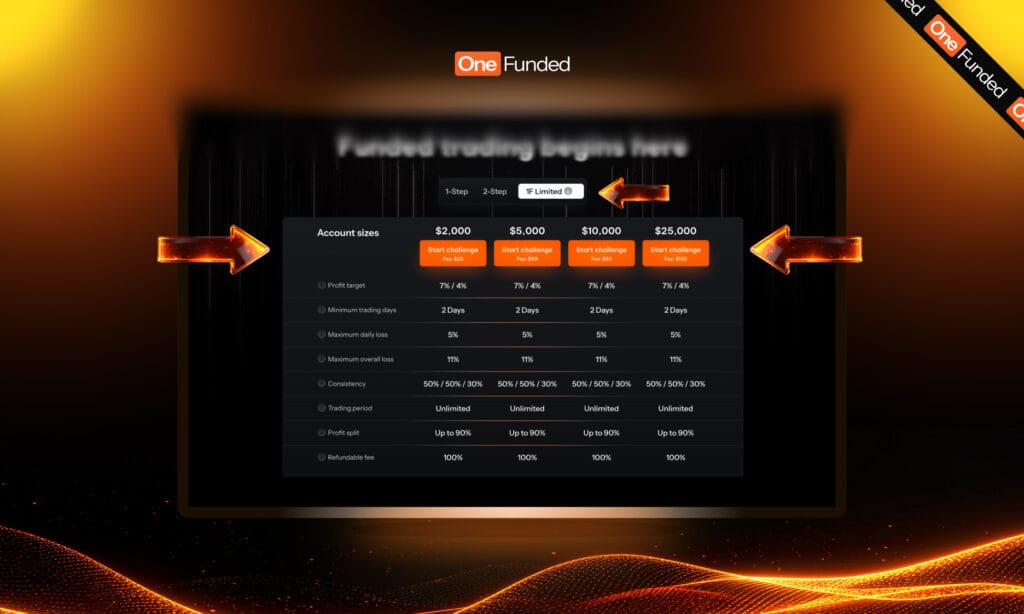
OneFunded offers a final challenge structure known as the 1F Limited Challenge, which offers more advantageous rules compared to the two challenges above. However, the 1F Limited Challenge is only available for a limited time, so traders may not always be able to access it in the future. Moreover, this challenge is only available in account sizes ranging from $2,000 to $25,000.
The 1F Limited Challenge is a two-stage challenge. Key terms include:
|
Profit Target |
7% stage 1 and 4% stage 2 |
|
Max Drawdown |
11% static |
|
Max Daily Loss |
5% |
|
Minimum Trading Days |
2 days |
|
Profit Split |
Starting at 80% (up to 90%) |
|
Consistency Rules |
Best day profit less than 50% of total profit (per stage) |
|
Time Limit |
Unlimited |
Because this challenge comes with lower profit targets and higher risk limits, it offers a more generous structure for prospective traders than OneFunded’s standard 2-Step challenge. However, the 1F Limited Challenge is also slightly more expensive to access. Once again, the consistency rule drops to 30% once a trader has completed their evaluation.

OneFunded offers trading on over 135 different instruments across several key asset classes. These include:
OneFunded’s leverage rules vary by asset class. In forex, traders can access leverage up to 1:100. For commodities and indexes, that level is set at 1:30. Finally, crypto has a leverage limit of 1:2.
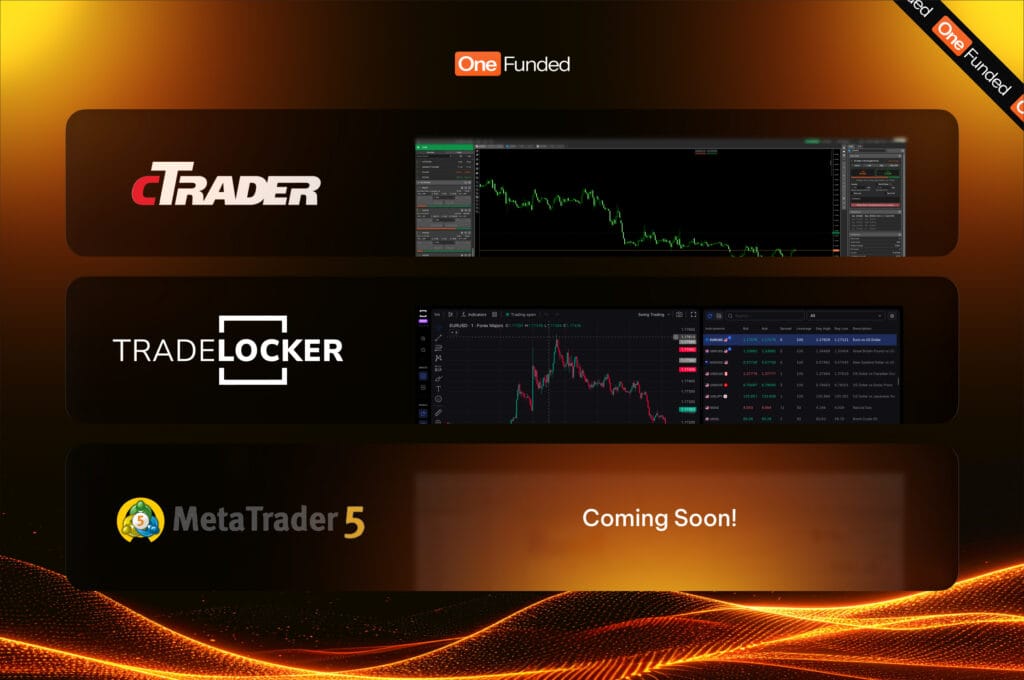
OneFunded offers traders notable flexibility when it comes to their trading environment. The firm currently features access to two separate trading platforms: TradeLocker and cTrader. The former is generally considered a more robust, professional tool, while the latter specializes in offering a lightweight, modern platform.
This multi-platform approach allows traders to select the environment that best suits their style. However, traders in the US should be aware that they will only be able to access TradeLocker. In the future, OneFunded is planning to add access to MetaTrader 5 as well.
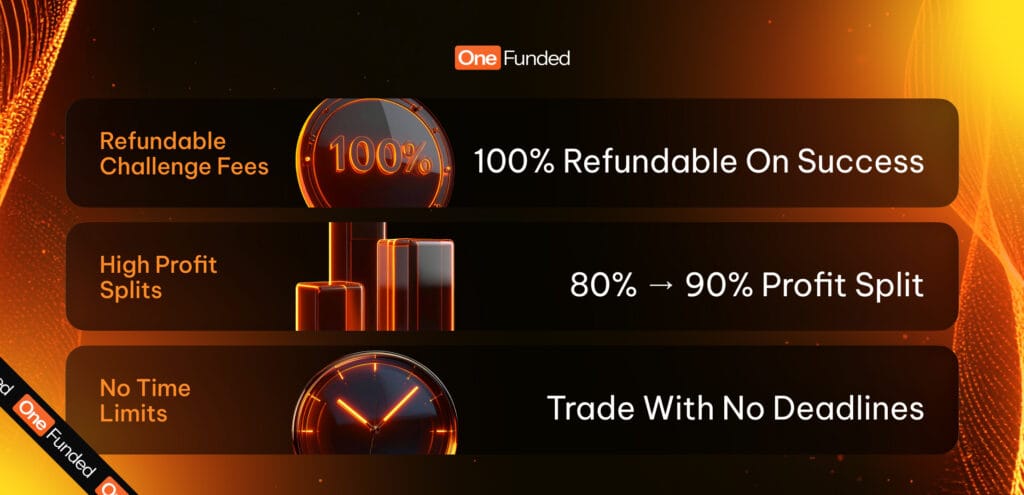
When it comes to profit splits, OneFunded offers traders a standard split of 80% across all accounts and challenge types. This is a competitive profit split in line with industry standards. However, traders can choose to boost their profit split to 90% by increasing their initial challenge fee.
In terms of payouts, OneFunded’s standard payout schedule is every other week. Once again, traders can choose to enhance this standard schedule by paying an increased challenge fee to access weekly payouts. Whatever the timeline, OneFunded has a minimum payout amount of $100, without payouts above $1,000 eligible to be withdrawn via bank transfer (all other transfers are conducted through crypto via USDT).
There’s one important aspect about OneFunded’s fees that’s essential to understand: the challenge fee is fully refundable as long as a trader passes their evaluation. That’s true even if a trader has purchased a higher profit split and faster payouts. As a result, this fee functions more like a refundable deposit, with only traders who fail the challenge actually paying the fee.
Here is how OneFunded’s standard fee breaks down by challenge type:
OneFunded Challenge Fees
| Account Size | 1-Step | 2-Step | 1F Limited |
| $2,000 | $29 | $23 | $25 |
| $5,000 | $56 | $45 | $49 |
| $10,000 | $107 | $89 | $92 |
| $25,000 | $143 | $125 | $135 |
| $50,000 | $215 | $195 | N/A |
| $100,000 | $395 | $361 | N/A |
| $200,000 | $699 | $650 | N/A |
Traders can pay an additional 20% for a 90% profit split and an additional 25% for weekly payouts (or a total 34.99% for both options together).
It’s also worth noting that OneFunded has a rewards center. By completing specific challenges and tasks, traders can access rewards that potentially unlock discounted challenge fees and other benefits. While less comprehensive than PipFarm’s XP system, this structure incentivizes continuous growth for traders at the firm.
OneFunded is led by founder and CEO Anastasiia Kaplunenko. Anastasiia has a strong background in fintech and trading, experience which motivated her to help launch a new type of prop firm – one that prioritizes traders and operates with clear rules and no hidden fees. She maintains an active presence on X.
Despite being a young firm, OneFunded’s community and educational resources are competitive. The company maintains a community discord with just under 5,000 members, where traders can build their network and access direct support. OneFunded also has a growing list of educational blogs on their website to help prop traders navigate their trading journey, discussing topics like order flow trading and the impact of market liquidity.
While OneFunded permits a wide range of trading strategies, the platform does prohibit several approaches that exploit the design of the platform. These include trading on delayed charts, latency arbitrage, and tick scalping strategies. Moreover, while copy trading is allowed between your own OneFunded accounts, it is not allowed between different users or from third parties.
Unlike PipFarm, US citizens can sign up for and use OneFunded, although they may face restrictions in terms of accessible instruments or platforms. OneFunded’s platform is not available in high-risk jurisdictions, including Syria, Iran, and Russia.
OneFunded stands out from competing prop firms through several key features:
User reviews of OneFunded are highly positive, with a rating of 4.4 out of 5 on Trustpilot. The firm has received strong trader feedback for the no-time-limit challenge process and the quality of the support team. While there are some negative reviews on Trustpilot, these appear to be mostly related to confusion about how OneFunded’s consistency score is applied.
Excerpts from positive reviews include:
5/5 – Dax, Nov 2025: “Great trading conditions as well as good customer support. Had a few questions regarding my account and they helped me within minutes!”
5/5 – James, Oct 2025: “Clean dashboard, fair spreads, no weird rules. Funded and paid, that’s what matters.”
Nonetheless, some mixed reviews noted delays with KYC (Know Your Customer) regulatory checks, which could be a potential headache for traders looking to start their trading challenge quickly.
3/5 – Troy, Jun 2025: “Had some trouble with the KYC process which delayed funding by a day, but support helped me through it. The platform is okay, but I’d like to see more trading tools in future updates. Still happy with the overall experience.”
3/5 – Barbara, Apr 2025: “Had a bit of an issue with the KYC process, so it took longer than I expected to get my funded account.”
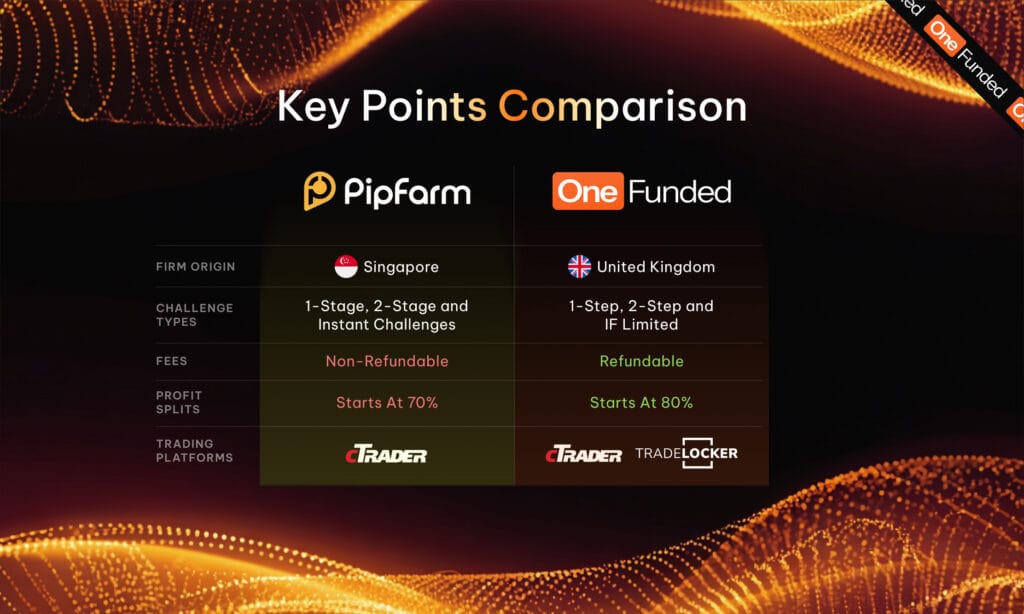
Above, we provided comprehensive and detailed overviews of both PipFarm and OneFunded. Now, it’s time to look at how these prop firms stack up in a head-to-head comparison. Below, we look at several tables to directly compare PipFarm and OneFunded across many of the key aspects that traders care about.
First, we compare the firms as a whole, seeing how their overall approaches differ. Next, we look at a side-by-side comparison of their respective trading challenges. Finally, we summarize this info into a clear pros and cons table across various factors.
PipFarm vs OneFunded: Overall Firm Comparison
| PipFarm | OneFunded | |
| Standard Profit Share | 70% | 80% |
| Maximum Profit Share | 99% | 90% |
| Standard Payout Schedule | Monthly | Biweekly |
| Types of Challenges | 1-Stage, 2-Stage, Instant | 1-Stage, 2-Stage |
| Refundable Fee? | No | Yes, on success |
| Instruments | FX, commodities, crypto, indexes | FX, commodities, crypto, indexes |
| Trading Platforms | cTrader | cTrader, TradeLocker, MetaTrader 5 (coming soon) |
| Trustpilot Score | 3.9 | 4.4 |
PipFarm vs OneFunded: Trading Challenge Comparison
For direct comparison, this table looks at a $50,000 account for each firm’s standard 2-stage challenge. Classic mode is used for PipFarm’s challenge, which is most closely comparable to OneFunded’s model.
| PipFarm | OneFunded | |
| Cost | $375 (Nonrefundable) | $195 (Refundable on success) |
| Profit Target | 8%, 5% | 8%, 5% |
| Max Daily Loss | 3% | 5% |
| Max Static Drawdown | 9% | 10% |
| Min Trading Days | 3 days for each stage | 3 days for each stage |
| Time Limit | 365 days | Unlimited |
PipFarm vs OneFunded: Pros and Cons of Each Firm
Based on the tables above, how should traders think about choosing between the two platforms? The analysis below summarizes key points of comparison.
| PipFarm | OneFunded | |
| Profit Splits | Lower standard, higher max | Higher standard, lower max |
| Instruments | Same asset classes, slightly fewer instruments | Same asset classes, slightly more instruments |
| Profit Targets | Slightly higher on average | Slightly lower on average |
| Challenge Types | More flexibility | Less flexibility |
| Risk Limits | More strict | Less strict |
| Payout Schedule | Less frequent standard | More frequent standard |
| Challenge Fees | Generally more expensive, nonrefundable | Generally less expensive, refundable |
| Trading Platforms | Less flexibility | More flexibility |
Based on the above comparison, OneFunded has an overall advantage in terms of most areas that traders care about. Not only does OneFunded generally have less expensive fees for comparable challenge structures, but these fees are fully refundable upon a trader successfully passing an evaluation. Moreover, OneFunded has profit targets that are generally equivalent to or less than those set by PipFarm, along with risk limits that are more lenient.
With that said, PipFarm does have an advantage in two areas. First, the firm has a wider variety of challenge types, which can give traders more flexibility in how they approach their evaluation period (including the ability to unlock instant funding). Next, PipFarm has a higher maximum profit split – although traders need to achieve the highest rank in PipFarm’s XP system to achieve that split. Using this comparison table, prospective traders can make the most intelligent decision on which firm to work with based on their unique needs.
Selecting the right prop trading firm is about more than just profit targets; it requires balancing cost, flexibility, and long-term potential. PipFarm distinguishes itself through its gamified XP system and varied challenge structures, making it a strong choice for traders who value flexibility and the ability to scale over time.
However, OneFunded currently holds a competitive edge regarding core trading conditions. With fully refundable fees, higher starting profit splits, and no time limits on challenges, it offers a more accessible and potentially lucrative path for most traders. Ultimately, if profitability is your priority, OneFunded takes the lead.
Comparing OneFunded to other major firms? Read our Funding Pips vs OneFunded review. Traders who value challenge variety can also see our GoatFundedTrader vs OneFunded comparison.
With OneFunded, traders don’t have to settle for slow payouts or low profit splits. Launch your OneFunded challenge today to prove your skills and start your prop journey with the one firm to fund them all.


No, US citizens cannot use PipFarm, as the platform is not available to American traders. For US prop traders looking for a competitive alternative, consider OneFunded, which features high profit splits and refundable challenge fees.
Whether PipFarm or OneFunded is better depends on a trader’s unique preferences and needs. However, OneFunded generally features lower upfront costs, more lenient risk limits, and less-aggressive profit targets, which could make it a stronger choice for many traders.
Yes, OneFunded is a legitimate prop firm. The company is registered in the UK and is a rebrand of long-standing prop firm Prop365. OneFunded currently has a Trustpilot score of 4.4 out of 5 based on 138 reviews.
Based on most indicators, PipFarm appears to be a legitimate prop firm. The company is registered in Singapore and currently has a Trustpilot score of 3.9 out of 5 based on 309 reviews. Nonetheless, some reviews complain of delayed and inaccessible payouts, so it’s important to research the firm thoroughly.

Choosing the right prop firm can be a difficult task. This article offers a comprehensive look at two reputable prop...

Most, if not all, traders want to enjoy the massive capital opportunity that a proprietary trading firm, or prop firm,...

The prop trading landscape has grown rapidly in recent years, with firms competing to attract traders through diverse challenge structures...
 Set Preferred on Google