




How to Choose a Prop Firm in 2026: 8 Things Serious Traders Check First
You’ve made up your mind; you want to go into trading full-time in 2026. Great. But there are tens of prop firms fighting for your attention. So, how can you choose the one that suits your needs? In trading, knowing how to choose a prop firm is important. Make the wrong pick, and you’d lose your money, waste your time, and see your confidence fall to all-time lows.
On the flip side, selecting the right prop firm has its fair share of advantages. You encounter fair rules, actual payouts, and room to scale.
This prop firm checklist covers 8 things that smart traders look at before they set sail with any prop firm. It’ll also consider how major firms like OneFunded, The5ers, FTMO, BrightFunded, and others measure up to these metrics.
Drawdown rules are just like guardrails you’d see on the stairs. They prevent you from falling while you go up and down, and they’re important to check when deciding how to choose a prop firm.
Prop firms set a limit on how much you can lose in a day (the daily loss limit) and what you can lose in total (the overall loss limit). Go past this limit, and the firm will close your account.
Here’s one reason you should check the drawdown rules. According to our own breakdown of why traders fail challenges, 78% of failed challenges don’t end because the trader lacks skills. They end because the trader went over the drawdown limit. And guess what? These failures can take place within the first three trading days.
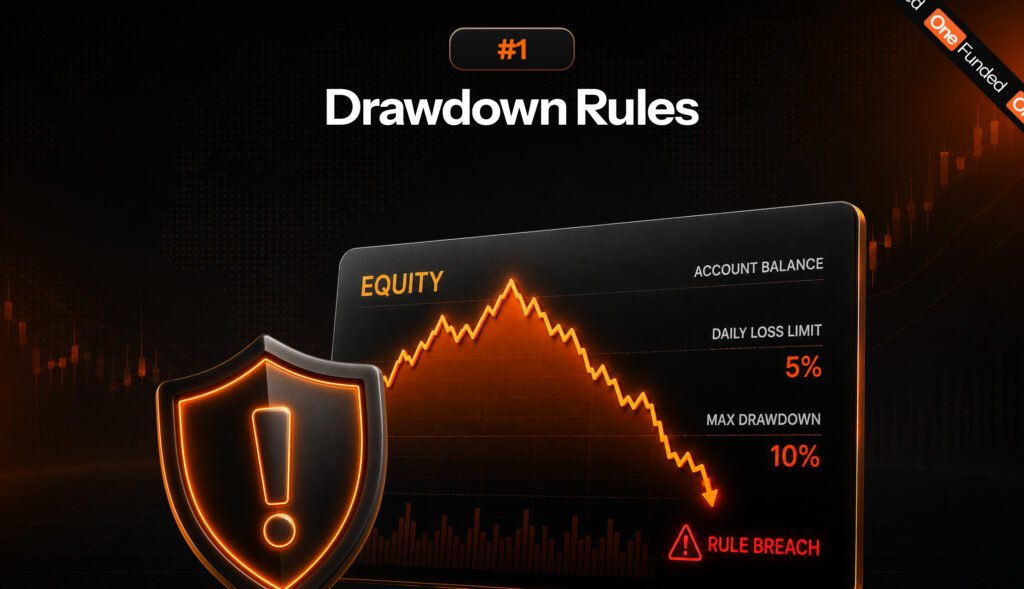
On OneFunded, the daily loss limit and overall loss limit are 5% and 10%, respectively, on the Core plan. These numbers allow you to trade normally. The prop firm’s Value plan is much tighter at 4% daily and 8% overall. This makes sense for traders with a proven strategy.
FTMO makes use of a 5% daily and 10% overall loss limit on its standard 2-step challenge account. On FundedNext, you’d come across similar loss limits on its Stellar 2-Step challenge plan. The same applies to FundingPips’ 2-Step Standard plan.
The number matters less than the type. Ask three questions before you buy:
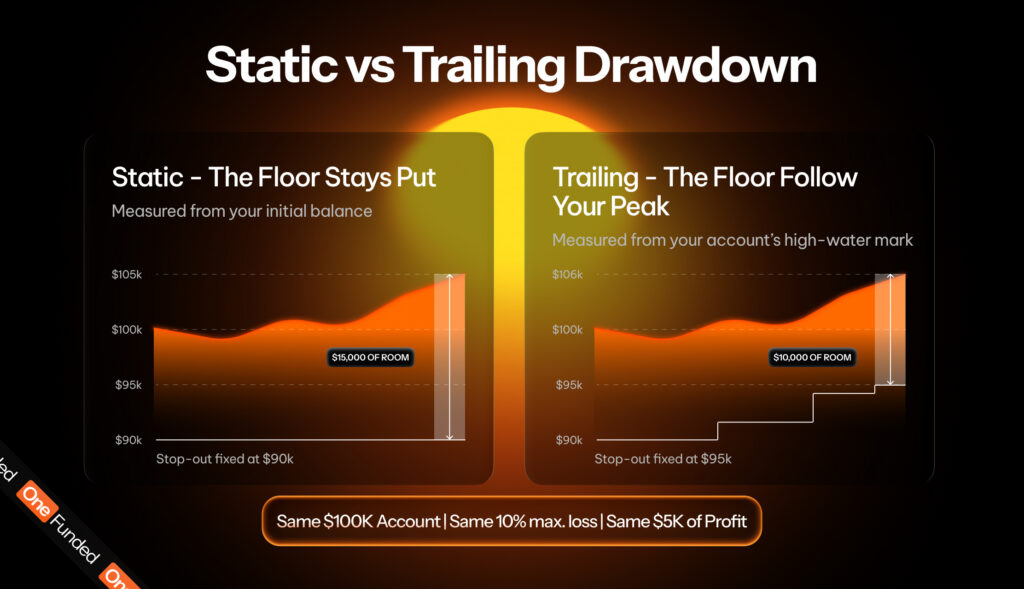
Static means the limit stays where it started, measured from your initial balance: every dollar of profit widens the gap between your equity and the stop-out level. Trailing means the limit follows your account’s high-water mark, so the buffer never grows no matter how much you win — and giving profits back hurts far more than it does on a static account.
OneFunded sticks to the static principle on all its challenge accounts. However, prop firms such as ThinkCapital use the trailing drawdown on their Lightning program (a static 3% daily limit plus a 6% trailing maximum that locks at your starting balance once the account grows 6%). This moving target catches many traders unaware.
Four of the ten firms in this guide have no trailing plan at all: OneFunded, The5ers, FundedNext, and RebelsFunding. The other six all use trailing on at least one plan, and it’s almost always the 1-step. That’s worth knowing before you buy the shortest evaluation on offer — the shorter the challenge, the tighter the risk model behind it.
If the limit is measured on equity, a floating loss can breach the account before you close the trade. If it’s measured on balance, only closed trades count.
Some firms measure it from your initial balance, some from yesterday’s closing balance, and some from the higher of yesterday’s balance or equity. Reset times differ too: 00:00 UTC, 17:00 EST, 21:00 UTC.
OneFunded also spells out how the daily limit is measured: against your start-of-day equity, reset at 00:00 UTC, counting floating losses, commissions and swaps. That last detail decides whether an open position can breach the account before you close it, and plenty of firms leave it unsaid.
| Good sign | Red flag |
|---|---|
| The rules page says “static” or “from the initial balance” in those words | You have to infer the type from a blog post or a support ticket |
| The daily reset time is published, with the timezone | The reset time isn’t stated anywhere |
| The firm says whether floating losses count | The limit is described only as a percentage, with no basis |
| Superseded rules are archived with dates | Rules changed and old buyers were never told which version applies |
IMPORTANCE (10/10): The drawdown is the #1 account killer. Before you choose a prop firm, check to see if this metric is static or trailing. When you’re sure of which, you can plan your trades without your account going bust suddenly.
You passed the challenge and got funded. You go ahead to trade and make profits. But you don’t get to keep all your earnings because the prop firm has its own cut. This is another factor to consider when deciding how to choose a prop firm.
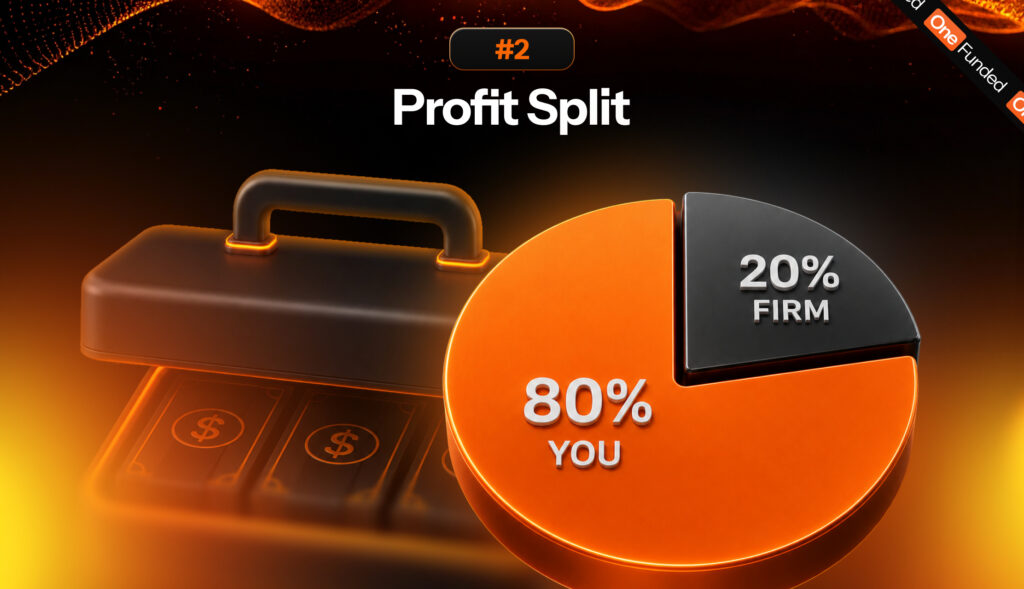
At OneFunded, the profit split is 80% to the trader. However, you can bump this up to 90% if you buy the Profit Split 90/10 add-on as you purchase a challenge plan. The split isn’t the only thing that grows. OneFunded’s scaling plan raises your capital by 20% to 40% across five levels, up to $1 million, once you’ve completed three consecutive profitable payout cycles with at least 6% net profit in each. Requests are reviewed within 48 hours. On a split-versus-capital basis, a bigger account at 80% often pays more than a smaller one at 90%.
The standard profit split at FTMO is 80% on 2-step challenge accounts; this number goes to 90% on the 1-step challenge. The 80% minimum lives at The5ers on its High Stakes program (Hyper Growth starts at 75%), and the 100% split only arrives at the top scaling tiers. BrightFunded’s profit splits can reach 100%, but you can only get this from your third successful account scale-up.
At FundingPips, the structure is a tad different. The exact profit split you get depends on how long you’re willing to wait between payouts.
Want to get your money every week? You’d get just 60%. Willing to wait for two weeks? 80% of profits are yours. If you don’t want to stick to a calendar and get your money when needed, the prop firm locks you to a 90% profit split. And if you’d like to go one month without making a payout request, you’d get 100% of your profits.
| Good sign | Red flag |
|---|---|
| The starting split is stated as a number, not as “up to” | The homepage says “up to 100%” and the product page reveals an eight-month ladder |
| The conditions for each step are published with dates and thresholds | “Contact support to discuss your split” |
| Add-on prices are visible before checkout | You can’t tell which split you’ll actually get until after you’ve paid |
IMPORTANCE (9/10): A 10% profit split can add up pretty fast. Say you make $20,000 in profits. The gap between an 80% split and a 90% split is $2,000 in your account. Before you select a prop firm, check out the starting split and know the steps you need to take to access higher splits.
You’d need to pay a select amount to access the challenge account of your choice. It’s like an admission fee and an important factor when considering how to choose a prop firm. But only a few prop firms will give you your money back if you pass the challenge.
OneFunded refunds 100% of what you paid on its Core, Flash and Value plans. On Core, that refund lands with your first payout; on Flash and Value, it lands with your third. So, you’d get back the fee you paid, $899, for a $200K Core plan. You don’t have to ask for it, either: the refund is applied automatically. At FundedNext and FXIFY, you have to request it yourself, and at BrightFunded, it only exists if you bought the add-on.
FTMO also gives a 100% refund on challenge fees. But it depends on the kind of challenge. If you key into a 2-Step Challenge, you’d get your fee back after your first payout. On the flip side, you won’t get a refund on the 1-Step Challenge account.
At FXIFY, you’d get a challenge fee refund on the 1-, 2-, and 3-phase plans. However, this refund isn’t automatic; you have to request it manually.
RebelsFunding has a unique stance on refunds. If you purchase their Copper challenge and pass, you’ll get a 200% refund. So, if you paid €599 for that challenge and you pass, you’d get €1,198 back. You’d also get a refund on its Bronze program (150%), Silver program (100%), and Diamond program (100%). The Gold program has no fee refund at all.
But it isn’t easy to get refunds. On BrightFunded, refunds only apply to traders who bought the 100% Challenge Fee Refund add-on when buying their challenge plan. At ThinkCapital, challenge fees are only refundable after a third profit payout.
You’re automatically disqualified from fee refunds if you buy into select challenge plans. At OneFunded, for example, the Instant plan won’t get a dime in refunds.
| Good sign | Red flag |
|---|---|
| The refund rule names the plan and the payout number | “Refundable fee” with no conditions attached |
| The refund is automatic | You have to request it, and the deadline isn’t stated |
| There’s also a cooling-off refund if you never traded | The only refund route is a support ticket |
| Above-100% refunds are explained, not just advertised | A “200% refund” headline that applies to one tier out of five |
IMPORTANCE (8/10): A refundable fee is great to have; even though it’s your deposit, it still feels like a prize for passing certain challenges. As you check out different prop firms, see if the plan you’re interested in offers a fee refund. And if it does, see what you need to do to get it.
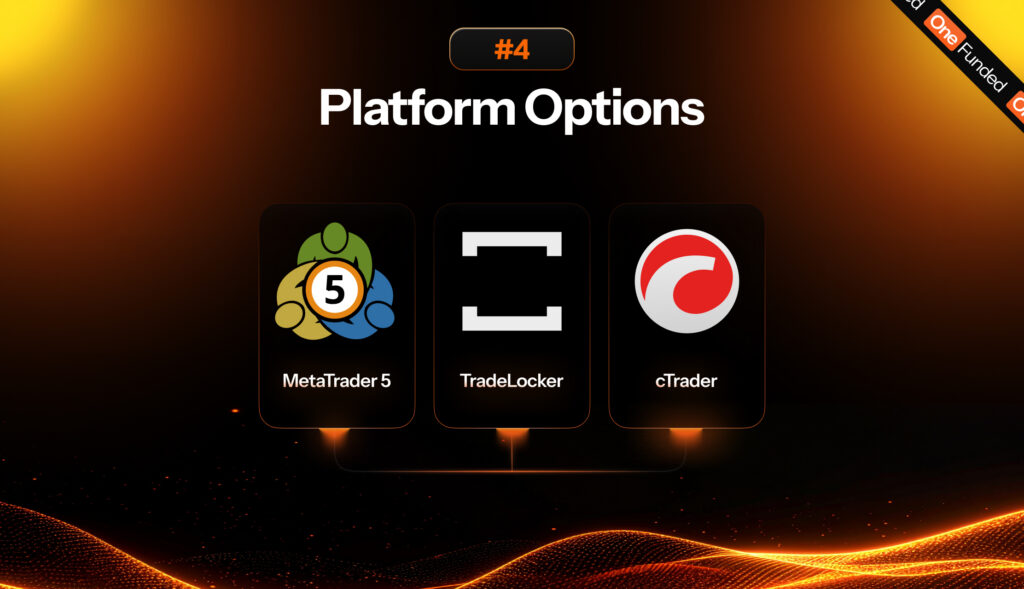
A trading platform is the tool that you use to place trades. It’s your workspace. And when thinking about how to choose a prop firm, this is one of the key things to consider. If it feels cluttered, you’d make mistakes no matter how foolproof your strategy is.
It’s 2026, and most traders trust platforms such as MetaTrader 5 (aka MT5), TradeLocker, and cTrader. A prop firm that supports any of these allows you to make trades as soon as possible.
OneFunded supports the three major platforms listed. This means you can pick whichever variant is convenient for you. That flexibility is important, as it saves you hours of getting frustrated by a particular tool.
At FTMO, you can use MetaTrader 4, MetaTrader 5, and cTrader. If you start your trading adventure at FundingPips, MT5, cTrader, and Match-Trader are available. FundedNext has the same platforms as FundingPips, plus MT4 and exclusive alternatives like NinjaTrader, Tradovate, and TradingView.
The firms we’ve mentioned do well in this category. This is because they feature platforms that most traders already know how to use.
Some firms go the extra mile to create their own platform. RebelsFunding has a custom platform called RF-Trader. ThinkCapital has its very own ThinkTrader, and it is the only platform the firm offers. However, these custom platforms have learning curves you need to go through for seamless use.
| Good sign | Red flag |
|---|---|
| The platform list is on the challenge page, with country restrictions | You find out at account setup that your platform isn’t available where you live |
| You can pick the platform at checkout | The choice is final and undisclosed until after payment |
| Automation support is stated per platform | “EAs supported” with no mention that the API is missing on one platform |
IMPORTANCE (8/10): Most prop traders use MT5 or cTrader due to how simple and intuitive they are. If you’re among this set, make sure you pick a site that supports these tools. If you don’t, placing trades will become a chore quickly.
You placed trades on a funded account and got a profit. You’re happy and hit WITHDRAW. What happens next? Will you get your money in one hour? A day? A week? A month?
Payout speeds let you know how long it’ll take for a prop firm to send your money. This is vital, as money in your prop account is cash you can’t spend or invest. You can only do these things when it’s in your personal account.
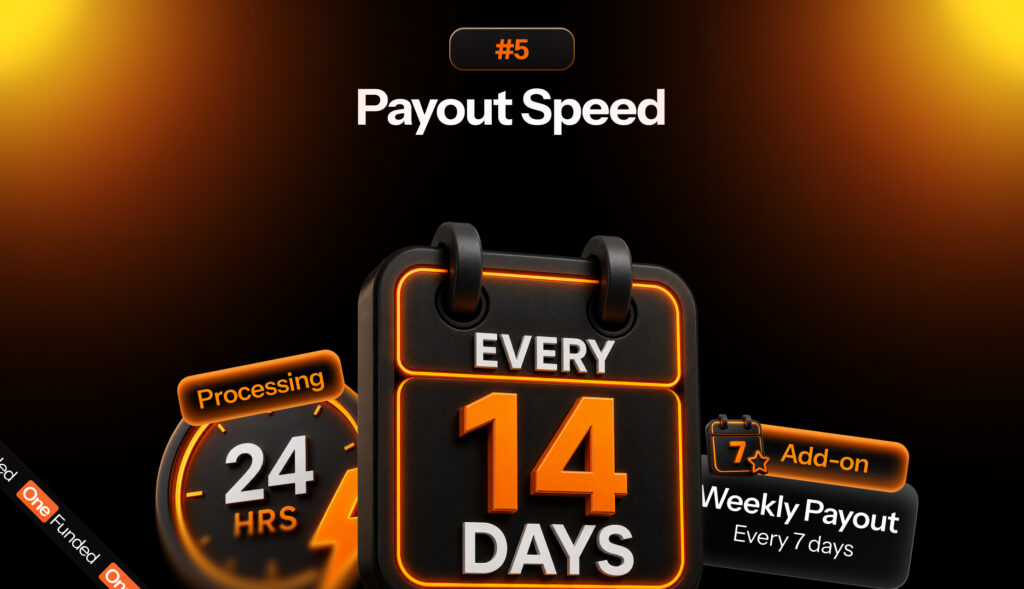
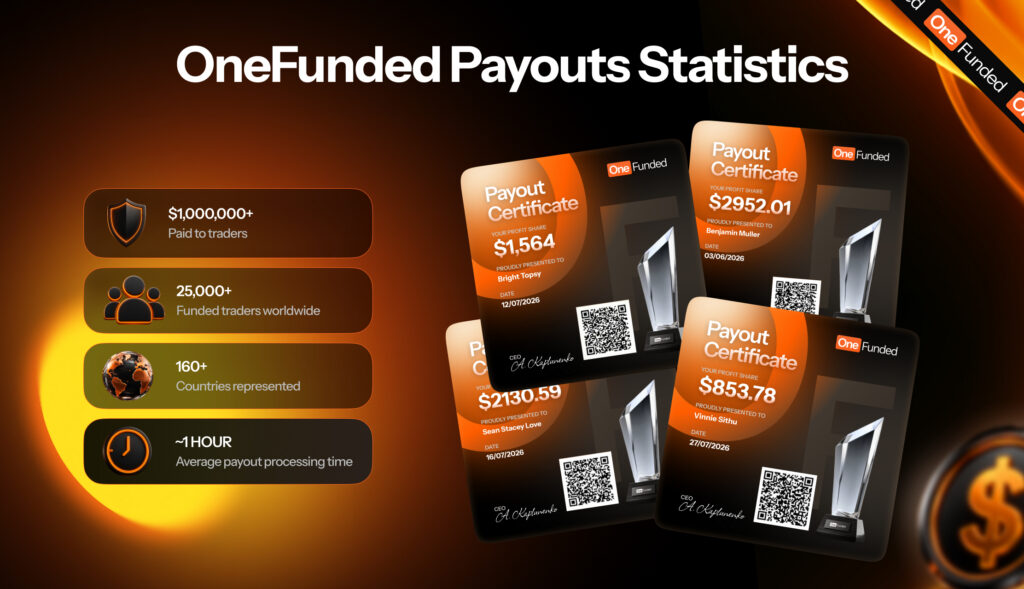
OneFunded processes payout requests within 24 hours — over the last 30 days, the average was under an hour. The prop firm permits one request every 14 days. But if you purchased the Weekly Payouts add-on, you can request withdrawals every 7 days. Requests run from $100 to $10,000 apiece, and the cycle, the caps and the payment methods are all published in the help centre before you buy.
FundedNext promises that it’ll process all payouts within 24 hours. It even goes further to say that if it defaults on this timeline, they’d give you $1,000 in extra compensation. Put your money where your mouth is, eh?
At FXIFY, crypto payouts take 24 to 48 hours to process, while regular withdrawals take 1 to 3 business days. On the 1-, 2-, or 3-phase accounts, you can cash out your first payout when you like. After that, its user agreement limits you to one request every 30 days, unless you buy the bi-weekly payout add-on.
The5ers, FTMO, and ThinkCapital have a 14-day payout cycle. And just like OneFunded, ThinkCapital allows users to cut that down to 7 days if they purchase the 7-day add-on.
Speed is where they part ways. The5ers processes payouts within about 72 hours, and FTMO takes 1 to 2 business days to verify a request and 1 to 2 more to send the money. ThinkCapital doesn’t publish a processing time at all.
FundingPips has more flexibility in the withdrawals department. This is because it lets you pick from different cycles (weekly, bi-weekly, monthly, and on-demand). Generally, FundingPips processes requests within 1 to 3 working days, plus 1 to 2 more for the money to land.
| Good sign | Red flag |
|---|---|
| Cycle and processing time are both published, separately | Only “fast payouts” appears, with no number |
| The firm names a consequence for missing its own deadline | Processing time is “not published” anywhere |
| Fees, minimums and per-payout caps are listed upfront | You discover a 2–3% fee or a $2,000 cap at the request screen |
| Payout proof is public and recent | The most recent payout proof is months old |
IMPORTANCE (9/10): Speed, especially when it comes to payouts, is super important when you’re looking for the best prop firm for you. You don’t want to get started at a spot that holds onto your money for weeks when you could find one that pays out within a few days.

You’re trading, and your chart freezes up. You try to reload the tool, and nothing’s working. You need help right now, as that spot you want to take isn’t waiting for you.
Good support can save a challenge account. That said, bad support could cost you a challenge. So, it’s vital that you get this part right when you’re looking for a prop firm.
At OneFunded, you can get assistance 24/7 via live chat, email, and Discord. If you want swift answers, we recommend using the chat as it taps into the site’s knowledge base.
FTMO does well when it comes to customer care. It provides support in over 20 languages. You can get help via several channels, including the live chat, WhatsApp, email and phone. Bots don’t dish out answers via the chat; humans do, around the clock.
CTI (City Traders Imperium) fares well when it comes to customer support. Like the firms we’ve listed already, it has a live chat. Support is also available via email, though the chat is quicker: CTI publishes an average response time of 9 minutes across its channels.
| Good sign | Red flag |
|---|---|
| Hours and time zone are published, not just “24/7 support” | “24/7” appears in marketing but nowhere in the help centre |
| Support in a language you can argue a payout dispute in | Support only in a language you’re not fluent in |
| A searchable help centre that answers rule questions without a ticket | Every rule question requires a ticket |
IMPORTANCE (8/10): Customer support is vital to your success as a trader. When you ask the questions and get answers immediately, you can know what to avoid and troubleshoot (in light of an issue). Check the firm’s support hours against the sessions you actually trade. OneFunded, FTMO, FundedNext and CTI all state 24/7 coverage, while The5ers runs Sunday to Thursday, 07:00–15:00 GMT, and FXIFY doesn’t staff weekends.
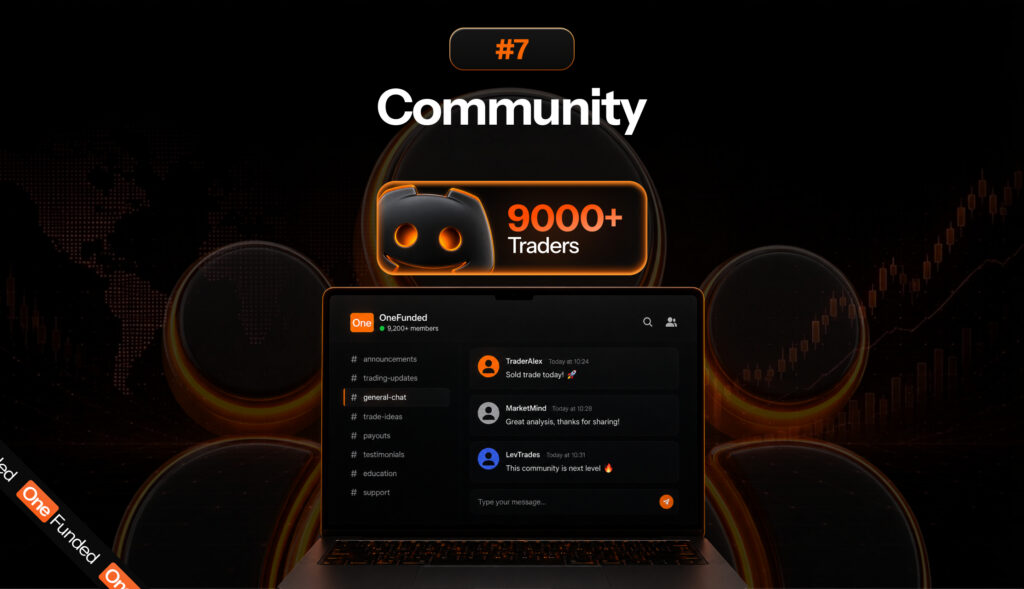
Most people take trading like a solo journey. But it shouldn’t be the case. Having a strong community you can reach out to anytime is crucial. With one, you can learn new things and talk to people about your woes before they eat you up.
OneFunded has a Discord community with 9,000+ members. You’d find multiple subchannels, including those issuing trading updates and customer testimonials. The firm also runs an Academy — 29 lessons across 5 modules, free with any account — plus a blog covering risk management, drawdown in prop trading, and trading psychology.
FTMO has a huge Discord community. Traders can also converse with like minds on FTMO’s comment sections on Facebook, Instagram, and X.
CTI has a presence on Discord. Its channel is home to 28,000+ people. There’s a trading academy too. You can start for free and gain access to 281 lessons from a senior trader with over 24 years of experience, Daniel Martin.
The academy gives knowledge on trading fundamentals, strategy, psychology, and how to get funded. 100% commitment can turn a trading noob into a profitable trader with working strategies.
| Good sign | Red flag |
|---|---|
| Free education with a named, credentialed teacher | “Academy” that is a paywall after two lessons |
| A blog that explains rules, not just announces promos | Content that never mentions the firm’s own restrictions |
| Channels where staff answer in public | An invite link to a server nobody has posted in for weeks |
IMPORTANCE (7/10): A great community won’t place your trades for you. Instead, it can teach, support, and keep you from making rookie mistakes. Look for prop firms with active Discord servers, updated blogs, and free courses. These mediums give you context on the fundamentals needed to go pro in the trading scene.

and fees before you spend real money. There are no surprising T&Cs hiding in the FAQs section.
A quick test. Open the firm’s help centre and try to answer three questions in a couple of clicks each:
If any of those sends you hunting through the terms, or if the landing page and the help centre disagree, that’s your answer.
OneFunded puts all its rules on the challenge page. This area highlights metrics like profit targets, drawdown limits, minimum trading days, and profit splits. You’d see all these and the challenge’s price before you spend money. OneFunded has no hidden conditions. Two things worth checking that most firms skip. OneFunded publishes the exact formula behind its best-day rule, not just the percentage. And when the rules change, the superseded version stays online with the dates it applied, so traders who bought an earlier challenge know which set governs their account.
Rules are also straightforward on FTMO. You’d realize it restricts news trading and weekend holding on standard funded accounts: on Normal accounts, you can’t open or close a position within two minutes either side of a selected news release, and positions have to be closed before the weekend. Swing accounts have no restrictions, and none apply during the challenge — so a habit you picked up before you reached funded status can put your account at risk the moment you’re funded.
The5ers has clear but strict terms and conditions. Strategies like arbitrage trading, tick scalping, high-frequency trading, and news sniping aren’t allowed. Disobey any of these rules, and the prop firm reserves the right to terminate your account.
RebelsFunding has clear rules on all its challenge tiers. However, with a proprietary trading tool in place, traders used to MT5 or cTrader will have issues adapting.
One more rule to look for while you’re there: the best-day (consistency) limit, which caps how much of your profit may come from a single trading day. OneFunded applies 50% on funded accounts and 15% on Instant, and publishes the formula it uses; FundingPips uses 35%, ThinkCapital 20% on its Bolt accounts, and BrightFunded and CTI have none. It usually delays a payout rather than closing an account, but it decides when you get paid.
These are the rules that don’t fit in a comparison table and still decide whether you get paid:
| Good sign | Red flag |
|---|---|
| Every rule is on the challenge page, or one click away, before checkout | Key rules live only in the T&C PDF |
| Superseded rules are archived with the dates they applied | Rules change silently and old accounts find out the hard way |
| The firm states what happens when you break a rule — breach, soft breach, or delayed payout | Consequences are described only as “the firm reserves the right” |
| Prices are visible without creating an account | You must register to see what a plan costs |
IMPORTANCE (10/10): Read every rule before you purchase a challenge at a prop firm. Be on the lookout for restrictions on weekend holding, news trading, and copy trading. If a firm doesn’t publish everything in one place, stay away to avoid “had I known” realizations down the line. Check out our piece on “What is a Prop Firm? The Complete 2026 Guide” for context on what you need to look out for.
As part of this prop firm checklist, all firm data was checked against each firm’s own rules pages and help centres in August 2026. Prop firm terms change often, so check the firm’s own pages before you buy.
| Prop Firm | Drawdown (flagship plan) | Profit Split | Fee Refund | Platform Options | Payout Speed | Customer Support |
| OneFunded | 5% daily / 10% max, static (Core; Value 4%/8%, Flash 4%/6% — all static) | 80% to 90% | Core (1st payout), Flash and Value (3rd) | MT5, cTrader, TradeLocker | Under 1 hour average | Live chat, email, Discord |
| FTMO | 5% / 10% static (2-Step); 3% / 10% trailing (1-Step) | 80% to 90% | 2-step only, 1st payout | MT4, MT5, cTrader | 1 to 2 business days | Live chat, email, WhatsApp, phone |
| FXIFY | 3% / 6% trailing (1 Phase); 3 Phase is static | 75% to 90% | 1, 2, and 3-phase (on request) | MT5, TradingView, DXTrade | 1 to 3 business days | Email, live chat |
| The5ers | 5% / 10%, static max (High Stakes) | 75% to 100% | Varies by program; partly hub credit | MT5, cTrader, TradingView | About 72 hours | Live chat, email |
| FundedNext | 5% / 10% static (Stellar 2-Step); 1-Step 3% / 6% | 80% to 90% | Stellar 2-Step (1st payout, on request); 1-Step and Lite (3rd) | MT4, MT5, cTrader, Match Trader, TradingView, NinjaTrader, Tradovate | Within 24 hours | Live chat, email, Telegram |
| RebelsFunding | 5% / 10% static (Copper to Silver); 6% max (Gold, Diamond) | 75% to 90% | Copper 200%, Bronze 150%, Silver and Diamond 100%, Gold none | RF-Trader (doesn’t support other traditional platforms) | Not published | Live chat, email |
| FundingPips | 5% / 10% static (2 Step Standard); Zero 3% / 5% trailing | 60% to 100% | 2 Step Standard only, 4th payout | MT5, cTrader, Match Trader | 1 to 3 business days | Live chat, email |
| BrightFunded | 4% / 8% static (2-Step Bright); 1-Step 3% / 6% trailing | 80% to 100% | All accounts (must select the refund add-on on checkout) | MT5, cTrader, DXTrade | Within 24 hours | Live chat, email, WhatsApp |
| CTI | 5% trailing, no daily limit (1-Step); 2-Step 5% / 10% static | 70% to 100% | Not published | MT5, Match-Trader | 24 to 48 hours | Live chat, email |
| ThinkCapital | 3% daily static / 6% trailing (Lightning) | 80% to 90% | All standard accounts (3rd payout) | ThinkTrader | Not published | Live chat, email |
Risk notice: prop firm challenges are evaluations on simulated accounts, not investment products, and most participants don’t pass one. Nothing in this article is investment advice.


The first thing you should check is the drawdown rules — and the type before the number. A static limit, like the 5% daily and 10% overall on OneFunded's Core plan, is measured from your starting balance, so every dollar of profit widens your buffer. A trailing limit follows your account's high-water mark instead, and that buffer never grows.
OneFunded processes payouts within 24 hours, usually in under an hour. Firms like FundedNext will give you $1,000 in compensation if they fail to process your withdrawal within 24 hours.
Yes, it does. If you're used to cTrader or MT5, it'll be best to pick a firm that supports one or both. If you start trading on a platform you're unfamiliar with, you'll have issues when placing trades. FTMO, OneFunded, and FundedNext support these trading platforms.
It depends on the firm you're at. OneFunded lets you trade the news on all account types, though trades placed in the five minutes either side of a high-impact release are reviewed. On FTMO, you can't open or close a position within two minutes either side of selected releases on standard funded accounts.

You’re at checkout. You’ve picked your challenge, and there’s one more choice to make: which platform? The cTrader vs MT5...

If you’ve ever looked for prop firm challenges, you have probably seen two options: 1-step vs 2-step prop firm challenges....

Every prop firm challenge has a unique set of rules. This includes profit targets, drawdown limits, and consistency demands. Most...
 Set Preferred on Google