



How to Scale a Funded Trading Account: From First Payout to Larger Allocations
You passed a prop firm challenge. Congratulations. But doing that just taught you a set of rules. Once you’re funded, the playbook changes. And this switch is one that nobody warns you about. Here’s one that matters most. If you want to scale a funded trading account at OneFunded, you need to have at least three payout cycles in a row. Each of those payouts must come in at 6% or more.
The rule is in the percentage. It doesn’t change no matter how big your account is. A trader with a $5,000 account and another with a $200,000 account obey the same principle.
Here’s how that 6% works out in actual cash:
| Account Value | One Cycle at 6% | Three Cycles Put Together |
| $5,000 | $300 | $900 |
| $25,000 | $1,500 | $4,500 |
| $50,000 | $3,000 | $9,000 |
| $100,000 | $6,000 | $18,000 |
| $200,000 | $12,000 | $36,000 |
Now’s the time to find your row. See those figures in the second and third columns? They’re all that stand in your way to a bigger account.
Three words in OneFunded’s scaling rule do all the work. In a row talks about three back-to-back payout cycles. It doesn’t mean three cycles spread across a year.
Say your first payout meets the 6% mark and your second doesn’t. This breaks the chain; your cycle goes back to zero, and you’d need to stack from there.
To land your account after meeting profit targets, you need to send an application. Once you do, OneFunded will run checks on your profile. If they don’t find anything suspicious, they’ll approve your scaling request within 48 hours.
But what happens before you scale? Keep reading for the answers.
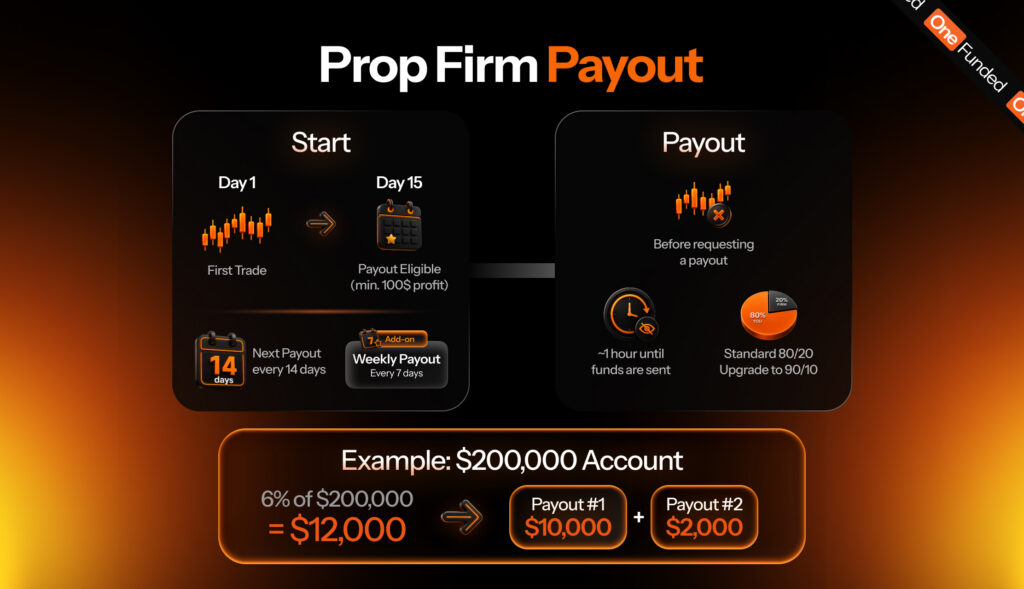
Time and tide wait for no man. This is the case at OneFunded. A clock starts to tick when you make your first trade on the platform. It doesn’t tick forever and will run for 14 days.
On the 15th day, you get the luxury of requesting a payout. You can do this if you’ve made a minimum of $100. After your first payout, you can request payouts after 14 days. What’s more? The site’s Weekly Payout add-on trims this wait period to just 7 days.
But that’s not all. Here are other T&Cs you’ve got to know about:
You see that $10,000 cap we talked about? It gets more and more important as you climb higher. It gets more and more important as you scale a funded trading account and climb higher. If you’re on a $200,000 account, for example, one cycle of 6% is $12,000. You can’t withdraw this figure at once. Rather, you’d need to break things down. This might mean making a first payout request of $10,000 and another of $2,000.
The Best Day Profit Ratio (AKA consistency rule) is your best trading day divided by the total profit you made in one cycle. OneFunded checks the result before they pay you a dime.
In simple terms, see your profit cycle as a cake. Your best day is a slice of it. However, that slice can’t be bigger than the cap placed on your account.
Let’s give an example of two traders to show how this rule works. They’ve been on a $50K account for two weeks, finishing a $3,000 cycle under a 50% consistency rule cap.
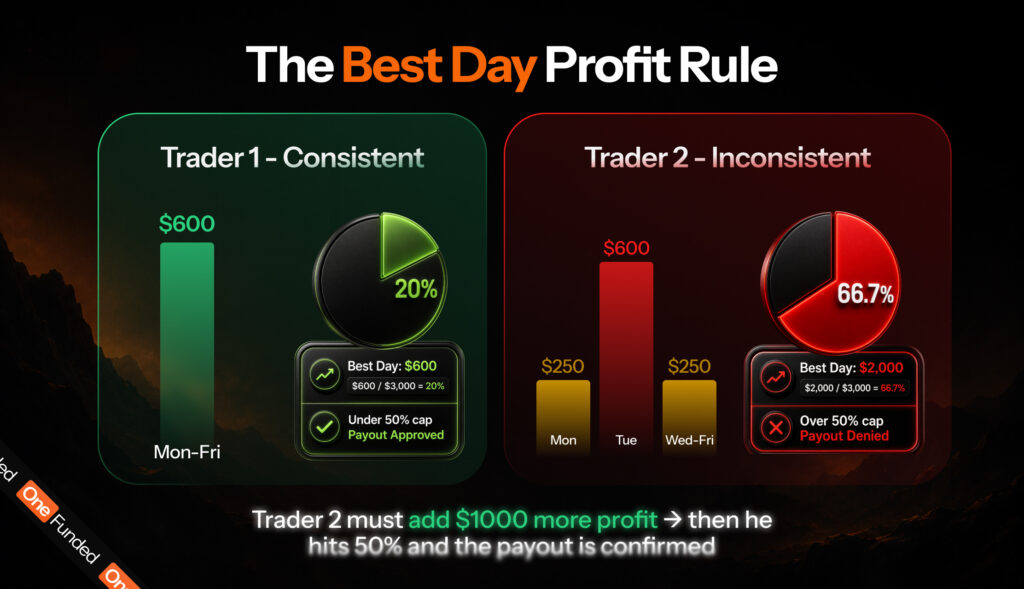
The first trader gets $600 in each of the five days. This brings their best slice to $600 out of a cake valued at $3,000. $600 represents 20% of everything they got. This falls under the 50% cap, so they can request a payout and get their money.
The second made $2,000 on a Tuesday where the stars seemed to align. On the remaining four days, they got $250. It’s still the same $3,000, but their best slice is 66.7%. They won’t get paid at that point.
To get paid, they’d need to keep trading. They’ll do this until their total profits get to where their best day’s profits ($2,000) make up for 50% or less of their total profits.
Using actual figures, they have to trade until they get $1,000 extra in profits for that cycle. This takes their total profits to $4,000, and their best day’s profit of $2,000 is 50% of that.
From the second trader’s tale, you can see that a big win doesn’t get you closer to scaling. It does the reverse and slows you down.
Bad days also affect you. If you have a losing day, the cake gets smaller. So, your best slice (most profitable day) takes a bigger part of the cake.
Let’s say you lose $500 on a $3,000 cake. At this point, your profit target goes down to $2,500. If your best day’s profit is $1,500, it’ll represent 60% (instead of the 50% if your target stayed unchanged) of your profit target. As such, you’d be unable to withdraw.
We’ve talked about the consistency rule. But the exact cap depends on your account type and the day you purchased it.
| Your Account | Best Day Cap at Funded Stage |
| Core, Value, or Flash purchased from the 26th of June, 2026 | 50% |
| Core, Value, or Flash valued at $100,000 and $200,000 | 30% |
| All Core, Value, or Flash bought before the 26th of June, 2026 | 30% |
| Instant Funding, all sizes | 15% |
From the table above, you can see that two traders on OneFunded can be subject to two rules. A $50K Core account you bought in July runs at 50%. But a friend who bought a $100K account that same day is subject to a 30% cap. So, make sure you look at the numbers before purchasing a challenge.
Your drawdown on OneFunded will change to suit the plan you’re on:
| Plan | Daily Loss Limit | Overall Loss Limit |
| Flash | 4% | 6% |
| Core | 5% | 10% |
| Value | 4% | 8% |
| Instant | 3% | 6% |
Put the figures in the table against the scaling rule at OneFunded. On the Instant and Flash plans, the max loss you can take in an account’s lifecycle is 6%. For these plans, a qualifying payout cycle is equal to 6%.
Yes, you read that right. Your full drawdown limit is equal to just one payout cycle. It’s 10% on Core, close to two cycles.
Your overall drawdown cap is also fixed, not fluid. So, whatever you lose on day 1 remains there and never goes up behind you as you trade and make more money.
This sounds great on the surface, but let’s look at what takes place when you start to scale.
Profits give you room to breathe. If you make 6% in profits, it represents one cycle, and you sit 6% over your floor. However, when you take that 6% out of your account as a payout, you’d see you’re back to square one.
When you do this three times, you start to notice a pattern. That cushion of yours never gets bigger. Scaling requires you to have three consecutive payouts.
So, if you grind for six weeks in a row, your account could still go bust if you go past your overall drawdown limit.
This is why many traders find it difficult to scale. It isn’t because of one bad trade. Rather, most accounts go up in flames just because the trader assumed they had a rising safety net that was never there.
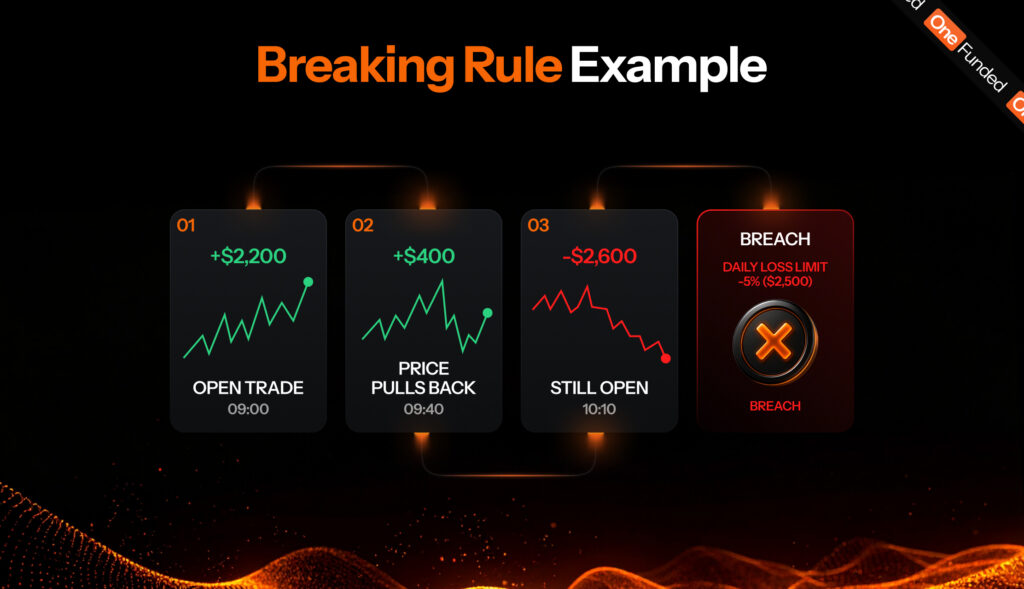
OneFunded counts every open and close trade you make. If a position you’ve opened falls from a big profit to a small one, it’s a loss against your daily limit. You don’t need to close anything to breach a rule.
The daily limit on your account resets at midnight (UTC time). Your floor doesn’t. Breaking a limit doesn’t end your cycle only. It also ends your account, and you’ll lose every dollar you made in profits.
This blog article titled “What is Drawdown in Prop Trading?” details what happens when you break a limit.
It glosses over a trader on a $50K Core evaluation account that broke the 5% daily loss limit just 40 minutes into a London session on a GBP/JPY gap. He’d already lost $2,600 before he reacted. Since he breached his daily loss cap (by just $100), his account was terminated.
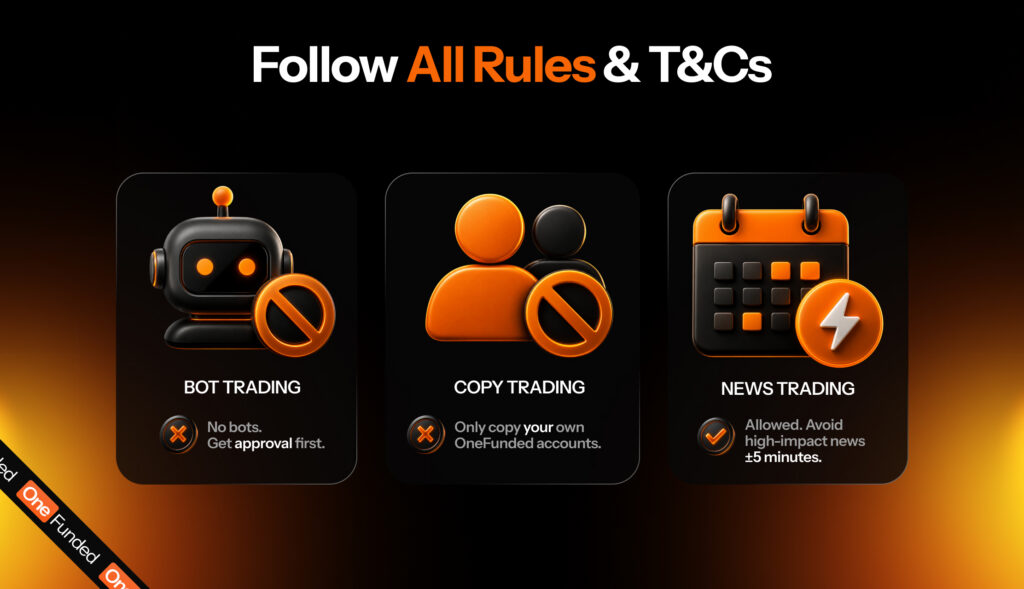
Staying clean at OneFunded isn’t about sticking to daily and overall loss limits alone. To have a clean account, you need to meet other T&Cs:
If you break any of the rules listed above, you’ll face consequences from OneFunded. These can range from trading restrictions to losing your account outright.
You won’t lose money from a policy violation as you would on drawdown breaches. But you’ll lose your scaling streak, and that can undo weeks of grinding.
Note that these rules only apply to prop trading. Want to know which alternative is better? Take a peek at our prop trading vs. self-funded trading article.
The total amount you can have on all your OneFunded funded accounts put together can’t exceed $200,000. But a prop firm scaling plan lets you go past this limit:
| Level | Name | Account Percentage Growth |
| 1 | One Step | 20% |
| 2 | One Stride | 25% |
| 3 | One Jump | 30% |
| 4 | One Run | 35% |
| 5 | One Leap | 40% |
Let’s look at a $200,000 account going through all five levels:
With scaling in the mix, you’ve been able to grow funded account almost four times its size. All these happened without the trader adding a cent of their money.
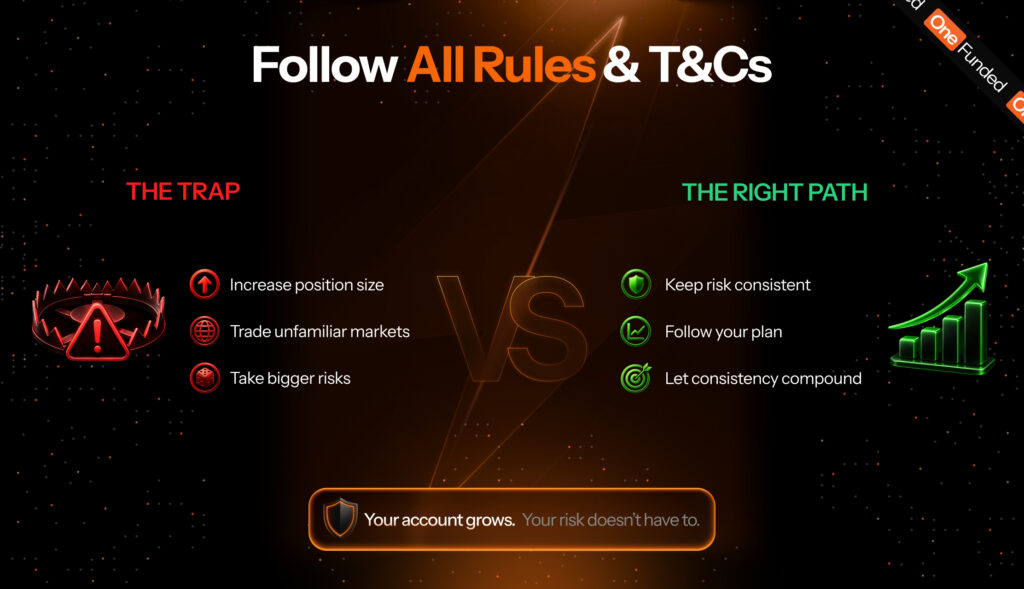
When you move from one tier to the next, you get a bigger balance. But that isn’t a pass for you to start risking more. If you risked 1% before scaling up a step, stick to it.
The 6% profit target you need to hit to climb the ladder in a new tier is bigger than what was in the last level. No need to chase it. Your scaling plan should be simple. With the right moves, the profits you seek will come.
If you fall into the trap of taking bigger risks and going into markets you’re unfamiliar with, you’ll most likely lose your funded account before finishing the scaling progression.
You’ve learned all there is to know about scaling at OneFunded. The bigger account isn’t a reward for a great month; it’s a prize for three payouts that hit the target in a row. However, to scale a funded trading account and enjoy the benefits of scaling, you must meet the T&Cs outlined in this guide. Disregard any, and your account goes bust.
New to prop trading and would like to get to the phase where you get funded and scale to huge amounts? Choose a challenge that suits your needs today.


Join our mailing list today!
The fastest way is 42 days. This translates to three cycles in a row. But the Weekly Payout add-on being applied cuts this down to 21 days.
Not really. This is because the rule is 6% per cycle three times in a cycle, regardless of account size.
This caveat states your best day can't go above a set percentage of your profit target for a cycle. If you exceed this limit, your payout is held until you make profits that even things out.
It doesn't. Payouts represent progress. As long as you hit the profit target of 6% or more in a cycle, it counts towards the three you need in a row to scale.

Are prop firms legit? While some are, some aren’t. However, you can tell whether they’re legit or not if you...

Most, if not all, traders want to enjoy the massive capital opportunity that a proprietary trading firm, or prop firm,...
 Set Preferred on Google