



Trading Psychology During a Prop Firm Challenge: What Separates Funded Traders

Trading psychology during a prop firm challenge plays an important role more than strategy does. The majority of the traders come to a challenge with a working edge ready to use. The only thing that really differentiates those traders who get their funding from those who won’t is how they will act using that edge when they are close to earning the money and one wrong move is enough to destroy all their previous hard work.
A trader with $50,000 in his/her account starts a OneFunded Core challenge and manages to make a profit of $3,900 on day two of it. Only $100 is left to reach a profit target of 8%, which equals $4,000. One more successful day is enough for that. But, instead, the trader decides to open one more trade position of 3% of his/her capital, almost doubling the previous positions. In eleven minutes, the trader loses $2,100 going after that last $100.
This article focuses on the process of evaluation stage only; this is the stage that starts right from when a trader buys the challenge to the time he passes it or fails.
A prop firm evaluation works like a controlled experiment in decision-making under a deadline that doesn’t officially exist. OneFunded challenges carry no time limit, but traders act as though one is ticking anyway, because every session moves them toward a profit target or toward a drawdown floor. Neither direction stays neutral for long.
There are three key moments in the evaluation process where traders are likely to make poor decisions: approaching the target level, the period following a good start, and for traders in programs where it applies, reaching a point where the best trading day exceeds OneFunded’s consistency limit. Every moment requires handling a particular instinct, which traders can manage if they prepare in advance.
Taking away a deadline makes the situation even trickier, as it is impossible for traders to blame time pressure for their decisions. Trading psychology during a prop firm challenge still plays a major role. The trader working in accordance with a deadline faces pressure from the calendar, while the trader taking on OneFunded’s evaluation experiences pressure from proximity to the target or drawdown level or to a certain limit of a rule.
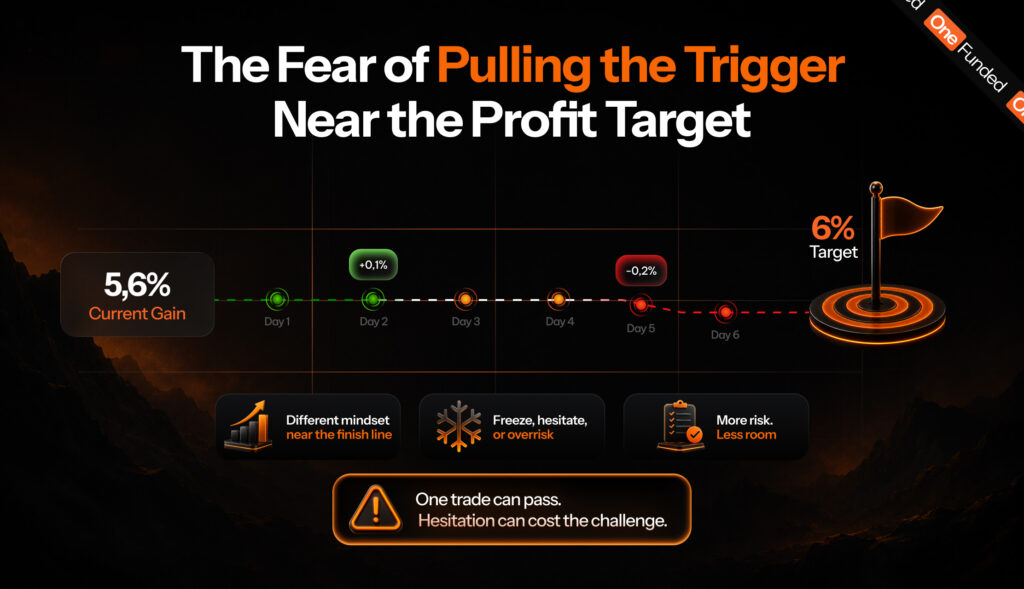
A trader doing a Value challenge of $100,000 is at 5.6% gain while having a goal of reaching 6% for Phase 1. It just takes one profitable trade for this trader to pass the phase. However, instead of making this happen, the trader decides to pull out from all viable positions.
Over the next six days of trading activity, there will be no improvement; there will only be an increase of 0.1% on one day and a decline of 0.2% on another day. This trader isn’t managing risk; they’re avoiding making a decision. Afraid that one losing trade could cause the challenge to fail, they stop trading altogether instead of confidently executing their strategy.
This pattern shows up constantly in evaluations and can look like discipline from the outside. In reality, discipline means following the same process regardless of how close you are to the target. What changes near the finish line is the trader’s perception of loss. Early on, a loss simply means losing money. Later, it feels like losing the funded account, the reward, and the outcome the trader has already started imagining.
There is another frequent behavior that typically shows up: instead of using the position sizing approach to reach the first 8% profit, a trader sitting 1% from target abandons the position sizing that produced the first 8% and doubles risk per trade to “finish it today.”
In both cases, the main reason for that is the same: a different attitude towards the last percent compared to the first one.
| Distance to profit target | Common behavior shift | What it actually does |
| 3–5% away | The trader executes the plan normally | Neutral |
| 1–2% away | Hesitation on valid setups; position sizes shrink without a rule requiring it | Extends the evaluation with no risk benefit |
| Under 1% away | Position sizes spike to close it out, or the trader freezes entirely | Raises the odds of a drawdown breach at the exact point where margin for error is thinnest |
In advance of the test, a trader should record the position size they used when reaching 5% profit, and resolve to take the same size or less until the goal is achieved. No rule in any OneFunded challenge, Core, Value, or Flash, rewards finishing faster.
The profit goal serves only as a binary benchmark; in the case of a Core challenge, passing at 8.0% will yield the same result as passing at 8.7%.
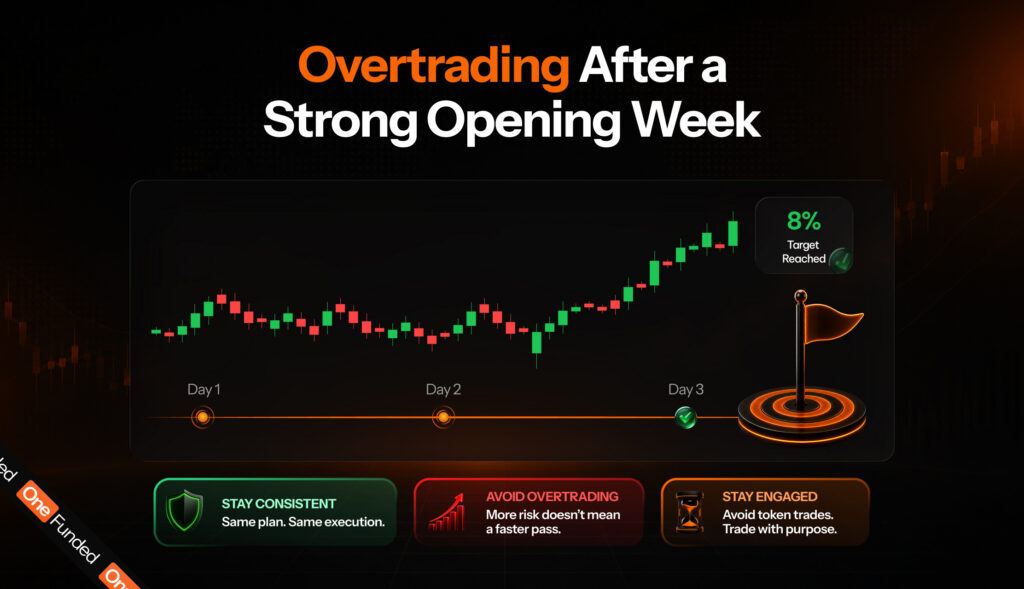
Traders participating in a $50,000 Core challenge reach their 8% Phase 1 target in two days from a single successful EUR/USD trading day.
According to calculations, the trader won the Core challenge. However, according to the rules, this is not the case. In OneFunded’s Core rules, the evaluation stage takes at least 3 days. As a result, the trader now has to keep trading a phase that this trader believes they have already finished.
Two opposite mistakes tend to follow, and both trace back to the same root cause. In both cases, the reason lies in the fact that traders consider that they have already won their challenges. This is where trading psychology during a prop firm challenge becomes especially important.
The first mistake is overtrading to pad an already-reached profit. After reaching the profit target, traders begin to take up any setup in order to be active, as more trades will most likely do good.
This is wrong, since every additional trade carries downside risk against a daily drawdown limit that stays fixed no matter how far ahead the account already sits. The trader participating in Flash faces the same 4% daily drawdown limit on the third day as on the first day.
The second mistake runs in the opposite direction: token trading. The trader enters a position at 0.01 lots just to record himself as being active for the day, stays in the trade for only two minutes, and then exits.
Such an approach may meet all the requirements for active daily trading, yet it means that the trader has already lost interest in the market, and that disengagement tends to produce careless execution when a real setup appears later in the same week.
| Trader behavior after hitting the target early | Result |
| Keeps trading the same size and the same setups used to get there | Meets the active trading day requirement without adding unnecessary risk |
| Increases size to lock in the win faster | Exposes an already-passed target to fresh drawdown risk |
| Reduces to token trades to wait out the requirement | Meets the letter of the rule but often produces careless execution once real trading resumes |
This approach takes the days after the initial target achievement not a victory lap or a chore. If the strategy that produced 8% in two days holds up, running that same strategy at the same size for the remaining required days converts a strong open into a pass with the least added risk.
Defending a gain and completing the task essentially become the same thing. Traders who do not understand this make one of the mistakes mentioned above.
OneFunded applies the Consistency, or Best Day Profit, rule differently depending on both the program and the account stage.
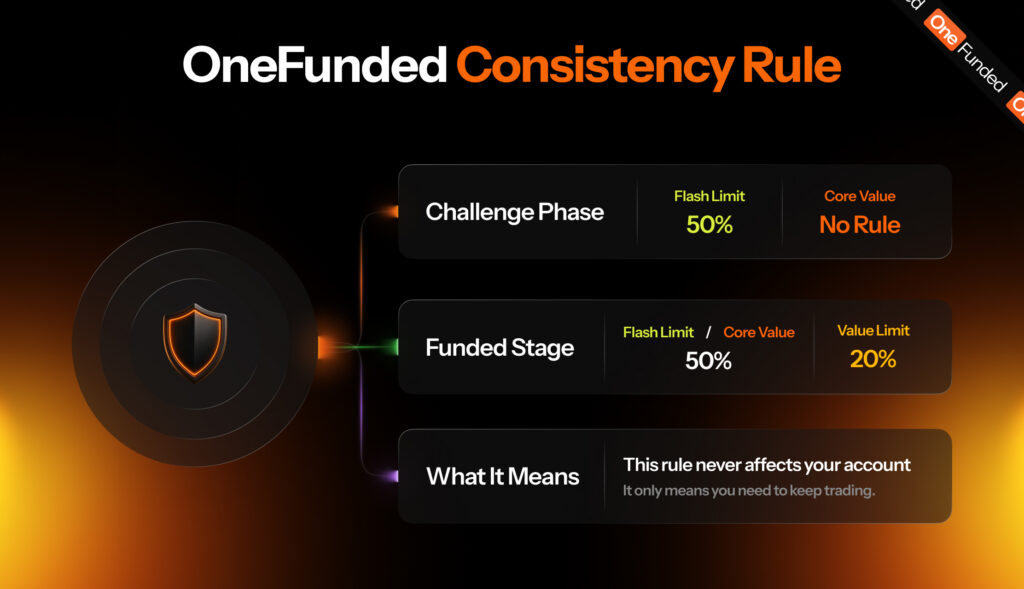
During the challenge phase, the rule applies only to Flash, where the Best Day Profit limit is 50%. Core and Value challenges do not have a consistency rule during evaluation. During the funded stage, the Best Day Profit limit is 50% for Core, Value, and Flash accounts, while Instant accounts use a 20% limit.
The Best Day Profit rule indicates the percentage of the trader’s total profit that the trader earned in one best day. If this ratio exceeds the limit when the trader achieves his or her profit goal, then the trader will not pass the stage. However, this rule never affects the trader’s account in any way; it only requires the trader to continue trading.
The first trader operates a $100,000 Flash account, where the challenge-phase Best Day Profit limit is 50%, and makes $2,000 on Day 1, $2,500 on Day 2, and $6,000 on Day 3 from a good gold trade. In total, the trader earns $10,500, which is enough to pass the profit target.
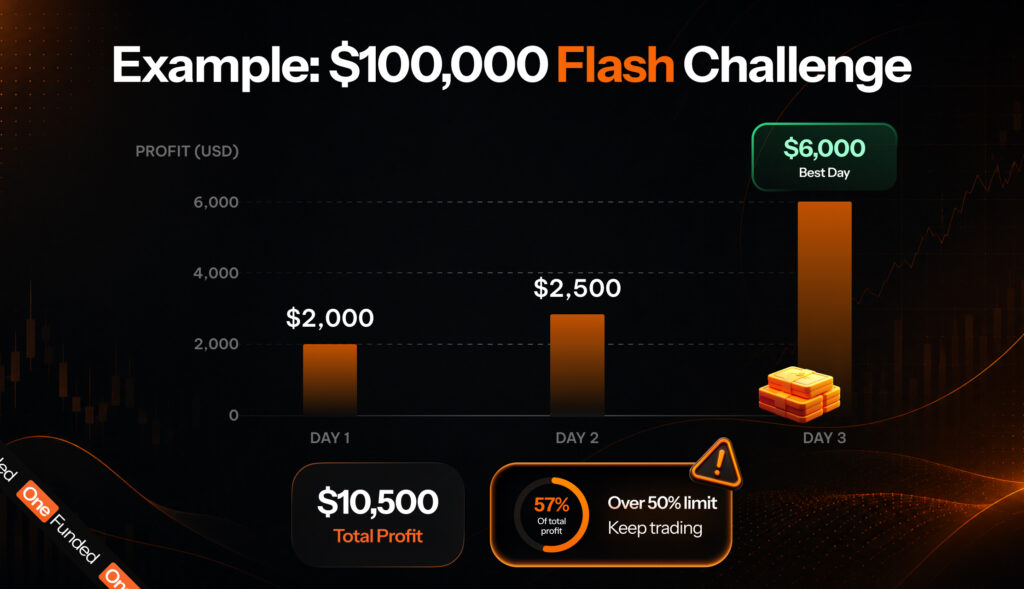
However, the best trading day produced $6,000, which represents approximately 57% of the total profit. Because the Flash challenge applies a 50% Best Day Profit limit during the evaluation stage, the trader has not yet satisfied the consistency requirement. The trader needs to continue trading until the best day accounts for no more than 50% of total profits. In this example, earning approximately $1,500 more without exceeding the existing best day would reduce the ratio to 50%.
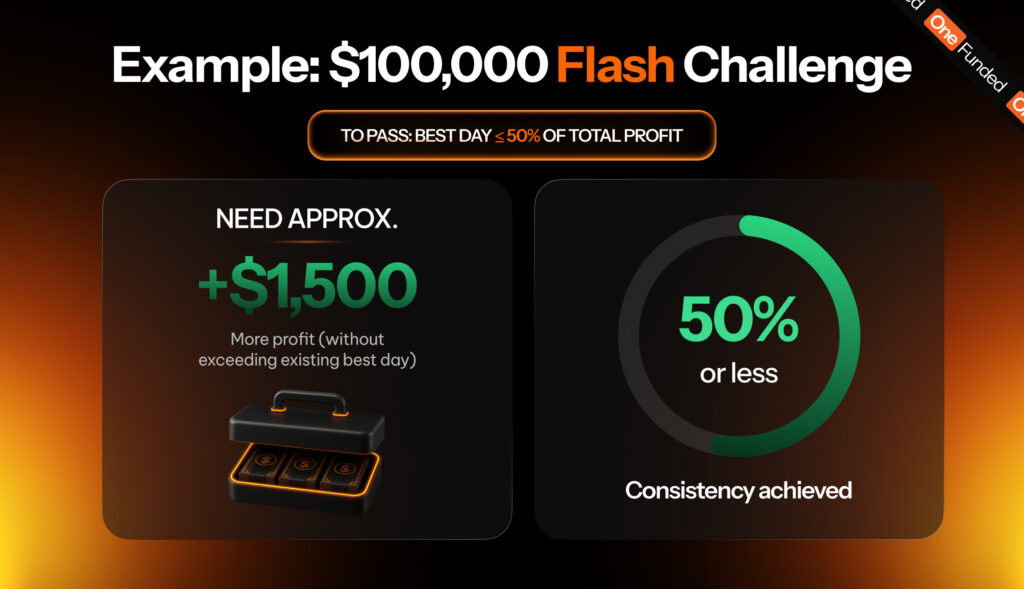
This system leads to an interesting psychological effect because traders can consider themselves done with the phase before the platform does so. Trading psychology during a prop firm challenge becomes especially important in this situation. And this discrepancy can lead to problems.
There are three unproductive reactions traders can have when they encounter this mechanism for the first time:
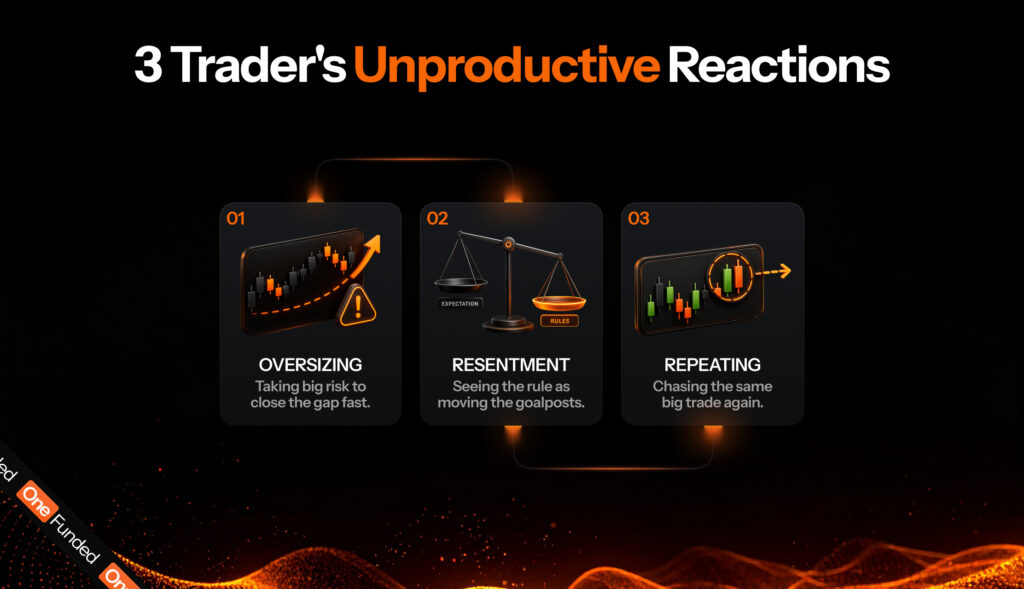
This strategy involves taking into consideration the consistency limit when making sizing decisions from day one.
For traders completing a Flash challenge, planning around the 50% Best Day Profit limit can help avoid needing additional trading after reaching the profit target. Rather than allowing one exceptionally large trading day to dominate total profits, traders should aim for steady performance across multiple sessions so the best day remains within the permitted percentage.
The OneFunded dashboard displays the current Best Day Profit ratio in real time alongside the applicable cap, so a trader does not need to run this math by hand mid-session. Taking this figure into account before increasing the size of trade on the day of success is quicker than the trade itself.
For the full mechanics and worked examples of how the ratio recalculates daily, see OneFunded’s consistency rule explainer.
The three traps above, fear near the target, overtrading after a fast start, and the consistency rule, share a common fix: decide the rules of engagement before the challenge starts, not while it is underway.
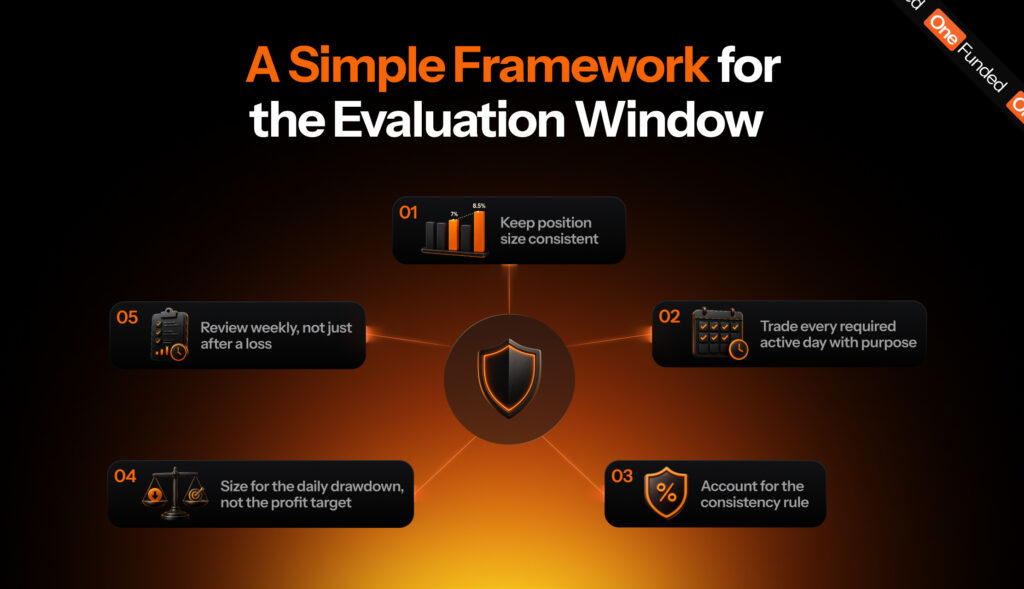
These measures do not imply any need for making more accurate predictions about the market. Trading psychology during a prop firm challenge is largely about this kind of discipline. All of them simply involve pre-commitment to the trading strategy regardless of balance level.
In most cases, most evaluation failures at OneFunded trace back to a behavioral decision rather than a flawed setup
OneFunded’s own breakdown of why traders fail prop firm challenges shows that daily drawdown breaches account for 78.7% of failed evaluations, with emotional or revenge trading and oversized positions ranking as the two leading behavioral causes behind those breaches.
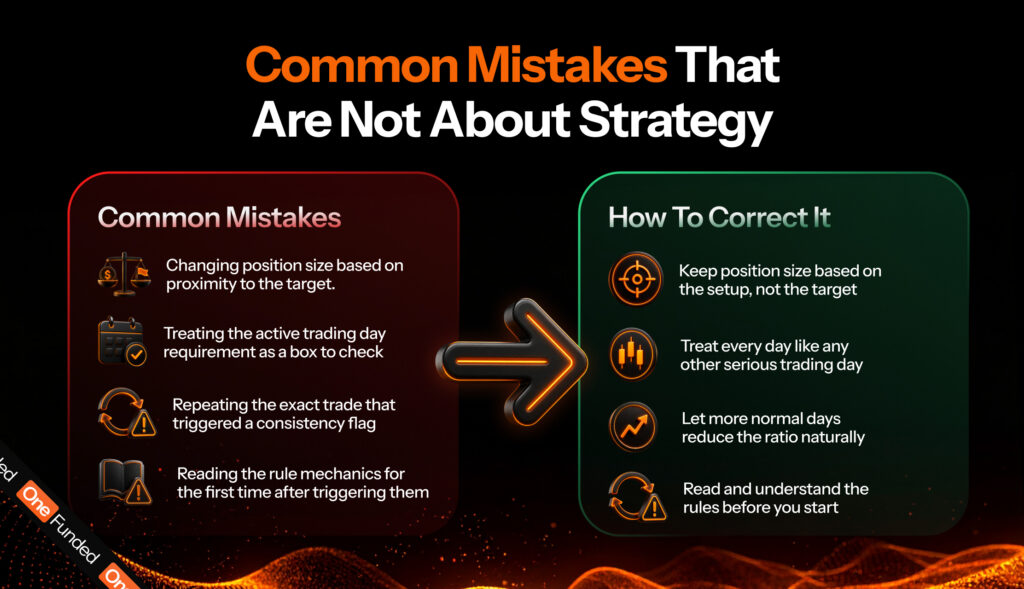
The patterns below show up repeatedly during the evaluation window specifically:
A trader can also easily correct each of the mistakes without altering the approach that already took the trader a long way. To get more insight into trading psychology during a prop firm challenge, the psychology behind such choices, and how to master emotions like loss aversion and the house money effect, please check out OneFunded’s trading psychology resource.
A prop firm challenge tests if a trader is able to keep a plan consistent under two different forms of pressure that happen simultaneously. There is a visible deadline and a set of guidelines the firm establishes before the challenge.
Strong trading psychology during a prop firm challenge is often what separates traders who stick to their strategy from those who start making emotional decisions under pressure. The traders who pass rarely run the most aggressive strategy. Their trade sizes are similar near the target as on the first day, they do not regard the obligatory trading day differently than any other day, and they understand which rules apply to the specific program they are trading, including the consistency rule where applicable.
Refer to the current OneFunded challenge rules to review the applicable drawdown limits, profit targets, minimum trading-day requirements, and any consistency rule that applies to your chosen program and account stage.


Join our mailing list today!
The Best Day Profit Rule limits how much of a trader's total profit may come from the single most profitable trading day. During the challenge phase, the rule applies only to Flash accounts, where the limit is 50%. Core and Value challenges do not have a consistency rule during evaluation. During the funded stage, Core, Value, and Flash accounts use a 50% Best Day Profit limit, while Instant accounts use a 20% limit.
Not necessarily. A trader must satisfy every requirement that applies to the selected program before the challenge is considered complete. For Flash challenges, traders must also satisfy the 50% Best Day Profit rule before passing. Core and Value challenges do not have a consistency rule during evaluation, although all other applicable challenge requirements must still be met.
The published requirements of OneFunded indicate that the minimum period for Core is 3 days, for Flash is 5 days, and for Value is 4 days. According to OneFunded, OneFunded calls any calendar day on which the trader opens a new trade an active trading day. The above statistics come from OneFunded's Academy page, which may differ from statistics that OneFunded publishes in other parts of the website.
Proximity to the target influences the psychological significance of the loss, despite the fact that the rules treat all trading days equally. A loss at 7% from an 8% Core target usually leads to indecision or overtrading when closing the position, and it increases the risk of drawdown breakage precisely at the moment when the account is least able to withstand a mistake.
The strategy decides if a trader has an advantage over others. Psychology determines whether that edge gets executed consistently under pressure, including a clear profit goal, drawdown constraints, drawdown limits, minimum trading-day requirements, and any consistency rule that applies to the selected program. An excellent strategy that a trader executes poorly near the finish line does not overcome obstacles that the same strategy executed consistently can conquer.

Why traders fail prop firm challenges: daily drawdown breaches, revenge trading, oversizing, rule misunderstandings, and poor strategy prep explained.

Isaac Newton, widely known as one of the most brilliant physicists in history, also moonlighted as a trader and investor....
 Set Preferred on Google