



1-Step vs 2-Step Prop Firm Challenges: What’s the Difference?
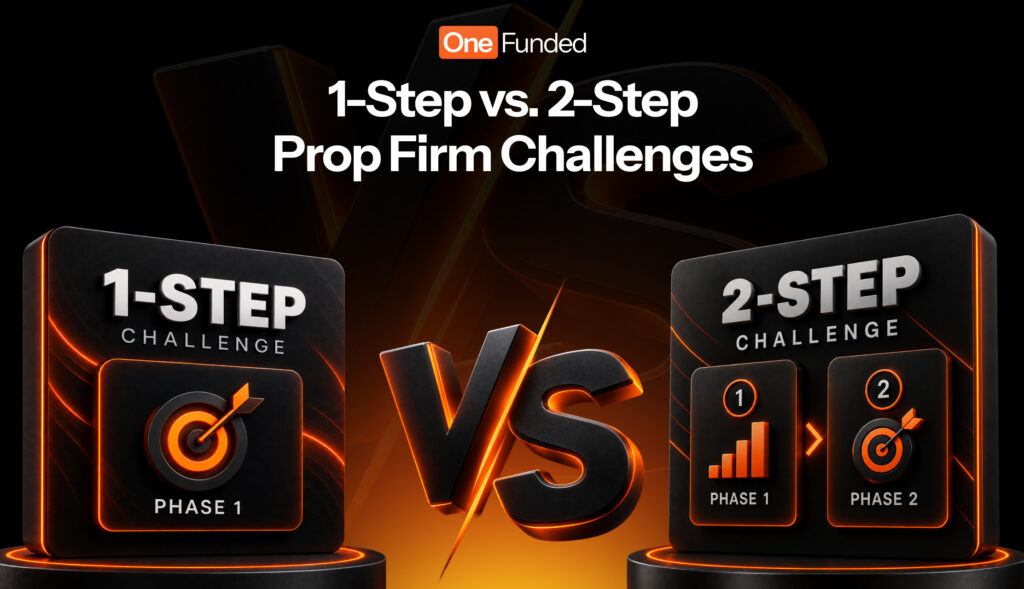
If you’ve ever looked for prop firm challenges, you have probably seen two options: 1-step vs 2-step prop firm challenges. Most traders want to know which one fits them before they spend anything.
Here’s a brief version. A 1-step prop firm challenge has one phase. Key into it, and you’d need to hit one profit target and follow other rules. And if you stick to these T&Cs, you’ll get funded.
On the other hand, a 2-step prop firm challenge is split into two phases. Each phase has its profit target. You can get funded via the 1-step or 2-step challenge account. However, they function differently, have unique costs, and suit the trading needs of different traders.
We’ll show you how each one works. It’ll run you through the rules and which one is the better bargain overall using figures from OneFunded’s challenge accounts. That’s not all. We’ll also cover tales of two traders to show you how each route plays out in real time.
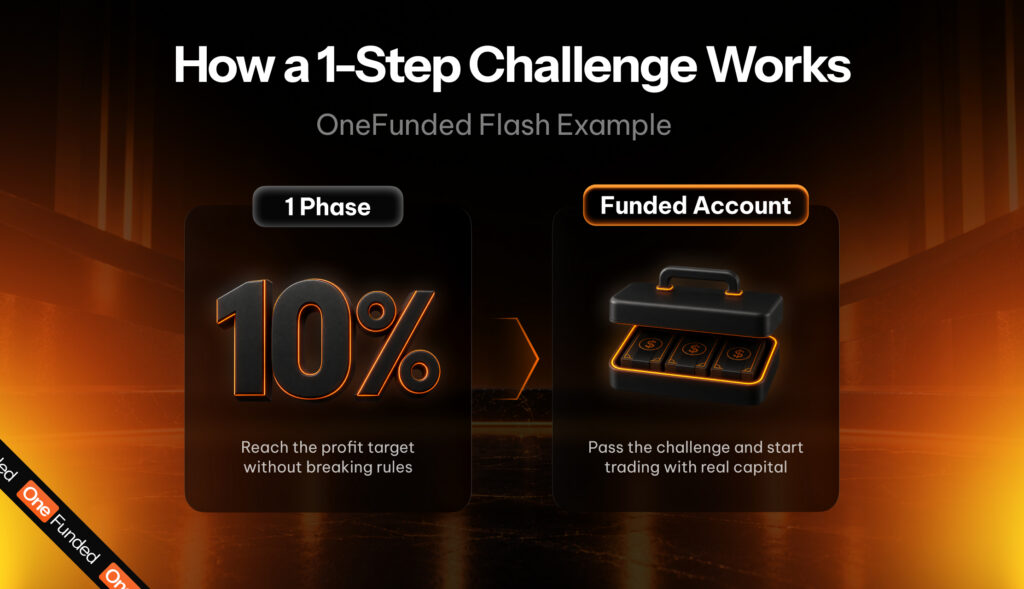
A 1-step challenge is simple. There’s only one phase and one profit target. If you hit it while following all the rules, the prop firm will move you straight to a funded account. No second round exists. You’re done once you pass.
You can use OneFunded’s 1-step Flash challenge to understand how this works. Here are the T&Cs linked to a $50,000 Flash account:
| Metric | What’s Applicable |
| Profit Target | 10% |
| Minimum Trading Days | 1 day |
| Daily Loss Limit | 4% |
| Overall Loss Limit | 6% |
| Consistency Rule | 50% (no single day should contribute more than half of your total profit) |
| Trading Period | Unlimited |
| Profit Split | Up to 90% |
| Fee | $279 (refunded with your third payout) |
The profit target on a 1-step account is higher than what you’ll get on a 2-step challenge. And that’s the catch. There’s one phase, so you must hit that 10% in one go instead of dividing it across two.
The 1-step challenge has a 6% overall loss limit. It’s a bit tighter than what you’d encounter on OneFunded’s 2-step options. So, if you’ve got a strategy that demands you take some losses early on in your trading journey, that cushion might feel restrictive. The consistency rule of 50% means no single trading day should account for more than half of your profit. You can’t hit most of your profits in a day and call it quits. To pass, you must have at least two profitable days to even things out.
Flash accounts at OneFunded start at $56 for the $5K account and go up to $949 if you want the $200K account. If you pass the Flash challenge, you’d get a refund together with your third payout.
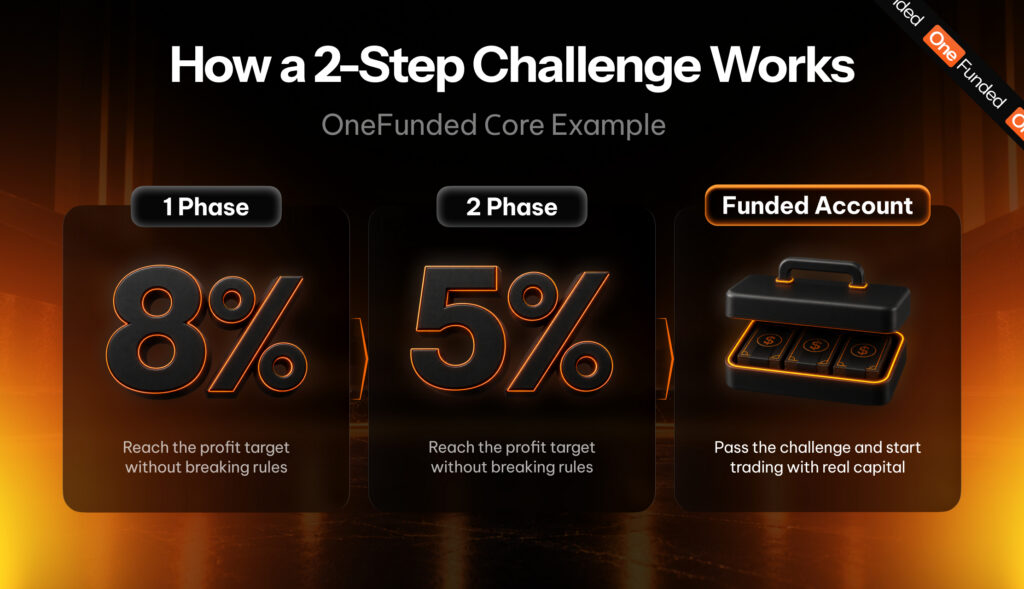
A 2-step challenge divides your evaluation into two phases. You get a profit goal in phase one. And if you smash it, you’d move to phase two that has a smaller target. Pass both phases, and you’ll get funded.
OneFunded features two 2-step options: Core and Value. Core is the most popular. However, Value is also recognized as it’s got the lowest-priced entry point at just $29.
| Metric | What’s Applicable |
| Profit Target (Phase 1) | 8% |
| Profit Target (Phase 2) | 5% |
| Minimum Trading Days | 3 days |
| Daily Loss Limit | 5% |
| Overall Loss Limit | 10% |
| Consistency Rule | Off |
| Trading Period | Unlimited |
| Profit Split | Up to 90% |
| Fee | $259 (refunded with your third payout) |
| Metric | What’s Applicable |
| Profit Target (Phase 1) | 8% |
| Profit Target (Phase 2) | 6% |
| Minimum Trading Days | 4 days |
| Daily Loss Limit | 4% |
| Overall Loss Limit | 8% |
| Consistency Rule | Off |
| Trading Period | Unlimited |
| Profit Split | Up to 90% |
| Fee | $199 (refunded with your third payout) |
In the tables above, the profit targets on each phase are lower than what the 1-step demands. That’s why most traders go the 2-step route. On this path, you don’t need to hit a 10% goal at once; you can split it into two. 8% in the first phase and 5% (Core) or 6% (Value) in phase two.
The overall loss is bigger too. On a Core account, you get 10%, over 1.5 times what’s on a Flash account. This extra room helps if the strategy you choose has to go through rough patches before it delivers the goods.
But there’s a catch with 2-step challenges. It takes longer. You have to go through two phases before you get a funded account. Settling for this means giving up on speed for lower targets. And depending on your needs, that’s quite the trade-off. Neither Core nor Value applies a consistency rule.
Value’s $5K account is cheap at $29. For Core, you’d need to spend $35 for the same account size. And remember, if you pass either evaluation, OneFunded will refund the fee you paid alongside your third payout.
Here’s a side-by-side comparison of OneFunded’s 1-step and 2-step $50K evaluations:
| Feature | Flash (1-Step) | Core (2-Step) | Value (2-Step) |
| Phases | 1 | 2 | 2 |
| Profit Target | 10% | 8% (Phase 1) | 5% (Phase 2) | 8% (Phase 1) | 6% (Phase 2) |
| Min. Trading Days | 1 days | 3 days | 4 days |
| Daily Loss Limit | 4% | 5% | 4% |
| Overall Loss Limit | 6% | 10% | 8% |
| Consistency Rule | 50% | Off | Off |
| Profit Split | Up to 90% | Up to 90% | Up to 90% |
| Fee ($50K Account) | $279 | $259 | $199 |
| Fee Refundable | Yes (with the third payout) | Yes (with the third payout) | Yes (with the third payout) |
| Trading Period | Unlimited | Unlimited | Unlimited |
You’d see a pattern in this table. On the 1-step route, you’d need to meet a higher profit target in one phase with 1 minimum trading day. The 2-step evaluations ask for less per phase. However, you’d need more time to hit their milestones.
None of the evals mentioned have a deadline. You’ve got an unlimited amount of time. You can trade when you want to without worrying about an invisible clock running out. Several prop firms have a 30-day to 60-day clock on their evals. This system mounts pressure on traders, making them breach rules that’ll see them fail the challenge. The one clock OneFunded does have is inactivity: 60 days without a trade on an evaluation account, or 30 days on a funded account, and the account can be closed.
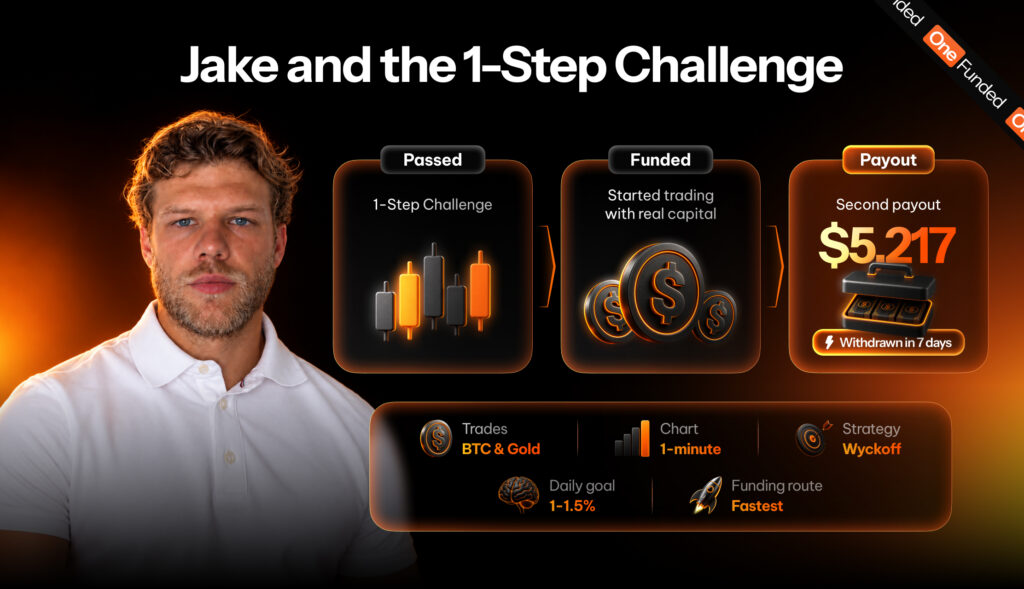
Jake passed OneFunded’s 1-step challenge and has gotten two payouts from his funded account. His second payout was valued at $5,217 (around $4,100 after the profit split). He earned this in a week and was able to withdraw it within seven days, as he got the Weekly Payout add-on when buying his challenge.
According to his interview, Jake trades BTC and gold on the 1-minute chart using a strategy based off Wyckoff. He looks around for key price levels and waits for this number to come back before he retests them. After that, he enters with a stop loss set.
Jake had a game plan when he got a funded account. He went for 1% to 1.5% daily. When he hits this mark, he closes the charts. This discipline helped him grow the account without incurring too many big losses.
During the payout cycle, he had just one losing day. That loss happened due to indiscipline. It occurred when he was up by $600 but wanted more money. His greed got the better part of him. If he had stayed content, he would’ve landed an even bigger payout.
The 1-step eval worked great for Jake because his strategy was solid and he was confident in it. He didn’t need a two-phase eval that would take more time to pass. He had an eye out for the fastest funding route, and Flash offered that.
Jake settled for a $100K account size he got for about $400 during a OneFunded sale. He said that this account size on other prop firms would’ve cost anywhere from $800 to $1,000. Jake requested a payout during the interview, and it landed in his account in under 10 minutes.
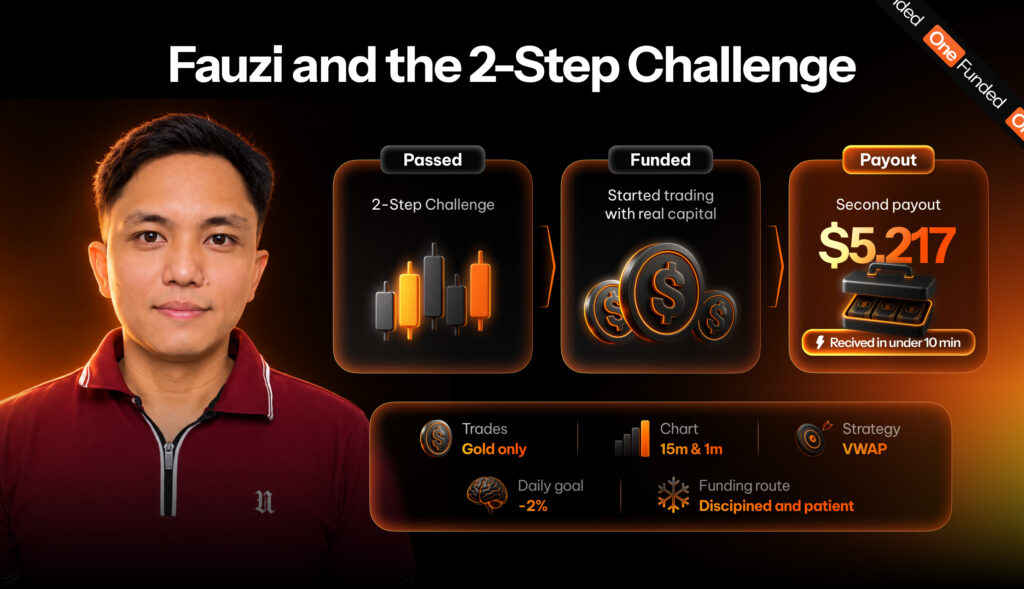
Fauzi is an Indonesian who works a regular 9-5 job. When he gets home, he starts to trade the New York session. Beyond passing OneFunded’s 2-step challenge, he’s gotten two payouts already. When he processed a payout during the interview, his crypto wallet got credited within 10 minutes.
He hit a 7% profit target in the first phase and a 5% target in the second phase. This just shows how a 2-step challenge at prop firms like OneFunded plays out. The target spreads across two phases, so you’re not trying to reach one big number at once.
Fauzi refers to himself as a careful trader during his interview. He targets around 2% profit for every payout cycle. Once he hits this mark, he doesn’t trade until the next cycle. This kind of patience is rare, and that’s why OneFunded’s 2-step options are great for traders like him. There’s no rush to go big.
He utilizes a simple strategy that involves two charts. There’s a 15-minute variant on the lookout for direction. That said, there’s a 1-minute type that lets him uncover his entry point.
That’s not all. He monitors the volume-weighted average price (VWAP) line to find candle patterns that can get broken before he takes any trade. This allows him to risk one unit for two.
Fauzi gravitated towards OneFunded due to the firm’s spread on gold. He only trades gold, and he puts OneFunded’s spread at two pips against four to seven pips at other firms he has used. When you trade one instrument each day, that difference can add up to something massive.
Fauzi’s tale is proof the 2-step model is great for traders who want to take things slow. Unlike Jake, he didn’t want the fastest path to a funded account. He needed something that fit his careful strategy and gave him two smaller milestones to meet rather than one big goal.
There’s no right or wrong answer here. It all boils down to how you trade.
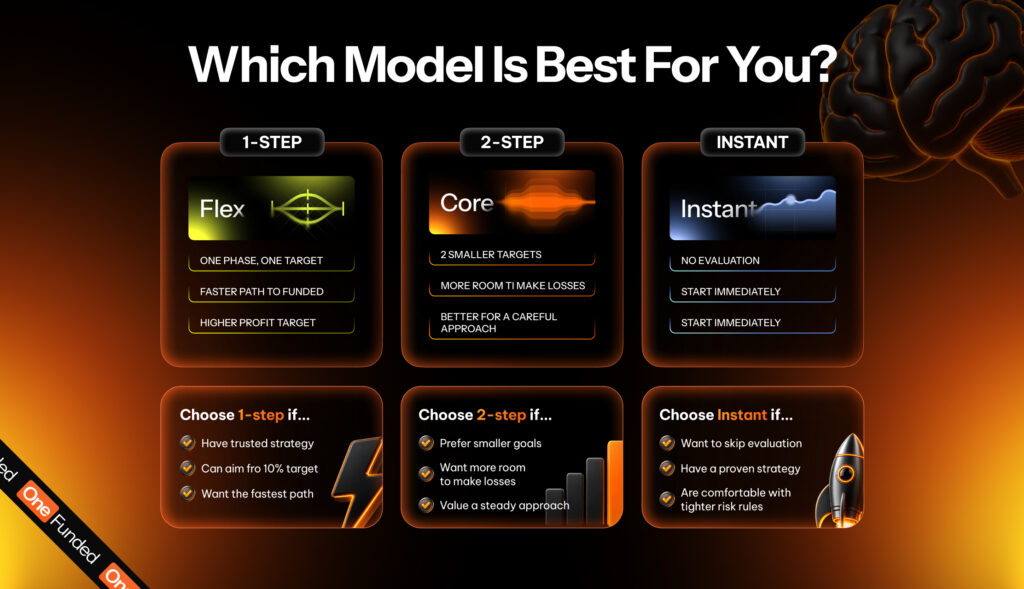
Choose a 1-step challenge if you have a trusted strategy that can help you hit a 10% profit target without breaching your drawdown limits. Think about Jake for a minute. He set his sights on returns of 1% to 1.5% per day. This allowed him to keep his losses to the barest minimum. Little wonder he was able to pass within a week.
Opt into a 2-step challenge if you prefer to reach smaller goals for every phase, want room to make losses, trade carefully, or don’t mind waiting. Fauzi understood he was a 9-to-5 worker. So, he went with the 2-step challenge to make trades at night and have ample time to hit phase 1 to 2 targets without rushing.
If you’re new to prop firm challenges, start with a 2-step option like OneFunded’s Core challenge, as it’s easier. You’ll find with lower targets and bigger loss limits that let you experiment. Gone this route already? If yes, opt for the 1-step Flash account to avoid the extra round and get funded quicker.
There’s a third route worth knowing about. Instant Funding skips the evaluation entirely and puts you on a funded account straight away. The trade-off is tighter risk rules, so it suits traders who already know their numbers rather than those still finding a strategy.
Once you pass a 1-step or 2-step challenge, complete OneFunded’s KYC procedure and sign a funding agreement. After you do these, you’d get a funded account.
Regardless of the challenge, you can keep up to 90% of the profits you make. You’d be able to make your first payout 14 days after you made your first trade on the funded account. Remember, you must have made at least $100 before requesting a payout.
After your first payout, you’d be allowed to make payout requests every 14 days. You can cut this down to 7 days with the Weekly Payout add-on. OneFunded pays out via methods like crypto (USDT or USDC), bank transfer, or Rise.
Once you place a request and it’s approved, you’d get a payout within an hour. However, note that international bank transfers can take several days to process.
On your third payout, you’d get back the fee you paid to buy your Flash, Core, or Value accounts. OneFunded refunds the full amount you paid for those evaluations.
It doesn’t end here. If you keep performing as a funded trader, you can grow your account up to $1,000,000 with OneFunded’s scaling plan in the mix. To achieve this feat, you’d need to finish three consecutive profitable cycles with a minimum net profit of 6% each.


Join our mailing list today!
1-step evals have higher targets and tighter drawdown limits. But the 2-step options spread targets across two phases, allowing you more room to make losses. This setup makes the 2-step easier than the 1-step.
Yes, you can. Flash, Core, and Value will refund the full evaluation fee along with your third payout.
Not all of them. OneFunded, for instance, gives traders an unlimited amount of time to pass its evals. Once you hit the minimum trading days and reach your profit target without breaching other rules, you'll pass the evaluation and get funded.
It depends on the account size. You'd pay $56 for a $5K 1-step Flash account. However, the max $200K account will cost you $949.

Every prop firm challenge has a unique set of rules. This includes profit targets, drawdown limits, and consistency demands. Most...

You’ve made up your mind; you want to go into trading full-time in 2026. Great. But there are tens of...

What is a prop firm? Learn how do prop firms work, and how successful traders get funded accounts enjoy payouts...
 Set Preferred on Google