




FTMO vs OneFunded: Full Comparison for 2026
One of the biggest decisions you'd need to make as a trader revolves around picking a prop firm. This FTMO vs. OneFunded guide compares both firms side by side.
That way, you can know what a challenge costs, how drawdown limits work, and when you get paid. This guide uses plain words and figures to help you choose a firm that suits your trading needs without scratching your head.
But before we go further, let's refresh your memory quickly by defining what a prop firm is. Simply put, a prop firm is one that lets you trade with virtual cash instead of yours. To get started, you must pay a fee and take a challenge. If you pass, you'd get a funded account. When you make profits on this account, you can withdraw a large part of it.
Challenges at prop firms have their own set of rules. You must hit a profit target and not lose more than a certain amount daily and throughout the challenge. At prop firms like OneFunded and FTMO, the slight differences in these rules can determine if you pass or fail.
To ensure this guide is as accurate as possible, we made sure to check every price and rule on each firm's website. The data bits used are accurate as of November 8, 2026. Euro prices are converted at the European Central Bank reference rate of €1 = $1.1127 on 11 November 2026. However, we want you to note that firms change their rules often. Before hopping on any, check these T&Cs once more.
Both prop firms are solid options. However, they suit different traders. FTMO has been in the mix since 2015. They've got bigger accounts. The largest account you can buy is capped at $200,000, and the Scaling Plan can grow it even further. That said, its 2-step fee is refunded with your first payout on the platform. FTMO also lets you run trading bots without seeking permission first.
OneFunded, on the other hand, launched in 2024, and has since grown to 25,000+ traders across 168 countries. It won Fastest Growing Prop Firm — Global at the UF Awards 2026 and Best Trading Conditions at the London Prop Trading Expo 2026. Its 2-step challenges cost less than FTMO's 2-step challenges. Every challenge you take allows you to hold trades overnight and trade the news; this remains the case even after you get funded. The overall loss limits on all OneFunded challenges are static, so your floor doesn't move as your equity changes. Accounts are sold from $5,000 to $100,000, and the Scaling Plan can grow a funded account up to $1,000,000.
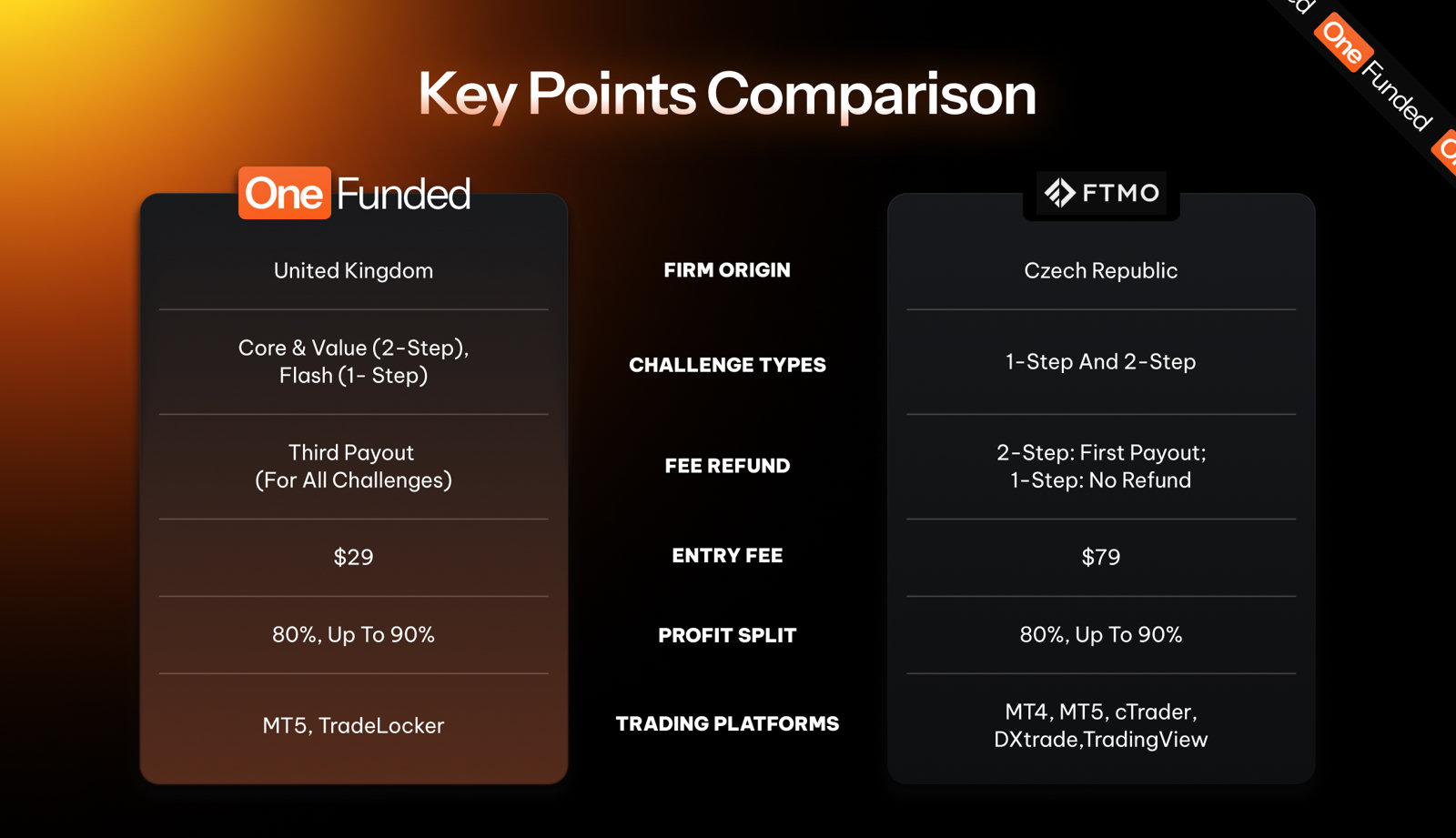
| Feature | FTMO | OneFunded |
|---|---|---|
| Challenge Types | 2-step and 1-step | Core and Value (2-step), Flash (1-step) |
| Instant | Yes | Yes |
| Account Sizes | $5,000 to $200,000 | $5,000 to $100,000 |
| Cheapest Challenge | €79 (about $88) for a $10,000 1-step account | $29 ($5,000 Value account) |
| Price of a $100,000 2-Step Challenge | €439 (about $488) | $469 (Core), $349 (Value) |
| Time Limit | None | None |
| Phase 1 Profit Target | 10% | 8% on Core and Value |
| Overall Loss Limit Structure | Static on 2-step, trailing on 1-step | Static on every plan |
| Profit Split | 80% on 2-step (up to 90% with the Scaling plan), fixed at 90% on 1-step | 80%, up to 90%, with the profit split add-on |
| First Payout | 14 days after you make your first funded trade | 14 days after your first trade. You can cut this timeline down to 7 days with the add-on |
| Payout Processing | 1–2 business days after the invoice is approved | About 1 hour |
| Fee Refund | 2-step: First payout. 1-step: No refund | Third payout for all |
| News and Weekend Trades Once Funded | News Trading: Allowed, but you can't open or close trades after huge news breaks. No restrictions apply to Swing accounts. Weekend Holding: Allowed only if the market's night break is set at 2 hours or less. This restriction doesn't apply to Swing accounts. | Allowed on all plans |
| Trading Robots (EAs) | Allowed without approval | Only with approval |
| Scaling | +25% every 4 months, up to $2,000,000 | +20% to +40% per level after 3 profitable payout cycles, up to $1,000,000 |
| Platforms | MT4, MT5, cTrader, DXtrade, TradingView | MT5, TradeLocker |
A challenge is very similar to a driving test. You've got to show that you can follow the rules before you're handed the keys. At prop firms, you'll come across challenges with one, two, or three phases.
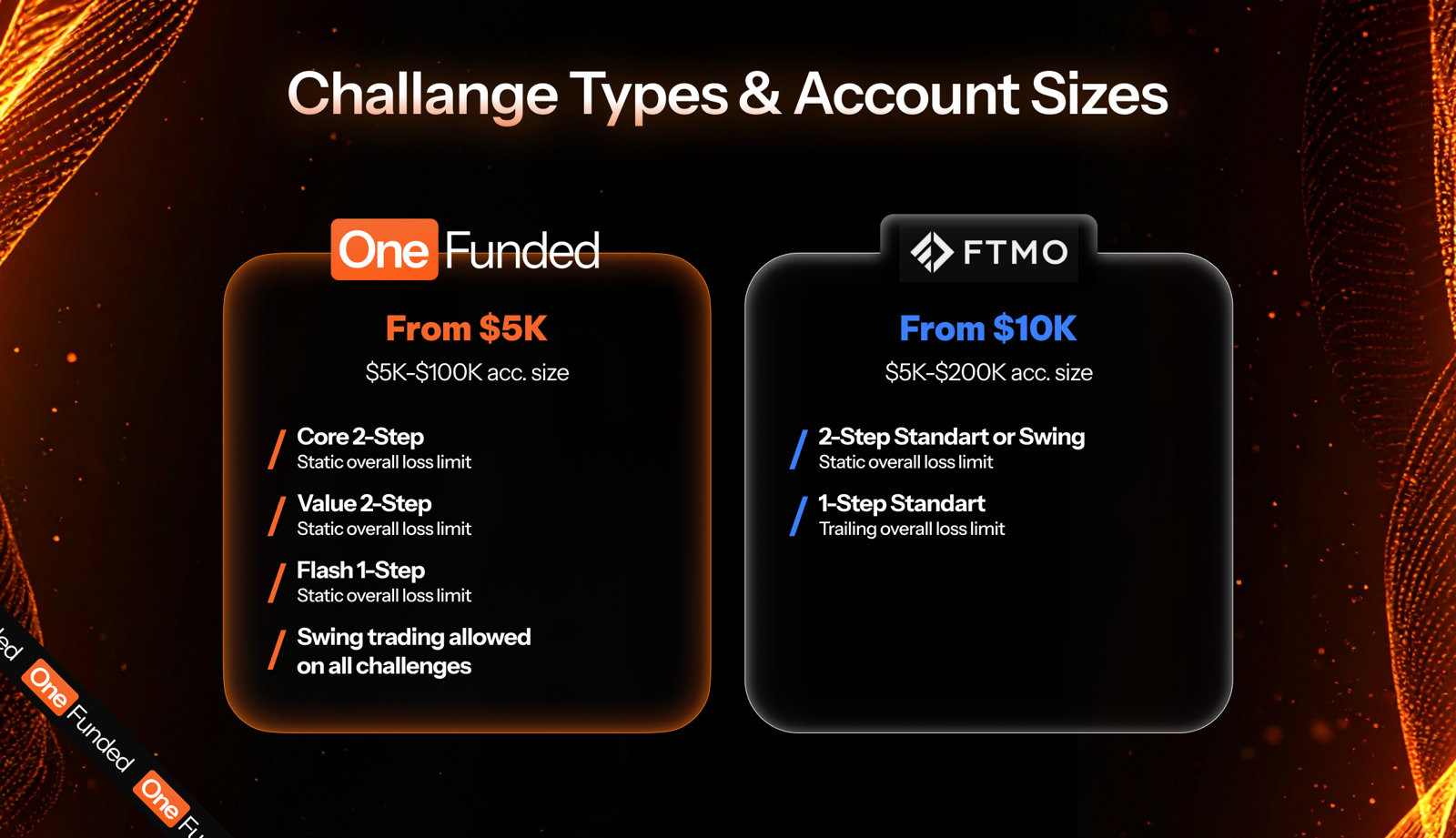
FTMO has two challenge types:
The challenges above come in five account sizes: $10,000, $25,000, $50,000, $100,000, and $200,000. Beyond the challenges above, FTMO just introduced an Instant account that gives you a funded account without passing any challenge.
OneFunded has three challenge types:
OneFunded has an Instant account that doesn't involve a challenge. Account sizes range from $5,000 to $50,000. That said, Core, Value, and Flash come in sizes from $5,000 to $100,000.
What you need to know about instant accounts. These accounts don't involve a challenge. But there's a trade-off: the rules get tighter.
FTMO's Instant account has sizes ranging from $5,000 to $100,000 and has a 90% profit split. That said, there's a 3% daily loss limit and a 10% overall loss limit that moves up in real-time whenever a closed trade results in a new balance high. These accounts also have a 30% consistency rule. You don't get a fee refund on this account type.
At OneFunded, the instant plan has a 60% profit split. However, it can go up to 80% with add-ons. There's a 3% daily loss limit, a 6% max loss limit, and a 15% consistency rule in place. Prices run from $79 for a $5,000 account to $349 for a $50,000 account.
Also, a floating loss above 1% of the equity at the moment the trade idea was opened is a hard breach that ends the account. There are no fee refunds on OneFunded's Instant account.
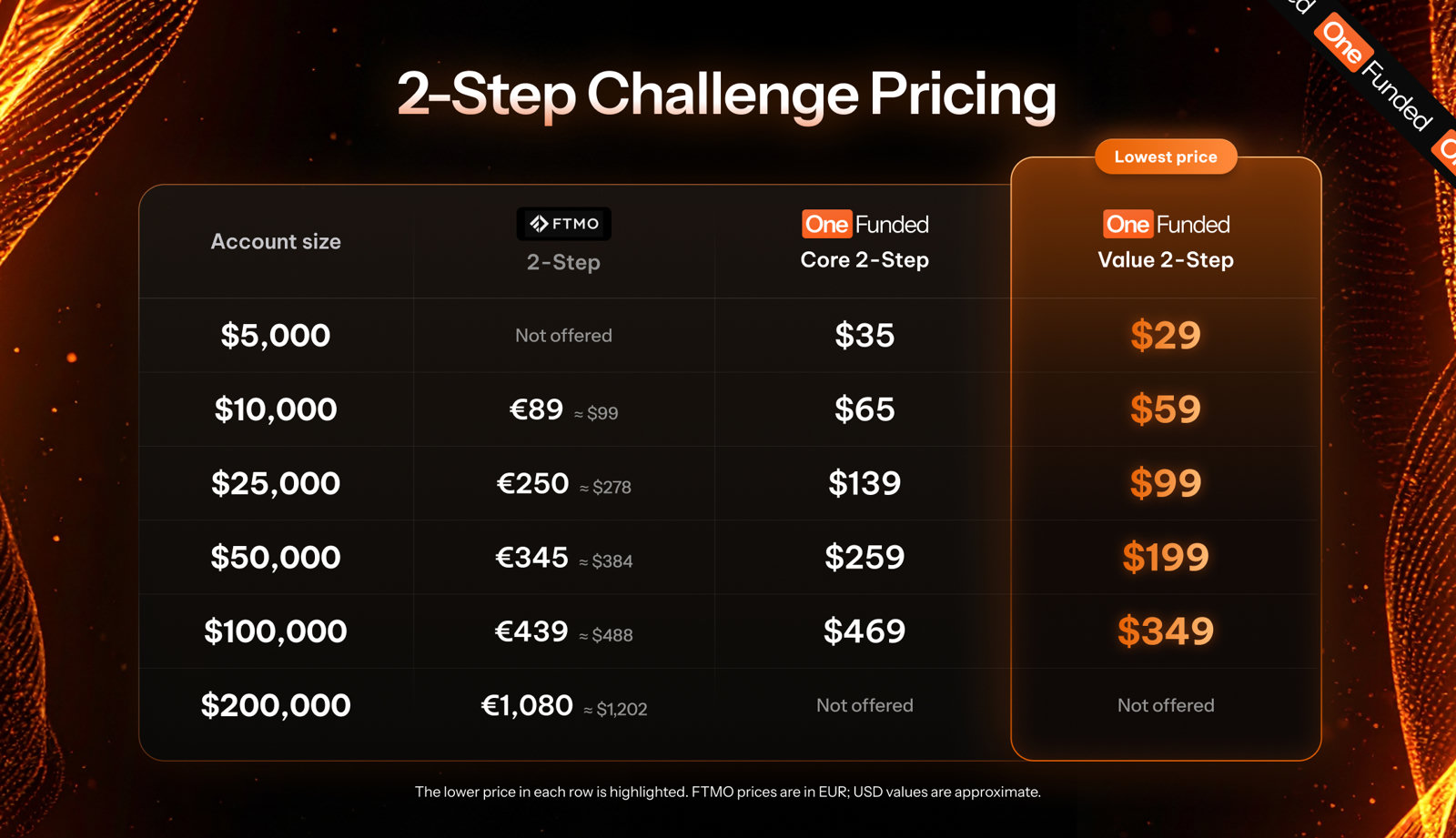
You pay a one-time fee for any challenge you want. You won't get a monthly bill on OneFunded or FTMO. However, we noticed that FTMO lists its prices in euros while OneFunded lists theirs in US dollars. A euro buys more than a dollar, so an FTMO price is always higher in dollars than the number on the page. We have converted every euro figure below so you are comparing like with like.
| Account Size | FTMO 2-Step | OneFunded Core 2-Step | OneFunded Value 2-Step | FTMO 1-Step | OneFunded Flash 1-Step |
|---|---|---|---|---|---|
| $5,000 | Not offered | $35 | $29 | Not offered | $56 |
| $10,000 | €89 (about $99) | $65 | $59 | €79 (about $88) | $98 |
| $25,000 | €250 (about $278) | $139 | $99 | €199 (about $221) | $159 |
| $50,000 | €345 (about $384) | $259 | $199 | €319 (about $355) | $279 |
| $100,000 | €439 (about $488) | $469 | $349 | €399 (about $444) | $499 |
| $200,000 | €1,080 (about $1,202) | Not offered | Not offered | €999 (about $1,112) | Not offered |
These are the prices we found on their sites when we visited. But both firms are known for running sales at one point or the other. With these deals active, you might pay even less.
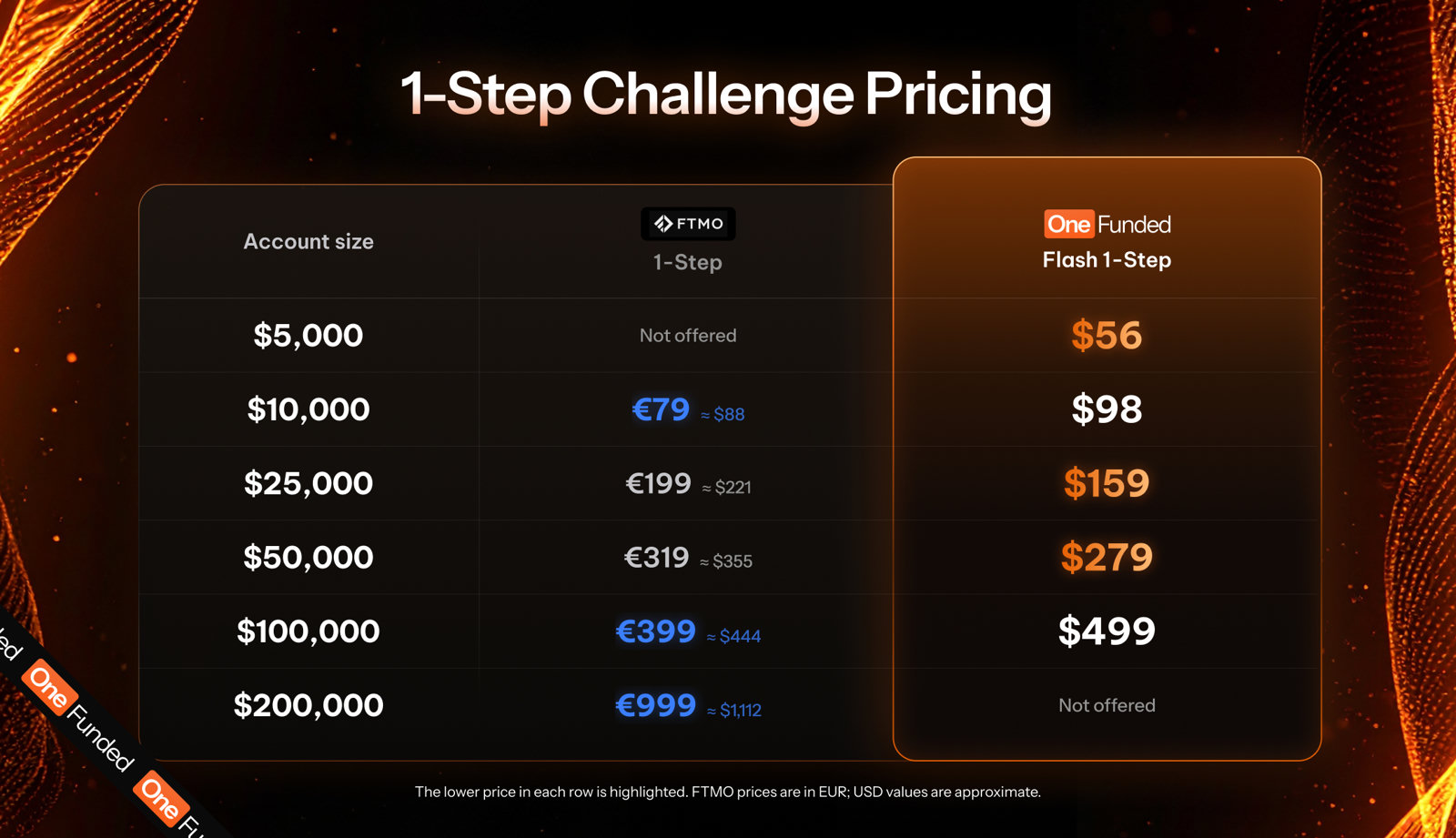
Once the euro figures are converted, OneFunded is the cheaper firm at almost every size.
Take a $50,000 2-step account. FTMO charges €345, which is about $384. OneFunded's Core is $259 and Value is $199. That is $125 and $185 less for the same account size. At $25,000 the gap is wider still: about $278 at FTMO against $139 for Core and $99 for Value.
The 1-step plans are closer. A $10,000 FTMO 1-step account works out at about $88, below the $98 OneFunded charges for Flash. Flash is cheaper at $25,000 and $50,000, while the $100,000 FTMO 1-step comes in at about $444 against $499 for Flash.
Then, there's the subject of add-ons. OneFunded sells extras at the checkout area. Weekly payouts add 20% to what you'd pay. The 90% profit split adds 25%. However, a combo of both adds 34.99% to the total cost price of a challenge.
If you want to get a $100,000 Core account with the profit split add-on, you'd pay $586.25. Remember, you've got to select the add-ons you want at checkout. You can't get them down the line at OneFunded.
FTMO doesn't have add-ons on its platform. Its 1-step challenge already has a 90% profit split, and you can get a similar profit split in its 2-step challenge through its Scaling plan.
OneFunded also runs a Rewards Center, where points earned for activity on the platform convert into discounts or free challenges, and free monthly trading competitions where the prizes include evaluation challenges and Instant Funding accounts. Both can bring your real cost of entry below the list price.
Would you like to uncover more metrics that add to your total expenses at prop firms? Read our detailed guide on what a prop firm challenge really costs.
Think of a profit target like a goal line. You need to grow your account by a certain amount to pass a step.
| Rule | FTMO 2-Step | OneFunded Core 2-Step | OneFunded Value 2-Step | FTMO 1-Step | OneFunded Flash 1-Step |
|---|---|---|---|---|---|
| Profit Target | 10%, then 5% | 8%, then 5% | 8%, then 6% | 10% | 10% |
| Daily Loss Limit | 5% | 5% | 4% | 3% | 4% |
| Overall Loss Limit | 10%, static | 10%, static | 8%, static | 10%, trailing | 8%, static |
| Minimum Trading Days | 4 days per phase | 3 days per phase | 4 days per phase | None | 1 day |
| Time Limit | None | None | None | None | None |
Let's say the numbers in the table above apply to a $100,000 account. On FTMO's 2-step challenge, you'd need to make $10,000 in profits in the first phase, and then $5,000 in the second phase. That's $15,000 in total.
On OneFunded's Core, you'd need to make $8,000 and then $5,000. That's a total of $13,000 in profits.
That difference matters more than it looks. Phase 1 is where most traders fail, and OneFunded asks for 8% there against FTMO's 10%, so you need a fifth less profit to clear the hardest stage. Across both phases you are $2,000 short of what FTMO wants on the same $100,000 account. Core also asks for 3 trading days per phase against FTMO's 4, and Flash needs just one trading day, which makes it the quickest route to a funded account of any plan in this comparison.
A trading day is one in which you open at least one trade. Most challenges have minimum trading days you must meet. Fall short and you simply have to continue trading until you meet it.
There's no time limit on whatever challenge you pick. But at OneFunded, there's a catch. You must place one or more trades every 60 days on a challenge account; this reduces to 30 days when you get funded. If you go AWOL any longer, you'll lose your account.
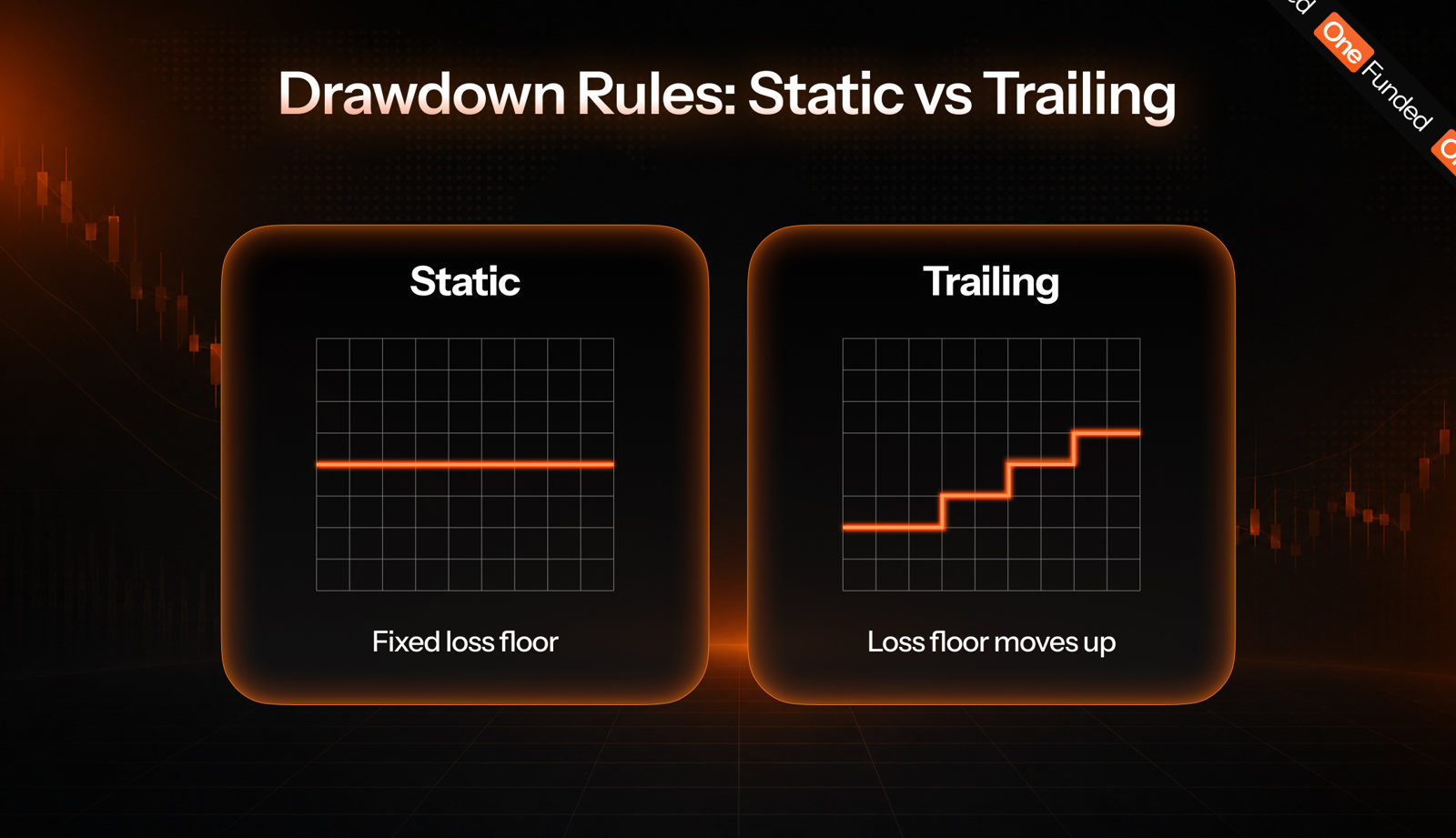
Drawdown in prop firm terms speaks to how much you can lose before you fail a challenge. You can see it as a floor. If your account reaches the floor, you can bid it goodbye.
FTMO and OneFunded measure your floor against your equity. Just so you know, equity is your total balance plus/minus your open trades. So, if you've got an open trade that's losing, that loss can see you fail your account before you close it.
Static means that your floor stays unchanged. This drawdown setting applies to FTMO's 2-step and every OneFunded challenge. On a $100,000 OneFunded Core account, the overall loss limit is 10%. So, your floor is $90,000. This floor never changes. Even if you grow your account to $150,000, your floor remains at $90,000. Your profits in this setup become extra room.
Trailing means your floor moves up when you win. FTMO's 1-step uses this setup. When it's midnight CE(S)T, FTMO takes a look at your balance. If it's your highest since you started that challenge, the floor moves up behind it. The gap remains at 10% of your starting balance, which is equal to $10,000 on a $100,000 account. This new floor never goes down.
You buy a $100,000 challenge account. At the end of Monday, your balance is at $106,000.
On day one, OneFunded's Flash gives you the least room of all challenges above. But after a good trading day, it gives you more room than FTMO's 1-step.
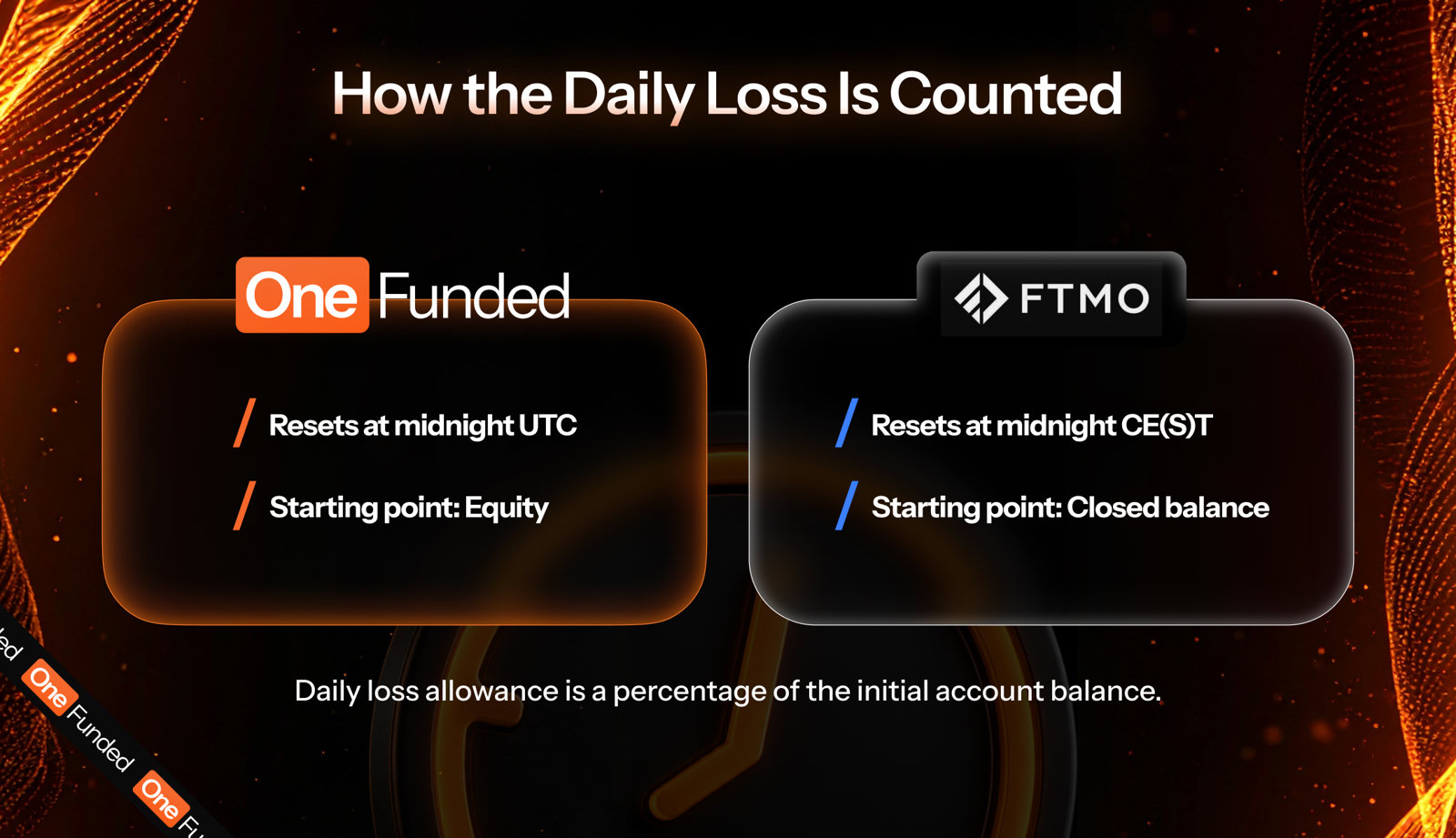
The daily limit stops you from losing too much in a day. FTMO resets this limit at midnight CE(S)T. At OneFunded, the daily drawdown resets at midnight (UTC). The big difference between both firms when it comes to calculating daily loss limits is the starting point.
FTMO starts from your closed balance at midnight CE(S)T. OneFunded starts calculations from your equity at midnight, and that includes open trades. The similarity between both firms is that your daily loss limit is still calculated as a percentage of the cash you started out with.
You have a $100,000 account with a 5% daily limit. This is $5,000. Your closed balance is $100,000, and you hold one open trade into the next day.
If you're on FTMO's 2-step with a 5% daily loss limit, the firm will take your closed balance and subtract $5,000 from it. This is the same whether the open trade is in profit or in loss.
However, OneFunded takes your equity, alongside the loss or gain of the open trade, and then subtracts $5,000 from it.
This table gives a picture of how it goes down:
| What Happens | FTMO 2-Step Floor | OneFunded Core Floor |
|---|---|---|
| Open Trade is Up $2,000 at Midnight | $100,000 - $5,000 = $95,000 | $102,000 - $5,000 = $97,000 |
| Open Trade is Down $2,000 at Midnight | $100,000 - $5,000 = $95,000 | $98,000 - $5,000 = $93,000 |
Want to know more about how drawdown limits work at prop firms? Read our guide to daily vs. overall drawdown.
Let's start with news trading.
Big news, such as a job report, can result in swift jumps in prices. During any FTMO challenge, you can trade the news whenever you like. But once you're funded, you won't be able to open or close a trade on affected markets 2 minutes before and 2 minutes after a major report breaks. This also counts if your stop loss or take profit closes the trade. Swing accounts aren't affected by this rule.
At OneFunded, you can trade the news during a challenge and when you get funded. But the prop firm checks all trades made 5 minutes before and 5 minutes after big news is reported.
Next on the menu is holding overnight and over the weekend.
At FTMO, you can hold trades overnight and over the weekend during an active challenge. Things change when you get funded. At this point, you can only hold trades over the night if the market's night break is no more than 2 hours. On longer breaks (weekends included), you must close all active trades. These T&Cs don't apply to swing accounts. OneFunded lets traders hold trades overnight and over the weekend on all challenges.
Regardless of the firm you choose, you'd need to pay a small charge, known as a swap, for every night you hold a trade.
You might be wondering how trading robots are viewed at both prop firms. At FTMO, you can use expert advisors (EAs) without getting approval. That's not the case at OneFunded. Here, you're only allowed to use tools that the prop firm approves. Using a bot without consent ends your challenge.
So, what's the play with the consistency rule?
This rule prevents one lucky day on the charts from making up a large part of your profits. FTMO's 2-step doesn't have a consistency rule, but there's a 50% rule on the 1-step plan. At OneFunded, the rule depends on the plan and stage:
OneFunded removed the evaluation-stage consistency requirement on Core and Value during 2026, and changed how the ratio is worked out. Only profitable days now count towards the calculation, so a losing session no longer shrinks the profit base and makes the rule harder to meet.
The best part of the consistency rule is that you can't break this rule even if your profits for a day go above the stated percentage. What you'd need to do is continue to trade until you strike a balance.
Here's an example of the consistency rule in motion:
You're on a $100,000 FTMO 1-step challenge. You make a profit of $6,000 on Monday and $4,000 across the remaining days. You've hit your $10,000 goal. But Monday accounts for 60% of your total profits, and that's above the 50% consistency rule. In this scenario, you need to keep trading until your total profits hit $12,000. At this point, that Monday win contributes only 50% of your profit total, allowing you to pass the consistency rule.
OneFunded has a metric known as max exposure. One trade idea can't carry a floating loss above 3% of your account equity at the moment the trade idea was opened. It's 2% on $100,000 accounts bought on or after August 21, 2026.
Note that trades made on similar markets count as a trade idea. On accounts purchased on or after October 13, 2026, the first two breaches lead to warnings. However, a third breach results in account deactivation. On Instant, there's no warning stage. Reaching 1% deactivates the account immediately.
Want to know more about the metrics highlighted in this section? Read our in-depth guide on EAs, news trading, and copy trading.
Some rules will change after you pass a challenge. Here's a table for more context:
| Rule | FTMO Challenge Account | FTMO Funded Account | OneFunded Challenge Account | OneFunded Funded Account |
|---|---|---|---|---|
| Profit Target | Yes | No | Yes | No |
| News Trading | Allowed | Standard: 2-minute ban. Swing: Allowed | Allowed | Allowed |
| Weekend Holding | Allowed | Standard: Must close first. Swing: Allowed | Allowed | Allowed |
| Consistency Rule | 50%, 1-step account | 50%, 1-step account | Core 2-Step: None. Value 2-Step: None. Flash 1-Step: 50% | Core: 50% ($100,000: 30%). Value: 50% ($100,000: 30%). Flash: 50% ($100,000: 30%) |
At FTMO, you can pick one of the following trading platforms:
That said, if you go with OneFunded, you'd have access to these trading platforms:
Using the above platforms, you can access forex, metals, indices, oil, and stock charts. And remember, you can only choose one platform at checkout. You can't switch after purchasing a challenge.
| Payout Rule | FTMO 2-Step | FTMO 1-Step | OneFunded 2-Step Core, Value | OneFunded Flash 1-Step |
|---|---|---|---|---|
| Profit Split | 80%, up to 90% with the Scaling plan | 90% | 80%, up to 90% with profit split add-on | 80%, up to 90% with profit split add-on |
| First Payout | 14 days after making your first funded trade | 14 days after making your first funded trade | 14 days, or 7 days with the weekly payouts add-on | 14 days, or 7 days with the weekly payout add-on |
| Processing Time | 1–2 business days after approval | 1–2 business days after approval | About 1 hour | About 1 hour |
| Fee Refund | Comes alongside your first payout | Not available | Comes with third payout | Comes with third payout |
OneFunded pays out by crypto (USDT TRC20), bank transfer, or Rise, and requests are typically processed in about an hour rather than over a business day or two.
Real-world example: You make $6,000 on a $100,000 account
Neither firm caps you at the account you buy. Both let consistent traders move up to larger capital, but the route is different.
FTMO grows the account by 25% every four months. To qualify you need at least 10% net profit over the preceding four months and at least two processed Rewards. The ceiling is $2,000,000, and the Instant account is excluded.
OneFunded works on payout cycles rather than the calendar. Close three consecutive payout cycles at 6% net profit or better, submit a free application, and the team responds within 48 hours. Each approved level raises the account by between 20% and 40%, and the ceiling is $1,000,000. Because a payout cycle is 14 days, or 7 with the weekly payouts add-on, three qualifying cycles can be completed in about six weeks rather than four months.
So FTMO's ceiling is higher, while OneFunded's first step up can arrive considerably sooner.
| Prop Firm | Pros | Cons |
|---|---|---|
| FTMO | Account sizes up to $200,000 and scaling to $2,000,000, 2-step plan offers a fee refund if you pass, you can use bots without seeking approval, and five trading platforms are accepted. | 2-step challenges are pricey once euros are converted, and there are news trading and weekend limits on funded accounts. |
| OneFunded | 2-step prices undercut FTMO at almost every size, Phase 1 asks for 8% rather than 10%, the overall loss limit is static on every plan, news and weekend trading stay open once funded, payouts process in about an hour, fee refunds cover Core, Value, and Flash, and the Scaling Plan runs to $1,000,000. | Accounts are sold up to $100,000 rather than $200,000, the fee comes back with your third payout rather than your first, bots need approval before use, and funded accounts carry a max exposure rule that FTMO's 2-step does not have. |
Are you still torn between choosing the 1-step and 2-step accounts at prop firms such as OneFunded and FTMO? Well, you're not alone. However, reading our guide to 1-step vs 2-step challenges can help you make an informed decision.
You can get a funded account on FTMO and OneFunded. However, the rules tied to these prop firms reward distinct habits. FTMO is a great fit for traders who are looking for a prop firm with a solid track record that permits bots and scales furthest, to $2,000,000.
OneFunded, on the other hand, is a fit for traders that want to spend less for a 2-step challenge and clear a lower Phase 1 target to get there. This prop firm is also great for those that want a max loss floor that never moves, allows news trading and weekend holding, pays out in about an hour, and delivers fee refunds on all challenge accounts.
Ultimately, the right fit for you is the one that suits your trading patterns. If OneFunded is that, check out its challenges and choose a plan that fits your purse and trading habits.


The FTMO vs OneFunded debate has raged on for a long time. But your choice should be based on how you trade. OneFunded is cheaper at almost every account size once euro prices are converted, asks for 8% in Phase 1 rather than 10%, keeps news and weekend trading open on funded accounts, and processes payouts in about an hour. FTMO scales higher, allows EAs without approval, and refunds the fee one payout sooner.
Yes, it does. However, you can only get a refund on the 2-step challenge. If you bought the 1-step challenge, you won't get a refund.
OneFunded allows news trading during the challenge and when you get funded. FTMO permits this during the challenge; there's a 2-minute ban around huge news when you get funded.
There's no deadline for passing at FTMO and OneFunded. This allows you ample time to pass a challenge without feeling rushed at any point.
OneFunded, at almost every account size. FTMO prices in euros, so its figures look smaller than they are. A $50,000 2-step account is €345 at FTMO, about $384, against $259 for OneFunded Core and $199 for Value. FTMO is only cheaper on the smallest 1-step account and on the $100,000 1-step.

FundedNext vs OneFunded 2026: challenge rules, drawdown limits, fees, profit splits, payouts and trader reviews compared side by side.

Looking for FundingPips alternatives? Compare OneFunded vs FundingPips on challenge fees, refunds, profit splits, platforms, and rules.

GoatFundedTrader vs OneFunded compared: challenge fees, refund timing, profit splits, daily profit caps and platforms to find the best prop firm in 2026.
 Set Preferred on Google