

Cheapest Prop Firms: What a Challenge Really Costs
Imagine shoes for a minute. A $20 pair that breaks after 30 days is more expensive than a $40 pair that’ll last for a year. Prop firms work similarly. The cheapest prop firms win on the price tag. But affordable prop firms win based on how much you’ve spent in total when you can successfully make a payout request.
Most traders today consider the lower price before anything else. This is no surprise as nobody wants to spend a fortune for a test. However, that entry fee is just the beginning. What goes out of your pocket depends on the number of times you take the test, the add-ons you purchase at checkout, and how difficult the firm’s T&Cs are.
This guide details how to uncover a prop firm that’ll cost you less at the end, not just at the checkout. We’ll walk you through every cost, from fees and extras to failures, using OneFunded prices, T&Cs, and trader experiences.

A prop firm challenge is a test. You pay a fee, get access to a practice account to trade, and do all you can to reach a profit milestone without breaching any rules.
You pass the challenge if you tick these boxes. And if that’s the case, you’ll get a funded account. As time passes, you’ll get to keep a part of your earnings.
A pass might seem routine. But that’s not true. Most traders don’t pass challenges on their first try. If you’re keen on prop trading, you don’t just leave after your first failure. You stick around and pay another challenge fee. That’s why the question, “How much will I spend before I get paid?” is important.
Here are three things that can change the answer:
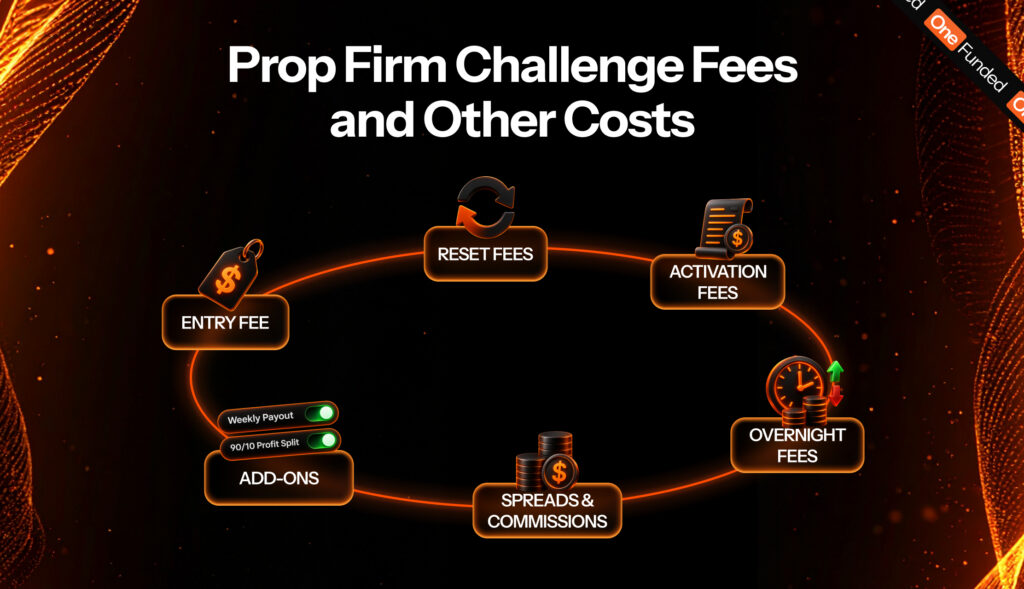
The fee you spot first is just one of six costs you’ll find along the way. So, before you buy any test, check them out:
This is the fee you pay for the challenge you want to key into. At OneFunded, you’d pay it just once.
Firms like FundedNext allow you to reset your account during an eval. Going this route will see you pay 10% less than the actual challenge price. OneFunded doesn’t permit resets. If you fail the challenge, you’d need to buy a new one at the regular price.
Some firms will charge a fee for them to open your funded account. OneFunded doesn’t take this route.
These are extras you can choose when you want to pay for a challenge. At OneFunded, you can pay for two:
On a $35 Core eval, you’d pay $8.75 extra for the split and $7 more for weekly payouts. To get both add-ons in one swoop, you’d pay $12.25. On OneFunded, you have to pay for these add-ons again if you want to start a new challenge.
The spread is a gap between the buying price and selling price. A commission is what you pay for each trade. The commission you pay on OneFunded depends on your trading platform and chosen instrument. For instance, forex trades on MetaTrader 5 (MT5) have a $4 commission per lot. But if you trade cryptocurrency, you won’t have to settle any commission.
Let’s say you trade 2 forex lots daily for 20 days via MT5. That’s 40 lots in total. At $4 per lot, you’ll pay $160 in commissions. You’ve got to win that back to hit the profit target required to pass the challenge.
NOTE: To know the exact commission costs on your trading platform on OneFunded, right-click the instrument you’re trading in the Market Watch window and select “Specification.”
OneFunded will charge you overnight fees when you hold positions open after the market closes. They can be positive or negative, depending on currency interest rates.
There are three routes to get funded. Each path changes your total costs uniquely. It sets how much you pay at the start, how much legroom you get if you fail, and if your fee gets refunded. Here’s how they compare:
So, which of these challenge structures should you go for? Choose one you can pass with the fewest tries. To know more about these account types, read our detailed guide on 1-step vs. 2-step prop firm challenges.
OneFunded has four challenges. Value, as the name suggests, costs the lowest. But their rules determine how easy they are to pass.
| Metric | Value | Core | Flash | Instant |
| Number of Steps | 2 steps | 2 steps | 1 step | N/A |
| $5K Price | $29 | $35 | $56 | $79 |
| $10K Price | $59 | $65 | $98 | $139 |
| $25K Price | $99 | $139 | $159 | $249 |
| $50K Price | $199 | $259 | $279 | $349 |
| $100K Price | $349 | $469 | $499 | N/A |
| Profit Target | 8% (Phase 1), 6% (Phase 2) | 8% (Phase 1), 5% (Phase 2) | 10% | N/A |
| Minimum Trading Days | 4 days | 3 days | 1 day | N/A |
| Daily Loss Limit | 4% | 5% | 4% | 3% |
| Overall Loss Limit | 8% | 10% | 6% | 6% |
| Profit Split | Up to 90% with the Profit Split add-on | Up to 90% with the Profit Split add-on | Up to 90% with the Profit Split add-on | Up to 80% with the Profit Split add-on |
| Consistency Rule | None | None | 50% | 15% |
| Fee Refund | 100%, with your third payout | 100%, with your third payout | 100%, with your third payout | No |
| Free Second Try? | Yes, via the Progress Pass initiative. However, note that terms and conditions apply | No | No | No |
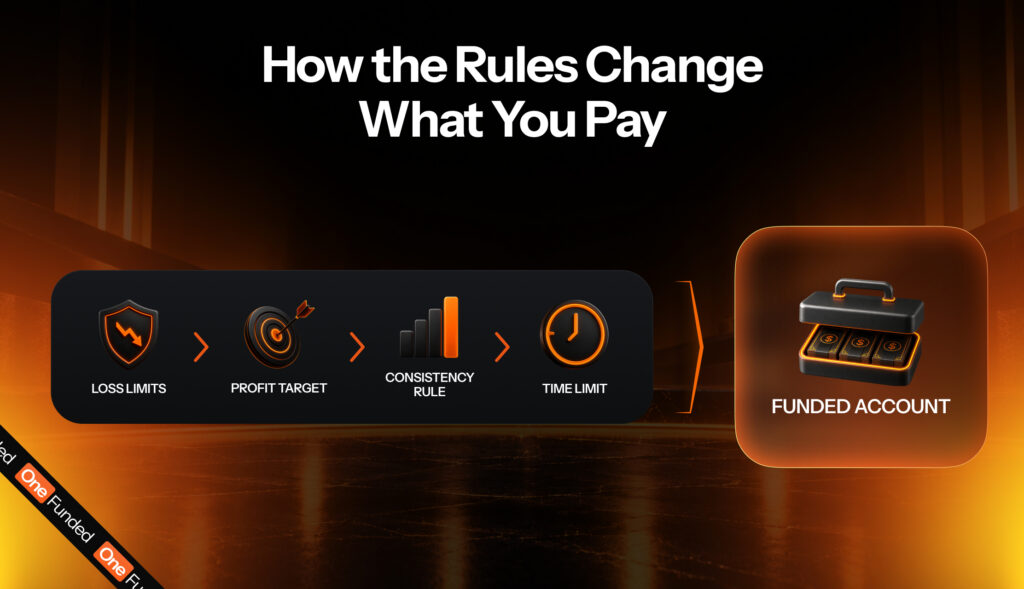
Every rule is a route to failure. When this happens, you’d need to buy a new challenge. So, while you might not know it, the rules are part and parcel of the price, even though they’re not on the tag. Quickly, let’s run you through the main rules in dollars for a $5K account:
They’re also called drawdown limits. If you breach either one, your test ends. Say you’ve got a torrid day and lost $220.
On a Core eval, you’ve not breached the daily loss limit of $250. So you’re still in. But on a Value account, this loss exceeds the $200 daily loss limit. At this point, you’re out and must pay $29 once more if you’re still interested in that challenge.
Flash is a one-step eval that needs you to reach a $500 profit goal in one round. On a Core account, you’d need to hit $650 in total profits, but in two smaller steps. Smaller steps are easier to hit, as traders can conduct trades without needing to take big risks.
This rule prevents one good day from taking all the glory. On a Flash eval, your best day can’t account for more than 50% of your profit.
Say you make $400 on a Monday. This means your other days must add up to that figure or more before you can pass the challenge. If this happens, you’d need $800 in profits, rather than the usual $500 (if your best day didn’t account for more than 50% of your profit).
But unlike other T&Cs, the consistency rule doesn’t make you fail. If you go past the mark, you’d just need to trade more to balance things up.
OneFunded challenges don’t have time limits. Since there’s no clock ticking down, you’re not rushing to complete a test. But the absence of time limits doesn’t mean you can take time off trading.
According to OneFunded’s T&Cs, you must place at least one trade every 60 days during an active challenge and every 30 days once funded. If you don’t, OneFunded will close your account. When this happens, you’ll lose your chance to get your fee refund.
IMPORTANT NOTE: Before you buy a challenge, make sure you turn each rule into dollars. Ask yourself if a bad week or day will breach it easily. If it can, that cheap test could prove expensive eventually. For more context on how OneFunded’s rules play out in real-time, read our guide on prop firm rules.
This section looks at two traders with similar skills. Both want to start small, so they choose tests with a $5K account size. These two traders fail their evals twice but pass on their third try.
| Metric | Trader A (Value) | Trader B (Core) |
| Price for Each Try | $29 | $35 |
| Tries Paid For | 3 | 3 |
| Total Paid | $87 | $105 |
| Money Back After 3rd Payout | $29 | $35 |
| Real Cost | $58 | $70 |
From the table, you can see that while both traders had the same number of tries, Value costs $12 less. But it’s a different ballgame when we add these twists:
In short, the cheaper plan is only better if it fits how you trade.
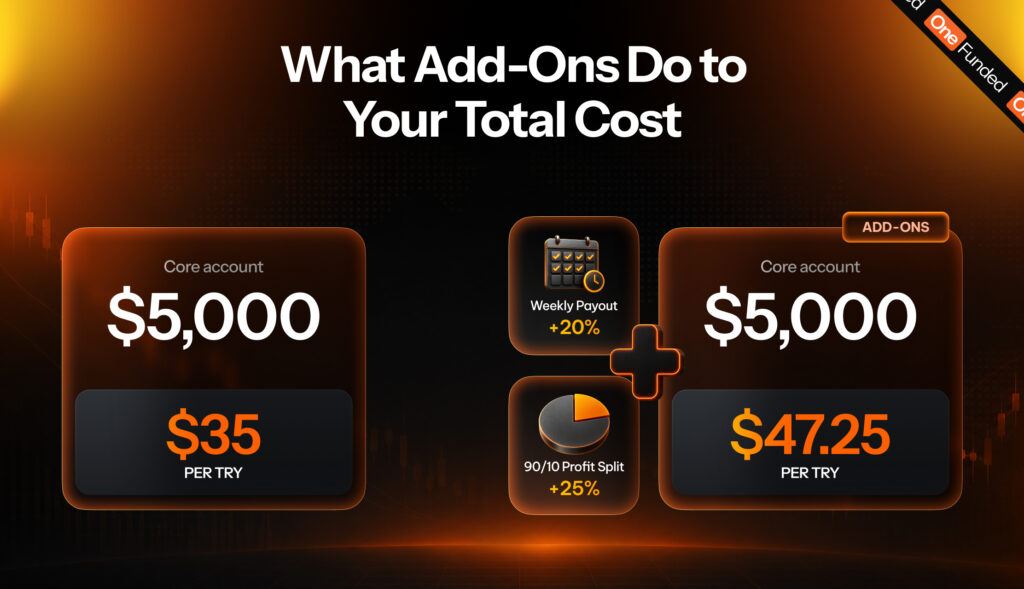
Let’s add a third trader to the mix, Trader C. They select the same $5K Core account, like Trader B. But what’s different in both journeys is that Trader C purchases both add-ons at checkout. At a prop firm like OneFunded, you have to pay for add-ons on every retry.
Three tries for Trader C won’t cost $105. They’ll come to $35 + $12.25, three times over. Here’s some context in the table below:
| Metric | Trader B (Core) | Trader C (Core + Add-Ons) |
| Price for Each Try | $35 | $47.25 |
| Tries Paid For | 3 | 3 |
| Total Amount Paid | $105 | $141.75 |
| Money Back Along With 3rd Payout | $35 | $35 |
| Real Cost | $70 | $106.75 |
The fee refund doesn’t cover add-ons. It covers just the $35 challenge fee. This means Trader C spent $36.75 more than Trader B for the same three tries. So, if you want to buy add-ons, add them to every attempt, not just the first.
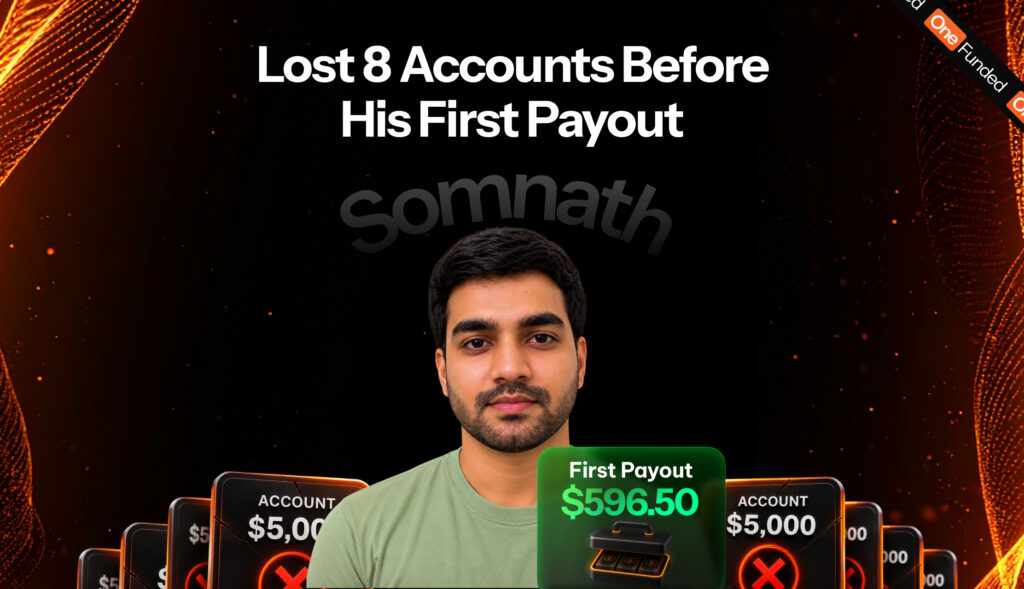
Somnath joined OneFunded at the start of 2026. In his interview, the India-based trader said that forex and gold were new to him. And since he didn’t really understand them and went into them regardless, he lost eight accounts. He links his failures to trading with emotions and taking many trades after a loss.
Somnath didn’t keep trading blindly. Rather, he started to work on his risk. He says he now risks around 0.3% to 0.5% of his account balance on every trade he makes. This change ushered in his first payout valued at $595.50.
We have no idea how big each lost eval was. But if it were to be the $5K Core account that costs $35 each, his total expenditure would’ve been $280. If it was a $25K account that costs $139 each, eight tries would’ve summed up to $1,112.
His first payout covers just the first number, not the second. The lesson? Stick to learning the basics before spending money on real accounts.
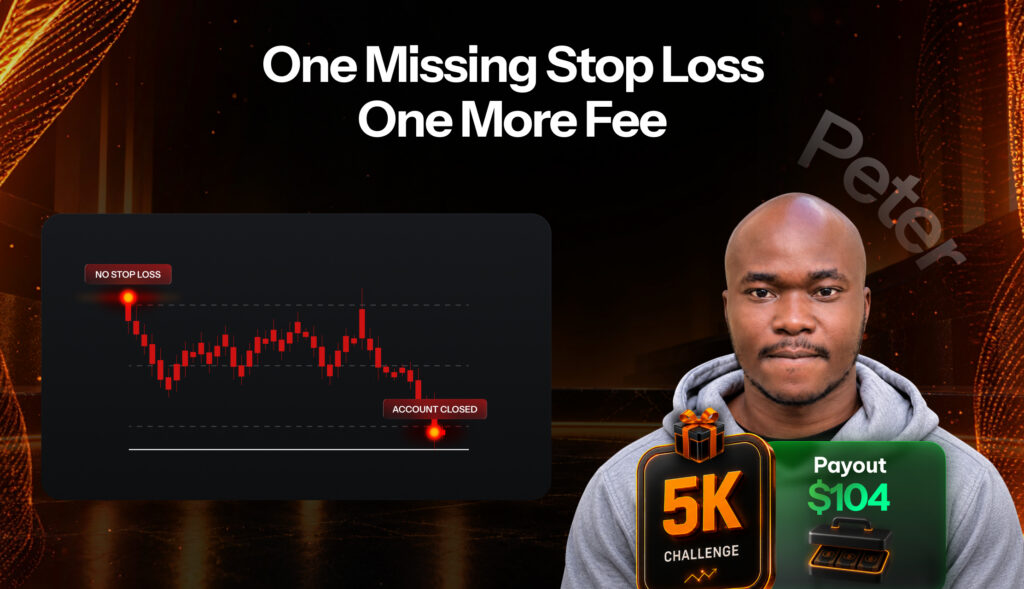
Peter is a Nigerian who studied engineering. In his detailed interview, he says that before he joined OneFunded, he took a $10,000 test at another prop firm. He passed phase 1. In phase 2, he needed to hit a $500 profit target. He had $450 at that point.
He was feeling invincible at the time. So, he went to make a trade without placing a stop loss. The trade went sideways. This incident led to the closing of his account, meaning that he lost his eval fee and all the work he’d put in up to that point.
Peter learned from this error. He now uses a trading journal to track this type of thinking before it becomes an action. Peter later got lucky and won a $5,000 OneFunded account during a giveaway. On this account, he made $130 and got his share ($104) within a day.
Two OneFunded features lower what you spend:
Pass Value, Core, or Flash, and OneFunded will refund what you paid for them, along with your third payout. You won’t get Instant and failed-test fees back.
Progress Pass allows you to do the Value test for a second time without paying a dime. None of the prop firms highlighted in our comparison table below has a free retry in the mix.
Who Qualifies: Only Value accounts bought on or after September 21, 2026. Those bought before that day won’t qualify. Flash, Core, and Instant accounts don’t qualify either.
What Triggers It: You must hit at least 50% of the profit goal in your current phase before breaching a rule. OneFunded measures this by using your highest closed-trade balance in that phase. Note that profits made on open trades don’t count towards your target.
You got a $10K Value account with an 8% profit goal in Phase 1. Your target is $800. If your account balance is $10,400 after closing all your trades, and you breach a rule, you qualify for OneFunded’s Progress Pass.
What You Get: A new Value challenge for free. It’ll have the same account size and trading platform as the last one where you breached a rule. This process is automatic at OneFunded. But you’ll receive a confirmation email.
What You Don’t Get: Add-ons such as the 90/10 Profit Split and Weekly Payouts won’t carry over. You’ll also start from Phase 1, even when you breached in Phase 2.
We took these refund and reset terms from each prop firm’s website. They’re correct as of October 30, 2026:
| Firm and Plan | Steps | Fee Comes Back | Free Retry? | Paid Resets? |
| OneFunded Value | 2 | Yes, with the third payout | Yes, via Progress Pass | No |
| OneFunded Core | 2 | Yes, with the third payout | No | No |
| OneFunded Flash | 1 | Yes, with the third payout | No | No |
| OneFunded Instant | None | No | No | No |
| FTMO 1-Step | 1 | No | No | Yes |
| FTMO 2-Step | 2 | Yes, after you pass | No | Yes |
| FTMO Instant | None | No | No | No |
| FundedNext Stellar 1-Step | 1 | Yes, with the third Performance Reward withdrawal | No | Yes |
| FundedNext Stellar 2-Step | 2 | Yes, with the first Performance Reward withdrawal | No | Yes |
| FundedNext Stellar Lite | 2 | Yes, with the third Performance Reward withdrawal | No | Yes |
| FundedNext Stellar Instant | None | No | No | Yes |
Before choosing a prop firm, here are five metrics you need to check before you pay:
Abhishek, a trader from India, lost money to crypto. After that, he lost three of his gold accounts. In his interview, he said that after these events, he joined OneFunded and passed a $5K Core test.
He went with Core because it had two steps, which meant extra legroom to lose. Abhishek keeps his losses under $100. And within 150 days, he got three payouts valued at $500.
The cheapest prop firms plan is only the cheapest if you can pass it. A $29 test you fail four times is more expensive than a $35 challenge you pass on your second try.
Before you choose a challenge because of its price tag, think about how many tries you might need to take, the add-ons you’ll pay for on each attempt, and what you’d get as a refund. After considering these metrics, pick a plan that suits your trading activities.
Ready to find the right fit? Compare OneFunded’s challenges and pick the plan with T&Cs that fit your budget and trading style.


OneFunded's Value challenge is one of the cheapest. A $5K account costs $29.
Many prop firms do. But you can only get it if you pass the challenge. On OneFunded, you'd get a refund if you pass Value, Core, and Flash. This refund comes alongside your third payout.
To get the exact number, add up every try, with add-ons and resets. After that, take away the refund you get for passing. Let's say you fail four $35 challenges and pass the fifth. You've spent $175 in total. After you get your $35 refund, your actual cost is $140.
Reset and activation fees are easy to miss, so check for them before you pay. At OneFunded, you only pay for your challenge and any add-ons you choose at checkout.

As a trader, you might have searched for prop firms that allow EAs or prop firms that allow news trading....

Are prop firms legit? While some are, some aren’t. However, you can tell whether they’re legit or not if you...
You passed a prop firm challenge. Congratulations. But doing that just taught you a set of rules. Once you’re funded,...
 Set Preferred on Google