



Trade The Pool vs OneFunded: Full Comparison
Different prop firms have different goals. Some seek to build a specialized platform for a small group of traders, while others offer robust features for a broader user base. Today, we’ll be comparing two firms that illustrate this divide: Trade The Pool and OneFunded.
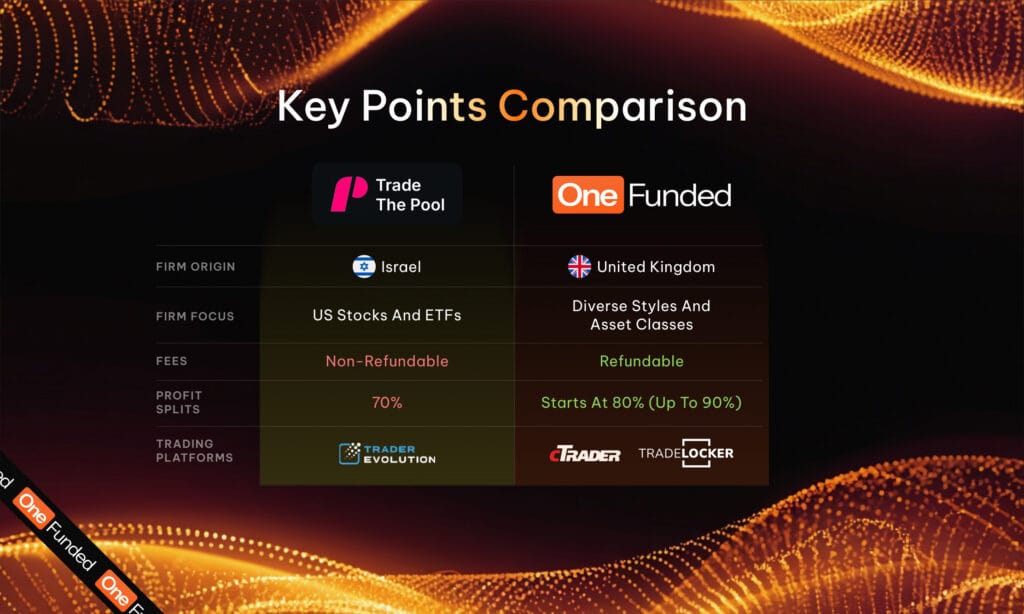
In this article, we’ll provide a comprehensive comparison between the two firms, covering key similarities and differences. Overall, OneFunded will likely be a better fit for most traders, thanks to the firm’s refundable challenge fees and higher profit splits. However, the right choice for a trader depends on their unique goals, strategy, and style.
Looking to take your trading journey to the next level? Start your OneFunded challenge today, featuring no time limits and a refundable challenge fee.
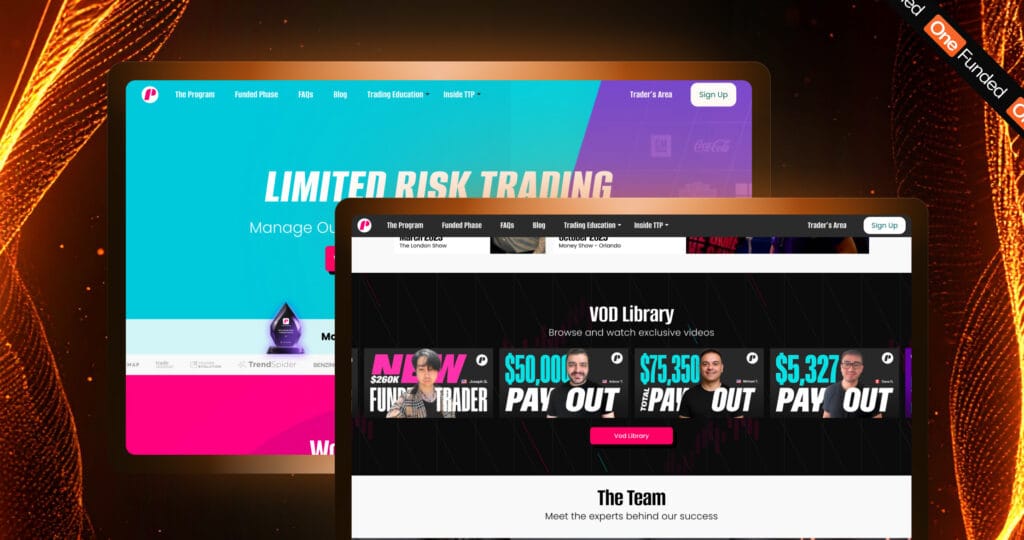
Note: Information for this section was drawn from Trade The Pool’s official website and online reviews.
Founded in 2021, Trade The Pool is a prop trading firm headquartered in Israel. The firm offers access to paid trading evaluations, with successful traders eligible to unlock funded accounts to expand their profit potential. Trade The Pool is a sister company of The 5ers, a prop firm founded in 2016.
Below, we offer a comprehensive look at Trade The Pool, summarizing the firm’s trading challenges, available asset classes, and key terms.
Trade The Pool features a customizable challenge structure. The core decisions a trader needs to make are between the platform’s Day Trade and Swing Trade programs, as well as between Beginner and Advanced trading levels. Unlike other prop firms, Trade The Pool does not offer multi-step evaluations.
Another key difference between Trade The Pool and its competitors is how the firm treats daily losses. Many prop firms automatically end a challenge if a trader exceeds a set daily loss level. In contrast, Trade The Pool has a ‘daily pause’ framework that bars a trader from making additional trades until the next day.
Somewhat confusingly, Trade The Pool also calls the Beginner level its ‘Flex’ trading option and the Advanced level its ‘Max’ trading option. Traders should be aware that these respective choices are identical when navigating the firm’s website. Below, we explore how the various challenge structures impact a trader’s evaluation.
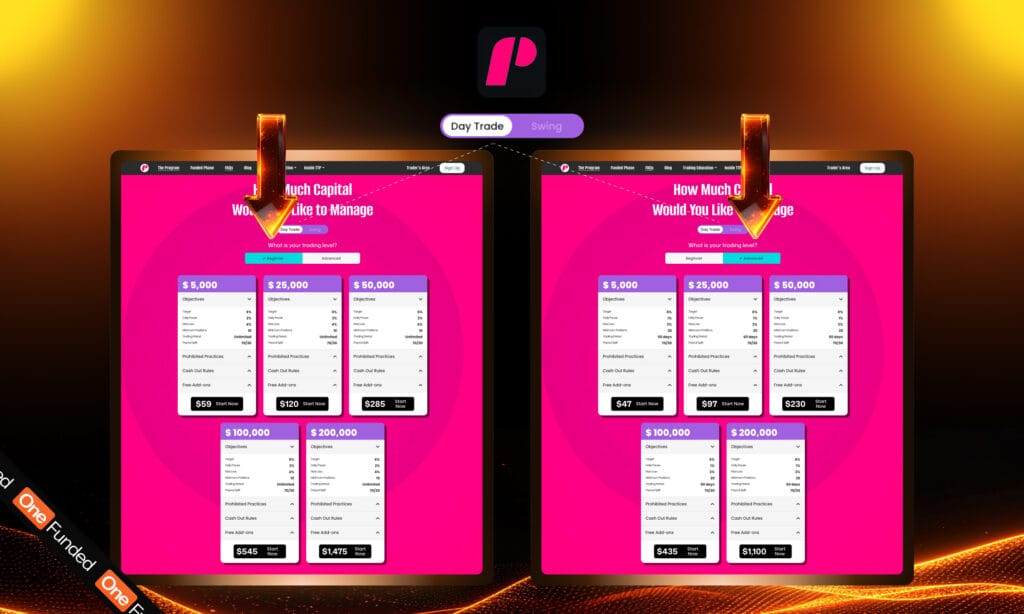
Trade The Pool’s Day Trade program is best-suited for traders with a day trading style – meaning that positions are not held overnight. Selecting this program means that a trader’s positions are automatically liquidated ten minutes before the close of each trading day (including both open positions and pending orders). While traders can choose to re-open positions during pre- and post-market trading, allowable exposure levels are significantly reduced.
Here are the key terms for the Day Trade program’s Beginner option across all account sizes:
| Profit Target | 6% |
| Daily Pause | 2% |
| Maximum Loss | 4% |
| Minimum Positions | 10 |
| Consistency Rule | 50% |
| Min. Profit Days | 3 (0.5% Profit) |
| Trading Period | Unlimited |
| Payout Split | 70/30 |
‘Minimum positions’ refers to the minimum number of trades that need to be executed in order to successfully complete the challenge. The ‘consistency rule’ dictates that a single trade cannot make up more than a set percentage of a trader’s total profit during the evaluation period – in this case, 50%. Finally, this program also requires that traders have at least 3 days with a minimum profit level of 0.5% of the account size, an additional consistency requirement.
In addition to the Beginner (Flex) option, traders using the Day Trade program can also select the Advanced (Max) option, which comes with the following terms:
| Profit Target | 6% |
| Daily Pause | 1% |
| Maximum Loss | 3% |
| Minimum Positions | 20 |
| Consistency Rule | 30% |
| Min. Profit Days | N/A |
| Trading Period | 60 Days |
| Payout Split | 70/30 |
Both the Beginner and Advanced levels come with the exact same profit target. The difference between the two choices lies in how restrictive the trading conditions are. The Advanced level comes with stricter consistency and risk rules, as well as a higher minimum number of positions.
What’s more, Advanced level traders only have 60 days to complete the challenge. In exchange for these stricter conditions, the Advanced challenge comes with a cheaper fee (discussed below).
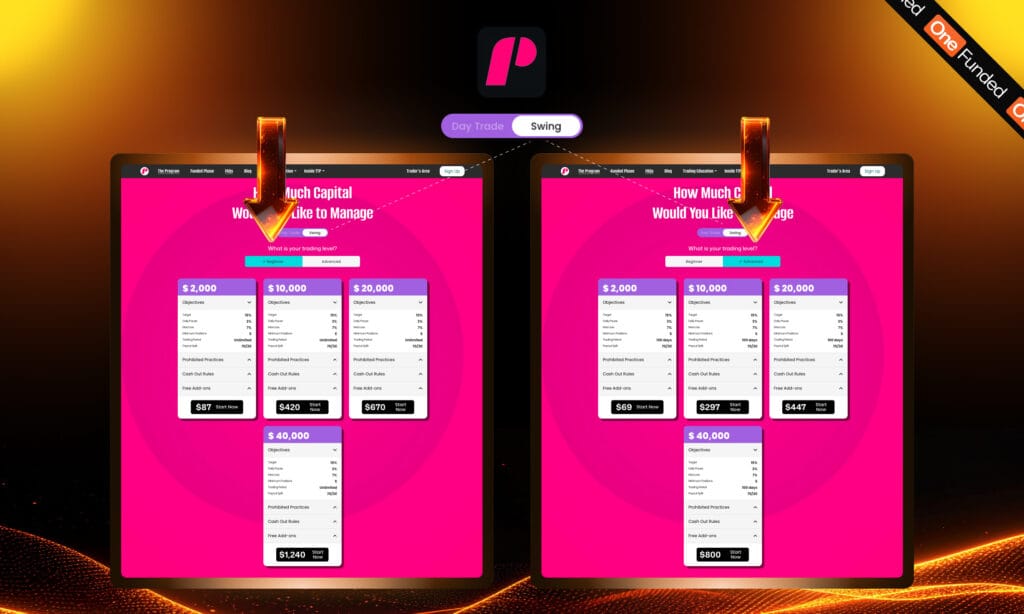
In addition to the Day Trade program, Trade The Pool also offers a Swing Trade option. The Swing Trade program is designed for traders with a strategy that requires holding longer-term positions. In contrast to the Day Trade challenge, Trade The Pool does not automatically close positions for Swing Traders at the end of each day.
However, there are some exceptions to this rule. First, assets must trade a daily average of 500,000 shares over the past 14 days to be eligible for overnight holding. Next, traders cannot hold shares of a company overnight that’s due to report earnings.
The Swing Trade program also comes with Beginner and Advanced options. The key terms for the Beginner Swing Trade challenge are:
| Profit Target | 15% |
| Daily Pause | 3% |
| Maximum Loss | 7% |
| Minimum Positions | 5 |
| Consistency Rule | 50% |
| Min. 0.5% Profit Days | 3 |
| Trading Period | Unlimited |
| Payout Split | 70/30 |
In comparison to the Day Trade challenge, the Swing Trade structure has a profit target that’s over twice as high. However, the program also comes with more flexible risk limits. For the Beginner level, Traders need to lose 3% in a session to hit a daily pause and 7% overall to fail the challenge.
As before, the trading period is unlimited, but traders need to abide by key consistency metrics. Notably, the Swing Trade has a sharply lower number of minimum positions. This could be suitable for traders utilizing a low-turnover, high-conviction strategy.
For the Advanced Swing Trade program, these terms remain almost identical. The only differences are:
Again, the Advanced Swing Trade program is cheaper than the Beginner Swing Trade program for equivalent account sizes.
Upon achieving an evaluation’s profit target, traders become eligible for a Trade The Pool funded account. However, violating the maximum loss limit will immediately result in a failed challenge. In order to attempt an additional challenge, traders have to pay another fee.
Funded traders need to continue monitoring their risk limits. A trader who violates their maximum loss level will immediately lose access to their funded account. This maximum loss level continues to shift upward as a trader achieves additional profits according to a pre-specified formula.
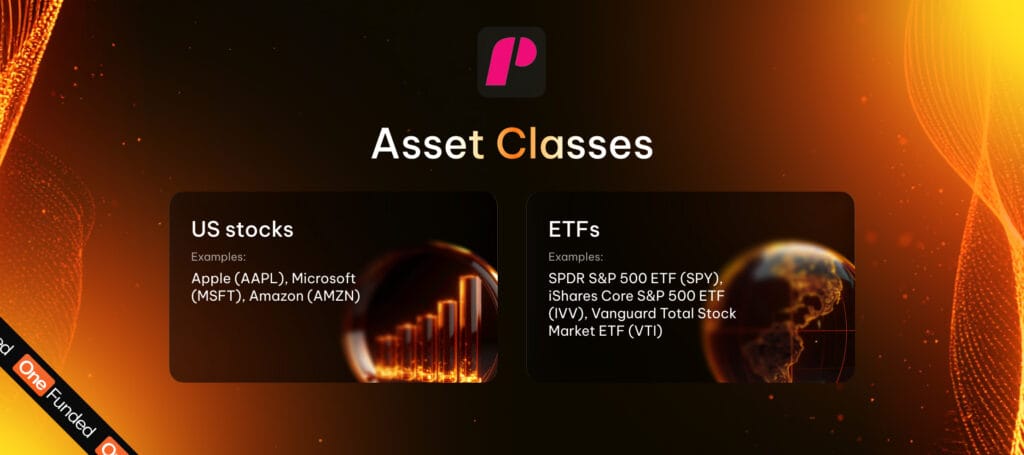
When it comes to asset classes, Trade The Pool is relatively unique compared to other prop trading firms. The company exclusively offers access to US stocks and ETFs. That means traders will not be able to trade markets like forex, commodities, metals, or crypto.
While that still leaves over 12,000 symbols available for trading, Trade The Pool may not be a good fit for traders focused on non-equity asset classes. Notably, the firm offers short-selling on stock positions, meaning traders can utilize a broader range of equity-focused strategies.
Trade The Pool utilizes the Trader Evolution platform. Trader Evolution is generally regarded as a professional-grade trading platform, suitable for both sophisticated analysis and complex strategies. However, the platform is also noted for having a steep learning curve, and the lack of other options means that traders lack flexibility.
Currently, Trade The Pool offers a universal 70/30 profit split across the board – 70% to the trader and 30% to the firm. This amount is below the industry standard, which is generally considered to be 80/20. As a result, the firm may not be the best fit for traders seeking to maximize their profit splits.
Trade The Pool used to offer higher profit splits on certain accounts, potentially up to 80/20. As a result, legacy programs might offer greater profit potential for traders grandfathered into higher rates. However, these splits appear unlikely to make a return for new traders.
Payouts on Trade The Pool occur every 14 days. Traders need to achieve a minimum of $300 in profits to be eligible for a withdrawal. These payouts can be processed via wire transfer, crypto, credit card, or credits to purchase trading tools on the platform.
Trade The Pool’s challenge fees vary based on three distinct factors: Day Trade vs. Swing Trade program, Beginner vs. Advanced trading level, and account size. The two tables below summarize the challenge fees on Trade The Pool based on the firm’s current rates. Importantly, these challenge fees are not refundable – prospective traders will pay these amounts regardless of whether they succeed or fail.
Looking for a prop firm with refundable challenge fees? Make the smart switch to OneFunded, and let your trading performance cover the cost of admission.
Day Trade Program: Trade The Pool Challenge Fees
| Account Size / Trading Level | Beginner | Advanced |
| $5,000 | $59 | $47 |
| $25,000 | $120 | $97 |
| $50,000 | $285 | $230 |
| $100,000 | $545 | $435 |
| $200,000 | $1,475 | $1,100 |
Swing Trade Program: Trade The Pool Challenge Fees
| Account Size / Trading Level | Beginner | Advanced |
| $2,000 | $87 | $69 |
| $10,000 | $420 | $297 |
| $20,000 | $670 | $447 |
| $40,000 | $1,240 | $800 |
Generally speaking, challenge fees for the Swing Trade program are greater than for the Day Trade Program. Although Trade The Pool does not offer the same account sizes for each program, Day Trade fees are typically less than 1% of the account size, while Swing Trade fees are between 2% and 5% of the account size. For traders looking for the cheapest way to access Trade The Pool, the Day Trade program may be a more competitive option.
Trade The Pool is notable for its robust community and education features. The firm has developed a network of traders collectively seeking market success, along with informative material suitable for varying levels of experience. These features include:
Based on these elements, Trade The Pool could stand out as a prop trading platform for individuals seeking greater structure and education along their trading journey.
All of Trade the Pool’s challenges, including their Day Trade and Swing Trade programs, come with certain rules and prohibited practices. These include:
The first two rules could be a significant hurdle for traders who utilize a scalp trading style, including those based on order flow analysis. A minimum trade duration and trade range can make it harder to generate small, consistent profits on short-term trades. The final rule could also be an issue for traders with a strategy that focuses on relatively illiquid assets, as their position sizes may be limited.
In addition to these rules, Trade The Pool features several other common trading restrictions. For example, traders cannot copy trades from a third party, nor can they enter offsetting trades in two different accounts (so-called ‘wash trading’). However, traders are allowed to copy trades between a maximum of two of their own accounts, with some limitations on account sizes.

For prop traders interested in working with Trade The Pool, there are several key features that help the firm stand out from competitors:
Online reviews for Trade The Pool are generally quite positive. On Trustpilot, the firm has a rating of 4.4 out of 5 stars, indicating high overall satisfaction. In positive reviews, users commonly cite the firm’s strong support team and transparent evaluation process.
Selections from positive reviews on Trustpilot include:
5/5, Oct. 2025: “They have everything an amateur trader needs to reach a professional level, with a free live trading room, constant free community learning, and different account sizes to suit your skill level… The entire team is great, with excellent support.” – Fernando, Brazil
5/5, Oct. 2025: “Professional and honest. Their rules are reasonable and provide plenty of room for various trading styles. There is a selection of plans and capital levels in order to facilitate anyone’s needs. The platform itself is well-featured but intuitive, and support is extremely responsive and helpful.” – Joseph, US
But at the same time, not all experiences have been so positive. Although Trade The Pool doesn’t have a large number of negative reviews, those that exist typically cite frustration with delayed payouts or the firm’s confusing platform:
1/5, Sep. 2025: “I’ve been with Trade The Pool for a while now and I’ve had payouts denied and buying power restricted over rules I thought I was following, but the way the terms are written makes everything so unclear. It just feels way too restrictive and excessive… It comes across more like they’re there to limit traders and find reasons not to pay out.” – Moe, US
1/5, Oct. 2024: “Unfortunately, my experience has been negative due to recurring technical issues and unsatisfactory support… Despite promises and claims of professionalism, in reality, you will continuously face technical bugs, slow support, and unclear rules.” – Oleh, Poland
Based in the UK, OneFunded was launched in 2024 following the acquisition and rebranding of Prop365. Having looked at Trade The Pool, we’ll now review how OneFunded stacks up across the same categories.
Looking to take your trading journey to the next level? Start your OneFunded challenge today, featuring no time limits and a refundable challenge fee.
In terms of challenge structure, OneFunded takes a different approach to Trade The Pool. Instead of differentiating challenges by trading style, OneFunded differentiates challenges by the number of stages involved. Moreover, OneFunded offers fully refundable challenge fees if a trader successfully passes their evaluation – a key distinction.
The firm offers three primary structures: a 1-Step challenge, a 2-Step challenge, and a 1F Limited challenge. OneFunded does not automatically close positions at the end of each trading day for any challenge, allowing for a greater variety of trading styles. However, holding positions overnight may involve financing charges, depending on the instrument.
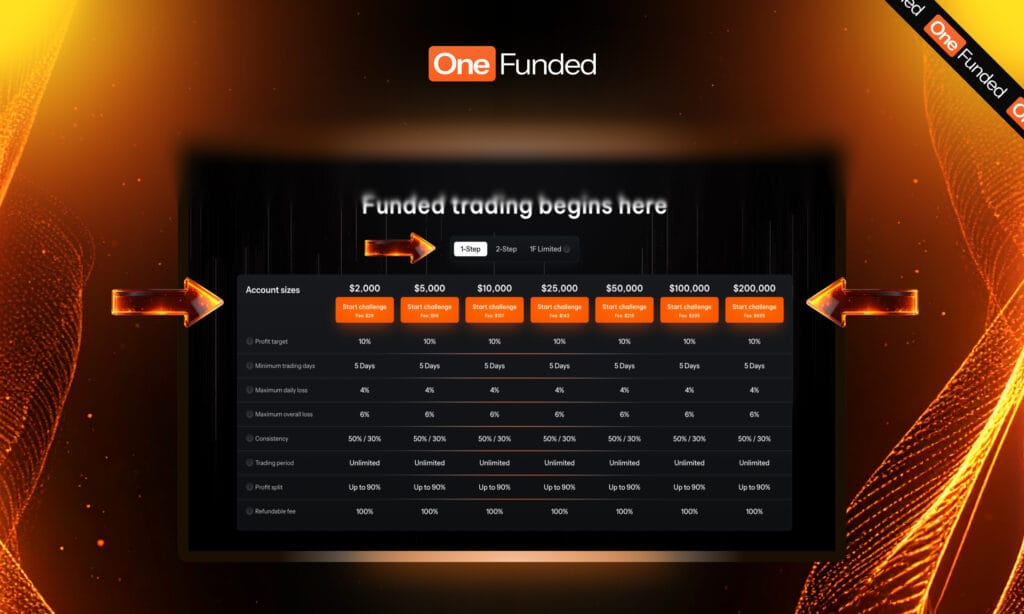
OneFunded’s 1-Step challenge has a single evaluation stage before traders are considered for a funded account. Account sizes range from $2,000 to $200,000. Key terms include:
| Profit Target | 10% |
| Max Drawdown | 6% |
| Max Daily Loss | 4% |
| Minimum Trading Days | 5 days |
| Profit Split | Starting at 80% (up to 90%) |
| Consistency Rules | Best day profit less than 50% of total profit |
| Time Limit | Unlimited |
While most risk limits remain the same once a trader unlocks their funded account, the consistency rules change slightly; a trader’s best day is required to be less than 30% of their total profit. This limit resets with each payout cycle.
Note that OneFunded’s ‘minimum trading days’ refers to the number of days in which a user places at least one trade. In contrast, Trade The Pool requires that users be profitable for a minimum number of days, an important difference.
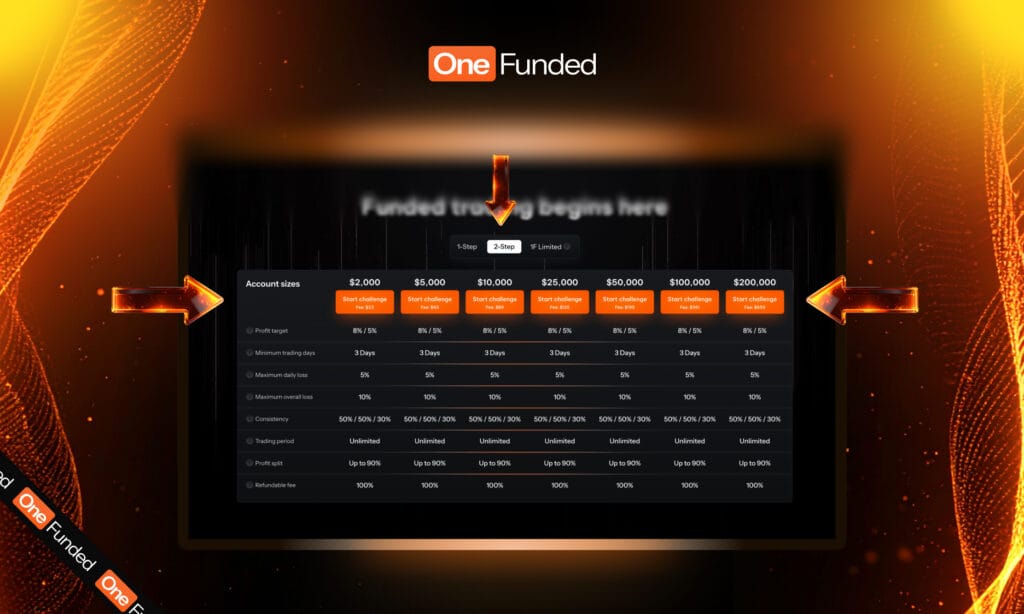
OneFunded’s 2-Step challenge functions similarly to their 1-Step challenge, except that traders need to achieve two separate profit targets to unlock a funded account. Again, account sizes range from $2,000 to $200,000, and the consistency rule drops to 30% if a trader unlocks a funded account.
Key terms include:
| Profit Target | 8% stage 1 and 5% stage 2 |
| Max Drawdown | 10% |
| Max Daily Loss | 5% |
| Minimum Trading Days | 3 days |
| Profit Split | Starting at 80% (up to 90%) |
| Consistency Rules | Best day profit less than 50% of total profit (per stage) |
| Time Limit | Unlimited |
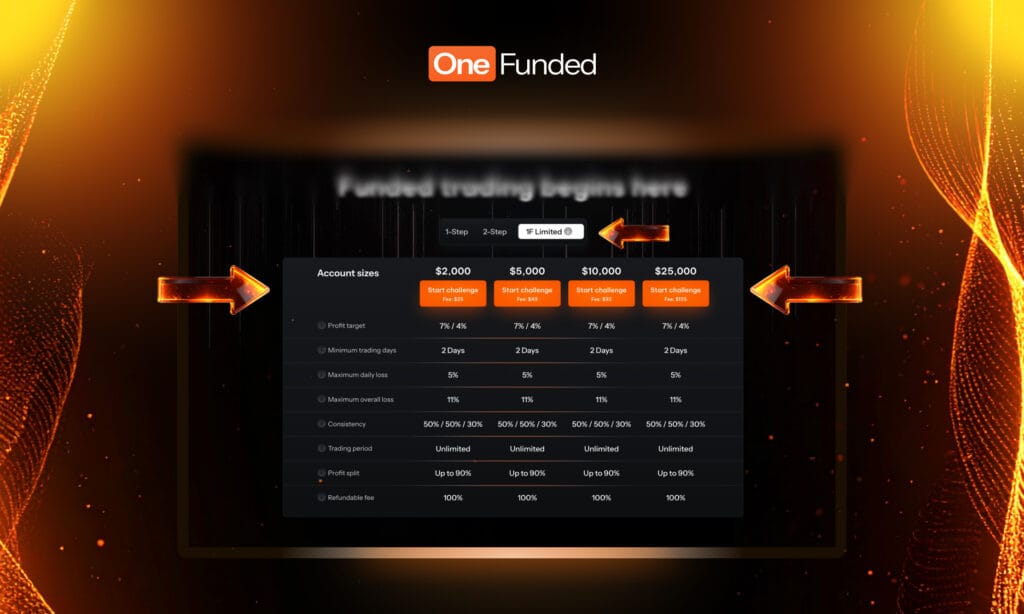
The 1F Limited Challenge offers more advantageous rules compared to the two challenges above. However, the 1F Limited Challenge is only available for a limited time. This challenge is only available in account sizes ranging from $2,000 to $25,000.
The 1F Limited Challenge is a two-stage challenge. Key terms include:
| Profit Target | 7% stage 1 and 4% stage 2 |
| Max Drawdown | 11% static |
| Max Daily Loss | 5% |
| Minimum Trading Days | 2 days |
| Profit Split | Starting at 80% (up to 90%) |
| Consistency Rules | Best day profit less than 50% of total profit (per stage) |
| Time Limit | Unlimited |
Because this challenge comes with lower profit targets and higher risk limits, it offers a more generous structure for prospective traders than OneFunded’s standard 2-Step challenge. However, the 1F Limited Challenge is also more expensive to access. Once again, the consistency rule drops to 30% once a trader has completed their evaluation.

In contrast to Trade The Pool’s exclusive approach, OneFunded offers trading on over 135 different instruments across several key asset classes. These include:
OneFunded’s leverage rules vary by asset class. In forex, traders can access leverage up to 1:100. Commodities and indexes; 1:30. Crypto; 1:2.
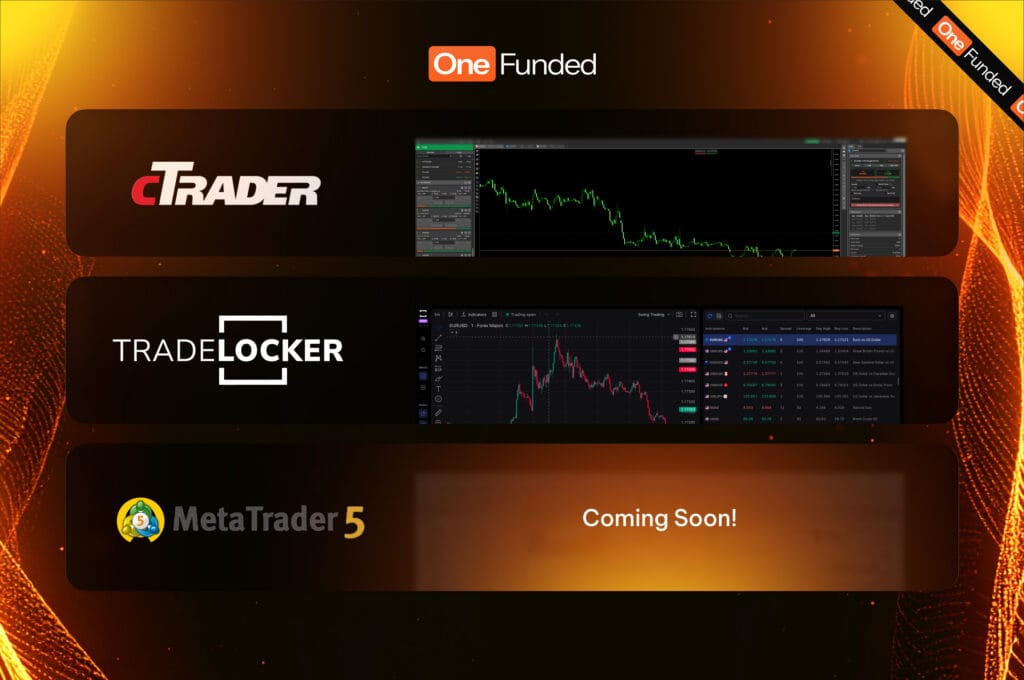
OneFunded currently features access to two separate trading platforms: TradeLocker and cTrader. The former is generally considered a more robust tool, while the latter specializes in offering a lightweight platform.
This multi-platform approach allows traders to select the environment that best suits their style. In the future, OneFunded is planning to add MetaTrader 5 access as well.
When it comes to profit splits, OneFunded offers traders a standard split of 80% across all accounts and challenge types. Traders can also choose to boost their profit split to 90% by increasing their initial challenge fee.
OneFunded’s standard payout schedule is every other week. Traders can enhance this standard schedule by paying an increased challenge fee to access weekly payouts. OneFunded has a minimum payout amount of $100, with payouts above $1,000 eligible to be withdrawn via bank transfer (all other transfers are conducted through crypto via USDT).
Unlike Trade The Pool, OneFunded’s challenge fees are fully refundable as long as a trader passes their evaluation. That’s true even if a trader has purchased a higher profit split and faster payouts. As a result, this fee functions more like a refundable deposit for successful traders.
Here is how OneFunded’s standard fee breaks down by challenge type:
OneFunded Challenge Fees
| Account Size | 1-Step | 2-Step | 1F Limited |
| $2,000 | $29 | $23 | $25 |
| $5,000 | $56 | $45 | $49 |
| $10,000 | $107 | $89 | $92 |
| $25,000 | $143 | $125 | $135 |
| $50,000 | $215 | $195 | N/A |
| $100,000 | $395 | $361 | N/A |
| $200,000 | $699 | $650 | N/A |
Traders can pay an additional 20% for a 90% profit split and an additional 25% for weekly payouts (or a total 34.99% for both options together).
OneFunded’s community and educational resources are competitive, maintaining a Discord channel with just under 5,000 members. OneFunded also has a growing list of educational blogs on their website, covering topics like market liquidity. While actively growing, OneFunded’s educational resources are less mature than Trade The Pool’s, reflecting the firm’s more recent launch.
Unlike Trade The Pool, OneFunded does not enforce a minimum tick size or duration for trades to count as profitable. However, the firm does prohibit several approaches that exploit the design of the platform.
Prohibited strategies include trading on delayed charts, latency arbitrage, and tick scalping strategies. Moreover, while copy trading is allowed between your own OneFunded accounts, it’s not allowed between different users or from third parties.
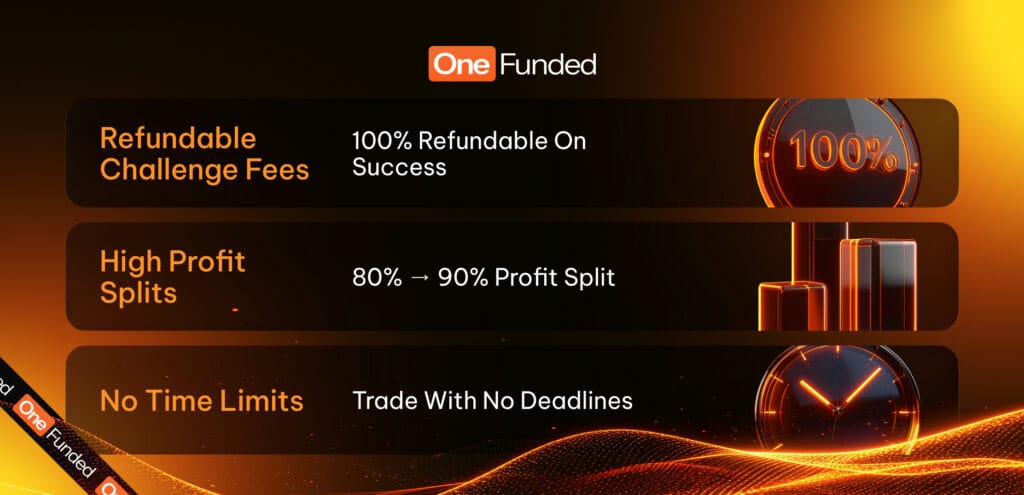
OneFunded stands out from competing prop firms through several key features:
User reviews of OneFunded are highly positive, with a rating of 4.4 out of 5 on Trustpilot. The firm has received strong trader feedback for the no-time-limit challenge process and the quality of the support team.
Excerpts from positive reviews include:
5/5 – Dax, Nov 2025: “Great trading conditions as well as good customer support. Had a few questions regarding my account and they helped me within minutes!”
5/5 – James, Oct 2025: “Clean dashboard, fair spreads, no weird rules. Funded and paid, that’s what matters.”
Nonetheless, some mixed reviews noted delays with KYC (Know Your Customer) regulatory checks, which could be a potential headache for traders looking to start their trading challenge quickly.
3/5 – Troy, Jun 2025: “Had some trouble with the KYC process which delayed funding by a day, but support helped me through it. The platform is okay, but I’d like to see more trading tools in future updates. Still happy with the overall experience.”
3/5 – Barbara, Apr 2025: “Had a bit of an issue with the KYC process, so it took longer than I expected to get my funded account.”
Now that we’ve reviewed both firms individually, it’s time to see how Trade The Pool and OneFunded fare in a head-to-head comparison. Below, we look at how the firms stack up as a whole and in terms of their specific trading challenges.
Trade The Pool vs OneFunded: Overall Firm Comparison
| Trade The Pool | OneFunded | |
| Standard Profit Share | 70% | 80% |
| Maximum Profit Share | 80% (Legacy only) | 90% |
| Standard Payout Schedule | Biweekly | Biweekly |
| Types of Challenges | 1-Stage | 1-Stage, 2-Stage |
| Refundable Fee? | No | Yes, on success |
| Instruments | US stocks & ETFs | FX, commodities, crypto, indexes |
| Trading Platforms | Trader Evolution | cTrader, TradeLocker, MetaTrader 5 (coming soon) |
| Trustpilot Score | 4.4 | 4.4 |
Trade The Pool vs OneFunded: Trading Challenge Comparison
For direct comparison, the table below looks at a $10,000 account for each firm. To ensure that terms are compared as fairly as possible, this table uses a Beginner Swing Trade account for Trade The Pool and a 1-Step account for OneFunded, both of which allow overnight positions and feature an unlimited time period.
| Trade The Pool | OneFunded | |
| Cost | $420 (Nonrefundable) | $107 (Refundable on success) |
| Profit Target | 15% | 10% |
| Max Daily Loss | 3% (Pause) | 4% |
| Max Static Drawdown | 7% | 6% |
| Min Trading Days | 3 days (0.5% profit) | 5 days (No profit requirement) |
| Consistency Rule | 50% | 50% |
| Time Limit | Unlimited | Unlimited |
As the comparison indicates, OneFunded’s challenge fee is not only substantially cheaper, but also conditionally refundable. Moreover, OneFunded’s profit target is lower, although the challenge also comes with more strict risk limits.
Because Trade The Pool and OneFunded have distinct evaluation structures and trading rules, it can be challenging to compare their pros and cons directly. Nonetheless, we can discuss how each firm handles a few key areas and identify which offers the stronger proposition overall.
OneFunded stands out in terms of fees, since the firm offers a fee refund for successful traders. Moreover, OneFunded’s fees are typically between 0.3% to 1.5% of account size across all challenge types.
In comparison, Trade The Pool requires a fee between 2.0% to 4.4% of account size for those that allow swing trading. Trade The Pool’s day trading accounts are cheaper to access, averaging fees of 0.4% to 1.2% of account size, but automatically close positions at the end of each day. All challenge fees on Trade The Pool are non-refundable.
OneFunded has a higher standard profit split of 80% and a higher maximum split of 90%. Trade The Pool has a standard split of just 70%, and higher splits are limited to legacy accounts. Both firms offer biweekly payouts, although OneFunded also offers a weekly option.
Trade The Pool is largely designed for one type of trader: day traders focused on US equities. That’s clear in terms of both the challenge structure and the available instruments.
OneFunded serves a much wider variety of traders. Challenges can be suitable for short-, medium-, and long-term strategies, and available asset classes are more diverse. Trade The Pool is best described as a speciality platform, while OneFunded takes a broader focus.
Because Trade The Pool and OneFunded offer such different challenge structures, it’s not possible to say whether one is inherently better than the other. Instead, traders need to evaluate the firms’ challenges based on their unique goals and trading strategy:
OneFunded’s challenges feature slightly greater flexibility, but traders with a specific strategy or focus could potentially find a better fit with Trade The Pool’s choices.
Overall, OneFunded is likely the better prop firm for most traders. Not only does OneFunded feature refundable challenge fees, higher profit splits, and more flexible challenge structures, but the firm also facilitates access to a wider variety of asset classes. With that being said, Trade The Pool’s specialized focus might appeal to some users – especially day traders focused exclusively on US stocks.
For another specialist matchup, see our Earn2Trade vs OneFunded comparison. Traders weighing multi-asset alternatives can also read our PipFarm vs OneFunded breakdown.
Looking to start your prop trading journey? Explore launching your OneFunded trading challenge today. With account sizes up to $200,000 and a 90% profit split, traders can maximize their earning potential and take their strategy to the next level. Prove your skills and build your potential with the best in the business.


Whether one of these prop firms is ‘better’ than the other depends on how a trader approaches the market, since both platforms have unique features and philosophies. With that said, OneFunded is likely a better choice for most traders due to the firm’s higher profit splits and refundable challenge fees.
Based on online reviews and the firm’s public presence, yes, Trade The Pool appears to be a legitimate prop firm. However, some traders have reported negative experiences relating to delayed payouts or slow support.
Yes, OneFunded is a legitimate prop trading firm. The company was launched in 2024 following a rebrand of the popular prop firm Prop365. Online feedback reflects positive reviews of the firm’s trading platform and challenge structure.

Choosing the right prop firm can be a difficult task. This article offers a comprehensive look at two reputable prop...

Most, if not all, traders want to enjoy the massive capital opportunity that a proprietary trading firm, or prop firm,...

The prop trading landscape has grown rapidly in recent years, with firms competing to attract traders through diverse challenge structures...
 Set Preferred on Google