



What Is a Prop Firm? The Complete 2026 Guide
As a trader, gone are the days when you needed to get all the capital required to start your investment journey. Many traders these days hardly reach a point where they wonder whether they should continue trading with their own funds or join a prop trading firm. Instead of having capital as an obstacle, investors with solid strategies and limited account balances tend to opt for alternative funding via such trading companies. But what is a prop firm? This guide answers the question: How do prop firms work? You’ll get a prop trading firm explained and also understand everything you need to know about how such firms came about, the reality of modern prop firms, and how to choose one.
A proprietary (prop) trading firm is a company that supports traders by offering them access to capital in exchange for a fraction of their trading profits. These companies solve a major challenge in the global trading and investing space by helping traders get access to bigger amounts that may take years to put together or be impossible to even get on their own.
So, unlike the typical trading experience where you must risk all the capital in your account, you can do more with lesser risk by partnering with prop firms.
For instance, at OneFunded, traders can access funding running from $5,000 to $200,000 across multiple challenge options. That way, you can commit to your preferred funding path, whether you’re a beginner or an experienced trader.
However, this type of funding is only approved after you’ve been able to convince them that you can trade consistently and responsibly.
While prop trading is more popular among modern traders, it wasn’t always this way. Let’s take a look at how proprietary trading has evolved over the years.
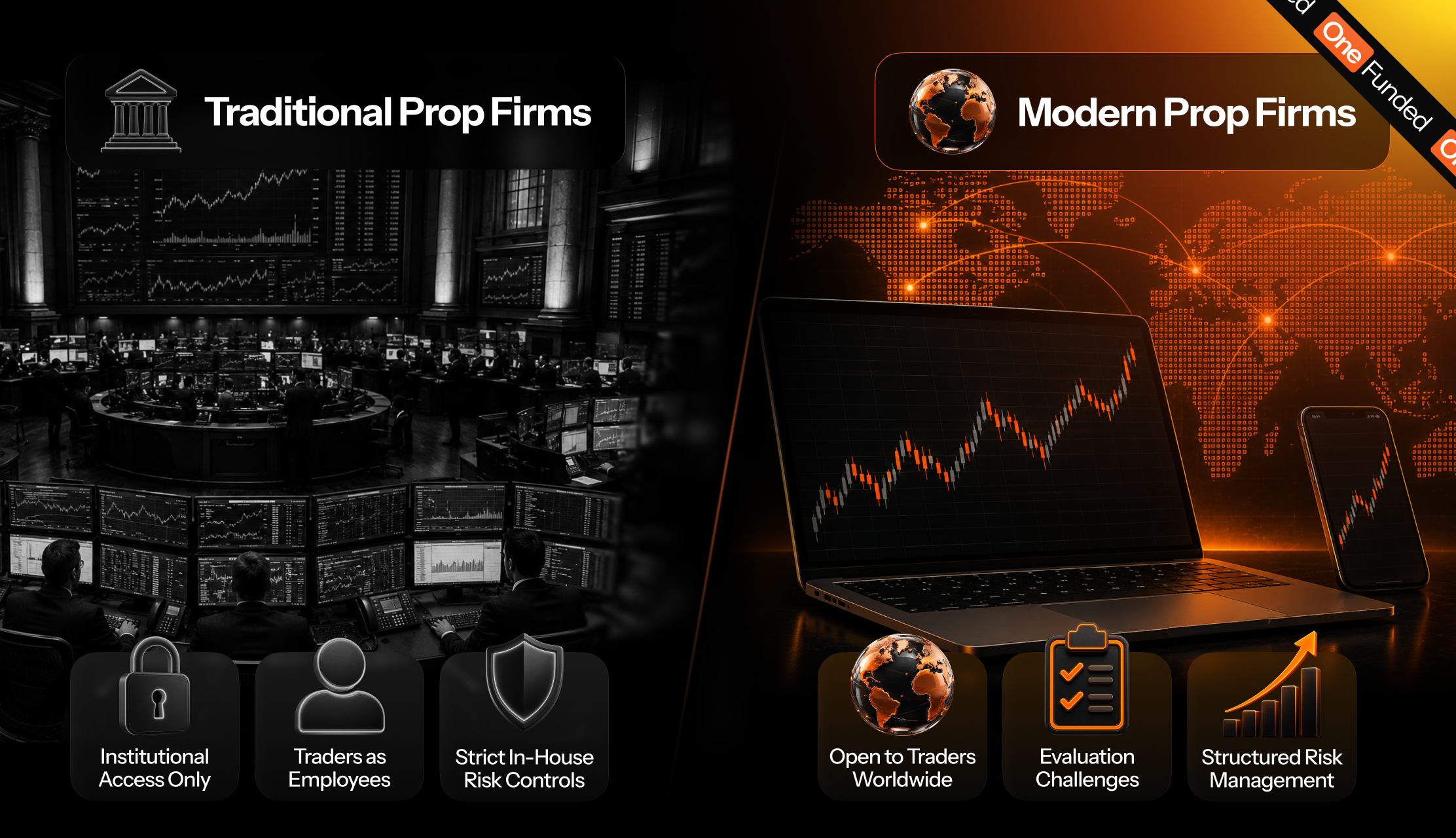
Back when online trading wasn’t a thing due to the inaccessibility of mobile devices, proprietary trading mainly existed inside financial institutions like investment banks, hedge funds, and specialist trading firms.
These companies hired professionals to trade the capital provided to them rather than clients’ funds.
The structure involved traders working from physical trading floors, following strict internal risk controls, and often specializing in asset classes such as equities, futures, fixed income, or foreign exchange.
As a result, most retail traders found it nearly impossible to access institutional capital from traditional prop companies.
With the growth of technology came a positive change in the prop firm industry. As more traders got access to online trading platforms and fast internet, market access improved and trading companies redesigned their systems.
Rather than hiring only full-time traders as employees, modern prop firms created structured evaluation programs that allowed traders from anywhere in the world to prove their ability and unlock funding.
This model has democratized traders’ access to proprietary trading while helping them maintain structured risk controls through challenge rules, drawdown limits, and ongoing account monitoring.
Additionally, modern prop firms provide their users with more asset classes than many traditional firms. Typically, you’ll find investment options across:
Top platforms like OneFunded also support professional trading platforms, including MetaTrader 5 (MT5), cTrader, and TradeLocker to enable access to different kinds of trading environments.
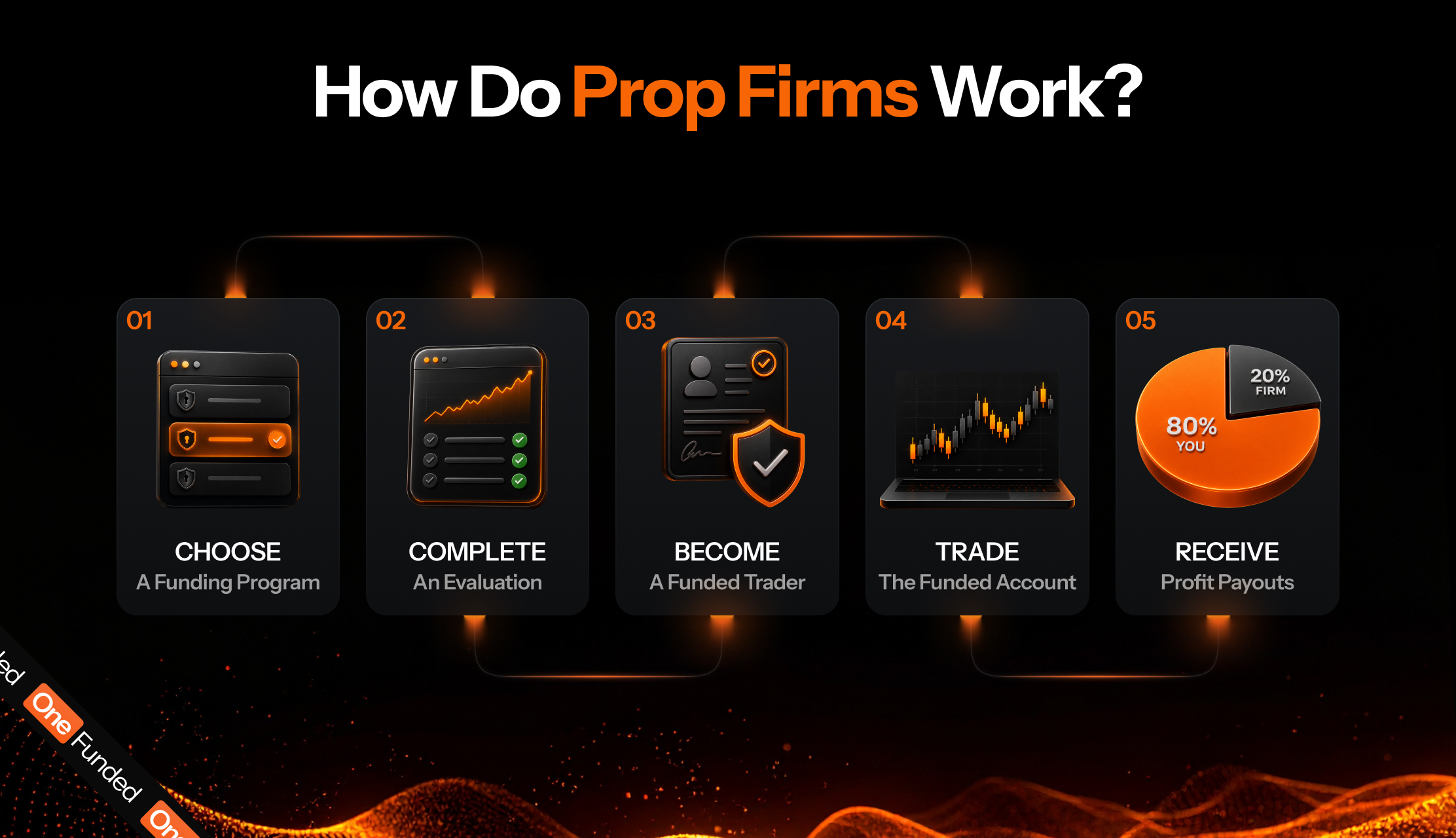
While prop firms offer significant amounts of capital to traders, they simply don’t hand their traders funds. Here’s a detailed breakdown if you need a prop trading firm explained.
The first step is selecting a suitable funding model on your preferred platform. You’re more likely to get favorable outcomes if the challenge aligns with your trading style, experience, and goals.
Each challenge option has different profit targets, drawdown limits, and minimum trading day requirements, allowing traders to choose a structure that suits their experience level and risk tolerance.
Once you’ve subscribed to a program, the evaluation stage begins. However, instead of trading solely for profits, an evaluation should prioritize managing risk consistently over time.
Some of the performance metrics prop firms look out for at this phase, include profit targets, daily loss limits, maximum drawdown, and consistency rules.
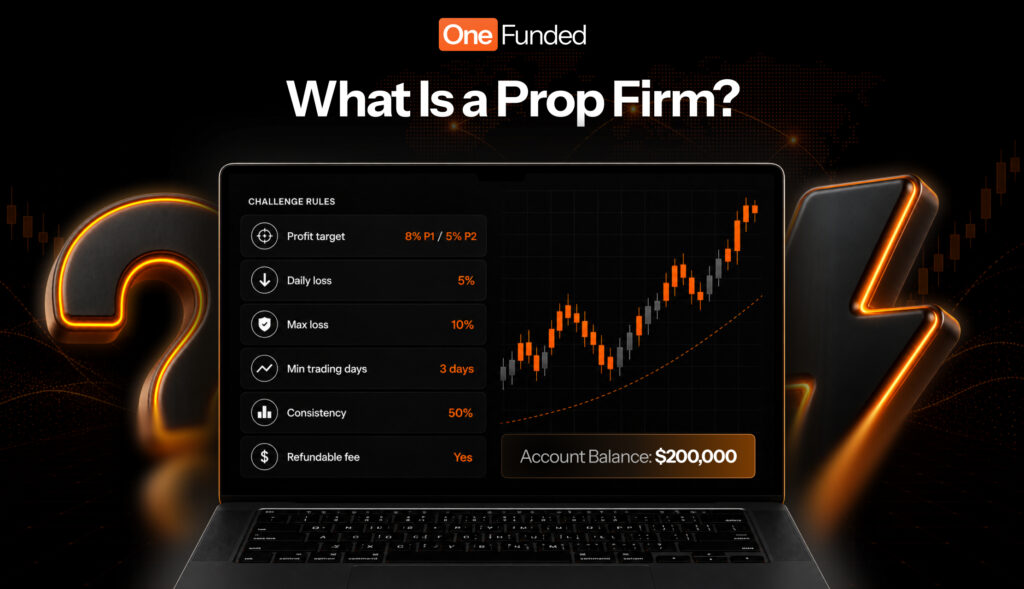
For example, OneFunded’s Core Challenge requires traders to achieve an 8% profit target in phase one and 5% in phase two, while complying with a 5% daily loss limit and a 10% maximum loss limit.
This structure allows you to complete evaluations at your pace and reduces unnecessary pressure to meet a deadline.
You are unlikely to get a funded trading account immediately after passing an evaluation. Usually, trading platforms request identity verification and a signed funding agreement. Some even review trading activities to determine whether you didn’t break the operating rules.
After the approval, your objective switches to generating consistent profits while adhering to the firm’s risk parameters.
At this stage, a trader gets a funded account with the capital associated with their chosen program. The focus here is to execute their strategy consistently while complying with the company’s risk rules.
Some funding models also offer access to additional features such as multiple accounts, overnight trading, news trading, or other opportunities to increase players’ profit over time.
Rather than keeping all trading profits, prop firms distribute earnings according to an agreed profit-sharing agreement.
For instance, if a funded trader agrees to an 80:20 profit split and makes a total profit of $1,000, the prop firm takes $200 and the rest is the trader’s.
Approved withdrawals follow predictable payout cycles, such as 7 or 14 days on the best prop firms, allowing for regular access to earnings.
Modern prop firms do not fund traders based on promises or past performance. Instead of funding users based on promises on past records, modern prop firms depend on evaluation challenges as the true test.
Only those who scale through these evaluations through consistency, discipline, and profitability go all the way to getting funded trading accounts.
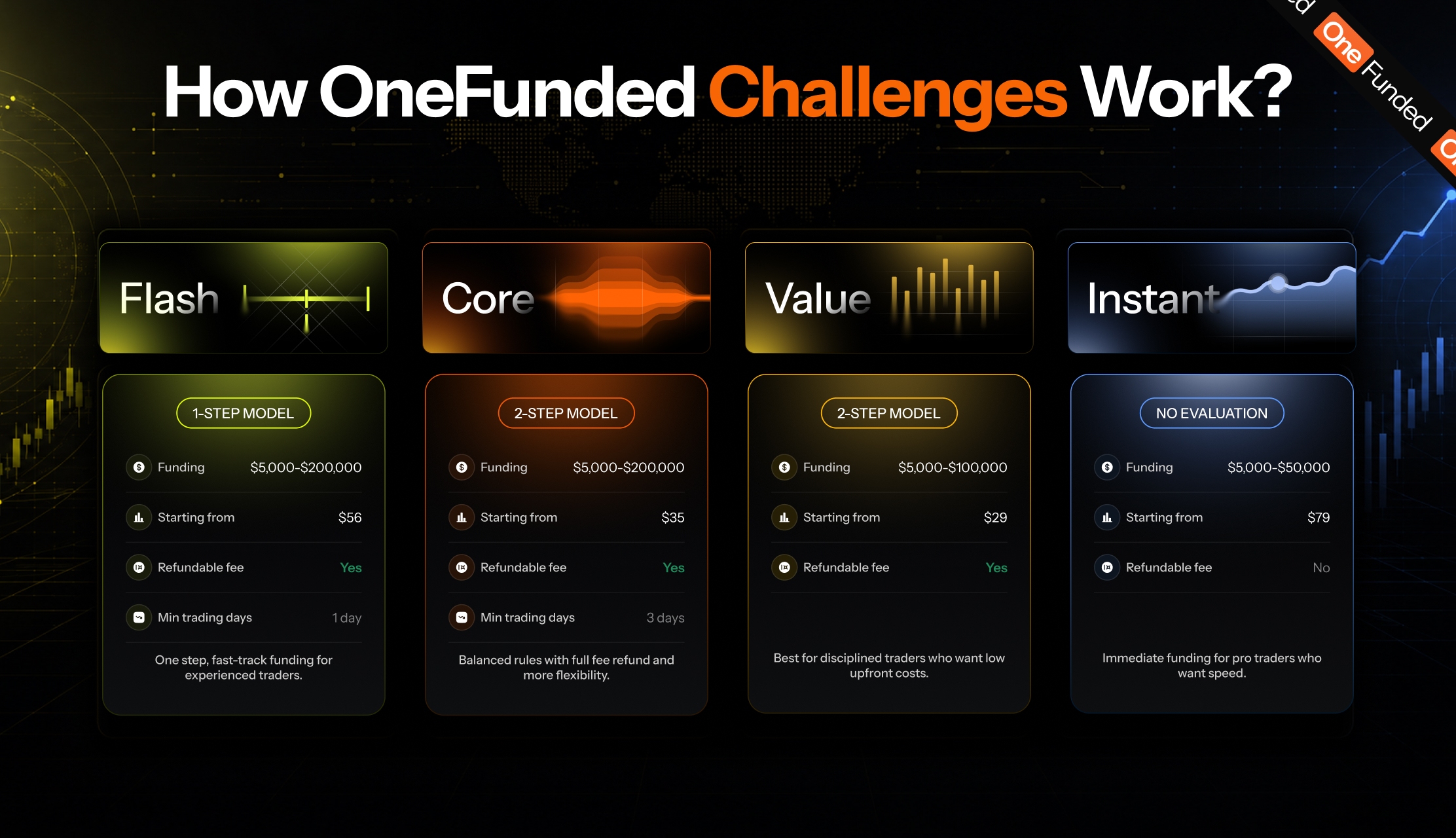
To cater to traders across all experience levels, OneFunded offers four challenge models:
The OneFunded Value challenge is a two-step model. It is a good option if you are big on discipline and small upfront costs. The challenge offers between $5,000 to $100,000 in funding and prices start from $29.
The Core Challenge on OneFunded starts from $35. It is ideal if you want a combination of rules and the security of getting a 100% refundable fee. The challenge requires three minimum trading days for this challenge, while the 5% daily drawdown and 10% maximum loss limits are top considerations.
Flash is a one-step challenge that starts from $56. It offers between $5,000 and $200,000 and a 100% refundable fee. This makes the challenge option ideal for you if you already have enough experience but need quick funding.
Instant Funding on OneFunded comes with no evaluation stage. It starts from $79, but offers lower funds between $5,000 and $50,000. Since funding is immediate, this model is recommended to pro traders who want to unlock capital in no time.
| OneFunded Challenge | Value | Core | Flash | Instant |
|---|---|---|---|---|
| Evaluation Steps | 2 | 2 | 1 | N/A |
| Starting Price | $29 | $35 | $56 | $79 |
| Profit Target | 8%/6% | 8%/5% | 10% | N/A |
| Maximum Daily Loss | 4% | 5% | 4% | 3% |
| Maximum Overall Loss | 8% | 10% | 6% | 6% |
| Minimum Trading Days | 4 | 3 | 1 day (for $50K and below), 5 days (for $100K to $200K) | N/A |
| Fee Refund | 100% | 100% | 100% | No |
| Best For | Disciplined traders | Most traders | Fast-track traders | Experienced traders |
All the challenges on OneFunded support top-rated trading platforms, including MetaTrader 5 (MT5), cTrader, and TradeLocker.
One of the most common questions beginner traders ask is: how do I actually get paid? The short answer is that it depends on your total gains and the profit-sharing model used by your chosen prop firm.
Since you don’t carry all the financial risk and the funds are provided by the company, they get a fraction of the amount you make after trading.
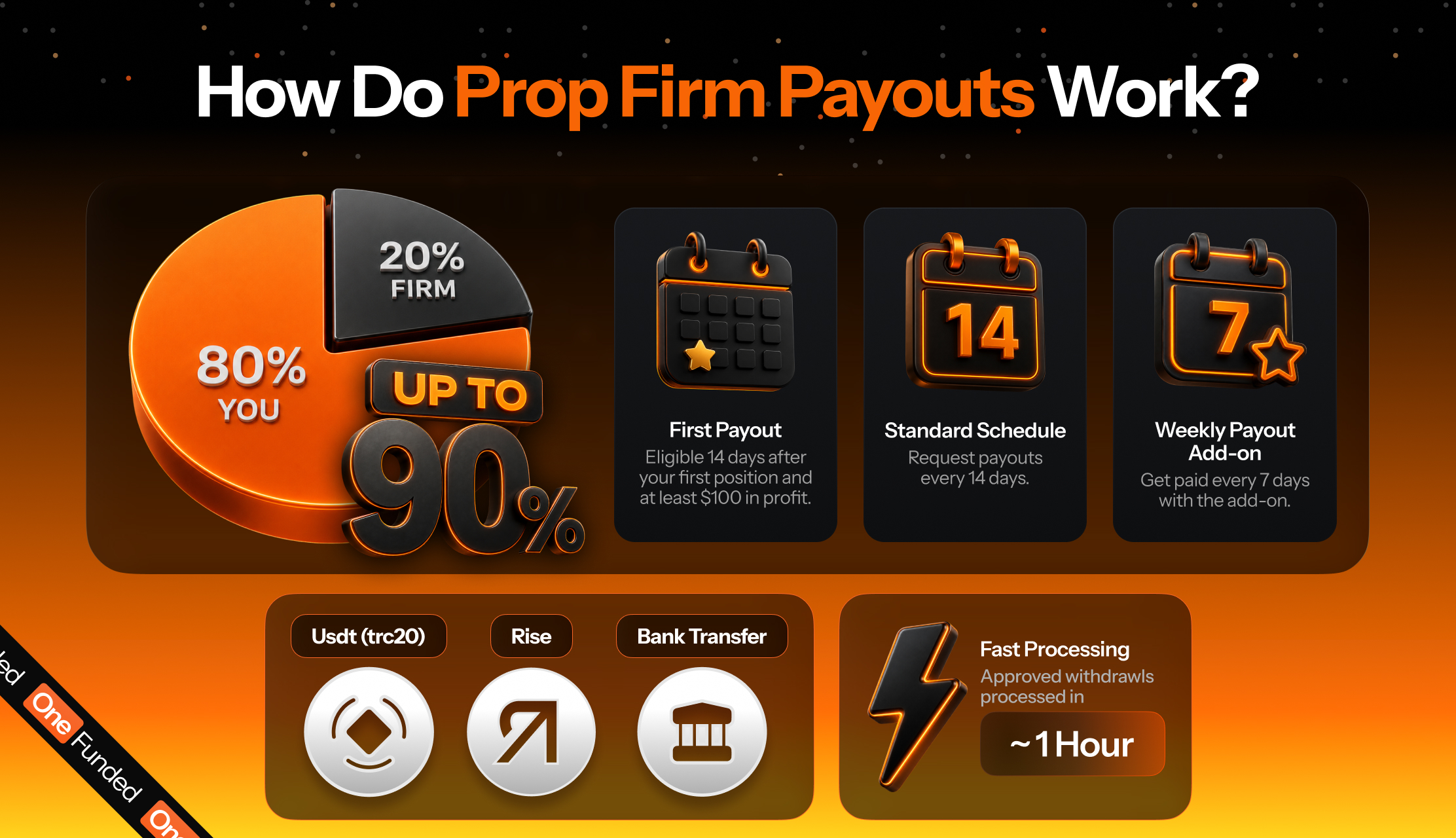
At OneFunded, funded traders begin with an 80% profit split. However, they can increase it to 90% through eligible add-ons and account progression.
Besides the profit split, timing also matters in payouts. Funded traders are eligible for their first payout 14 days after opening their first position, provided they have generated at least $100 in profit.
After the first withdrawal, you can request payouts every 14 days under the standard schedule. You can also choose the Weekly Payout Add-on, which permits withdrawal requests every seven days.
OneFunded currently supports payouts through:
Approved withdrawals are processed in approximately one hour, giving traders predictable access to their earnings.
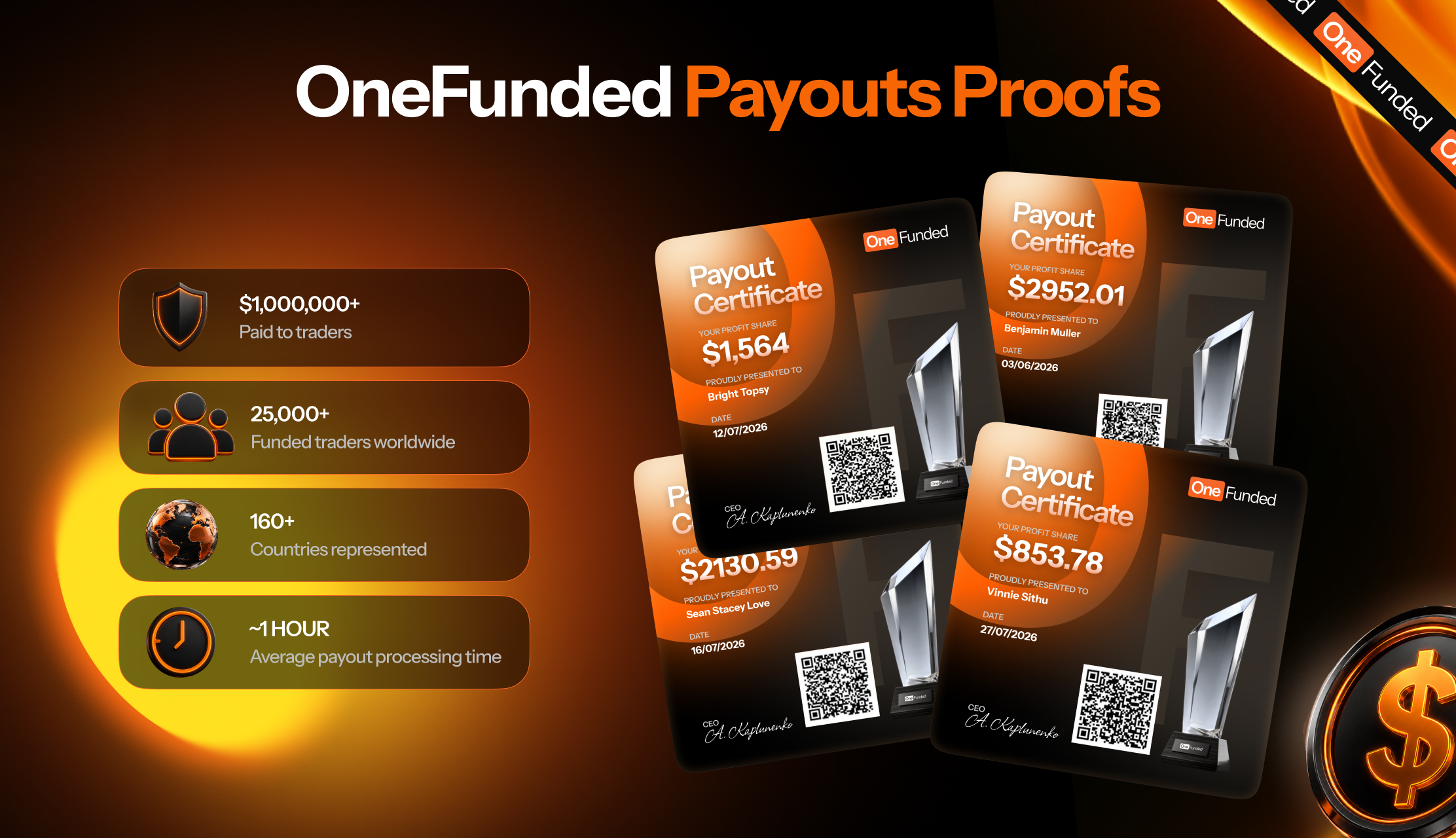
If you’re thinking of how to pass a prop firm challenge on OneFunded, you’re probably wondering if traders have done so in the past and received payouts. At the time of writing, company data shows that OneFunded has paid over $221,609 to traders in the last 30 days, with average payout amounts around $1,756.
One recent example is Jake, a trader from Kent in the United Kingdom, who began trading about two and a half years ago after discovering trading through online content creators.
Like many traders, Jake’s biggest challenges were not technical but about his trading psychology. He struggled with overtrading, revenge trading, and emotional decision-making before joining OneFunded.
Jake started with a $25,000 funded account and earned a $1,600 payout, receiving around $1,300 after the 80% profit split. Following that experience, he said he plans to scale up to larger account sizes because he now has confidence in how the funding model works.
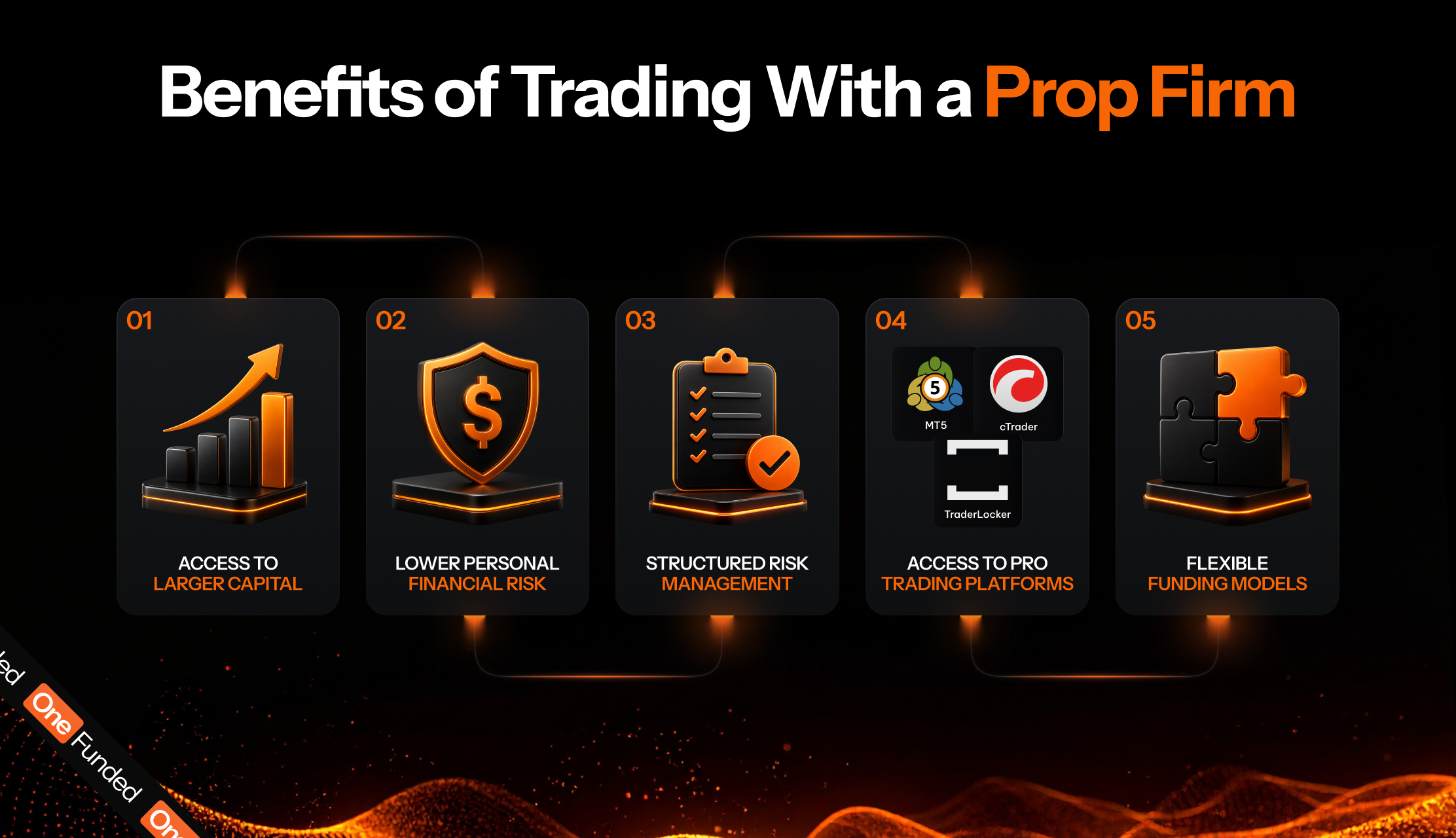
Some of the most significant benefits of using prop trading firms like OneFunded include:
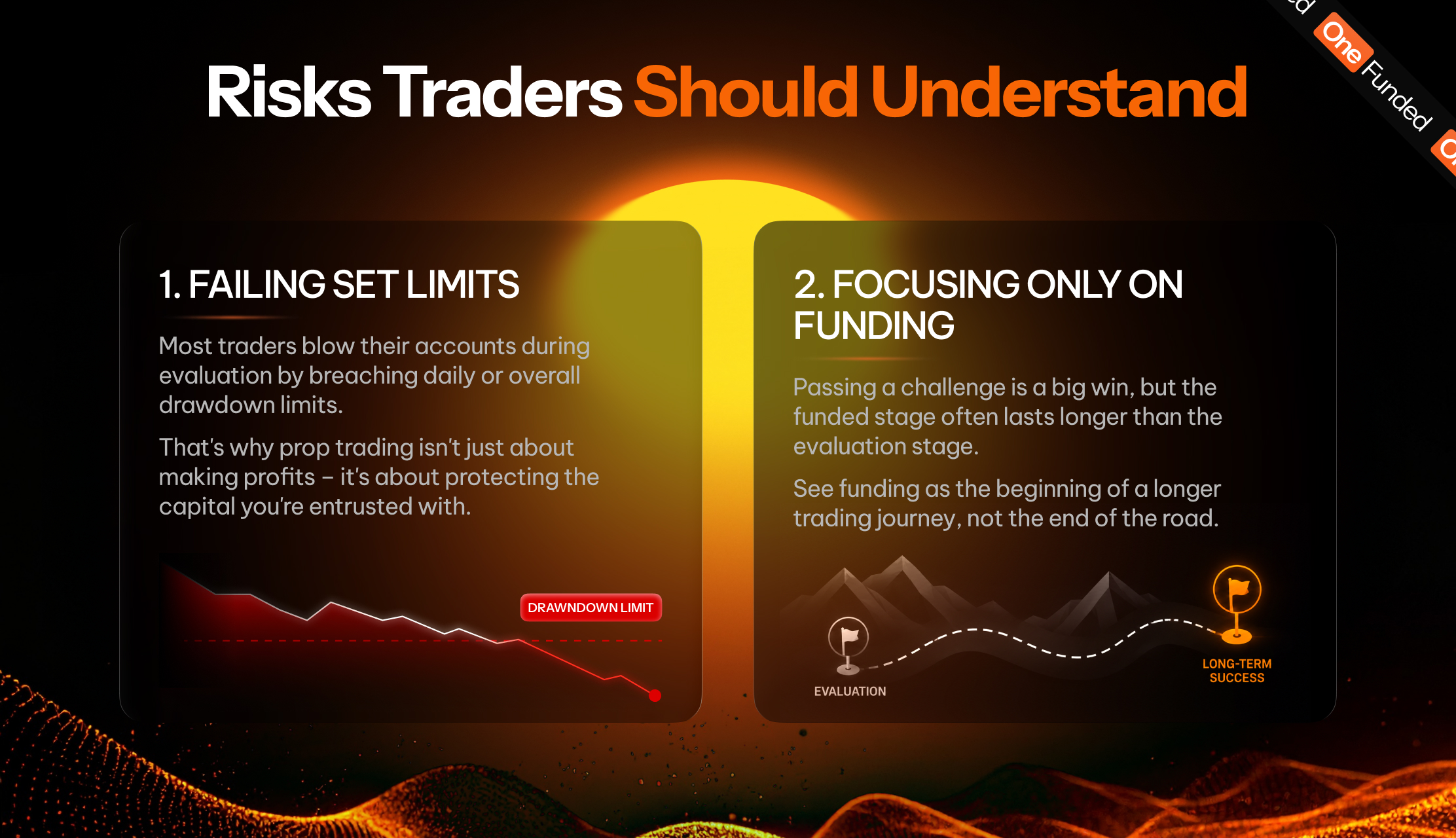
While all of the opportunities above are real, prop trading comes with significant risks that also require attention. These include:
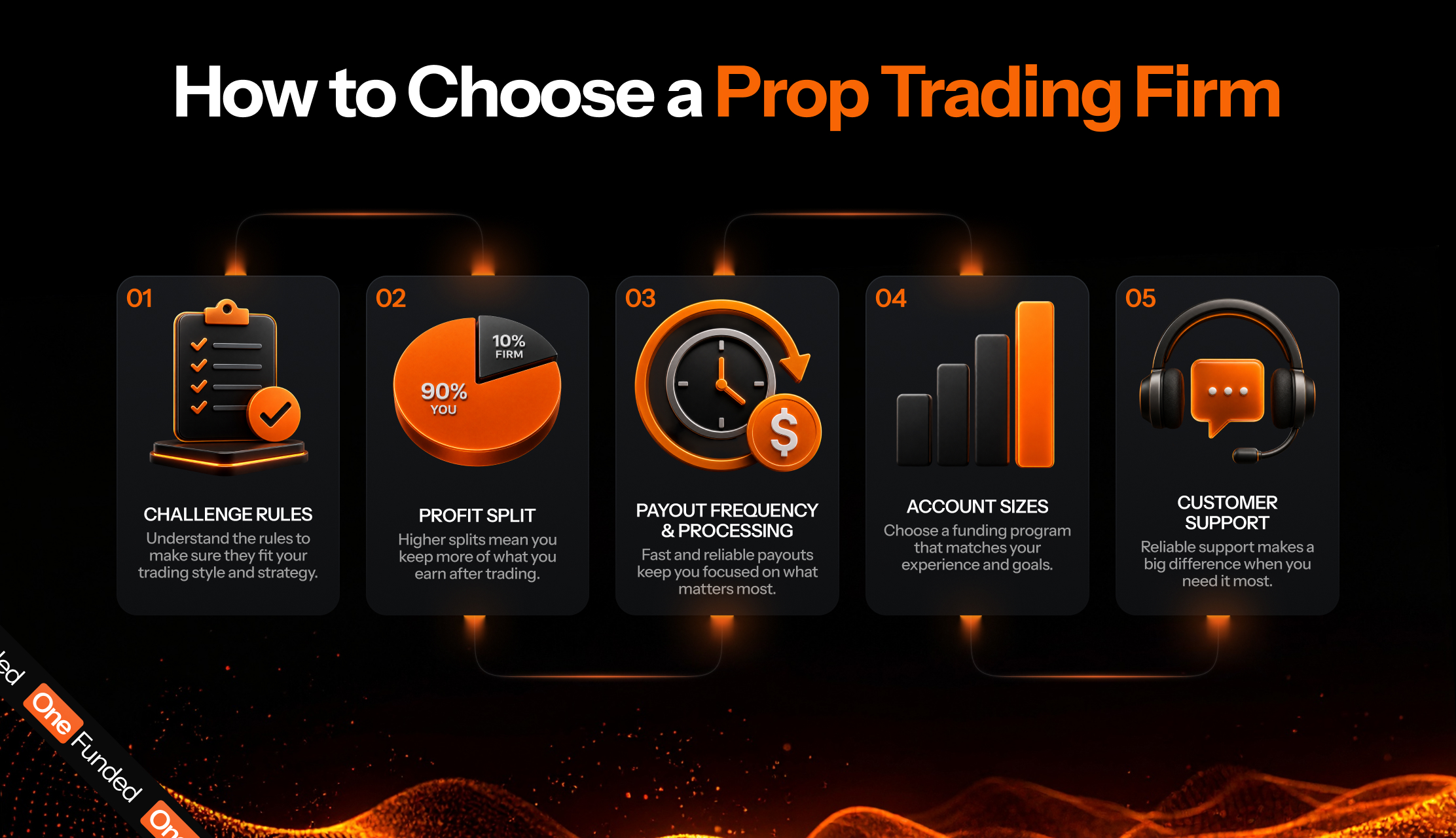
Before purchasing a challenge from prop firms, here are some of the most important factors to consider when you already know what is a prop firm:
Every challenge comes with unique and strict terms, such as:
The first thing is to understand these rules to determine if they are suitable for you. If a prop firm isn’t transparent about its challenge rules, it may be best to find another option like OneFunded that lays everything bare before committing to a challenge.
Profit split directly affects your long-term profitability. The average industry split is 80%, but a higher profit split around 90% allows you to retain more of the money you make after trading. However, you should consider the split alongside the firm’s conditions, payout schedule, and overall funding model.
The last thing any trader wants is their payouts getting delayed after consistent days of trading and making gains. For the best trading experience, prioritize prop firms with quick withdrawal processing times and fair minimums.
A funding program should offer account sizes that match your current experience, even if you’re just starting out. This makes it easy for you to choose an account you’re comfortable managing instead of being forced to handle one beyond your capacity. Moreover, it also gives you the option of choosing low-cost challenges if you have a tight budget.
Look for firms with credible and reliable support. Such prop firms have fast response times and support users with educational materials that help them navigate different challenges that may arise.
Prop trading has grown over the years, with prop trading growth increasing by over 1,260% between 2015 and 2025. As prop trading continues to grow, many misconceptions are becoming common due to deceptive marketing by some companies and influencers.
A funded account is not free capital. For every funded trader who gets access to funds, there was an intentional effort to meet clearly defined evaluation requirements and show consistent risk management. In other words, you must put in the work during evaluation to successfully get a funded account.
While passing a prop challenge is great, it only proves that a trader can follow laid down rules over a specific period. Long-term success in prop trading depends on maintaining those same habits during evaluation even after funding.
A larger account does not equate to more profits, as success depends on traders’ habits and risk management structures. Without consistency, increasing capital often leads to larger losses instead of more profits.
While experience can make a significant difference when trading with prop firms, many companies welcome beginners and slightly experienced traders with challenge models that are suitable for their stage of the journey. It’s crucial to choose an evaluation that matches your experience level rather than trying to qualify for the largest available account when starting out.
What is a prop firm trading experience like? We’ve covered the details in this article to help you learn the best approach to finding a company that suits your needs and how to prepare for a challenge regardless of your experience level.
Whether you choose a two-step evaluation, a one-step challenge, or an instant funding model, the principles remain the same. The traders who go all the way to build sustainable results are rarely the ones chasing the fastest profits or the largest account sizes.
Their results are largely due to disciplined efforts, effective strategies, and consistent trading habits. You can also start your journey with accounts ranging from $5,000 to $200,000 on OneFunded. However, remember to protect your capital first before anything else.


Join our mailing list today!
A prop trading firm provides traders with access to its company's capital instead of expecting traders to buy and sell assets out of pocket. In return, traders get between 80% and 90% of the profits they make after meeting the firm's funding requirements.
Prop firms generate revenue through evaluation fees and their share of funded traders' profits. For instance, challenge fees on OneFunded range from $29 to $899, and successful traders are expected to pay between 10% and 20% of their profits to the company.
Challenges evaluate a trader's ability to generate profits while respecting predefined rules such as profit targets, daily loss limits, maximum drawdown, and minimum trading days. Traders who successfully complete the evaluation become eligible for funded accounts.
If you violate the challenge rules or fail to meet the evaluation requirements, the challenge ends and the fee is non-refundable. However, many firms allow traders to purchase another evaluation and try again.
Yes, many prop firms support newbies with different funding models. As a beginner you can choose a challenge with less strict rules that match your current skills and build consistency as you learn.

Every prop firm challenge has a unique set of rules. This includes profit targets, drawdown limits, and consistency demands. Most...

You’ve made up your mind; you want to go into trading full-time in 2026. Great. But there are tens of...

Draft a trading plan for a prop firm challenge account that fits all of OneFunded's rules, entry criteria, loss limits,...
 Set Preferred on Google