



Risk Management for Prop Trading: The Framework Funded Traders Actually Use
When engaging with OneFunded’s challenge, you should understand that a good strategy may not be enough to make you successful. Risk management for prop trading is what separates traders who pass from traders who don’t — once you start, you may notice the sizing restrictions that override the habits you may have built using a personal account. For instance, you can’t just hold a losing position for days and expect a recovery.
OneFunded tracks your equity from a fixed point at the start of each day and halts your account if that equity drops too far below it. Three things keep you from hitting that floor: your size per trade, the number of open trades, and your daily stop.
A OneFunded Core account trader entered one EUR/USD trade and one GBP/USD trade, each at 2% position size, during the New York session. Spreads widened ahead of a data release, and both positions moved against the trader, creating $2,400 in combined floating losses. Because the two trades were correlated, OneFunded counted them as a single exposure, and the combined drawdown breached the 5% daily equity limit.
According to OneFunded data, 78.7% of failed evaluations are because of the daily loss limits being breached. The framework below builds on three core principles, which are 0.5% risk per trade, a maximum of three open positions, and a 1.5% personal daily stop, while adding five supporting rules for managing correlation, news events, overnight exposure, scaling, and profit protection.
You can approach the evaluation using the same prop trader risk management strategy you employ when trading your personal account: risk 1-2%, let profits ride, and take a few losses in the process.
Two assumptions behind that approach collapse inside a funded challenge. First, you have no open-ended runway to recover from drawdowns. Second, the platform counts floating losses, not just closed trades, toward your daily limit. For a deeper look at these pitfalls, read OneFunded’s breakdown of why traders fail prop firm challenges.
OneFunded calculates your daily losses from Start-of-Day equity at 00:00 UTC, counting realized losses, floating losses, commissions, and swaps.
Your equity only needs to touch the daily floor for the account to breach, even if the trade remains open. If you have a $25,000 Flash account, the floor is set $1,000 below the Start-of-Day equity, as Flash has a daily loss limit of 4%, whereas the Core risk profile accepts 5% losses, which sets the floor $1,250 lower.
The daily loss limit resets at 00:00 UTC. Overnight positions incur swap costs, and every transaction carries a commission.
On a $50,000 Value account, budget roughly $80 in daily fees (commissions plus swaps), leaving $1,920 of your 4% daily limit for actual trading losses.
These rules work on three dimensions: your loss per trade, number of positions, and when you stop trading for the day. There are five more rules that take care of external factors. Together, they form a complete approach to risk management for prop trading, making sure you do not breach the boundaries of Core, Flash, and Value during any drawdown period.
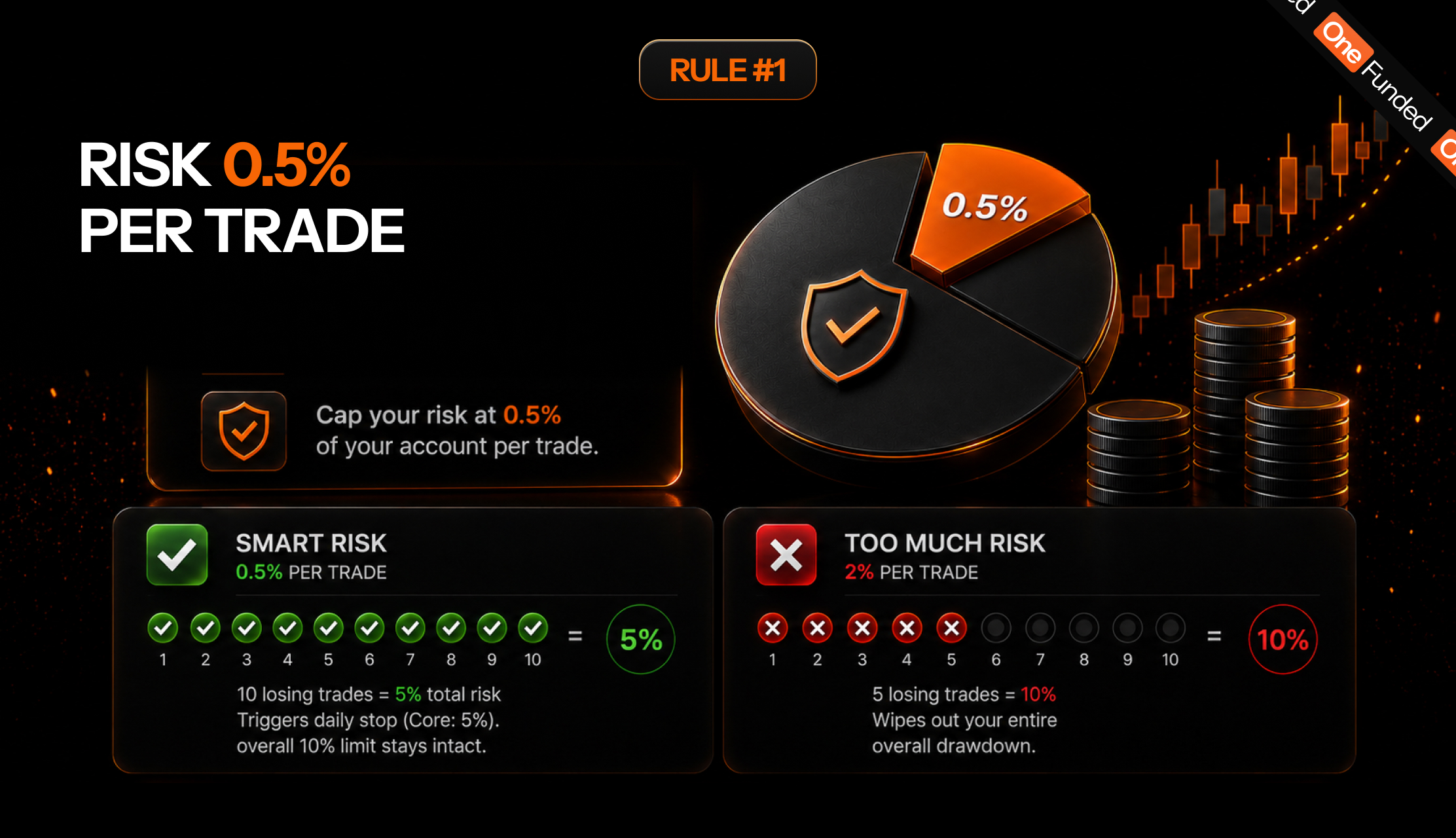
Cap your risk at 0.5% of the account per trade. On a $100,000 account, that limits each losing trade to $500. Even ten consecutive losses would total only 5% — triggering Core’s daily stop but leaving the 10% overall limit intact.
At 2% risk, five losing trades would wipe out your entire overall drawdown allowance. Keeping risk small gives your edge enough room to play out before the limits end the evaluation. Flash and Value shrink the daily stop to 4%, which makes your personal daily cap (Rule Four) even more critical.
A 50-pip stop on a major pair gives you roughly 1 standard lot at $10 per pip. Tighten the stop to 25 pips, and you can trade 2 lots for the same $500 risk.
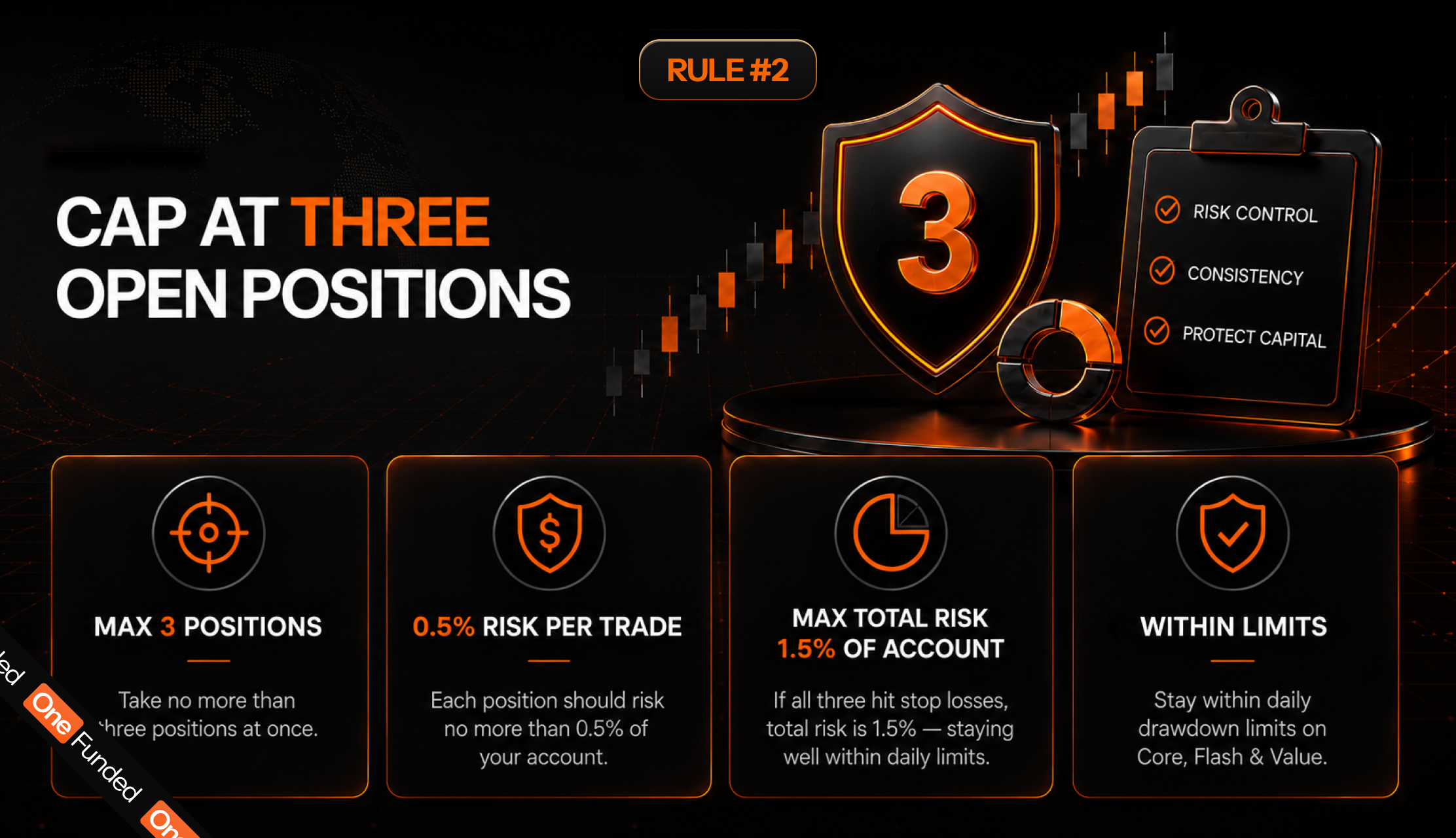
Take no more than three positions at once, each at a risk of 0.5% according to Rule One. If all three positions hit their stop losses at once, your total risk reaches 1.5% of the account size — leaving a comfortable buffer beneath the daily drawdown limits on Core, Flash, and Value.
This rule follows OneFunded’s policy of Position Sizing Consistency, which requires the trader to take no more than 3% risk of the initial account size per trade idea for all challenges. The company combines correlated trades into one trade idea, meaning that long EUR/USD, long GBP/USD, and short USD/CHF will be considered as one trade idea, not three positions.
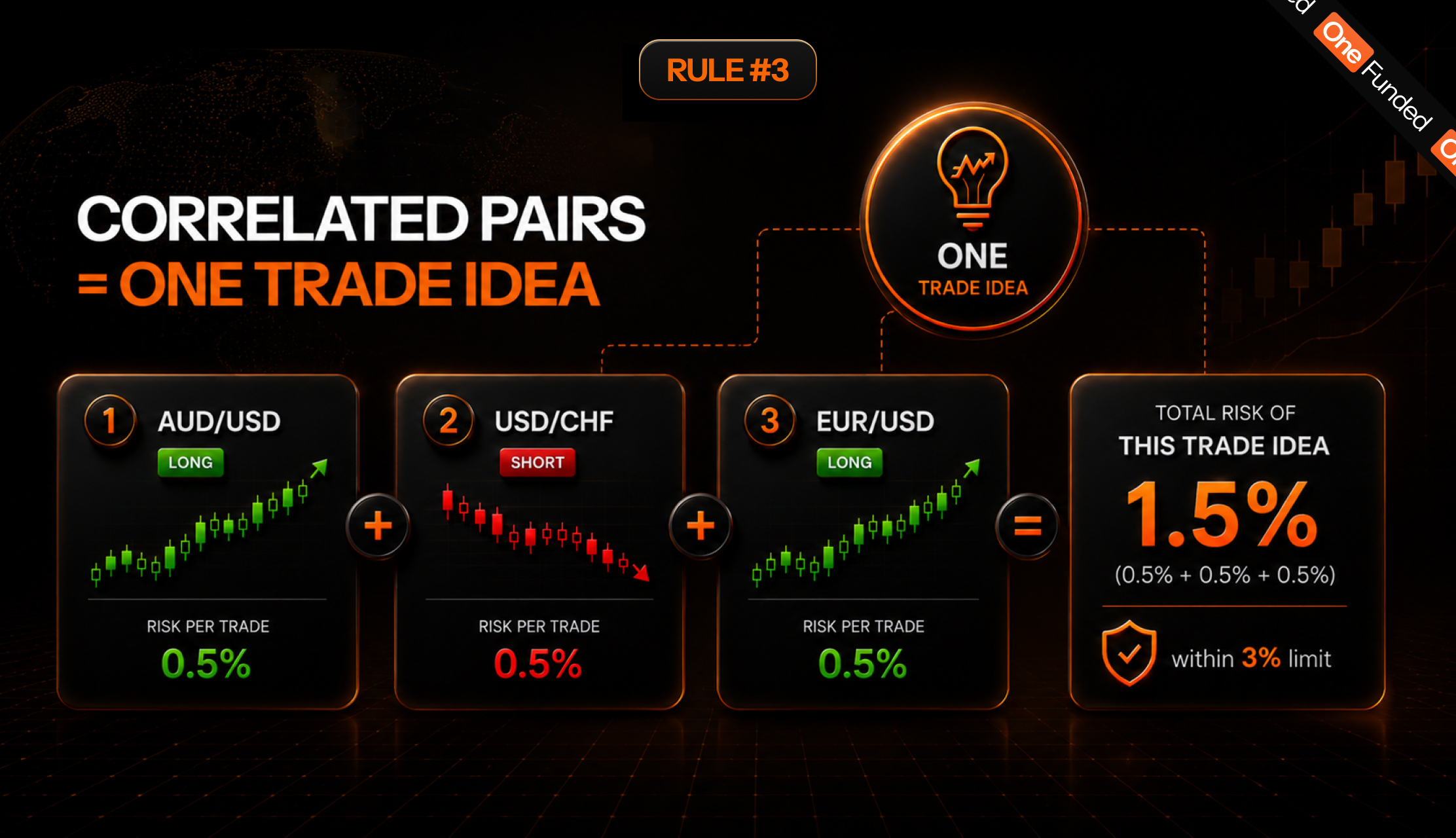
A trade idea at OneFunded includes all positions in the same instrument and direction, opened within two hours of the previous close, plus all other correlated instruments reflecting the same market idea.
Long AUD/USD and short USD/CHF both represent USD weakness and therefore form part of the same trade idea, which is limited by the 3% rule. Because both positions express the same underlying market view, OneFunded treats them as a single trade idea when calculating your total exposure.
When opening the second position, check whether it repeats the exposure of your current trade. If it does, sum up the risk of the two trades and calculate it in relation to the 3% trade idea risk limit.
Two 0.5% positions in correlated instruments give 1% risk. Opening the third one results in a total of 1.5% risk, representing half of the permitted trade-idea risk.
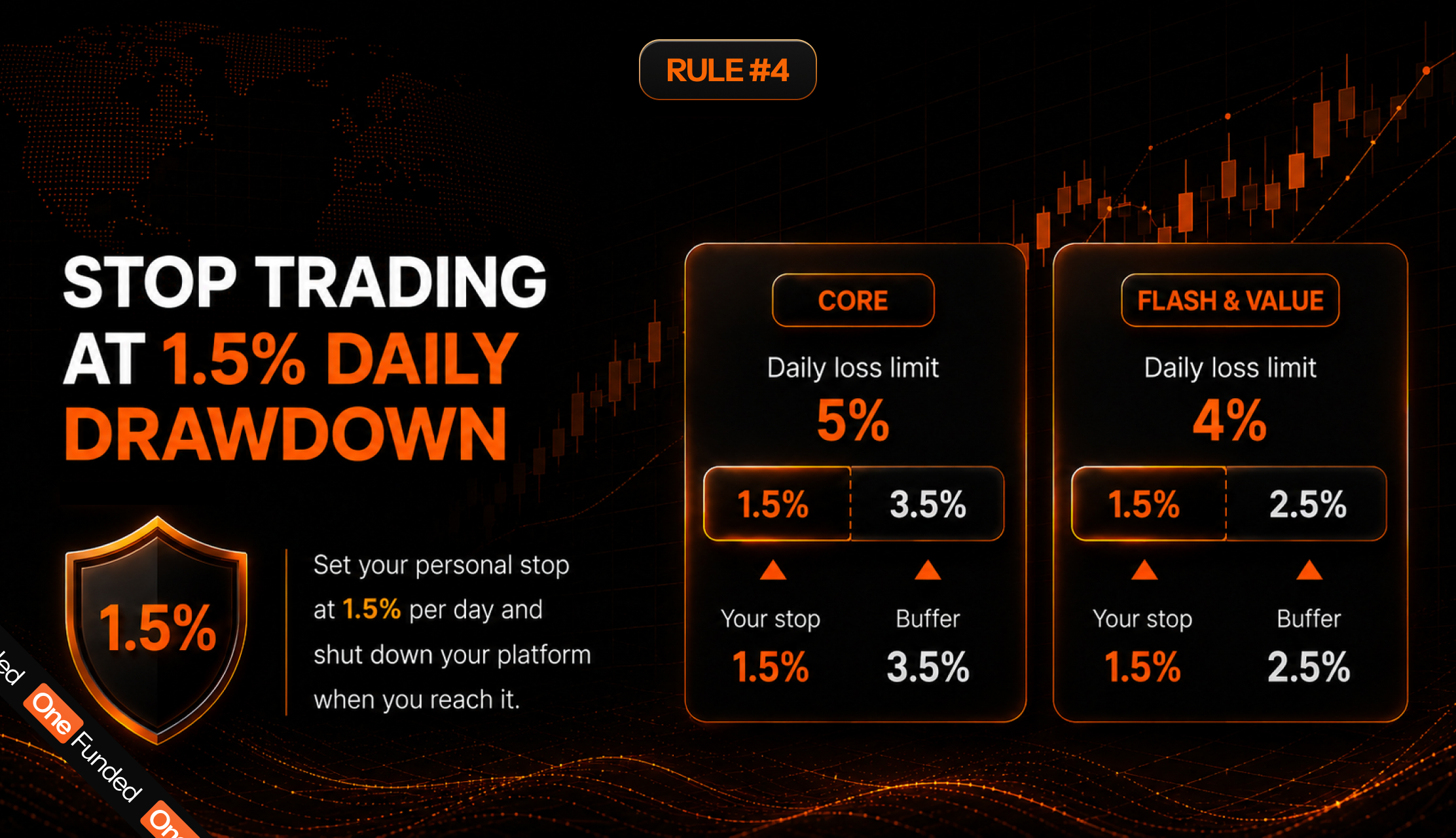
Establish your own stop at 1.5% per day and shut down your platform upon reaching it. Core allows a 5% daily loss limit, leaving a 3.5% buffer between your own stop and the point at which you will breach your account. The daily stops set by Flash and Value are smaller, at 4% each, but still give you a buffer of 2.5%.
This buffer accounts for slippage on exit, wider spreads during news releases, and gaps through a stop level. If you run your account right up to the daily stop with no margin, none of that buffer remains. With a personal stop of 1.5%, you can suffer a loss on three complete trades of 0.5% each and still shut down your platform.
OneFunded allows trading around news events on every challenge, but the firm monitors trades placed within five minutes before and after a scheduled release. Activity that appears to exploit sudden price spikes in this window may draw a compliance review.
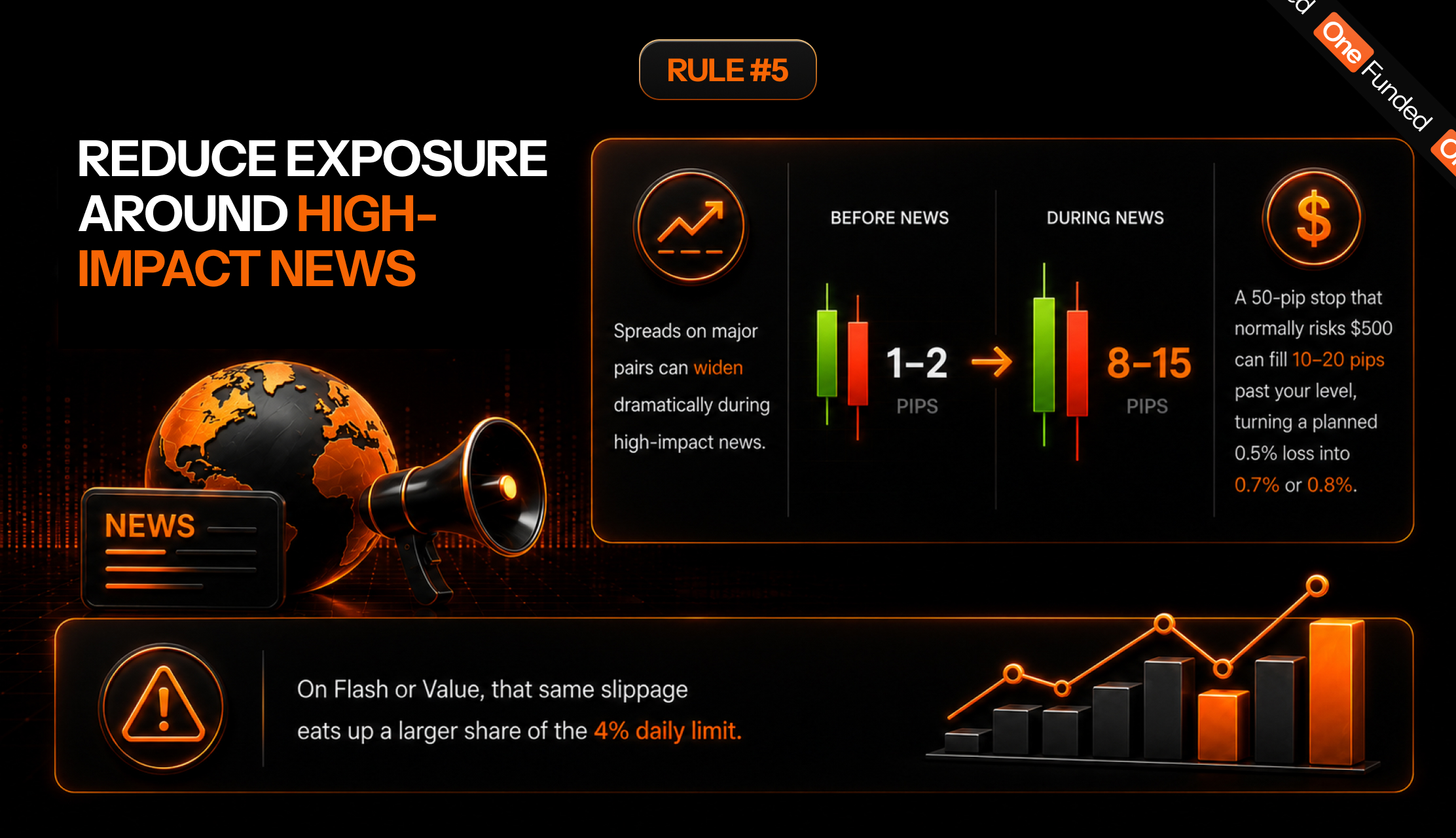
The spreads on major pairs can widen from 1-2 pips to 8-15 pips at the time of a Non-Farm Payrolls or CPI release. A 50-pip stop that normally risks $500 can fill 10–20 pips past your level, turning a planned 0.5% loss into 0.7% or 0.8%.
On Flash or Value, that same slippage eats up a larger share of the 4% daily limit. There are two ways to manage this situation. First, close or tighten positions 5 minutes before any of these newsworthy publications. Second, halve your position size in order for the widening of your fill to be within 0.5% per trade.
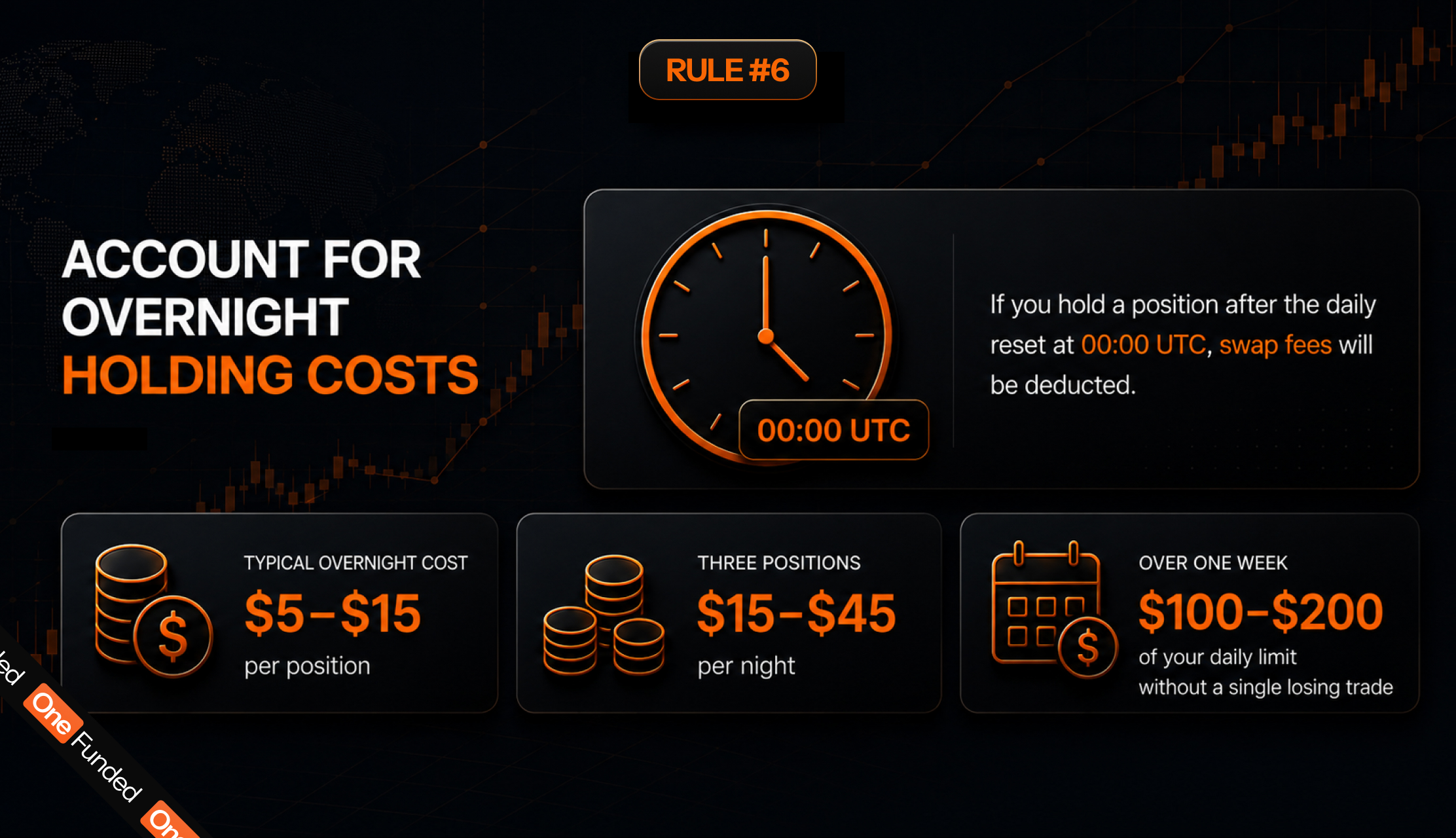
If you remain in the position after the daily reset at 00:00 UTC, swap fees will be deducted. The fees will be deducted from your daily limit, as OneFunded includes swap fees in the equity-based drawdown calculation during all challenges.
One overnight position costs roughly $5–$15 in swap fees, depending on the pair and direction. Three positions push that to $15–$45 per night.
Over one trading week, you can lose up to $100–$200 of your daily limit without a single losing trade. In case your trading strategy requires overnight positions, you should deduct the swap fee from your daily limit to place next day’s trades or flatten all positions until 00:00 UTC reset.
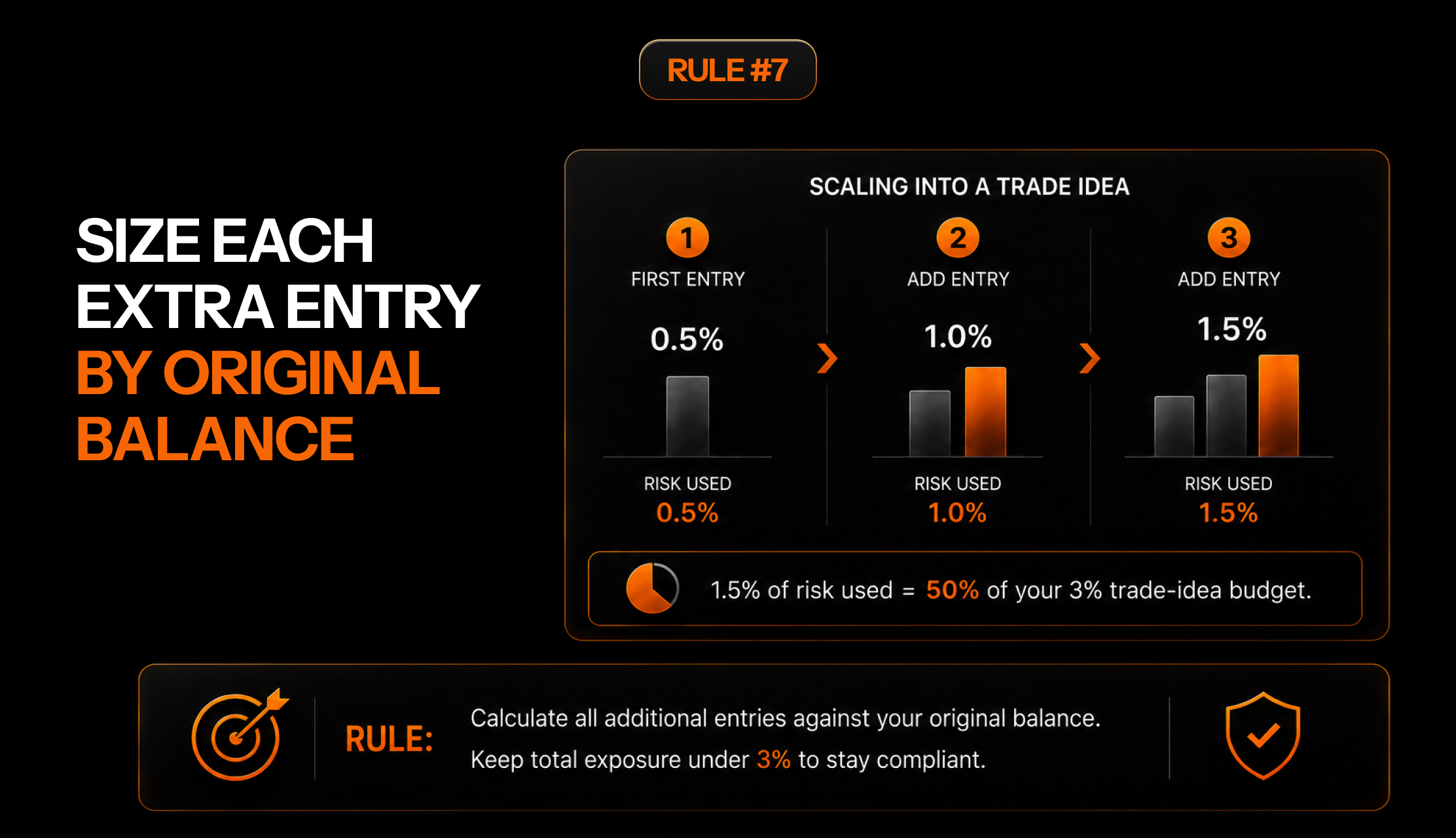
Adding to an already successful trade appears to be less risky, but this is not how the exposure calculation sees it. OneFunded checks for Position Sizing Consistency based on the initial balance and floating exposure on all subsequent entries for a particular trade idea. Scaling into a EUR/USD trade idea from 0.5% up to 1.5% risk already uses half of the 3% trade-idea budget — leaving little room to add further without breaching the limit.
Consider floating profit as company capital, not as an available risk budget to play with. Calculating exposures for all subsequent entries based on the initial balance and having the total exposure under 3% of risk budget will allow you to use the scale without breaching the compliance requirement.
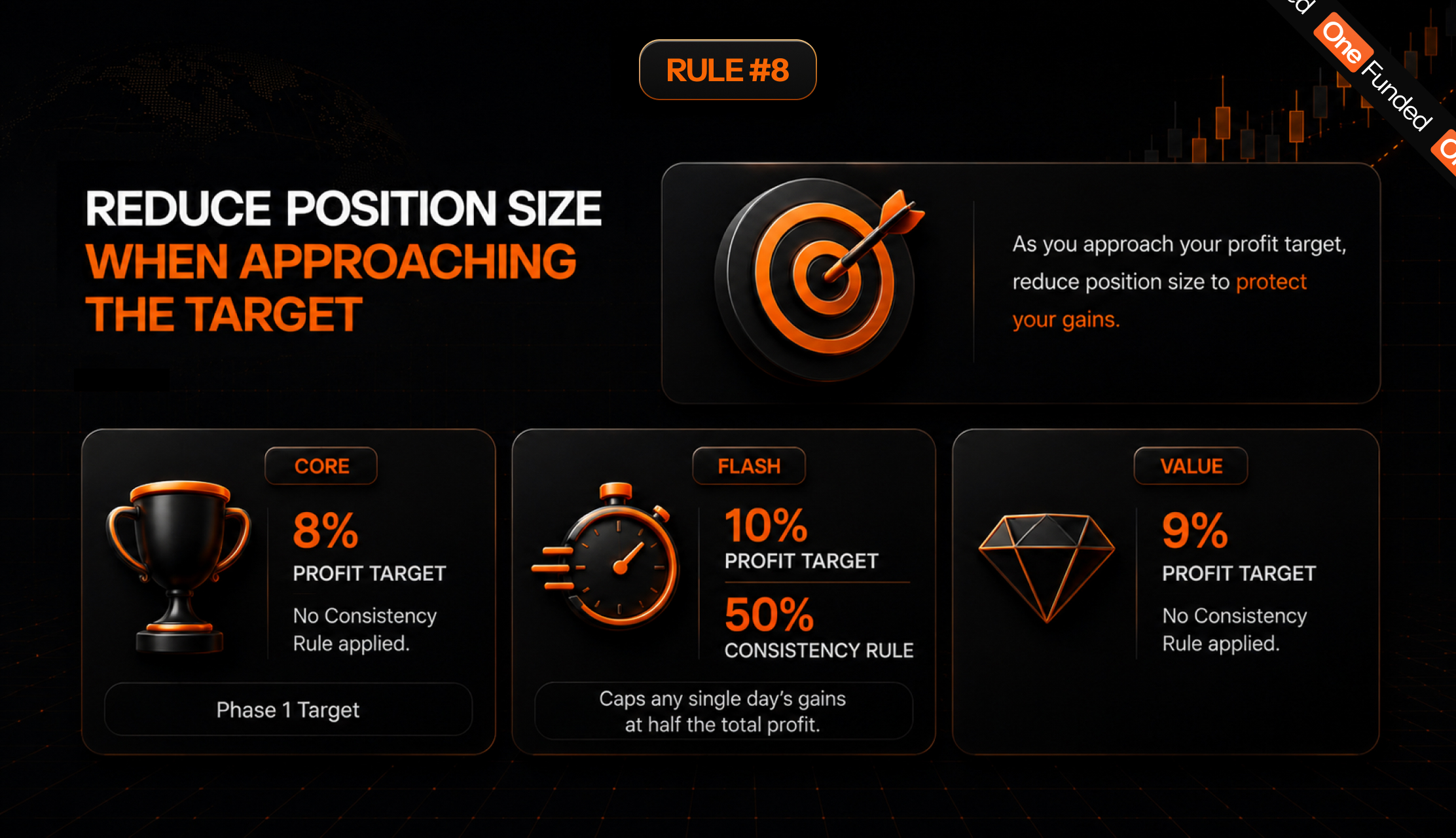
Toward the end of an evaluation, when the profit goal seems achievable, and after several consecutive profitable days, traders increase their sizing to finish faster.
The Core Phase 1 target is 8%, with no Consistency Rule applied. Flash carries a 10% profit target alongside a 50% Consistency Rule, capping any single day’s gains at half the total profit. Value’s 9% target comes with no Consistency Rule either.
Stay within the ratio by spreading your gains across multiple sessions. A single-day Consistency Rule violation won’t shut down your account, but the profit target freezes until later sessions bring the ratio back below the threshold. Trim your position size as you approach the target and aim to cross the finish line over two or three controlled sessions.
The framework earns its place when you check it against the limits that end evaluations. Every challenge enforces both a daily and an overall limit, and breaching either one closes the account. This is where risk management for prop trading proves its value — the rules only matter if they hold up against real drawdown limits.
Flash and Value have a daily loss cap of 4% of SODe, while Core is up to 5%. With a 0.5% loss per trade and holding three open positions simultaneously, your total risk in that moment will be up to 1.5%.
Your personal stop of 1.5% creates that restriction from your end. At the end of the day, you may be losing up to 1.5%, far from reaching the platform loss cap in any challenge type. For more information on what a drawdown means in prop trading and how OneFunded has set this daily risk limit, check out the drawdowns explainer for prop trading.
Value sets an overall drawdown limit of 8%, which on a $100,000 account means equity should not fall below $92,000. Flash limits it to 6%, setting the floor limit at $188,000 on a $200,000 account. The largest cushion is provided by Core, which has a floor limit of 10%, or $180,000, also on a $200,000 account.
The drawdown doesn’t rise as your equity grows; the daily stop ensures your cushion over time. In three consecutive losses, each of 1.5%, you can lose around 4.5%, which is way less than even the 6% floor of Flash. Even a profit-making first week does not increase the breach limit.
This walkthrough implements the framework for a $50,000 Flash account through a single day’s trading activity.
Day 1 starts at 00:00 UTC with equity of $50,600, up 1.2% relative to the previous day. Flash has a 4% daily risk limit, meaning that the floor is $48,576. The first trade involves placing a position in gold at 0.5% risk level and a stop of $250.
Instead of increasing position size beyond the trade-idea limit, you place a position in an uncorrelated index at 0.5%, giving 1% aggregate risk for two positions.
If the index trade reverses and hits the stop, the loss is $250. Meanwhile, the gold trade reverses and ends at zero. The end result of the day is being 0.5% down compared to your own stop of 1.5%.
You place a third trade on a major pair, risked at 0.5%. The position is stopped out, and the day’s realized losses become 1%. Another good setup becomes available, but you cannot use it as you are a trade away from your stop, and thus you shut down the platform.
That’s the framework in action. The fourth setup might have worked, but taking it would have left no room for error, since a loss there would have breached your personal stop. Your account sits at about $50,100 — roughly $1,500 above the daily floor of $48,576, and far from Flash’s overall drawdown limit of $47,000.
You used the framework throughout the whole day. You can check this account’s limitations against those of any account size on the OneFunded challenge page, and the framework scales the same way: 0.5% per trade, a maximum of three open positions, and a 1.5% daily stop.
This eight-rule approach to risk management for prop trading will keep you solvent until your edge comes through. Risk 0.5% per trade, hold no more than three uncorrelated open positions, correlate exposures to the 3% idea maximum per trade, set your own stop to 1.5% per day, deal with news and overnight variables and protect your sizing close to your target.
This system works across Core’s 5% daily / 10% overall limits, Flash’s 4% / 6%, and Value’s 4% / 8% — and it should be applied from Day One of the evaluation.


Join our mailing list today!
Risk 0.5% per trade. This caps each loss so that even a losing streak stays inside Core's 5% or Flash/Value's 4% daily limit.
You can have three uncorrelated trades open. If each risks 0.5%, your total exposure stays at 1.5%, which is below OneFunded's 3% cap, and correlated trades may count as one idea.
Yes. Setting a daily stop under the platform maximum is one of the most basic rules that funded traders have to follow when trading on OneFunded. Core sets its daily maximum to 5%, while both Flash and Value have their daily maximum at 4%. A 1.5% stop loss will give you a 3.5% buffer on Core and 2.5% on Flash or Value.
On a personal account, you can choose to sit through a floating loss. On a funded account, that same floating loss can breach the account before you close the trade. OneFunded tracks equity in real time, so open losses count against your limits immediately. Its daily loss limit also resets at 00:00 UTC, not based on when you personally start trading.
It all depends on the difficulty level. Core allows 5%, while Flash and Value allow 4%. OneFunded evaluates the maximum allowed loss in relation to the Start of Day Equity at 00:00 UTC and takes into account real and floating losses, commissions, and swaps.

You’re at checkout. You’ve picked your challenge, and there’s one more choice to make: which platform? The cTrader vs MT5...
If you’ve ever looked for prop firm challenges, you have probably seen two options: 1-step vs 2-step prop firm challenges....

Every prop firm challenge has a unique set of rules. This includes profit targets, drawdown limits, and consistency demands. Most...
 Set Preferred on Google