




A trading plan for a prop firm challenge must tell you what you need to do in the market while ensuring that you stick to the firm’s rules.
The problem is most traders disregard the second part, and that’s a major reason why their accounts go bust. Around 78% of challenge failures are due to traders breaching daily loss limits, not missing profit goals. This guide runs you through the vital parts of a trading plan built around OneFunded’s real rules and figures that today’s prop firm challenge traders make use of. This template should be helpful if you’re preparing for a OneFunded challenge soon.
What a Trading Plan for a Prop Firm Challenge Does
A trading plan allows you to connect your strategy to the prop firm’s rules before you even make your first trade. If there’s no link, you’d make rushed decisions and have nothing to fall back on.
Most traders’ plans (instruments, setups, and general risk approach) only consider market strategy. While useful, they never look at how these plans will work under a challenge’s stiff limits.
This route doesn’t crumble from the get-go. But it does when a losing session arrives and the trader makes an extra trade to recoup their losses. And that’s when they make errors that result in challenge account failures.
A Step-By-Step Guide to Building a Trading Plan for a Prop Firm Challenge
Making a trading plan for a prop firm challenge can look like too much work. But taking your time to get it done can see you wrap up the challenge and get funded. Follow these steps to draft a solid plan:
Step 1: Choose a Challenge and Lock in the Numbers
Before you create your plan, you need to choose a challenge. At OneFunded, there are four formats available to you, and each variant has different metrics as highlighted in the table below:
| Value | Core | Flash | Instant | |
|---|---|---|---|---|
| Evaluation Steps | 2 steps | 2 steps | 1 step | None |
| Account Size | $5,000 to $100,000 | $5,000 to $200,000 | $5,000 to $200,000 | $5,000 to $25,000 |
| Profit Target | 9%/6% | 8%/5% | 10% | N/A |
| Minimum Trading Days | 4 days | 3 days | 5 days | N/A |
| Daily Loss | 4% | 5% | 4% | 3% |
| Overall Loss | 8% | 10% | 6% | 6% |
| Consistency | Off | Off | 50% | 20% |
| Trading Period | Unlimited | Unlimited | Unlimited | Unlimited |
| Profit Split | 80% | 80% | 80% | 80% |
| Refundable Fee | 100% | 100% | 100% | N/A |
| Best For | Disciplined traders | Most traders | Fast traders who are confident | Experienced traders who want instant funding |
Once you choose the challenge and account size, the next thing you have to do is write the dollar values of that plan.
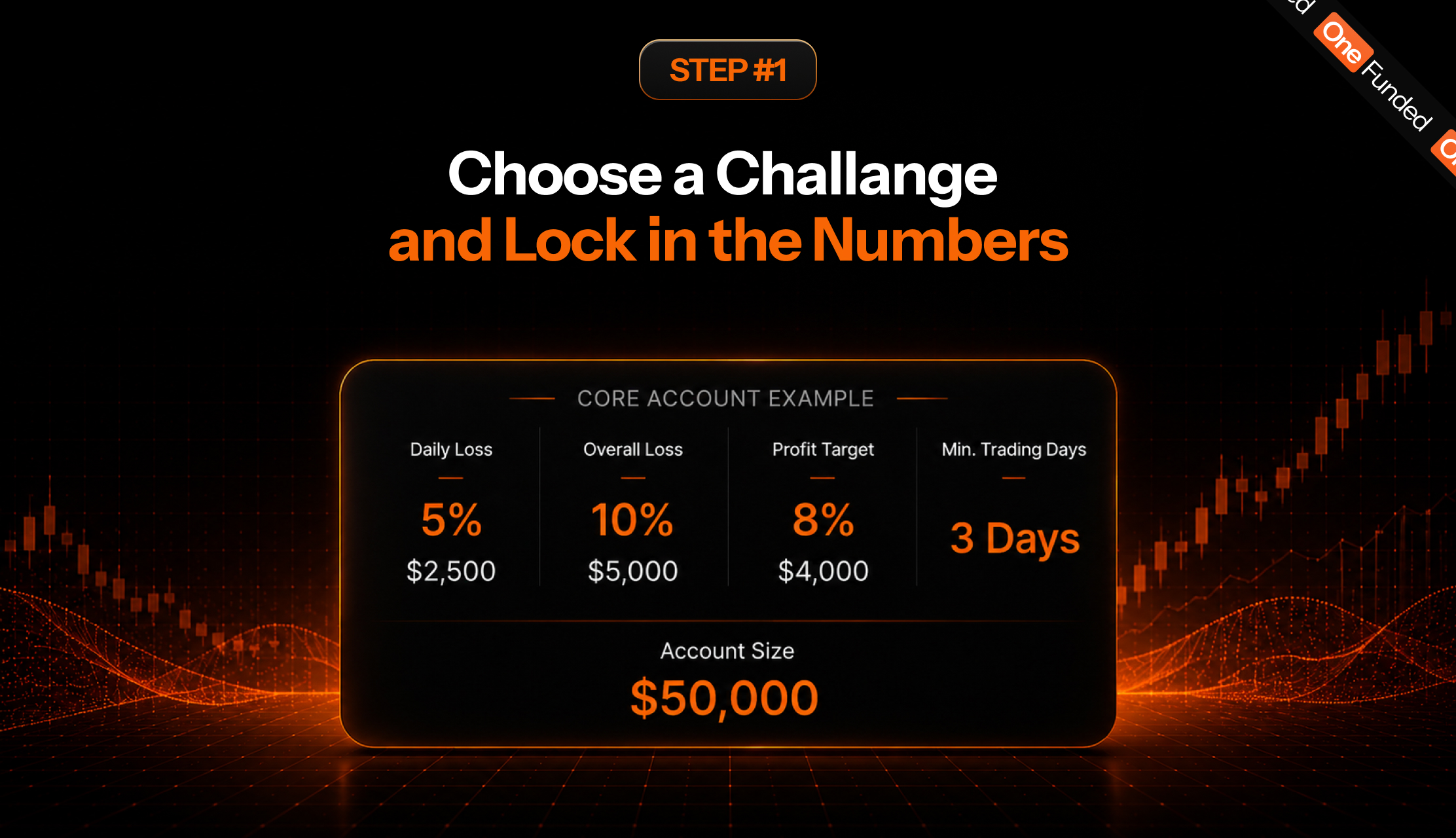
For example, a Core challenge account valued at $50,000 has a daily loss limit of $2,500 (5%) and an overall loss cap of $5,000 (10%). All position sizes and daily stops flow from these figures.
OneFunded makes use of a static overall loss limit. This means it doesn’t matter how much you make in profits on your challenge account; the cap of your allowed losses will never change. This is much safer than a trailing limit that follows your profit and gives you less room for error.
Step 2: Pick Your Markets

Before the challenge starts, select the instruments you want to trade. OneFunded lets you make trades on things like forex, metals, cryptocurrencies, stocks, and global indices. You can run these trades on TradeLocker, MT5, and cTrader.
A list made up of two or three instruments that you understand in-depth is better than a selection of 10 you know nothing about. For every one you decide to trade, ensure you take note of the spread average during your sessions, whether it has overnight swap coverage, and the news events that affect its price.
OneFunded allows news trading across all levels. But the prop firm checks positions made five minutes before and after high-impact news events. If it spots a strange pattern during its checks, your account may fall under compliance review. So, state in your plan if you want to avoid these windows or risk it.
Step 3: Set Your Session Times
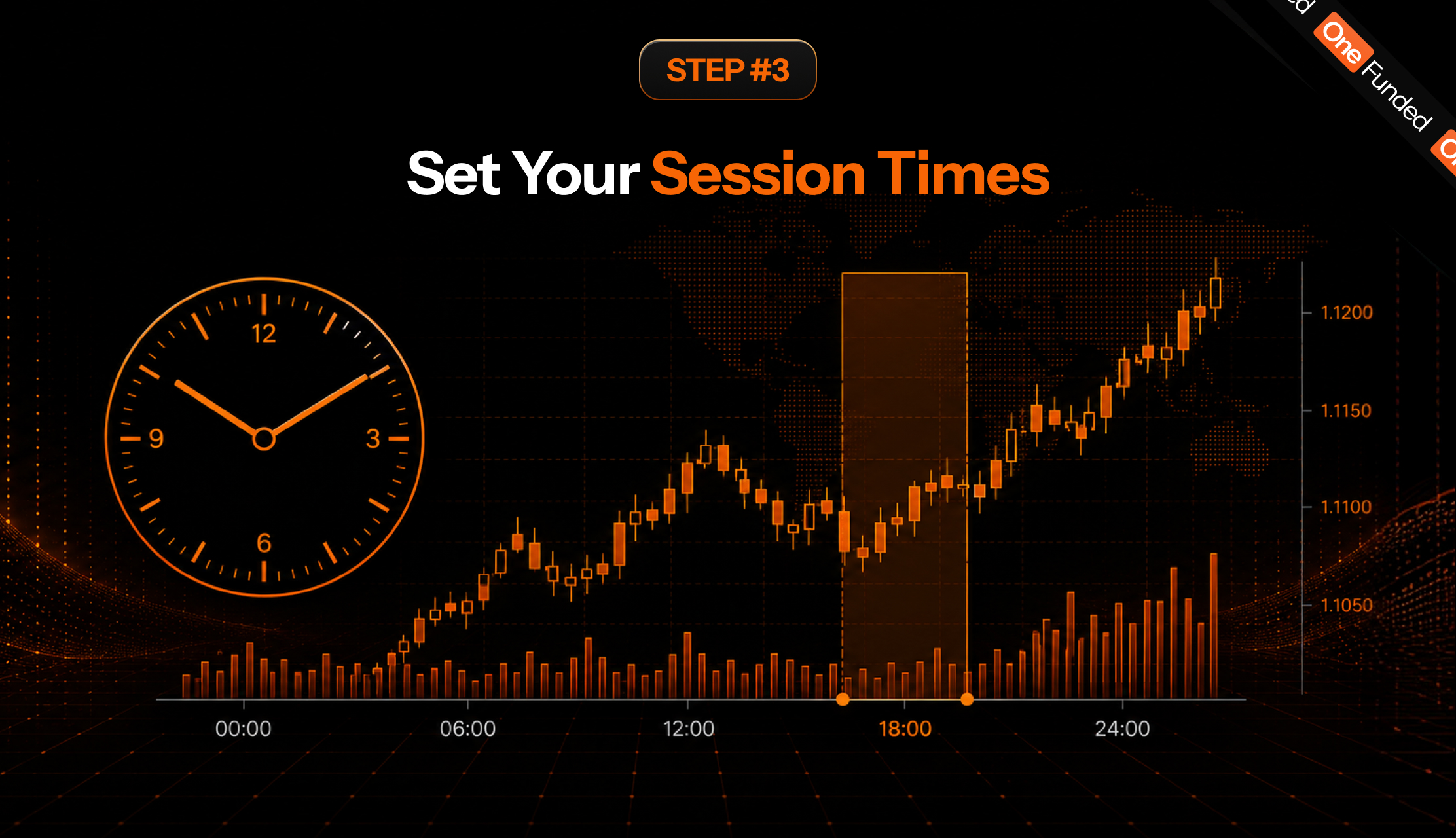
Adding specific session times for trading into your plan will make you avoid the temptation of making trades during a slow timeline or on setups that aren’t clear.
If you trade forex and metals, for example, 13:00 to 17:00 GMT are the best times to trade, as they’ve got tighter spreads and stronger confirmation than any other period.
Now you know about this; your plan could have something along these lines:
“I will start trading the EUR/USD and gold within the times of 14:00 to 16:00 GMT to take advantage of tighter spreads that can improve my profit margin.”
Being this specific will stop fatigue-driven trades that can result in losses.
Step 4: Write Your Entry Criteria
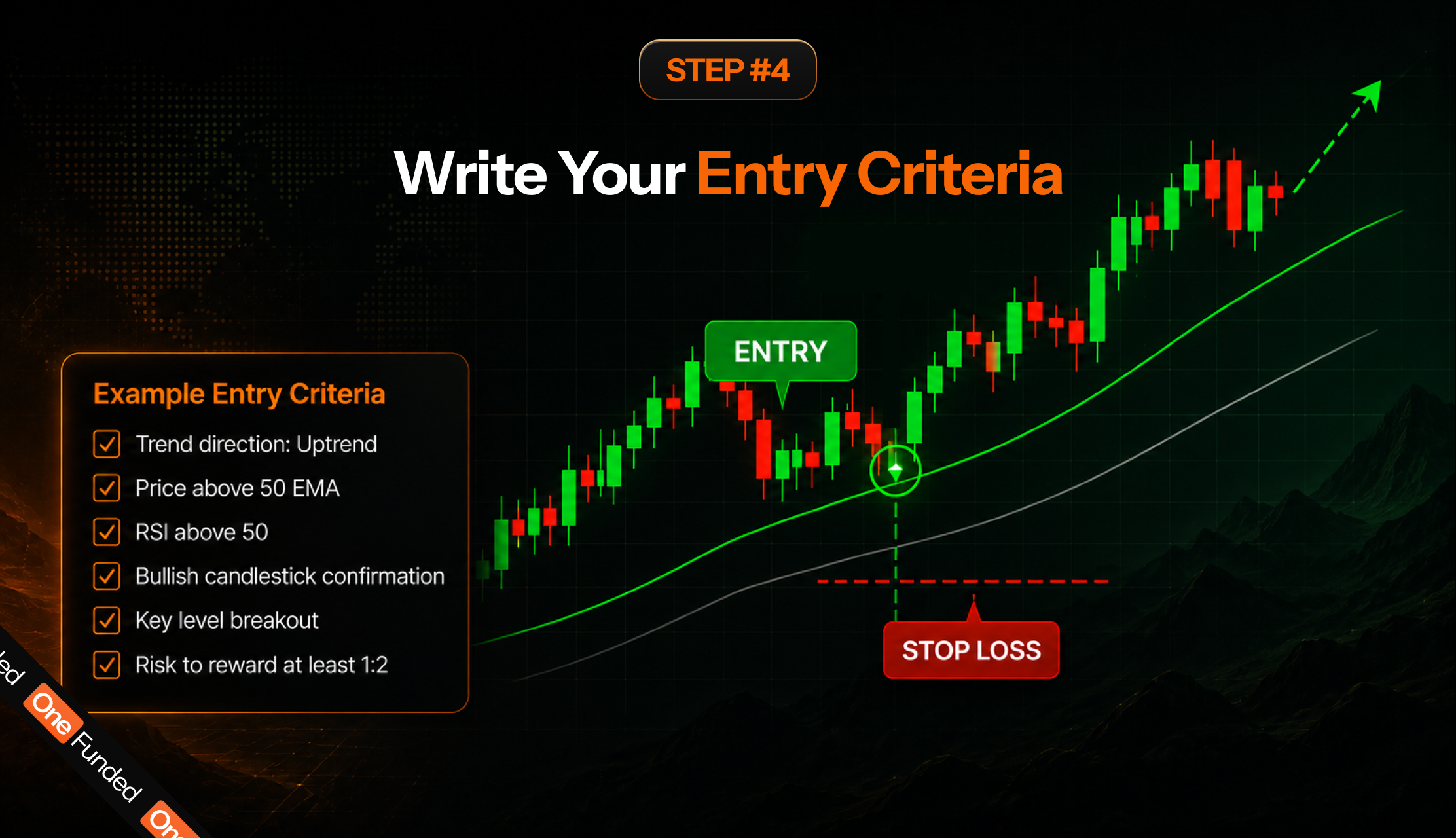
Entry criteria refer to conditions that have to be present before you can make a trade. If you don’t have rules in place, you’ll find it difficult to make informed trade decisions.
But with set criteria, you’ll know the boxes a trade needs to tick before you enter it. Here’s an entry criteria sample for a trend-following approach on gold:
“I will only go long on gold if (1) the price is moving up fast on the 1-hour chart, (2) the 4-hour chart shows the price bouncing off a strong floor, (3) the spread is lower than 50 cents, and (4) there hasn’t been any high-impact news in the last 10 minutes.”
This is just for gold. But you can write specific entry rules for other instruments on your list. If a setup fails to meet one of two conditions, avoid it as it isn’t a valid entry point.
Step 5: Define Your Exit Rules
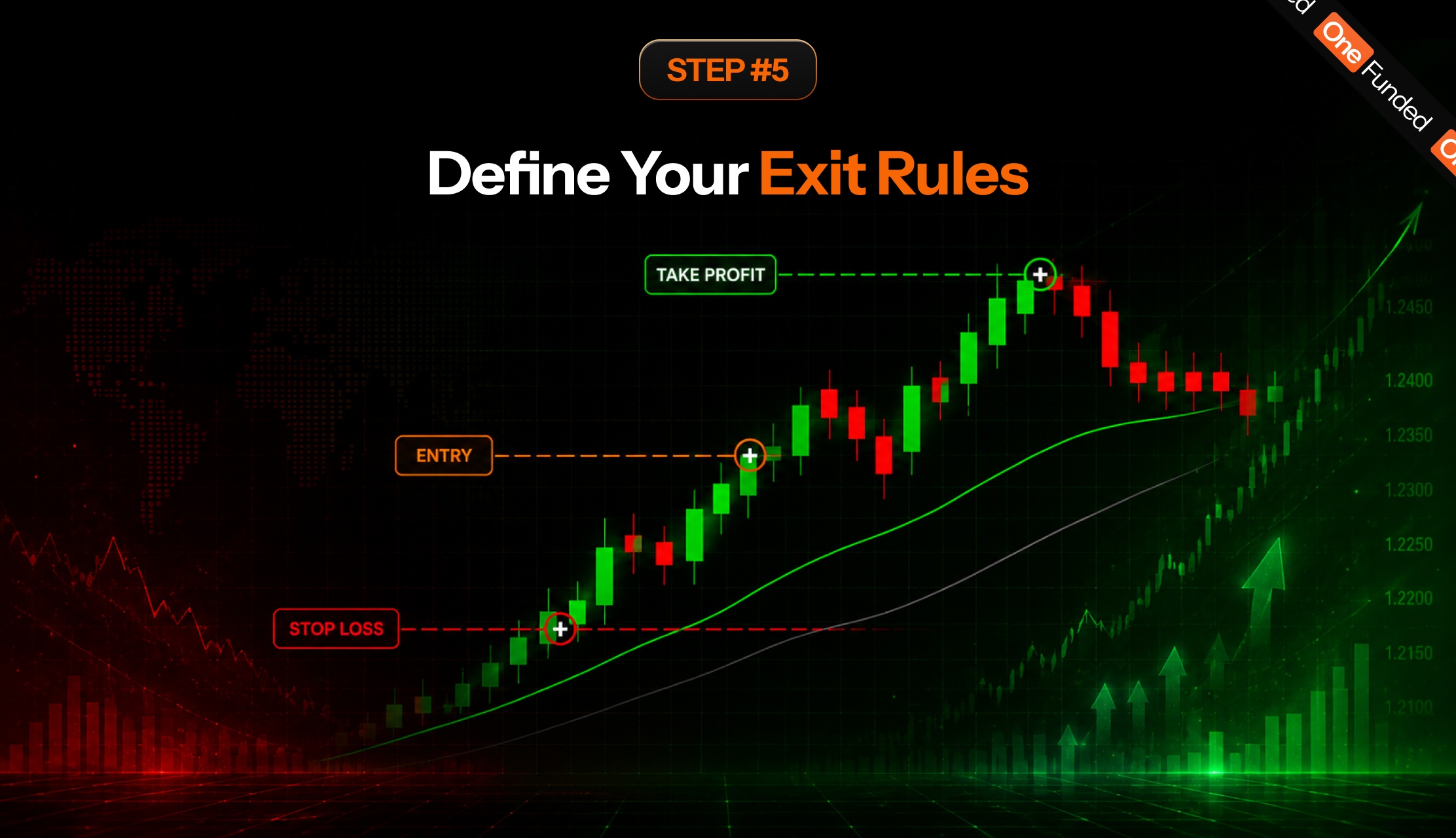
Here are some exit rules you can use if you’re on a OneFunded challenge account:
- Stop Loss: Put your stop where your trade idea becomes wrong. If you bought EUR/USD because it’s above 1.0850, put your stop at 1.0835. But don’t just base your stop on a 20-pip default. Instead, allow market logic to lead you.
- Take Profit: Set your target at the next key level or use a set risk ratio. Risking 0.5% to 1% for every trade will help you to avoid drawdown limit breaches. Aim for a 1:1.5 risk-to-reward ratio so that your wins can be higher than your losses.
- The Early Exit Rule: Know when you need to close a trade early. Your plan could have something like, “If the price hits 50% of my target and a 15-minute candle closes back past my entry point, I will close the trade manually.” Doing this prevents a winning trade from becoming a loss.
Step 6: Set Your Personal Daily Loss Limit
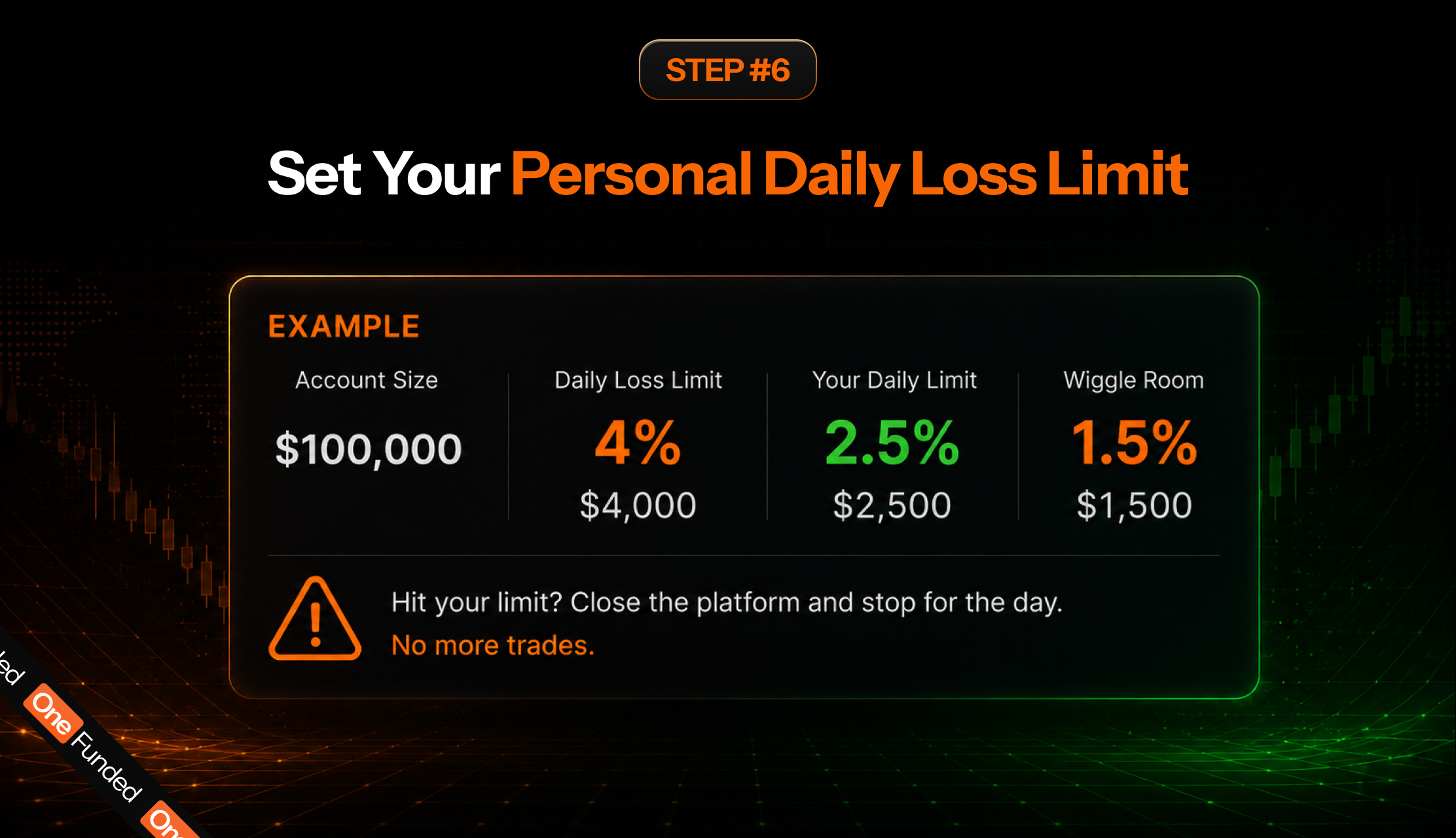
Every OneFunded challenge has a daily loss limit and breaching this cap will end it. To avoid this, consider setting a daily loss limit below the challenge’s maximum.
On a $100,000 Value account, the firm’s daily loss limit is set at $4,000 (4%). Set your cap at $2,500, and that’ll leave you $1,500 of wiggle room.
Once you hit this limit, close the platform and stop all trades for the day. Don’t feel there’s room for one more trade, just STOP. Obeying this rule is what separates traders who successfully pass challenges and those that buy them again.
Step 7: Set Up Your Maximum Trades Per Day
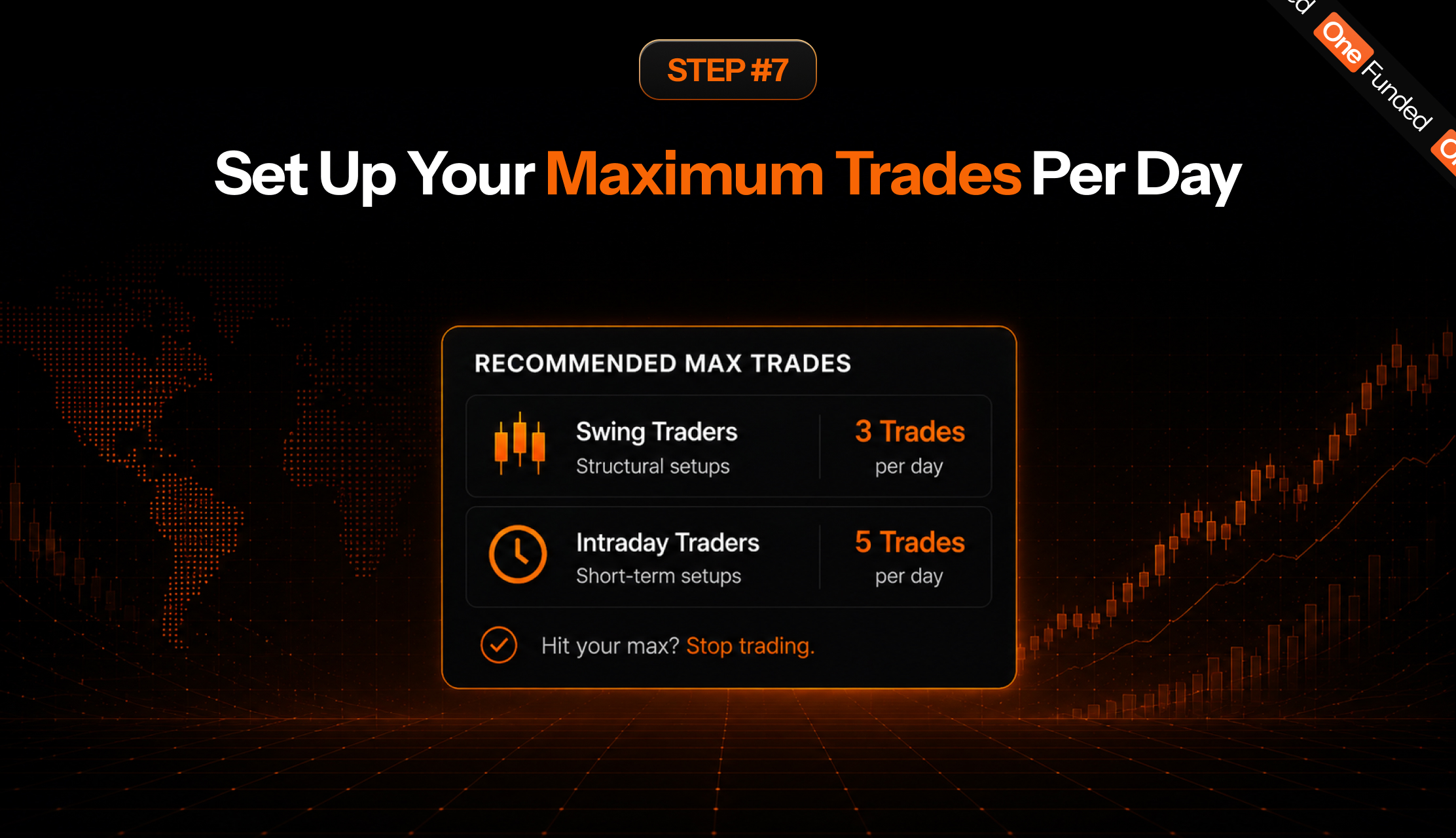
It doesn’t matter what challenge you’re on, a prop firm like OneFunded doesn’t cap the number of trades you can take in a single day. But trading indiscriminately is a major reason why many traders fail challenges.
It isn’t as if taking more trades is wrong. The fault we find in it is that more trades could expose you to making rash decisions, especially after one or two losing trades.
The solution is to limit yourself to three to five trades per session. But this depends on your strategy. If you’re a swing trader looking for structural setups, three trades daily work. If you’re a short-term intraday trader, you could accommodate five trades with ease.
Once you’ve settled for a number, write it down and stick to it. And when you hit your max number of trades for the day, stop trading.
What You Need to Know About OneFunded’s Consistency Rule
The consistency rule on OneFunded means that your best single trading day profit can’t go past a select percentage of your total profits on that challenge account.
During the Challenge phase, Value and Core carry no Consistency Rule — you can hit your profit target on a single strong day without it counting against you. Flash is the exception: it applies a 50% Consistency Rule already at the Challenge phase.
Once you reach the Live (funded) stage, all three formats — Value, Core, and Flash — apply a 50% Consistency Rule. Instant, which has no separate Challenge and Live phases, applies a 20% Consistency Rule throughout.
You might be wondering why OneFunded applies this rule. It’s there to spot traders who are profitable but didn’t get there by trading consistently.
For example, let’s say a trader has a $50,000 Core account at the funded stage and pulls in $900 in profit over a payout cycle. On their best day, they made $400. Since that’s less than 50% of total profit, they pass the test and receive their full payout. But let’s say another trader on the same account made $650 of that same $900 in a single day. That’s above the 50% cap, and they’ll fail the consistency rule.
Being in this spot doesn’t mean you’ve failed the challenge. You’ll just need to trade more so that you can generate returns that reduce the impact of your big day.
Roland From Germany: A Real Trader’s Experience With OneFunded
Roland is from Hamburg, Germany. He discovered OneFunded via TradeLocker, passed a challenge, and got a $100,000 Core funded account.
After that, he started trading gold and took a conservative route where he followed the 2% risk rule and ensured he stuck to his daily trade limit without fail.
Within three months of trading with this account, he got two four-figure payouts. And for him, that first payment was proof that approaching trading with a strategy could produce real results.
Roland’s experience doesn’t just teach us about payouts. It shows what can happen with a strategy behind all your decisions, whether it’s on a challenge or a fully funded account.
What Happens to Your Profits on OneFunded?
After passing your OneFunded challenge, you can request your first payout 14 days after you opened your first position at the prop firm. But this can only happen if your account has made at least $100 in profits.
Once you meet this requirement, you can receive payouts every 14 days. Traders that want to access their funds faster can opt into the Weekly Payout option that reduces this timeline to 7 days.
You won’t get 100% of your profits. OneFunded has a standard 80/20 profit split rule (80% for traders and 20% for the prop firm). However, this number can rise to 90% via eligible add-ons.
So, if you’ve got a $50,000 Core account and a profit cycle worth $900, you’d get $720 if there’s an 80/20 split in place. But this grows to $810 if your account is at the max 90/10 profit split.
Final Thoughts
A trading plan for a prop firm challenge isn’t a guarantee that you’d pass a challenge. But it helps you avoid decisions that cause most traders to lose their accounts. These decisions range from oversizing after a losing trade and placing trades outside a session to ignoring trade limits to compensate for a losing run.
This guide has given you the steps needed to make a plan around OneFunded’s rules. If you draft a plan before buying a challenge, the evaluation process becomes a test that confirms discipline rather than luck.