



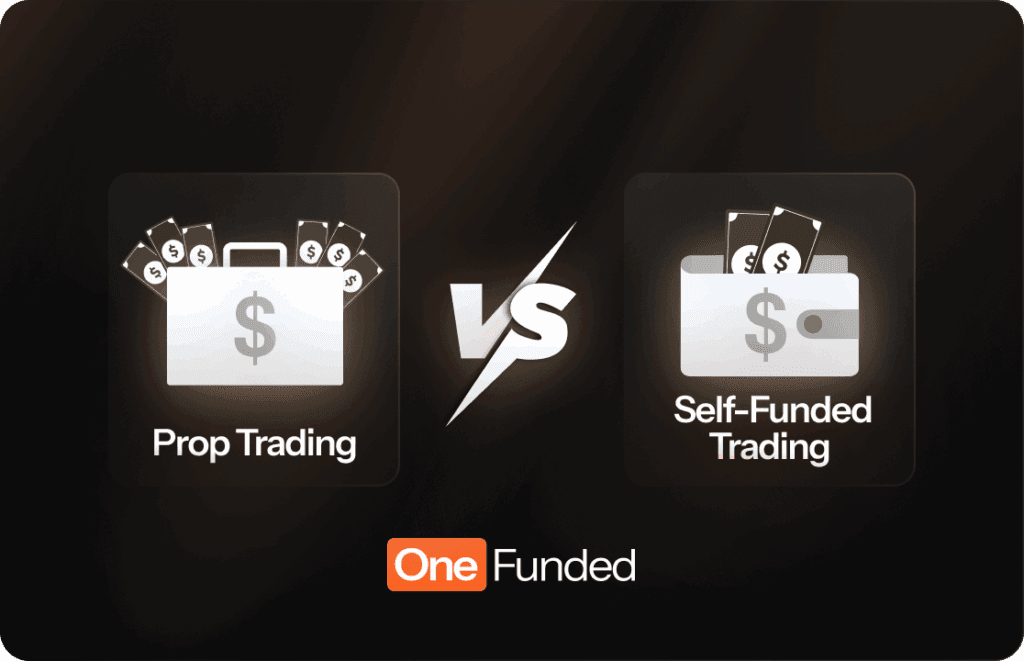
Most traders start out by funding their own book, deploying their personal capital to capitalize on profitable trades. Over time, however, a trader’s individual funds may no longer be sufficient to take advantage of all the opportunities the market has to offer.
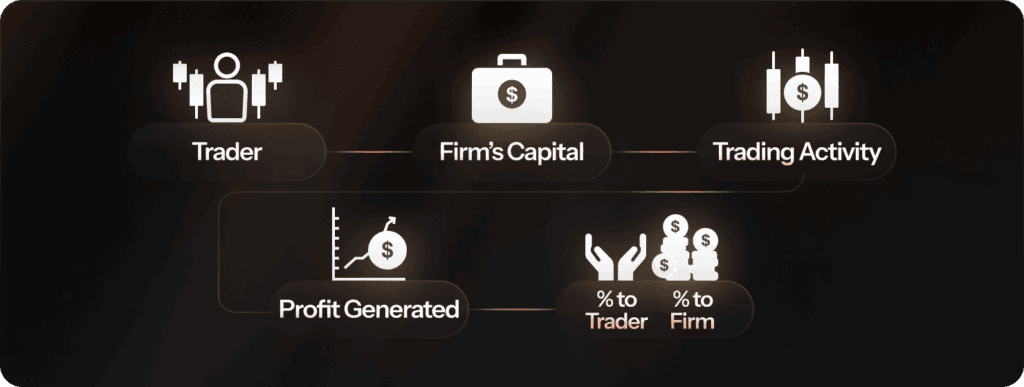
For traders looking to take on additional capital, proprietary trading could be a competitive solution. Proprietary trading, also known as ‘prop’ trading, involves traders deploying the capital of a financial firm to make trades rather than their own. While prop trading comes with certain considerations, it may help successful traders enhance their profitability beyond what they could otherwise achieve.
In this article, we’ll explore the basics of prop trading and see how it differs from self-funded trading. We’ll also review the pros and cons of each approach, finishing with a practical guide that traders can use to determine which path they should pursue. Ultimately, whether a trader chooses to work with a prop firm or sticks with their own capital will depend on their unique trading style and individual goals.
Key Takeaways
- Prop trading involves a trader deploying a financial firm’s capital to execute profitable trades. This differs from other ways to fund a trade, including self-funding, client capital, and investor capital.
- Self-funded traders can scale their personal capital through the use of margin at brokerage firms. However, borrowing costs and leverage limits can make this a sub-optimal solution.
- There are two main prop firm models: desk-based and challenge-based. Desk-based firms are invite-only and associated with institutional finance. Challenge-based firms are more broadly accessible, but require traders to prove their skills first.
- Prop trading comes with potential advantages over self-funded trading, including greater profit potential and reduced loss exposure. However, prop traders need to be mindful of trading within the firm’s limits, which can include restrictions on maximum losses and position sizes.
Understanding Prop Trading: Deploying a Firm’s Capital
At the most fundamental level, prop trading is a structure in which traders deploy the capital of a financial firm to execute trades and generate profits. This broad definition captures numerous possible arrangements. In some scenarios, prop traders may be full-time employees of a hedge fund running a book of capital worth millions. In others, prop traders may manage smaller accounts on a part-time basis.
While individual arrangements may differ, prop traders generally earn a cut of any profits they generate. This model is distinct from other possible sources of capital that traders might use to fund and profit from their book:
- Personal capital. Prop trading is most clearly opposed to self-funded trading, in which traders utilize their personal capital to execute trades. We discuss the important trade-offs between prop trading and self-funded trading in more depth below.
- Client capital. At financial institutions, traders may execute ‘client trades,’ rather than prop trades. These trades are completed on behalf of a client, either on a discretionary or instructed basis. Because these trades use client capital, traders are generally seeking to earn a commission or bid-ask spread, rather than profit directly.
- Investor capital. Finally, some institutions may use investor capital to fund their trading book. Hedge funds, for instance, often charge a ‘2 & 20’ fee to generate profits on investor capital – meaning a fixed 2% of assets under management and a 20% cut of any profits.
Importantly, the line between these funding mechanisms can blur at some firms. For example, a hedge fund that runs a trading book may fund positions using retained earnings of the firm, personal capital contributed by owners, and outside capital contributed by investors. This approach would combine every funding mechanism except client capital.
Understanding Self-Funded Trading: Deploying Your Own Capital
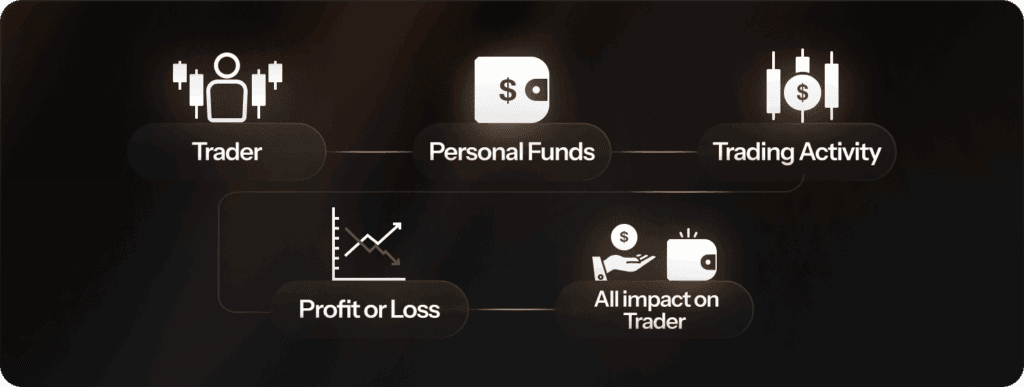
The self-funded trading model might seem straightforward, but it’s worth clarifying exactly how this approach works to understand its limitations. In self-funded trading, a trader deploys their own capital to fund their positions. That means any gains – as well as any losses – are entirely on the trader’s own balance sheet.
Self-funded trading is notable for its flexibility. Traders using their personal capital have no one to answer to in terms of allowable losses or trading limitations. They can deploy capital in essentially any asset class, with no formal risk limits, and in whatever size their personal capital allows.
What’s more, self-funded traders have the ability to scale their profit potential (although rarely to the same extent as prop traders). Depending on a broker’s margin requirements, a self-funded trader may be able to leverage their capital to many times its original size. While the trader will have to pay borrowing costs to access that capital, this approach can be a powerful way for self-funded traders to scale up their own strategies without turning to a prop firm.
Still, leverage limits at brokerage firms are likely far lower than the account sizes that prop traders can access. But not all prop trading firms are created equal. For self-funded traders considering taking the leap into prop trading, there are two distinct models to be aware of.
Prop Trading Models: Desk-Based vs. Challenge-Based
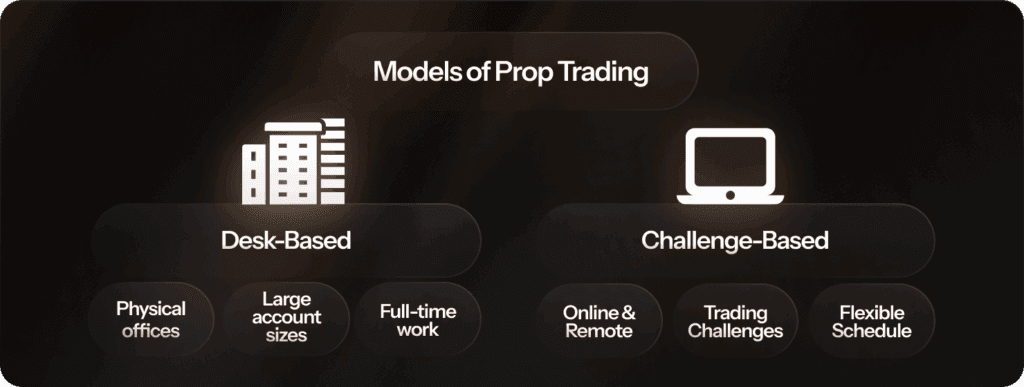
To understand prop trading, it helps to differentiate between two key models: the desk-based and the challenge-based approach. The first of these is exclusive, institutional, and generally offers direct access to firm capital. The second is more accessible and egalitarian, but requires traders to prove their skills before unlocking funded accounts.
Model #1: Desk-based
The ‘desk-based’ prop model is what traders will find on Wall Street. This approach is generally invite-only, where traders are recruited and tasked with undergoing a series of rigorous interviews to earn their spot on a desk. If they succeed, traders are immediately integrated on a team within the firm, deploying real capital, and often given their own small trading book to start out with.
While less well-known than major investment banks, high-end desk-based prop trading firms are still household names in finance. Their ranks include Jane Street, Susquehanna, and DRW. Desk-based prop firms are characterized by a few common elements:
- Physical offices. Traders at desk-based firms are typically expected to work at a physical office, usually in major financial centers like New York or London.
- Large account sizes. It’s not uncommon for traders at a desk-based firm to be managing account sizes of up to tens or even hundreds of millions of dollars.
- Full-time work. Desk-based trading is not a part-time activity, with traders expected to give their full attention to working at the firm.
Over the years, however, a more accessible version of prop trading has also appeared – the challenge-based model.
Model #2: Challenge-based
Because the desk-based model operates on an invite-only process, recruiting from a select few universities and firms, many prospective traders will find this model hard to access. That pressure has led to the development of a different model of prop trading: the challenge-based approach. In contrast to the desk-based model, challenge-based firms are accessible to almost everyone looking to start prop trading.
Challenge-based traders are not universally expected to make trading a full-time commitment. This can open up prop trading to skilled practitioners looking to maintain another role or gradually transition to full-time trading. However, this greater accessibility does come with important trade-offs:
- Virtual capital. Under this model, traders are generally given ‘virtual capital’ to trade with until they prove their skill by passing trading challenges. If a trader successfully completes these challenges, however, they may unlock funded accounts.
- Challenge fees. Challenge-based traders are expected to pay an upfront fee to access trading challenges. At most reputable firms, however, this fee is refundable if a trader successfully completes a trading challenge.
- Account sizes. Challenge-based firms generally extend smaller account sizes to traders than desk-based firms do. This allows challenge-based firms to effectively manage risk among the many different traders utilizing their platform.
Why Prop Trade? Advantages Over Self-Funded Trading
For some individuals, prop trading might seem like an unnecessary complication. If you’re already experiencing trading success by deploying your own personal capital, why deal with the process of passing a trading challenge at all?
While it’s true that the self-funded approach might ultimately be a better fit for some traders, the prop trading route can come with significant advantages depending on your goals:
Advantage #1: Higher profit potential
The first and most important advantage of prop trading is the potential for higher profits. In fact, the ability to manage a larger account size is one of the main reasons that individuals pursue prop trading. The math is simple – a 10% gain on a $1,000 self-funded account is $100, but the same gain could be $10,000 on a $100,000 prop account.
The caveat is that prop firms typically take a cut of a trader’s profit (without earning a cut, there would be little incentive for prop firms to operate their platforms). Depending on the profit split, however, traders can still have significantly higher profit potential than before. For example, utilizing our previous example, an 80% trader split leads to $8,000 in take-home profit – still far higher than $100.
Advantage #2: Reduced loss exposure
At a prop firm, traders face far lower loss exposure than they do under a self-funded approach. If prop traders lose money, they’re losing the firm’s capital, not their own. That can make trading a less risky prospect for traders with limited capital.
Still, traders who violate the prop firm’s loss limits will likely not have access to a prop account for long. Thus, prop trading should not be used simply as a tool to take on outsized risks. What’s more, under most trading challenges, traders will lose their upfront fee if they fail to pass the challenge – a direct and tangible loss on a trader’s own funds.
Advantage #3: Less psychological pressure
This advantage is closely tied to the previous one. Because traders face reduced personal loss exposure at prop firms, they will often feel less psychological pressure when it comes to placing trades. For traders prone to overanalyzing every opportunity to reduce the risk of losing their own money, this can result in more profitable trades being placed.
For example, a trader may believe based on rigorous analysis that a particular trade has a 70% chance of success. Despite this strong edge, however, a trader may still be uncomfortable with a 30% risk of losing their own money. By deploying a prop firm’s capital instead, this trader could be more willing to accept the risk of loss, resulting in a more profitable book in the long run.
Advantage #4: Built-in community and education
For independent, self-funded traders, the trading experience can be isolating. Typically, traders can spend long hours on their own analyzing charts and prices. Not only can this have psychological impacts, but it also limits the ability of traders to learn from their peers and continually educate themselves.
Prop firms often come with built-in community tools, such as dedicated chat channels or even trading courses. This can help a trader unlock new strategies and techniques that they would not have access to on their own. As such, prop trading can be a source of increased profit potential not just through the capital provided, but also through the community and education resources offered.
Advantage #5: Professional tools
In addition to community and education, prop firms can also offer their traders access to professional and sophisticated trading tools. These tools can potentially include deeper market data, advanced analytical software, or even entire trading platforms. For traders working on their own, such tools may be too expensive to justify – or even entirely inaccessible.
Why do prop firms provide their traders with such tools? The reason is straightforward. Because prop firms earn a percentage of profits from traders on their platform, they’re incentivized to support those traders, which can include access to premium tools.
All these advantages can serve as compelling reasons for self-funded traders to consider working with a prop firm. For those looking to take on a trading challenge, however, understanding the practical mechanics behind the process is essential.
How Prop Trading Works: A Practical Guide
Before making the leap into prop trading, it’s crucial to have a strong understanding of how the challenge-based model works. In this section, we cover key areas that prospective prop traders should understand before embarking on a trading challenge.
Single vs Multi-Step
Trading challenges can be structured in two different ways: single-step and multi-step. In a single-step challenge, traders are tasked with hitting just a single profit target. But in a multi-step challenge, you’ll need to hit multiple sequential profit targets. While a multi-step process is more demanding in terms of assessing a trader’s skill, it can also come with certain advantages. For example, initial challenge fees may be lower, or risk limits may be higher.
Profit Target
In a trading challenge, traders are tasked with achieving a specific profit target. This is typically expressed as a set percentage, such as 10% of an account size. In a multi-step trading challenge, each phase of the process may come with a different profit target for traders to achieve. If a trader hits their profit target without violating their risk limits, they pass the trading challenge. At challenge-based firms, this is the first step in securing a funded account.
Loss Limits
Trading challenges inevitably come with risk limits. Monitoring risk is essential to ensure that traders are placing responsible trades and effectively managing their book. Typically, risk limits are instituted as maximum allowable losses. The two most common types of loss limits are maximum daily losses and maximum total losses. The first is the amount a trader can lose in a single day – the second is the amount they can lose overall. If either limit is violated over the course of the trading challenge, the challenge usually ends immediately.
Fee Requirements
Unlike desk-based prop firms, challenge-based prop firms are typically accessible to all. The compromise for this accessibility is that traders need to pay a fee to begin a trading challenge. This fee ranges in amount, but is typically a small percentage of the account size that traders get access to. Importantly, reputable trading firms typically offer a fully refundable challenge fee for successful traders. This means that traders can get repaid out of the profits they generate during their initial challenge. As a result, while the fee requirement can seem like a hurdle, successful traders have the opportunity to earn it right back.
Account Sizes
Trading challenges come with varying account sizes. For traders looking to start small, it’s possible to start with account sizes of around $1,000 to $5,000. But for traders looking to deploy serious capital into the markets, some prop firms offer account sizes that range up to $100,000 or more. It’s important to recognize that the account size a trader uses during their trading challenge is directly linked to the funded account size they can unlock. If a trader passes a trading challenge using a smaller account size, a prop firm may still require them to pass a new challenge to unlock a larger one. Nonetheless, depending on the platform, traders may be able to access account size increases over time with strong performance on a funded account.
Profit Splits
The profit split is the final (but undoubtedly one of the most important) elements of a trading challenge to understand. The split is the percentage of profit that a trader gets to keep from their book. One of the main reasons that traders pursue prop trading is to increase their profit potential, but the split significantly impacts how much of this potential they may be able to realize. For example, suppose that a prop firm offers traders a competitive 80% profit split. For a trader who generates $10,000 in profits, they will get to keep $8,000, with the remaining $2,000 going to the prop firm. It’s important for traders to verify the payout cycle for any prop trading platform, since some firms pay out a trader’s split faster than others.
Prop Trading vs. Self-Funded: Direct Comparison
In the previous sections, we’ve looked at the main ways that traders can fund their book, the core advantages of prop trading, and how prop trading works in practice. In this section, we’ll directly compare prop trading and self-funded trading as the two main funding sources for most individual traders. Both options come with significant trade-offs across various dimensions of trading, as shown below.
| Freedom & Flexibility | Profits & Risk | Discipline & Emotion | Costs & Requirements | Learning & Support | |
| Self-Funded Trading | Offers the most freedom for traders. Self-funded traders do not have formal risk or size limits and are free to trade in any asset class they want. | Higher profit share, but lower profit potential overall due to reduced account sizes. Moreover, traders face the risk of losing their own personal capital. | Traders typically need to be more emotionally disciplined. Seeing swings in your personal net worth can be uncomfortable, and risk of loss can make traders hesitate on potentially lucrative trades. | Typically few upfront costs and low barriers to entry. Traders can get started directly on their personal brokerage account. Ongoing costs can include data fees and commissions. | Traders need to be self-starters in terms of learning and support. Few structured materials are available and many traders lack a community for ongoing education. |
| Prop Trading | Offers more structure for traders. Prop traders are typically given loss limits and traders can only participate in asset classes supported by the prop firm. | Lower profit share, but unlocking larger accounts can lead to a higher potential overall profit. Traders can lose their challenge fee, but firm capital is at risk. | Traders may find it easier to manage the emotions of trading, since their personal capital is not at risk. However, traders need to monitor the risk of overtrading due to the ‘house money’ effect. | Typically higher upfront costs in the form of challenge fees. However, challenge fees are usually refundable for successful traders. Ongoing costs include prop firm profit split. | Often comes with more structured resources to support trader education. Many prop firms also have community channels to help traders develop ideas and strategies together. |
Neither prop trading nor self-funded trading is inherently a better approach than the other. The right choice for any trader will depend on their risk tolerance, trading strategy, and desired level of independence. To help prospective traders decide which model they’d like to pursue, our practical guide below includes a step-by-step decision-making framework.
Which Trading Style Suits You? A Practical Guide
Who Prop Trading is Best For
- Traders with limited capital. Prop trading can be a competitive choice for traders with a limited pool of personal capital available. By working with a prop firm, traders may be able to execute more profitable trades than would otherwise be the case.
- Traders focused on short-term strategies. While not a universal rule, prop trading may be a better fit for traders with a short-term style, such as scalpers or day traders. The reason is simple – traders making long-term bets may find that their positions violate risk limits in the near-term, even if they’ll eventually turn out to be profitable.
- Traders who prefer an external structure. Some traders thrive with formal risk limits, explicit profit targets, and a supportive community of other traders around them. Individuals who tend to prefer this kind of external structure may find prop trading a good fit.
Who Self-Funded Trading is Best For
- Experienced traders with significant capital. Traders who have already accumulated significant personal capital, or those whose capital needs can be met with the margin offered by brokerage firms, may find self-funded trading a better option. Since these traders are unlikely to be size-constrained when deploying trades, they may not benefit from the main advantage that prop trading offers – the ability to use firm capital.
- Position or swing traders.While traders with a long-term style can potentially benefit from prop trading, position and swing traders may prefer to hold their positions through larger losses than prop firm rules may allow. If long-term traders fail the initial challenge, they may sacrifice their initial fee while being unable to realize many of the benefits of prop trading.
- Traders who prefer freedom and flexibility. Traders who prefer a flexible approach to the market may find the external structure of prop trading firms too constraining. These are traders who prefer to work across any asset class they choose, place trades of any size, and operate with variable risk limits.
Prop Trading vs. Self-Funded Trading: A Step-By-Step Approach
To understand whether prop trading or self-funded trading is a better approach for your own personal style, asking yourself the questions below can serve as a step-by-step guide to making a decision.
Question #1: Would I be able to benefit from increasing my total trading capital?
This question might seem straightforward, but it’s worth thinking carefully about your answer. Even if you could execute a successful strategy using your own funds, there are several reasons you may still be able to benefit from taking on outside capital:
- In the United States, some traders may be constrained by ‘Pattern Day Trader’ regulations. These rules limit a trader from placing trades if their account value is below a $25,000 minimum.
- Some traders may not have sufficient capital to take advantage of simultaneous profitable opportunities. If you’ve identified two attractive trades, but don’t have the capital to execute both of them, you could be sacrificing potential profit.
- Finally, traders conscious of their own risk management may not be able to effectively size their trades without risking too great a portion of their own capital. A trader may struggle to sufficiently diversify a small portfolio, especially if trading costs are significant.
Question #2: Would I be able to follow external trading rules and structure?
Because they take on outside capital, prop traders generally have to agree to follow external trading rules and a more formal structure. This can include limits on drawdowns, trading frequency, or position sizing. While some firms are more flexible than others, traders do lose some measure of independence by going the prop trading route.
Question #3: Have I proven that I can be consistently profitable?
Working with a prop firm is best suited for traders who have proven their ability to consistently generate profits. During their initial trading challenge and throughout their prop trading journey, traders will need to demonstrate a capacity to reliably execute profitable trades on an ongoing basis. For traders who are still refining their strategies, it may be preferable to wait before pursuing prop trading. These three questions can serve as a valuable benchmark for traders trying to decide between the two approaches. If you answered ‘Yes’ to all three questions, prop trading could be a beneficial and viable option. Still, your final decision should rest on a careful analysis of your strategy, mindset, and available capital.
Hybrid Approaches and Alternatives
Throughout this article, we’ve discussed self-funded and prop traders as belonging in two separate camps. In reality, however, the distinction isn’t always so clear-cut. Hybrid approaches that blend the two sides also exist, and could be worth considering depending on your individual situation.
Prop for short-term, self-funded for long-term
One of the most basic hybrid strategies is to use a prop trading strategy for short-term day trading, but a self-funded approach for long-term position trading. A trader might use prop firm capital to profit from intraday trends, while also placing fundamentally oriented high-conviction trades within a self-funded account. As we discussed earlier, prop trading tends to work better for short-term styles, which this hybrid approach reflects.
Hybrid prop accounts
Some prop firms offer ‘hybrid’ accounts, which are a blend between traditional self-funding and standard prop accounts. With a hybrid account, traders provide a certain portion of the capital, with the prop firm providing the rest. Because the trader has skin in the game, challenges may be less strict, and profit shares can potentially be greater.
Friends and family funding
For traders looking to take on outside capital, securing funds from friends and family can be an option that may offer more bespoke terms than a standard prop firm account. This approach can potentially allow a successful trader to scale into a formal fund. Most famously, hedge fund titan Ken Griffin started Citadel with an initial $265,000 investment from his personal network. However, traders should be mindful of potential regulatory issues and remember that this type of arrangement requires a high degree of trust and personal accountability.
Desk-based prop trading
While much of this article focused on the pros and cons of self-funded trading and challenge-based prop firms, desk-based models remain a viable option for successful traders. Although career advice for a Wall Street trading role is outside the scope of this article, it could be a feasible route for individuals looking to take their career growth to the next level. Remember that such an approach requires ample networking, strong recommendations, and likely an advanced diploma.
Conclusion: Finding Your Trading Path
The decision between prop trading and self-funded trading ultimately comes down to your individual circumstances and trading goals. Prop trading offers compelling advantages for traders with limited capital, short-term strategies, and those who thrive within structured environments. However, self-funded trading likely remains a superior choice for traders with sufficient personal capital, long-term investment horizons, and a strong preference for independence.
Remember that successful trading – whether prop or self-funded – begins with solid risk management and consistent profitability. Scaling up through prop trading, leverage, or any other form of outside capital should occur after you’ve demonstrated a strong capacity to generate profits over time. A continuous focus on skill development and market knowledge is also essential.
For traders looking to launch their prop trading journey, consider starting OneFunded’s trading challenge. With competitive profit splits, realistic risk limits, and fully refundable fees, OneFunded’s challenge-based model could be a strong fit for both new and experienced prop traders. Account sizes range from $2,000 to $100,000, offering ample flexibility depending on your trading goals.
Both prop trading and self-funded trading can offer legitimate routes to trading success. While the two paths have different trade-offs, they are both built on a foundation of disciplined risk management and demonstrated skill.