



Are Prop Firms Legit? How Do Prop Firms Make Money
Are prop firms legit? While some are, some aren’t. However, you can tell whether they’re legit or not if you look at how they make their money. So, before buying a challenge, ask this follow-up question: How do prop firms make money? The answer to this question should highlight who takes the risk, where your challenge fee goes, and where your payout comes from.
A prop firm sells you a test, called a “challenge,” on a practice account and allows you to make trades with virtual cash. Good firms have clear terms and pay out on time. At bad firms, vital T&Cs are hidden or changed after you pay. These firms also delay your payouts for no reason.
This guide follows the money, using OneFunded for verifiable examples. If you’re new to the concept of prop firms, read this article on what a prop firm is.
So, how do prop firms make money? Usually, fees from users come in first. Cash from funded traders comes in as time goes on; this flows in smaller amounts but stays consistent.
Here’s a table highlighting all four revenue streams:
| Revenue Stream | Who Pays? | When the Firm Earns It |
| Challenge Fees | Every trader who buys a challenge | Upfront; it doesn’t matter if the trader passes or fails the challenge |
| Resets and Add-Ons | Traders who buy challenges again or buy certain extras | Once they buy |
| The Firm’s Cut From Profits | Funded traders who make profits on their simulated accounts | Every payout |
| Commission on Trades | Every active trader, on winning or losing trades | Each trade |
Most firms don’t share the exact numbers linked to their income paths. You must be careful about the precise figures you find online. The pattern is clear, though. New prop firms earn most of their revenue from fees. But the prop firms that have been around for a while get more from funded traders.
Timing is also important. Fees come in today, but payouts are usually due a few weeks later. If the firm spends every fee it gets, it’ll have nothing to pay out when multiple traders pass at once.
A big part of your fee can be gone before you make your first trade. The firm you’re working with has to settle costs such as marketing, software, payment fees, and staff. The amount that’s left is for future payouts and profit.
Here’s how a $100 fee might be divided at a typical prop firm. Note that these numbers are shown to explain the idea.
| Where the Money Goes (Example) | Amount from $100 |
| Advertisements, influencers, and affiliate fees | $35 |
| Card payment charges and refunds | $5 |
| Trading software, market data, and ID checks | $12 |
| Customer care and risk staff | $13 |
| Money saved for future payouts | $25 |
| Firm profits | $10 |
At OneFunded, two details shape where your fee ends up. First, its affiliate program gives creators a set commission for every person who signs up with their link and buys a challenge.
Secondly, on Value, Flash, and Core evals, the firm refunds your fee alongside your third payout if you pass the challenge. But if you fail, OneFunded keeps the fee you paid.
Refunds impact a firm’s incentive structure. If it has to return the fee to traders who passed its evals, it must make money from them another way. That’s where profit splits, trade commissions, and add-ons come into the picture.
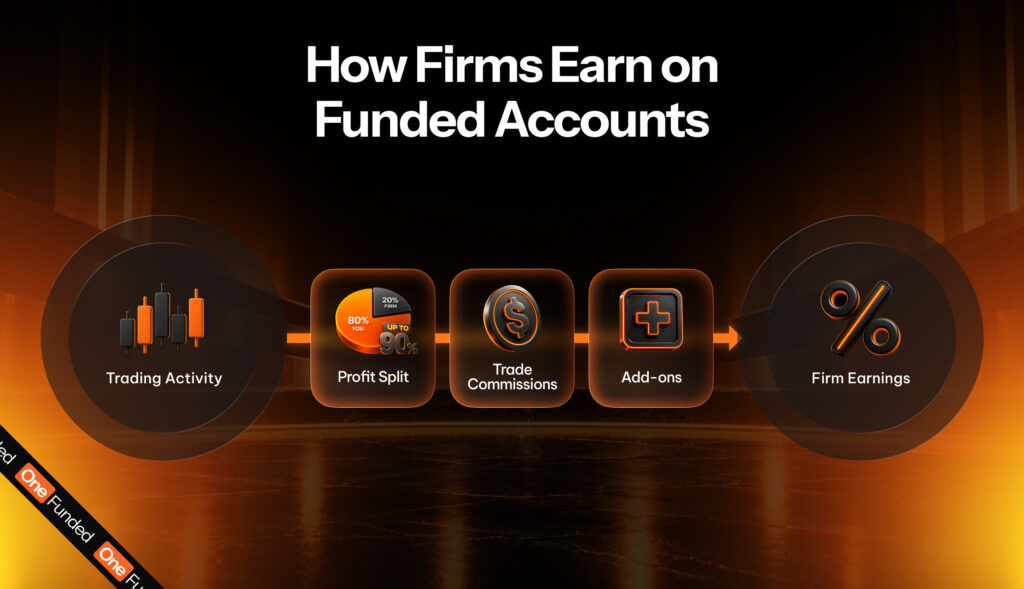
Once you get funded, the prop firm gets a cut from your trading activities. This includes a share of every payout, commission on each trade, and add-ons.
Here’s an example. Let’s say a trader on a $50,000 virtual account makes 5% of that account size in one payout cycle. That’s $2,500 in total. With an 80/20 profit split in place, the trader gets to keep $2,000, while the firm takes $500.
On top of that, if the trader pays a $3 commission per lot on 40 lots within that payout cycle, the firm receives another $120. This goes to the firm whether those trades win or lose.
A trader who has a funded account for several months and grows it into a bigger account through OneFunded’s scaling plan is more valuable to the firm than one challenge fee.
Why? The money comes in consistently. You pay a challenge fee once on the Value, Core, and Flash plans, and OneFunded returns it with your third payout.
But the firm’s profit split and trade commissions arrive every payout cycle. As your account grows, the earnings that the firm makes grow too. In the earlier example, the firm earns $620 in one payout cycle and can earn it again every 14 days.
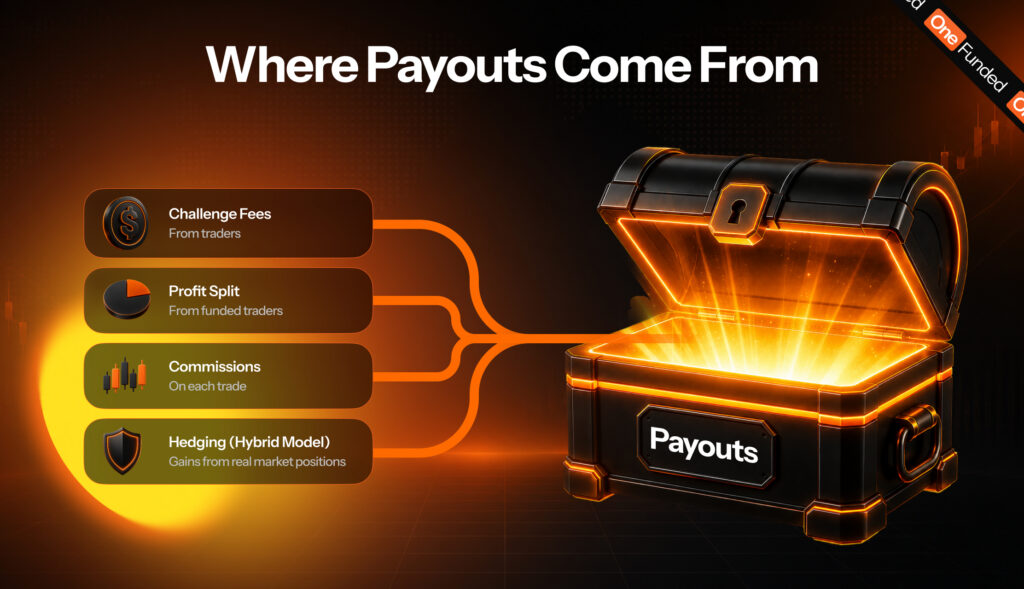
Payouts don’t come from real trades in the market. That’s because prop firms use virtual funds. The money the firm pays comes from the cash it earns from fees, its profit split, and commissions. At firms running a hybrid model, part of that money can also come from hedging. When a profitable funded trader’s positions are copied into the real market, the gains there help cover the payout.
OneFunded is quite vocal about this. On its How It Works page, it says that you trade virtual capital and not your money. However, payouts are real, and you’d get paid in fiat or crypto.
Note that before you request your first payout, you must have followed the firm’s rules and completed KYC. The minimum payout at OneFunded is $100, while the maximum is set at $10,000. There are 14 days between payouts; this timeline goes down to 7 days with a paid add-on. But while some traders can make payout requests, many will never get that far.
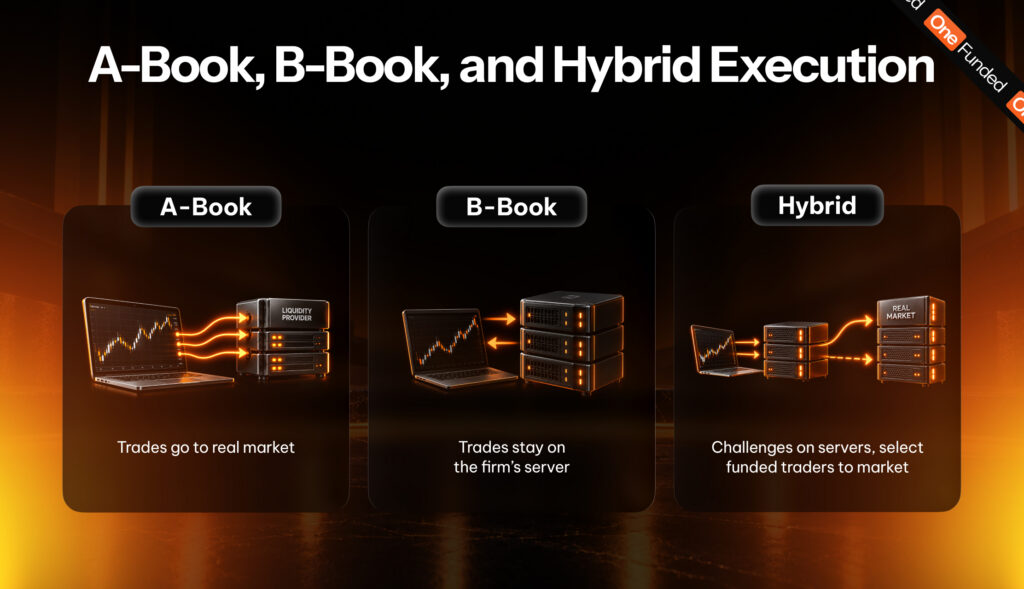
These terms tell you what a firm does with your trades, who shoulders the risk, and whether the prop firm makes money when you lose. For the average trader, this part of the business model matters the most.
n the A-book model, the firm passes its exposure to a liquidity provider, so it carries no directional risk of its own. In the B-book model, the prop firm carries that risk in full and settles payouts from its own revenue.
In the hybrid setup, the firm keeps most trades on its server and carries that risk alone. It only copies consistently profitable traders into the real market, as those traders cost them the most when it comes to payouts. The firm uses its gains from copying trades to fulfill their payout requests.
Most prop firms in the industry operate some form of B-book. Participants in the sector told Finance Magnates that almost all prop firms retain traders’ orders internally instead of sending them to liquidity providers.
This happens for three reasons. First, challenge accounts are simulated, so there is nothing to send to the real market in the first place. Second, hedging every funded account would mean paying to offset positions for every trader when only about 7% ever reach a payout. Third, the conditions a firm would need to run a true A-book model, such as real-market slippage, wider spreads and higher fees, are not what most traders are shopping for.
B-book speaks to where trades go to and doesn’t give context on whether a firm is honest or not. A prop firm that sells a simulated test, publishes clear rules, and pays out is legitimate, even if trades never reach the real market.
The risk in this structure resides in the incentive. A firm that keeps the risks tied to funded accounts in-house depends on most traders breaching their accounts.
But this might make some firms tweak their trading T&Cs or add strict limits after traders get funded. That’s why rule stability and payout history give you more information than the label.
In a hybrid system, the prop firm keeps challenge accounts and newer funded accounts on its own server. If a funded trader has a record of steady profits on a huge account, the firm will start to copy their positions to a liquidity provider.
You might wonder, why hedge these traders? It’s simply because a profitable trader is an open-ended cost.
Here’s an example.
Let’s say a funded trader makes $10,000 in virtual profit on an 80/20 split. The firm owes them $8,000. If the firm had copied the same positions into the real market at the same size, it would have received $10,000. That covers the payout in full and leaves the firm with $2,000, which is its share of the profit anyway.
It only works one way, though. If a trader loses consistently, hedging their activity turns a loss the firm would simply have kept on its own server into a real loss in the market. That is why firms are selective about which traders they hedge.
Here are four important questions you need to ask a firm about execution:
A reasonable answer is one that matches the rules published by the firm. Here’s an example:
“All accounts trade in a simulated environment. All payouts come from company revenue, and we may hedge some funded exposure. Either way, the rules and trading conditions that apply to you do not change.”
Some firms might decide not to disclose hedging info for commercial purposes. That’s not a warning sign. But red flags you should watch out for include responses that don’t answer original questions and claims you’re trading real capital when the T&Cs say simulated.
Prop firms don’t give you real cash to trade with. Rather, you get practice money to trade on a demo server. When you buy a challenge account, your fee pays for a test, not an investment.
This structure has kept prop firms outside the rules meant for brokers and investment funds.
What does this mean? There’s no regulator or insurance scheme protecting the money you paid for an eval or your payout. Your protection is based on the contract, the firm’s payout history, and the information you can find about the firm.
You can check this for OneFunded. The site’s footer says BRYNEX TECH LIMITED, a company in the UK (number 15918986), delivers software solutions, platform infrastructure, and related technical and operational support for OneFunded. It doesn’t give financial advice or accept or hold customer funds. You can find this company’s information on Companies House.
If you go against the rules of a challenge and fail it, the firm will keep your fees and won’t pay anything out to you. In the FPFX Tech data above, 86% of traders didn’t pass their challenge. This means failed challenges pay for a huge part of the prop trading market.
But that’s not the full picture. If a firm only makes money when traders fail, it won’t last long in the business. Why? People buy challenges after seeing other traders passing them and getting paid. Also, funded traders bring in shares of profits, commissions, and add-on sales.
There is a second reason, and it sits in the hybrid model. A trader whose results are consistent can be hedged: copy their positions into the real market and their winning trades produce real gains for the firm, rather than a bill it has to pay. That only works when the edge is repeatable. A trader who makes one lucky trade and gives it back the following week cannot be hedged profitably, because the firm would be copying noise into the market.
This changes what a firm is looking for. It wants traders whose results hold up over time, and it needs rules that can tell those traders apart from the lucky ones. Consistency requirements, minimum trading days and drawdown limits all do that job. They cap the firm’s exposure, but they also work as a filter: a trader who clears them has shown something repeatable, and a repeatable trader is worth more to the firm hedged than failed.
Trouble starts when a firm changes its rules to tip the scale. That’s why you should avoid firms that add rules after you’ve paid, apply new limits to old accounts, and reject payouts for reasons they never specified in their terms and conditions.
A firm with rules that don’t change all of a sudden and pays out on schedule has chosen to earn from funded traders, not just from failures.
Back in August 2023, the US regulator, the CFTC, sued Traders Global Group, the company behind My Forex Funds, for fraud. The CFTC said thousands of customers had paid a minimum of $310 million in fees.
After this, a court froze the firm’s money, and that led to its closure. A federal judge dismissed the case with prejudice in May 2025, meaning it can’t be brought again. The judge also sanctioned the CFTC for misconduct and ordered it to pay over $3 million in legal fees.
In March 2024, many traders complained about rejected payouts at The Funded Trader. The firm, which ran 80,000+ accounts, said it suspended payouts for a self-imposed internal audit. It stopped operations on March 28, blaming a forced move off MetaTrader.
The CEO mentioned it paid over $17 million in the first two months of 2024 while holding payouts of around $2 million. After relaunching in November 2024, 900 traders were still waiting to be paid.
In this OneFunded interview, Jake requested his second payout live. He made $5,217 in one week and estimated his share after the profit split at about $4,100.
He received funds within 10 minutes of making his payout request. Jake said earlier accounts didn’t work out at first. But Jake’s story is one company-shared result and isn’t a typical outcome.
Beyond this interview, OneFunded reports over $1 million paid out as of October 2026. This figure is from the company website.
OneFunded settles crypto payouts in USDT via the ERC20 or BEP20 network, and related transfers are recorded on the public blockchain.

Prop firms that sell simulated tests and pay out if you meet published terms are legit. But there are still some fraudulent firms in the mix. As such, it's vital you check the firm's history, payout conditions, and customer reviews.
BRYNEX TECH LIMITED, a company registered in the UK, operates OneFunded and publishes its refund and payout rules. You can check the company register to validate their status.
Prop firms make money from challenge fees, trade commissions, add-ons, and profit splits. Payouts come from the funds made from all of these.
Yes. You trade with simulated cash, but legitimate firms will pay out real money, in fiat or crypto, once you meet their terms and on their published payout schedule.
The firm keeps the money. On OneFunded’s Core, Flash, and Value plans, you'd get a refund after you pass the challenge, alongside your third payout.
Not really, and that's because most firms don't ask you to deposit money or trade real markets. The regulators in Belgium and Italy have said prop firms aren't licensed and can't provide investment services.
You passed a prop firm challenge. Congratulations. But doing that just taught you a set of rules. Once you’re funded,...

Most, if not all, traders want to enjoy the massive capital opportunity that a proprietary trading firm, or prop firm,...
 Set Preferred on Google