



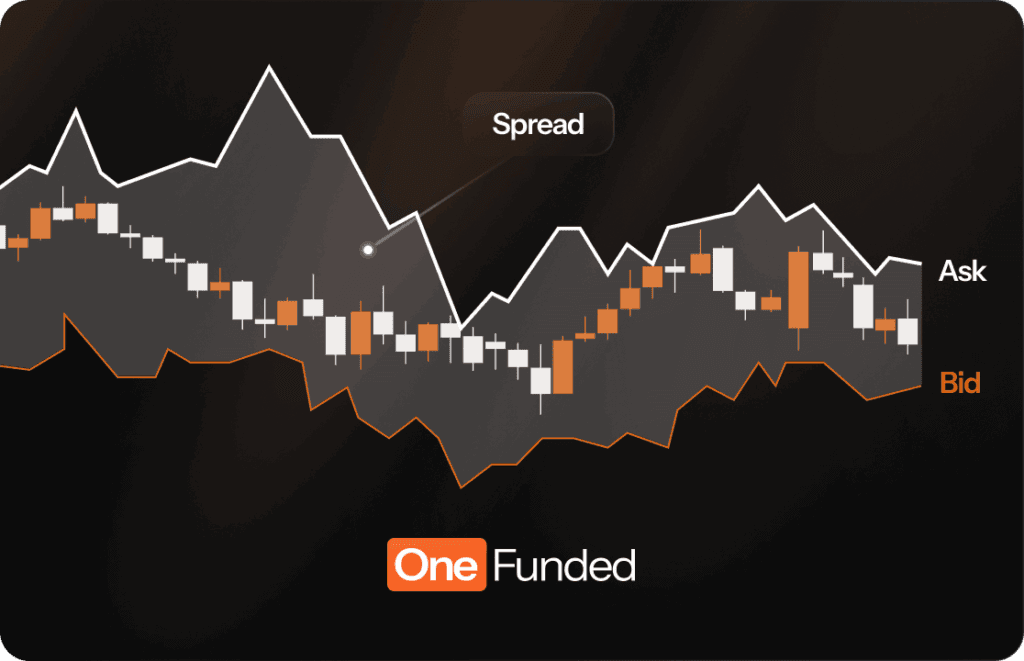
Financial assets are often quoted with a single price. However, traders know that every asset actually has two key prices: the best price at which someone is willing to buy it and the best price at which someone is willing to sell it. The gap between these two prices is known as the ‘spread,’ and it can play a surprisingly important role in your trading performance.
In foreign exchange trading, the spread is even more important than it is in other markets. Forex spreads don’t work like they do in other popular asset classes, requiring detailed understanding by sophisticated traders. As traders develop more advanced strategies, the spread becomes an area too important to overlook, representing a key trading cost that meaningfully impacts profitability.
In this article, we’ll dive deep into the concept of FX spreads and how they can impact a trader’s performance. First, we’ll look at the fundamentals of forex spreads and how this gap helps incentivize market liquidity. Then, we’ll turn to key factors that impact spreads and how traders can manage spreads as part of their overall trading costs.
While navigating the spread is sometimes considered an advanced trading concept, it’s a topic that even newer traders should be aware of. Failing to understand spreads could end up leaving money on the table. By the end of this guide, you’ll have the knowledge needed to minimize spread costs and maximize your trading edge.
Key Points:
- In forex, the spread is the difference between the best bid price and the best ask price. Unlike equity markets, where spreads emerge from a centralized order book, FX spreads result from a complex network of decentralized banks and brokers.
- The spread reflects compensation for liquidity providers – conversely, it is a price paid by liquidity takers (market orders). Without the spread, banks and brokers would have little incentive to provide liquidity or bear the risks of holding assets on their balance sheets.
- Key factors that influence spreads include liquidity and volatility conditions. What’s more, different brokers have different spread pricing models. While some brokers charge a fixed spread, others have a variable one that fluctuates with market conditions.
- While traders can’t avoid transaction costs entirely, they can help mitigate the impact of the spread with a few key strategies. These include focusing on major currency pairs, trading only during liquid hours, and potentially shifting toward a longer-term style.
What Are Forex Spreads? Understanding the Fundamentals
In financial markets, the ‘spread’ is the difference between what it costs to buy an asset and what it costs to sell an asset. Logically speaking, sellers aim to charge the highest ‘ask’ price they can, while buyers aim to pay the lowest ‘bid’ price they have to. At any given time, the gap between the lowest ask and the highest bid is considered the spread for an asset.
It’s important to understand spreads because they can impact a trader’s overall costs. For example, imagine that an asset currently has a best bid price of $99.90 and a best ask price of $100.00, resulting in a spread of 10¢. A trader who buys the asset (at a price of $100.00) and then instantaneously sells it (at a price of $99.90) will incur a loss of 10¢, even though the asset’s price has not moved. ‘Crossing the spread’ like this is considered a hidden trading cost, with traders paying a price for immediate execution.
Generally speaking, limit orders do not cross the spread and thus come with lower trading costs. Instead, spreads are most relevant to market orders, which are used by traders seeking immediate entry or exit. To better understand how spreads apply in forex trading, let’s look at how the situation compares to equity trading.

Forex spreads vs equity spreads
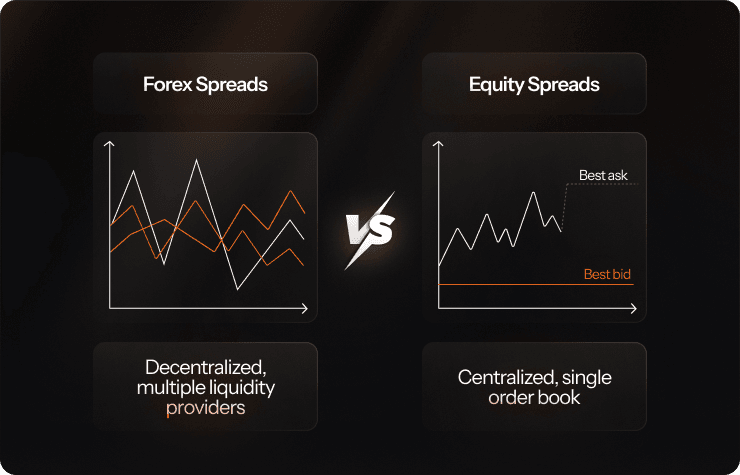
Traders coming to forex markets from equities may be familiar with the concept of a spread. In practice, however, spreads function very differently in each market. While equity spreads emerge naturally from limit traders, FX spreads are largely dictated by banks and brokers:
- Equity trading spreads – Equity markets are centralized, with traders converging on a single exchange (such as the New York Stock Exchange). Thus, all liquidity for a specific stock resides on the same order book, with the best bid and ask prices constantly shifting based on outstanding limit orders. The spread evolves over time based on these orders, shifting along with supply and demand.
- Forex trading spreads – Forex markets are decentralized, meaning that there’s no one exchange where market liquidity resides. Instead, liquidity is fractured among an interbank market of dealers, quoting prices to brokers who then transact with retail traders. Rather than emerging from a single evolving order book, spreads are continuously determined and quoted by banks and brokers.
In equity markets, it’s possible to point to a single defined spread for a stock at a particular point in time. But in forex, there’s no one spread for a currency pair. Instead, there is only an average of various spreads charged by different liquidity providers, with brokers typically charging a markup on the underlying bank spread.
How are forex spreads measured?
Just as FX spreads function differently from equity spreads, they must also be quoted differently. Earlier, we looked at the example of an asset with a bid-ask of $99.90–$100.00. Quoting this spread at 10¢ per share would be common in the equity market.
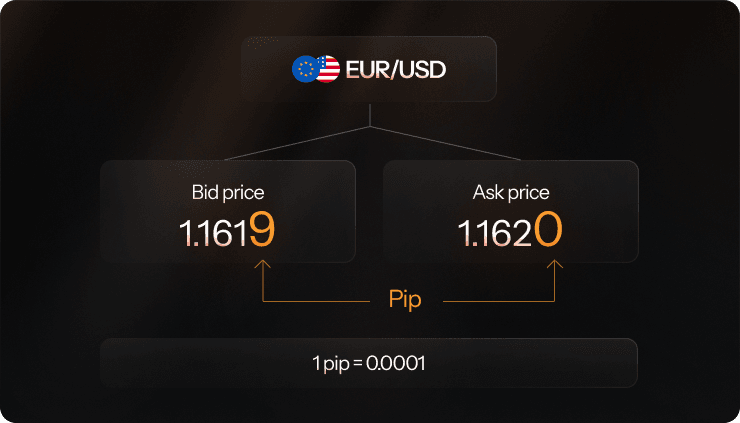
In contrast, the forex market uses ‘pips’ to quote a spread, typically reflecting the fourth decimal point after the price. The Japanese yen is the only major currency to deviate from this practice – yen pairs quote pips as the second decimal point due to the yen’s lower value compared to other currencies. To understand how pips work in practice, we can look at a standard example involving EUR/USD:
- Suppose that EUR/USD currently trades at a price of 1.1620. This means that €1 equals approximately $1.16.
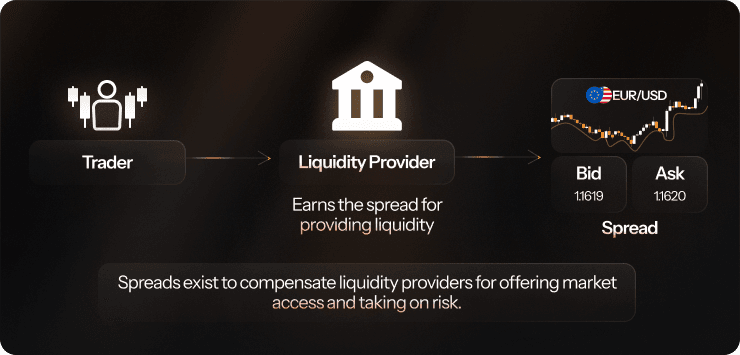
- Looking at your broker’s platform, you see that the EUR/USD market is currently quoted at 1.1619-1.1620. Because the bid is always listed first, this reflects a bid price of 1.1619 and an ask price of 1.1620.
- Subtracting the bid from the ask, we find a spread of 0.0001, also known as 1 pip. While 1 pip is a low spread reflecting the high liquidity of EUR/USD, spreads for other currency pairs may be many times higher.
For example, consider the GBP/CHF market, where British pounds and Swiss francs change hands. While GBP/CHF is still an important cross, it is not considered a major pair, since USD is not one leg of the transaction. As a result, average spreads may be higher. More exotic pairs like EUR/ZAR (the euro against the South African rand) can be even more expensive to trade.
Why do forex trading spreads exist?
For newer traders, spreads can seem like a frustrating aspect of financial markets, adding needless complexity to pricing and potentially disrupting their trading strategy. However, forex spreads exist for an important reason. Just as market traders pay the spread to consume liquidity, banks and brokers earn the spread for providing liquidity.
The typical business model of a liquidity provider is to hold an inventory of assets on its balance sheet, standing ready to buy and sell against market participants. Clearly, in order to generate a profit, the liquidity provider needs to sell those assets for a higher price than it pays for them. Moreover, the liquidity provider needs to consider the risk of holding these assets, since prices are constantly fluctuating.
Thus, spreads exist for two key reasons:
- As compensation for the service of providing market liquidity.
- As compensation for bearing the associated risk of holding volatile balance sheet assets.
Without the existence of a spread, banks and brokers would have no reason to provide market liquidity or bear the risks that make doing so possible. Thus, forex trading would be essentially impossible.
Factors That Influence Forex Spreads: Liquidity, Volatility, and Pricing Model
In the last section, we explored the basics of how forex spreads work and why they exist. However, spreads for any currency pair aren’t constant, shifting over time along with the market environment. In this section, we’ll look at the three main factors that influence how FX spreads are determined: market liquidity, market volatility, and broker pricing models.
Factor #1: Market Liquidity
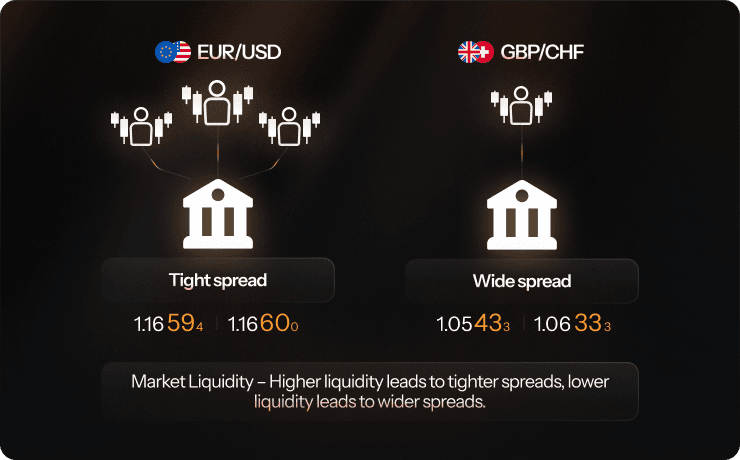
As we saw, one of the core reasons that spreads exist is to compensate banks and brokers for the service of providing liquidity. Like any service, however, increased competition can drive down this compensation. When markets are highly liquid, with many different buyers and sellers competing to have their orders filled, spreads tend to shrink.
Imagine that a bank trader is virtually the only source of overnight liquidity for a minor currency pair. If a stressed hedge fund manager calls the desk overnight seeking to liquidate their position, the bank trader might be able to charge a high spread – after all, the hedge fund manager has few other options. But if this same transaction took place during traditional market hours, the manager may be able to call several different traders and seek execution with the bank that offers the tightest spread.
Market liquidity is why spreads for more popular pairs (like EUR/USD) tend to be lower than less popular ones (like GBP/CHF). Moreover, this liquidity naturally fluctuates throughout the trading day, with the New York-London overlap typically the most liquid period for the forex market. As a result, traders operating in liquid markets tend to pay lower trading costs on average.
Factor #2: Market Volatility
The first factor focused on spreads as compensation for providing a service. Now, let’s look at spreads as compensation for bearing risk. Just as increased competition can drive down spreads, increased risk can drive them up.
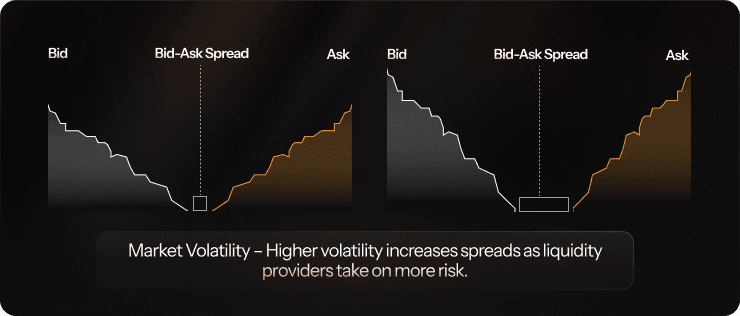
When markets are stable, with prices barely fluctuating, banks and brokers don’t bear much risk for holding balance sheet inventory. During the gap between when a liquidity provider purchases an asset and when they sell it, the risk of a major market movement is small. In volatile periods, however, this is no longer true – an unexpected price spike or decline can significantly impact a liquidity provider’s P&L.
As a result, liquidity providers need to increase the spread that they charge during volatile periods in order to compensate for possible losses. They may also need to charge higher prices to cover increased ‘hedging costs’ to offset the risks of their balance sheet positions. Either way, the impact is the same: greater market volatility results in higher spreads and an increased cost of trading for liquidity takers.
Factor #3: Provider Pricing Model
The final major factor that influences market liquidity is the pricing model that a liquidity provider chooses to use. Centralized markets like equities have a single ‘pricing model,’ with spreads fluctuating over time according to supply and demand. But in decentralized markets like forex, that’s not universally true.
Instead, banks and brokers typically use one of two pricing models:
- Fixed Spreads: Under a fixed spread model, a liquidity provider quotes a constant spread between buy and sell prices. For example, a broker may offer a fixed spread of 3 pips on a key currency pair.
- Variable Spreads: In contrast, a variable model works more like spreads in the equity market. A broker may constantly refresh and update their current spread for a currency pair based on market volatility, liquidity conditions, and quotes they receive from other liquidity providers.
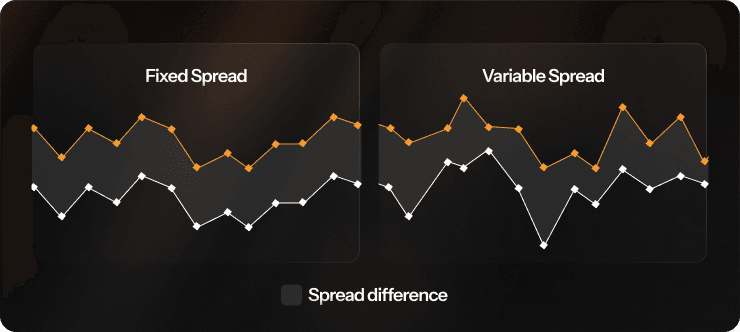
Fixed spreads can potentially offer greater consistency and predictability. Unfortunately, however, fixed spreads might be less reliable than they first appear during periods of high market volatility. Some brokers with a fixed pricing model may ‘requote’ trades during volatile periods to protect themselves from losses. This can be frustrating for traders seeking immediate execution.
Moreover, fixed spreads often result in greater trading costs overall when compared to variable spreads. Traders typically end up paying higher average transaction costs for the price of greater predictability. In contrast, while variable spreads may be less predictable, they are closer to reflecting true underlying market conditions.
Ultimately, the right choice between fixed and variable spreads depends on a trader’s strategy, broker preference, and desire for predictability. But either way, there’s no escaping the fact that forex spreads can impact trading performance.
For traders seeking the tightest possible spreads, raw spreads are an important concept to understand. Unlike typical retail spreads, which often include a broker’s markup, raw spreads reflect the true interbank market rates provided directly by liquidity providers. These spreads can be extremely tight, sometimes less than a single pip on major currency pairs, but brokers usually charge a separate commission per trade to compensate for facilitating access. Using raw spreads can significantly reduce overall trading costs for high-volume or short-term traders, such as scalpers and algorithmic systems, by allowing them to pay only for the liquidity they consume rather than inflated spreads.
Now that we understand the fundamentals of FX spreads and how these spreads are determined, we can look at the impact spreads have on trading profits.
How Forex Spreads Impact Trading Performance
For traders who demand immediate execution, wider spreads lead directly to worse trading performance. As we saw earlier, a trader who instantaneously buys and sells an asset with a 10¢ spread already incurs a loss, even though the asset’s price has not moved. If this spread widens, the trader’s loss increases.
As a result, market traders need to account for the spread when calculating the profitability of their strategy. To understand why, consider the following scenario in the forex market:
- A trader sees EUR/USD quoted at 1.1619-1.1620, indicating a 1 pip spread. For the purposes of this example, suppose that the EUR/USD market experiences no changes in volatility or liquidity conditions, meaning the spread remains stable.
- The trader identifies a bullish setup for the currency pair and takes a long position in EUR/USD. They execute a market order and enter a long position at 1.1620 (the current ask price).
- After a short period of time, the market begins to move in a bullish direction. The trader checks the quote again – the broker now lists EUR/USD at 1.1625-1.1626.
- Seeking to take profit, the trader enters a market sell order. Their transaction is executed at 1.1625 (the current bid price).
- The trader calculates their total profit from this trade. Subtracting 1.1620 from 1.1625, they find a profit of 5 pips.
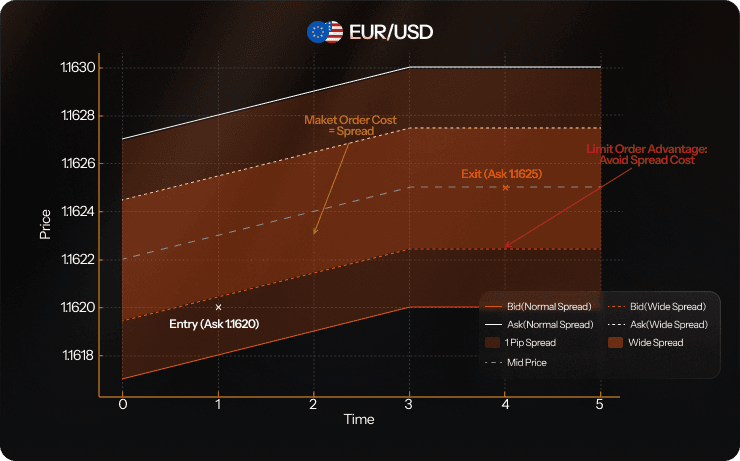
Notice something important, however. The EUR/USD market actually rose by a total of 6 pips while the trader held a long position: the mid-point price (average of the bid-ask) rose from 1.16195 to 1.16255. However, the trader only realized 5 pips in profit – precisely because they had to pay a 1 pip transaction cost resulting from the spread.
Now, consider if liquidity considerations worsened while the trader held their long position. As a result, suppose that the spread widened to 5 pips by the time the trader sought to exit the trade. How would this impact profitability?
Assuming the same midpoint price increase, the final EUR/USD quote would be 1.1623-1.1628. If the trader goes to liquidate their position, they would be filled at a bid price of 1.1623. That translates into a realized profit of just 3 pips on a 6 pip movement, demonstrating how unexpectedly high trading costs can potentially affect performance.
The bottom line is that traders utilizing market orders must factor in expected spread costs when determining their total profit – simply looking at mid-point price movements is not enough. Limit traders have greater control over execution costs, since they specify their exact entry and exit prices, avoiding the need to cross the spread for immediate fills. The true impact of spreads on performance, however, will depend on your trading style and strategy.
How spread costs differ by trading style
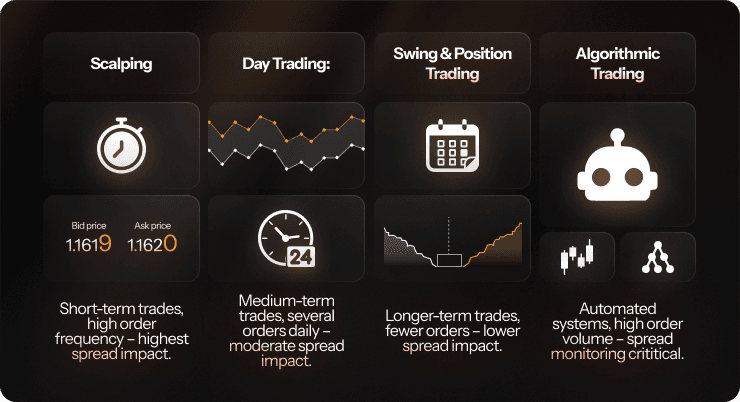
Spreads are a trading cost paid per transaction. That means trading styles that result in more transactions will naturally experience greater performance impact from spreads. In fact, while spread conditions can significantly impact short-term traders, long-term traders may be able to ignore spreads almost entirely:
- Scalping – Scalpers need to pay the closest attention to spreads. Traders using this style may have holding periods measured in just seconds or minutes, hoping to ‘scalp’ a few pips from each transaction. Because scalpers often use market orders to guarantee rapid execution, they are often exposed to the performance impact of spreads.
- Day Trading – Day traders do need to monitor spreads, but their importance is typically less than it is for scalpers. Because day traders are frequently looking to capitalize on trends that take place over hours, spread costs may be much smaller relative to the size of potential price changes. Nonetheless, for day traders who tend to place many market orders, spread costs can certainly add up.
- Swing Trading & Position Trading – For these medium- and longer-term styles, the impact of spreads starts to wane significantly. Generally, swing traders and position traders may only need to pay attention to spreads in seriously illiquid or volatile markets. These traders simply don’t tend to make enough trades in a short time period for spreads to materially impact their overall performance.
One final group that can see notable spread impacts is algorithmic traders. Algorithmic traders build automated systems that can independently place trades, potentially resulting in a higher volume of trade execution than a human trader can achieve on their own. This makes it exceedingly important that algorithmic traders have some way to measure spread conditions to help their systems determine whether a trade can be placed profitably.
Why can spreads be misleading?
The concept of a spread is relatively straightforward, reflecting the gap between the best bid and ask price. While this definition is certainly accurate, a more nuanced understanding of the topic can help traders realistically evaluate the impact of forex spreads on their performance. There are two key reasons that quoting spreads can be misleading without the proper context.
Reason #1: The potential for misleading spread quantity
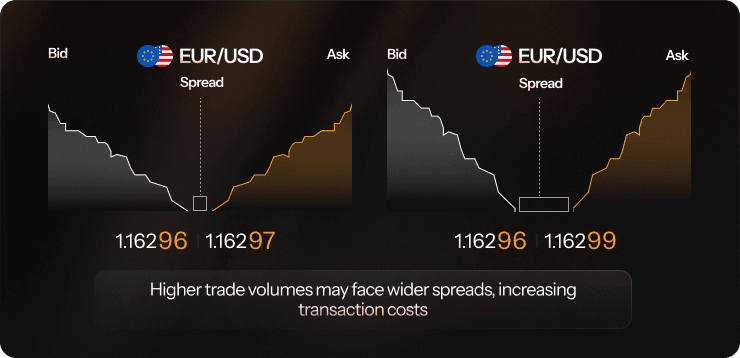
Spreads are quoted as the lowest ask and the highest bid prices available. However, this quoting convention tells traders nothing about the quantity of assets a liquidity provider is willing to trade at those prices. In equity markets, this problem is relatively straightforward, since the centralized order book displays both prices and quantities. In forex, however, things can be more complex.
In the forex market, the displayed bid and ask prices may only be applicable for orders of a certain size. For higher quantities, a bank or broker may widen the spread to accommodate larger trades, which can result in greater transaction costs than initially expected. To appropriately estimate anticipated spread costs, it’s essential not only to understand the current bid and ask prices, but also the total size a liquidity provider is willing to transact at those prices.
Reason #2: Spread impact is greater on smaller prices
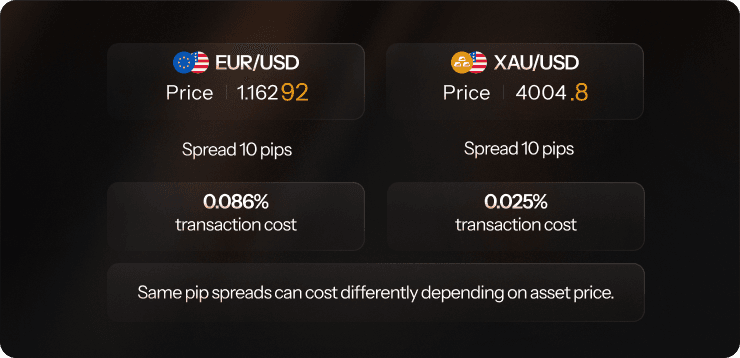
When trying to minimize transaction costs, novice traders may try to naively compare spreads in different markets. For example, if two currency pairs each have an average spread of 10 pips, they may each seem to be equally expensive to transact in. While this analysis isn’t necessarily wrong, it can be misleading without understanding the prices of the underlying assets.
For example, suppose that the first pair has a current price of 1.0000, while the second has a current price of 2.0000. Viewed as a percentage of the asset price, the 10 pip spread reflects a 0.10% transaction cost in the first market, but only a 0.05% transaction cost in the second market. In other words, the trader in the first market is effectively paying twice as much per trade compared to the second market.
Comparing nominal pips between markets can be a useful shorthand to quickly assess spread conditions for currency pairs of similar magnitude. A completely accurate comparison of spreads, however, requires understanding factors like percentage spread costs, liquidity conditions, and average volatility levels. These nuances are helpful to understand when incorporating strategies to minimize the impact of spreads on your forex trading.
Strategies to Minimize Forex Spread Impact
While high trading costs can potentially reduce your forex profitability, several key strategies can help you manage the impact of spreads. Below, we discuss four of these strategies, focusing on practical methods that traders can start implementing into their market approach.
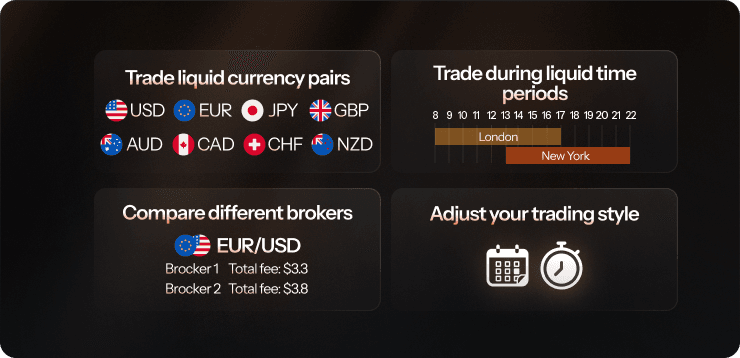
Strategy #1: Trade liquid currency pairs
Popular currency pairs tend to have far lower spreads than niche, exotic ones. Because so many traders focus on major pairs, these markets are highly liquid, resulting in spread compression from increased broker and bank competition. Here’s how this strategy might look in practice:
- Focus on the major pairs. There are 7 ‘major pairs’ in the forex market, all of which have USD as one leg of the transaction. The other 7 respective legs are EUR, JPY, GBP, AUD, CAD, CHF, and NZD. Since the majors are by far the most liquid forex markets, these pairs tend to have tight spreads.
- Trade exotics tactically. If you have a specific reason to trade an exotic currency, carefully consider the opposing leg to find the most liquid pairing. While this will often be USD, some exotics have strong relationships with other currencies. For example, some European currencies (such as the Polish złoty) may be better traded against the euro.
- Utilize synthetic currency pairs. Imagine a trader wants to express specific views on the performance of two exotic currencies, such as the Norwegian krone and the Thai baht. Because the NOK/TBH market might have very low liquidity, traders can potentially achieve lower spreads by creating a synthetic pair with a major currency. For instance, a trader could hold USD/NOK and USD/TBH to manufacture a synthetic NOK/TBH position with lower spreads.
Strategy #2: Trade during liquid time periods
The forex market operates 24/5, trading continuously throughout the business week. However, that doesn’t mean all hours are equally liquid. Traders can achieve the tightest spreads by focusing on the time periods when the market is most active:
- Trade the New York-London overlap. New York and London are the world’s two major forex centers. Each day, there’s roughly a four-hour overlap between the business days of the two cities. This window is generally considered the most liquid time to trade major currencies, which often results in the lowest spreads.
- Focus on local hours for specific pairs. For certain pairs, spreads can shrink noticeably during local business hours. It likely comes as no surprise that the market to exchange the Australian dollar and New Zealand dollar (AUD/NZD) is most liquid during Sydney hours. For traders focused on niche pairs like this, it can make sense to structure your trading window around key hours to lower spreads.
- Consider calendar year trends. Just as not all hours in the trading day are equally liquid, not all months in the calendar year are equally liquid. August tends to be a low liquidity month, with many financial professionals taking time away from work. Similarly, the second half of December can be illiquid as traders focus on their families during the holidays.
Strategy #3: Compare different brokers
Retail traders don’t always have a choice over which brokerage platform to work with – traders at prop firms, for example, may have to use the broker that their firm selects. However, self-funded traders can typically weigh different brokerage options based on the spreads they charge. If you’re comparing different brokers, there are several different elements to consider:
- Weigh fixed vs. variable spreads. In many cases, variable spreads result in lower overall trading costs. While fixed spreads can offer predictability, brokers generally charge a premium for that certainty. Moreover, some brokers only offer fixed costs for certain markets, meaning that traders should understand the cost structure for their preferred currency pairs.
- Factor in commissions. Some brokers that offer tight spreads can afford to do so only by charging higher commissions on each trade. It’s essential to understand that spreads are only one part of your overall trading costs, with commissions making up the rest. Ensure that you fairly compare different brokers by factoring in all your expected costs.
- Test real market execution. Finally, make sure to test whether a broker’s advertised spreads match up to real-world performance. While some brokers may offer virtual or paper accounts that simulate real-world trading, only deploying capital in a live account can help you determine how costly their spreads actually are.
Strategy #4: Adjust your trading style
In some cases, especially for traders who specialize in niche currency pairs, minimizing spreads can mean adjusting your trading style entirely. While traders rarely need to upend their entire approach due to the impact of spreads, a few basic adjustments could help reduce overall trading costs:
- Consider a longer-term approach. Shorter-term styles tend to come with a larger order volume as traders rapidly enter and exit positions. However, more trades typically mean higher trading costs. Shifting from scalping and day trading to swing trading and position trading can potentially help mitigate the impact of spreads by reducing overall order volume.
- Use limit orders instead of market orders. Because only market orders ‘cross the spread,’ limit orders are not impacted by spreads when it comes to trading costs. Instead, these orders execute only when the bid or ask price reaches the specified limit price. For traders looking to minimize the impact of spreads, incorporating more limit orders into their approach can be a useful strategy.
- Incorporate spread monitoring tools. Traders who aren’t in the habit of paying attention to spreads may not use spread monitoring tools as part of their market analysis. Many forex platforms allow traders to track spreads across different markets and compare them to historical averages. By using these tools, traders can effectively time their trades when liquidity conditions are strongest and spreads are lowest.
Conclusion: Knowledge is Power
When it comes to spreads, knowledge is power. Unfortunately, many forex traders still do not fully understand how spreads work or where they come from. As a result, they cannot properly manage spreads as part of their trading strategy.
By understanding forex spreads and key strategies to minimize them, market traders can effectively reduce their trading costs and boost their profitability. Whether it’s sticking to liquid markets or shifting to a longer-term style, traders have several powerful options to effectively navigate spreads. What’s more, this knowledge can be used to more deeply understand other key topics like market liquidity.
Mastering trading costs is important to develop a profitable strategy – but once you’re profitable, what comes next? Consider increasing your trading capital with a prop firm like OneFunded. Once you’ve passed a trading challenge, you’ll be on your way to accessing a funded account and scaling up your future profits. Start your OneFunded challenge today to unlock your full trading potential.