



Isaac Newton, widely known as one of the most brilliant physicists in history, also moonlighted as a trader and investor. Yet after losing a significant sum of money in an 18th-century stock market bubble, Newton quit the markets in frustration. Famously, he claimed that he could “calculate the motions of the heavenly bodies, but not the madness of people.”
Hundreds of years later, Newton’s quote still captures an essential fact about financial markets: while numbers are important, emotions also play a powerful role in driving asset prices. For traders, this means that understanding market psychology – as well as their own individual psychology – is paramount for robust trading success. Unfortunately, fostering an effective market mindset is still overlooked by many burgeoning traders.
In this article, we’ll cover the basics of trading psychology, looking at how traders can learn to use emotions to their advantage. By mastering the psychological dimension of trading, you can avoid Newton’s fate. The goal isn’t to eliminate emotions from your decisions, but to understand and channel them productively.
Key Points:
- In contrast to what standard economic and financial models suppose, traders and investors are emotional decision-makers whose choices frequently stray from rationality. As a result, mindset and psychology play a key role in driving market prices.
- Financial markets are influenced by three major emotions: fear, greed, and hope. In small doses, each emotion is essential for trading success. But in large doses, they can also be potentially damaging.
- In addition to their general emotional temperament, traders can also make poor decisions due to specific mental wiring that leads to predictable cognitive distortions. These distortions include loss aversion, uncertainty aversion, and recency bias.
- Ultimately, traders cannot hope to escape their emotions, nor the heuristics and biases that influence their decisions. However, with the right mix of research, planning, and emotional regulation, traders can transform their psychological outlook from a liability into an asset.
What is Trading Psychology? Understanding Market Mindset
Traders spend their days engrossed in an endless string of numbers: prices, volumes, probabilities, and more. As a result, trading can seem like a strictly quantitative endeavor. But as any experienced market participant will tell you, psychology, mindset, and other qualitative factors can have a tremendous impact on trading success.
A trader’s psychological outlook reflects many distinct factors, including confidence, resilience, and emotional discipline. In a perfectly rational and predictable world, such elements may not be important factors in becoming a successful trader. But in the world in which we live, there’s no escaping the qualitative side of trading. In fact, there are a few key reasons that understanding trading psychology should be an important goal for any market practitioner:
-
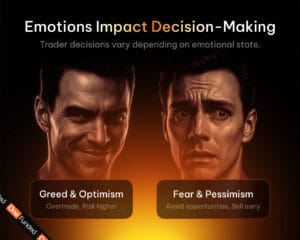
Emotions impact decision-making. When it comes to making trading decisions, data and analysis are not the only factors that matter. A trader overcome with optimism and greed will make decisions that are fundamentally different from those driven by pessimism and fear. Importantly, while some traders use an algorithmic style to try to remove emotions from the decision-making process, they still need to have the confidence to trust such an algorithm.
-
Humans are irrational. Decades of research in the field of behavioral finance have revealed one thing: humans are not rational calculating machines that optimize for the best course of action. Instead, people are beset by numerous biases and cognitive distortions that can lead to poor decision-making. Understanding the way in which people deviate from rationality can allow a trader to spot their own mistakes and those of others.

-
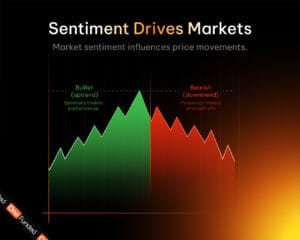
Sentiment drives markets. Although fundamental factors like interest rates and corporate earnings impact financial markets, so too does trader and investor sentiment. Generally speaking, when financial market participants are bullish and optimistic about the future, prices are likely to rise. In contrast, periods of pessimism and disbelief can lead to sell-offs and slowdowns.
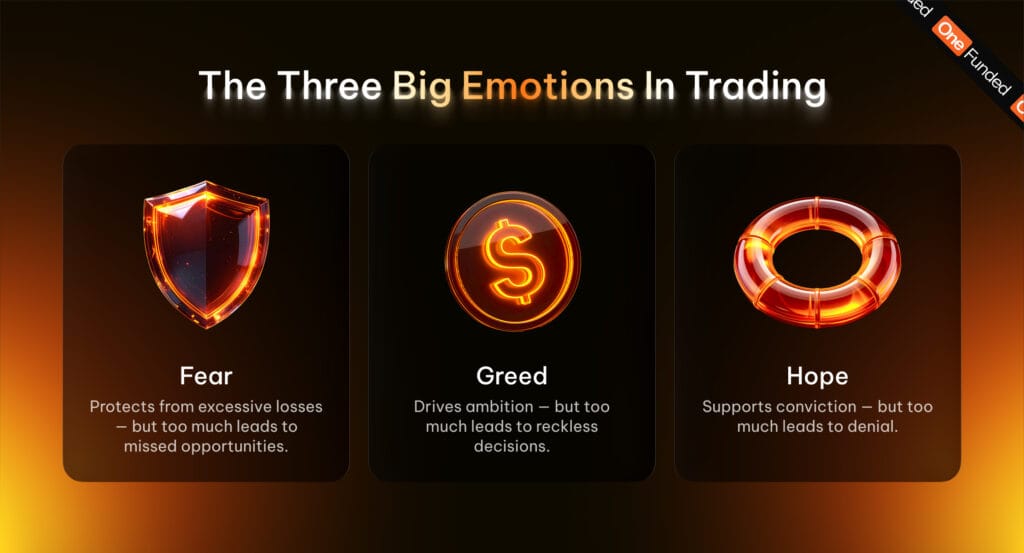
For these reasons, traders cannot afford to ignore the role of psychology in markets and trading, even if it seems less important than hard research and analysis. In studying market psychology, there are three major emotions that can drive both individual trader behavior as well as the herd mentality of markets as a whole: fear, greed, and hope.
In small quantities, fear, greed, and hope are all important for trading success. In larger quantities, however, these emotions can easily lead to destructive behavior. As a result, investors need to keep each of these elements in check, understanding when they may be driving adverse decision-making.
Fear: Balancing Risk Management and Avoidance
Without the fear of losses, investors would have little incentive to practice sound risk management. That includes not only sensible position sizing, but also avoiding opportunities with the potential for big losses. Nonetheless, it’s also easy for fear to swing into complete avoidance of risk.
Ultimately, all successful trading strategies embrace risk in some form – avoiding risk entirely would leave no potential for profits. For traders, fear should serve as a healthy skepticism that motivates sound research and analysis. When irrational levels of fear take the driver’s seat, such as during a market sell-off, traders may find themselves missing out on potentially lucrative opportunities.
Greed: Balancing Ambition and Recklessness
The word ‘greed’ is often viewed in a purely negative light. But the fact is, without a desire for material gain, traders would have little incentive to play the markets and identify profitable opportunities. A healthy level of greed drives ambition and the desire for trading success.
On the other hand, it’s also possible for investors to swing too far toward greed and become reckless in the process. For example, a trader might seize on any opportunity with the potential for huge gains, ignoring the risks of substantial losses in the process. Like fear, the right dose of greed provides a trader with the motivation for profits and success without making them careless about risking capital.
Hope: Balancing Conviction and Denial
Traders will likely be familiar with the concept of greed and fear as the main emotional forces behind financial markets. The role of hope, however, is not always well understood. Hope should be viewed as the link between fear and greed, determining which of the two is most important at any given time.
For example, suppose that a trader takes a long position based on a reliable technical set-up – an action clearly motivated by greed. If the position begins to turn against the trader, however, they may lose hope in their thesis, allowing fear to take over. On the other hand, when things seem bleak and fear has taken over, hope provides the motivation for traders to potentially turn bearishness into bullishness.
Like fear and greed, hope has a healthy medium. It’s important for traders to have conviction in their views and stick with strong trades despite short-term setbacks or volatility. At the same time, it’s also easy for hope to turn into outright denial that an initial thesis was wrong. Although traders should be mindful of their emotions quickly flipping between fear and greed, they should also be cautious about the opposite: blindly sticking to bullishness or bearishness regardless of new evidence.
The Big Three Market Emotions and Their Practical Consequences
| Emotion | Fear | Greed | Hope |
| Potential Positive Consequences | Sound risk management, strong stop-loss discipline, adequate position sizing, and taking gains when appropriate. | Drives ambition to find profitable opportunities, conduct sophisticated research and analysis, and pushes traders to maximize profits on their positions. | Allows traders to weather short-term volatility, maintain conviction in well-reasoned theses, and avoid being driven out of positions prematurely. |
| Potential Negative Consequences | Paralysis by analysis, premature exits on winning trades, missing potentially lucrative opportunities, and avoidance of risk-taking altogether. | Can result in overtrading, oversized positions, chasing losses, or holding winners too long in expectation of ever-increasing gains. | Can cause traders to hold losing positions too long, ignore deteriorating fundamentals, average down into failing trades, or refuse to accept when a thesis is simply wrong. |
These three emotions serve as the driving forces behind much of investor and trader behavior in financial markets. Think of them as guiding currents that can shape an individual’s decision-making and overall experience in markets. But in addition to these general mental states, there are also specific psychological quirks that can impact trading behavior as well, a subject we turn to below.
Behavioral Finance: The Role of Heuristics and Biases
In recent years, academic research has uncovered specific cognitive distortions that can impact a trader’s decision-making and lead them to miss out on potentially profitable opportunities. These errors, commonly known as ‘heuristics and biases,’ are studied by the rapidly developing field of behavioral finance. Although traditional financial and economic models posit that traders and investors are fundamentally rational, behavioral finance has strongly challenged that assumption through psychological experiments.
These mental distortions are important to understand since they can strongly affect trading decisions. In the context of trading psychology, we can view emotions like fear, greed, and hope as the general mental ‘weather’ that colors a trader’s outlook at any given moment. In contrast, heuristics and biases form the specific mental ‘wiring’ that helps determine how those emotions translate into actual decisions.
Importantly, much of this wiring can cause traders to predictably and systematically deviate from rational, profit-maximizing behavior. Although there are many such biases for traders to be aware of, the three most important are loss aversion, uncertainty aversion, and recency bias.
Loss Aversion: The Asymmetric Psychology of Gains and Losses
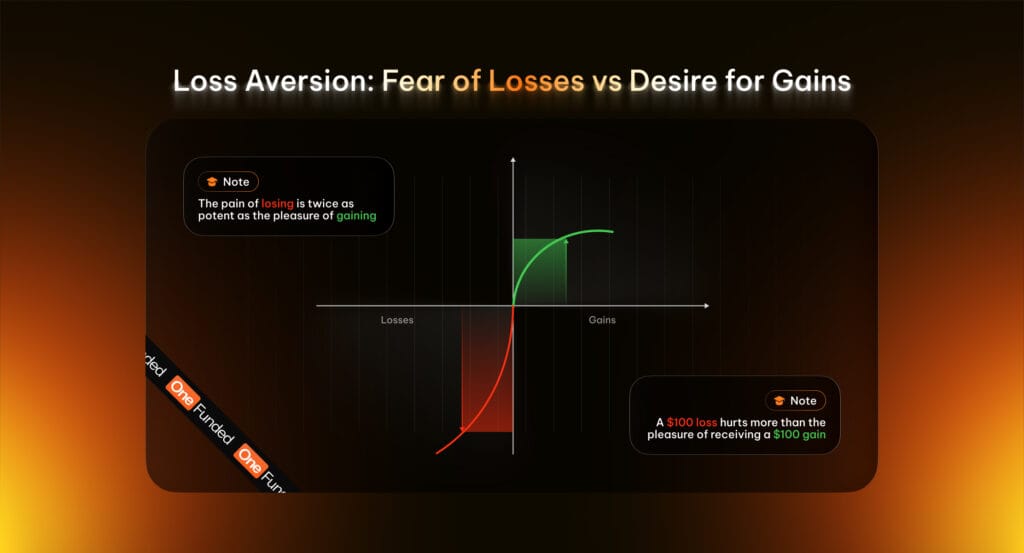
To state the obvious, every trader would like to avoid losses. Loss aversion, however, refers to the human tendency to fear losses to a potentially irrational level. Research indicates that people generally fear losing money about twice as much as they desire to gain an equivalent amount of money. In other words, it can take the potential for a $200 gain in order to offset just a $100 loss.
For traders, the reason that loss aversion can be so damaging should be clear – traders suffering from elevated loss aversion may overlook potentially profitable opportunities. For instance, a trade offering a 50% chance of gaining $400 and a 50% chance of losing $200 is almost certainly worth it from an expected value perspective (with an EV of +$100). However, loss aversion may cause traders to avoid this deal and miss out on potential gains.
Of course, some level of loss aversion can be healthy. Even a trade with positive expected value might not be worth it if it could lead a trader to go bankrupt or lose access to a funded account. Nonetheless, traders should be careful about understanding when they are avoiding trades due to a rational judgement or irrational loss aversion.
Uncertainty Aversion: The Hidden Cost of Waiting for Certainty
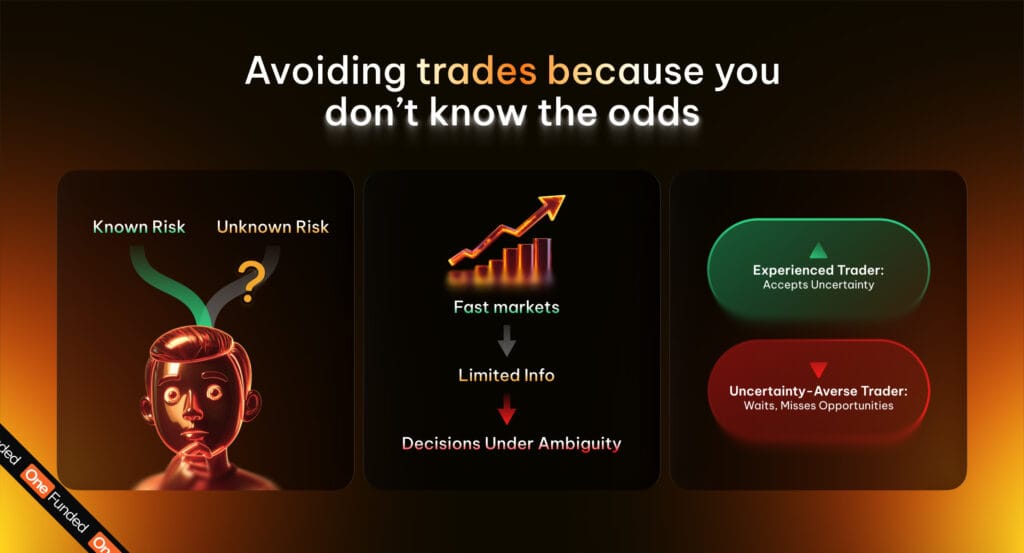
Uncertainty aversion is closely related to loss aversion. However, the two cognitive biases are fundamentally distinct, and each can mislead traders in its own way. Loss aversion is about avoiding a bet because losing feels worse than winning feels good, while uncertainty aversion is about avoiding a bet simply because you don’t know the odds.
That distinction might seem academic, but it’s quite important in terms of trader decision-making. When executing an opportunity, traders rarely have access to all the information that they would like – in fast-moving markets, decisions need to be made in ambiguous and complex circumstances. As a result, it’s often impossible for traders to feel fully confident about the probabilities of potential success and failure.
Uncertainty aversion isn’t something that can necessarily be solved through calculation. Instead, it takes practical judgment and market experience, as well as a continued acceptance that perfect information is impossible. Over time, the best traders learn to be comfortable with uncertainty.
Recency Bias: How Short-Term Memory Undermines Long-Term Strategy
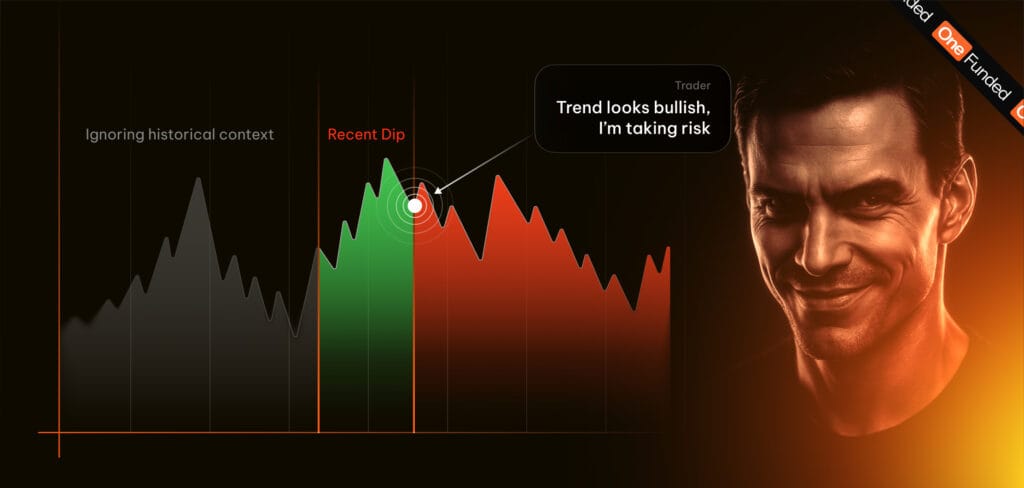
Finally, recency bias is the last major cognitive distortion that traders need to understand. This bias refers to the human tendency to attach more importance to events that occurred in the recent past than to events that occurred in the distant past. Like other cognitive biases, there’s some logic to this distortion – after all, information can certainly become stale over time and therefore less valuable from a trading perspective.
But at the same time, traders typically show a strong tendency to focus too much on recent movements and fresh data simply because they’re easier to recall in memory. For instance, a trader might sell out their entire long position in a stock simply because it had a recent dip, despite their long-term thesis still being sound. Alternatively, a trader could ignore risks in a key market just because the recent trend has been highly bullish.
In either case, the fundamental flaw is the same: traders are focusing too strongly on recent information rather than taking in the entire historical context based on all available data. This recency bias can create an unfortunate tendency toward impulsivity and quick reactions, which can undermine long-term profitability.
Other Heuristics and Biases Worth Understanding
For most traders, loss aversion, uncertainty aversion, and recency bias are some of the most impactful cognitive distortions uncovered by behavioral finance researchers. However, the field has also uncovered a host of other heuristics and biases that can be worth understanding. These include:
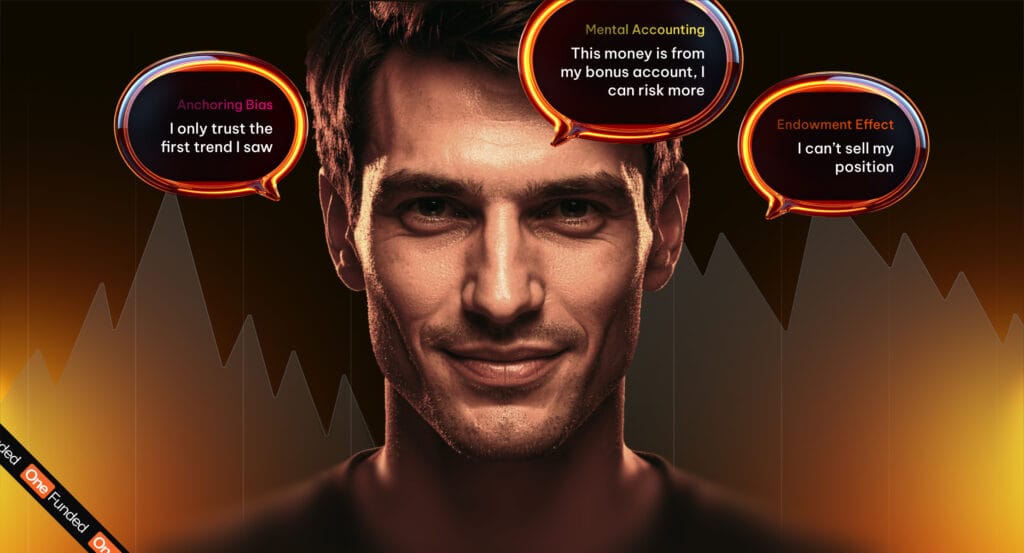
- Anchoring Bias. Traders often unconsciously attach special importance to the first piece of information that they find when researching a trade. For example, if a trader sees that a stock has a steadily rising moving average on strong volume, they might ‘anchor’ strongly on this bullish information. That can make it hard for subsequent bearish analysis to unseat the trader’s first impression.
- Endowment Effect. Traders typically attach more value to an asset simply because they already own it. This can lead to irrational behavior. A trader might refuse to sell a position at its current market price, even though they would never consider buying the asset at that price if they didn’t already own it.
- Mental Accounting. Mental accounting refers to the habit of treating capital as if it belongs to separate ‘accounts,’ even if the actual money is entirely fungible. This compartmentalization can lead to inconsistent risk management, since a dollar lost from one mental account has the same real-world impact as a dollar lost from any other. Mental accounting is closely related to the ‘house money effect,’ a subject we’ll turn to shortly.
These behaviors reflect consistent human patterns across a wide range of geographies and cultures, so it’s unlikely that traders will be able to avoid such heuristics and biases entirely. Nonetheless, being aware of their existence is the first step toward managing such distortions. And for prop traders, that awareness is particularly important, since funded accounts come with some uniquely challenging psychological aspects.
Prop Trading Psychology: Market Mindset for Funded Traders
Although all traders need to navigate market psychology, prop traders often have to deal with a particular set of challenges. For most retail traders, their trading capital is entirely made up of their own personal financial resources. But that’s not true for prop traders with a funded account, who trade the capital of the financial firm that they work with.
At first glance, trading ‘other people’s money’ might seem to nullify many of the emotional challenges associated with trading. After all, traders may not struggle as much with factors like loss aversion when it’s not their own money that they’re losing. But as we’ll see, while prop accounts mitigate some psychological elements of trading, they also emphasize others.
Challenge #1: Performance Under Pressure
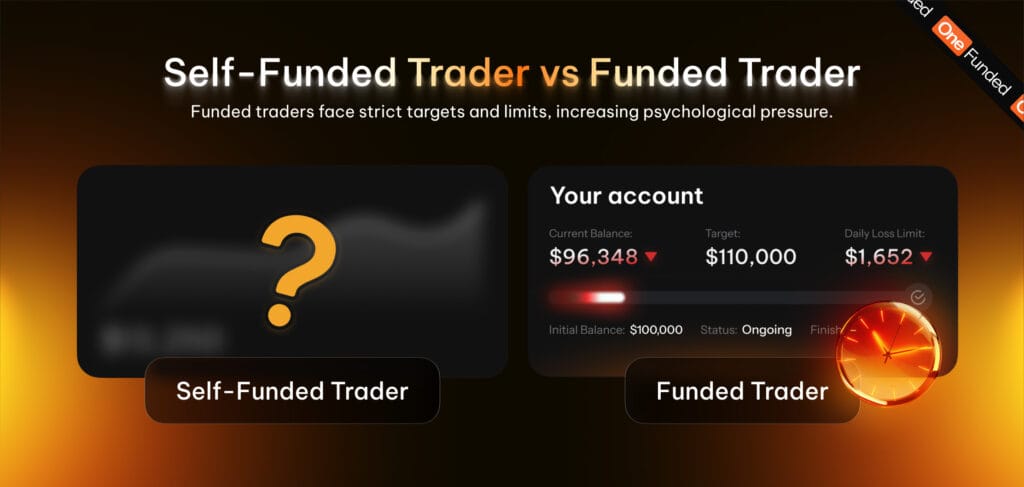
For traders using their own capital, there are often few externally imposed deadlines or limits. These traders get to set their own profit targets and maximum acceptable losses, rather than having a structure determined for them. But for traders looking to unlock and maintain a funded account, that’s not the case.
In fact, prop firms typically set strict risk limits and profit goals during the ‘evaluation phase,’ and often maintain a similar structure into a trader’s ‘maintenance phase.’ Violating limits or failing to achieve goals during either phase can lead to missing out on the opportunity to unlock a funded account or losing access to it entirely. Therefore, prop trading can have greater psychological pressure than self-funded trading.
The distinction is similar to an athlete playing in a practice scrimmage versus a real-world match in front of fans, coaches, and teammates. While each situation involves playing the same game, one has far greater pressure than the other. And just like an athlete, prop traders need to ensure that they’ve developed sufficient confidence in their skills to perform when it matters most.
Challenge #2: House Money Phenomenon
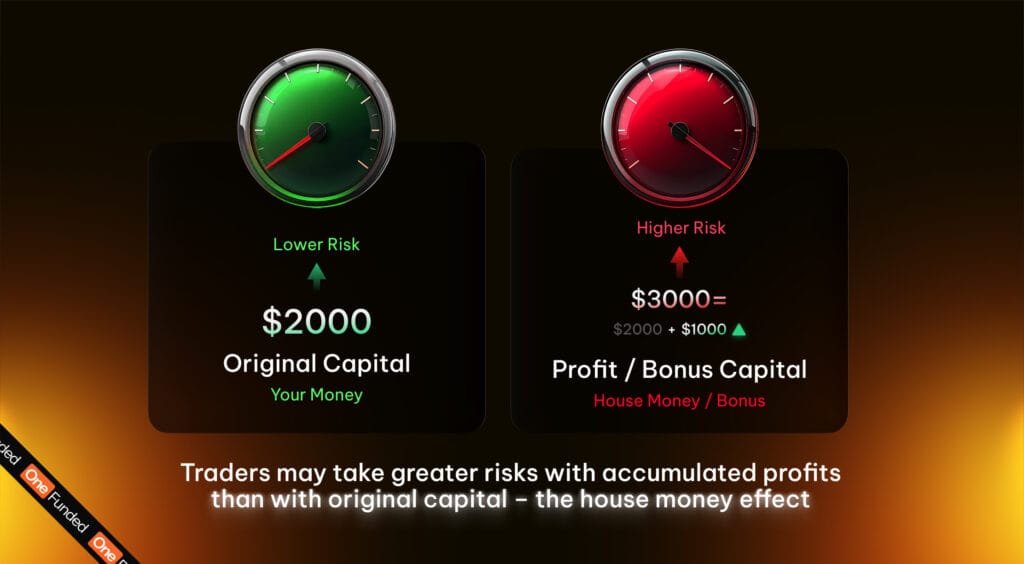
To understand the concept of house money, imagine a gambler who enters a casino with $2,000 in their pocket at the start of the night. After a lucky big win, their bankroll quickly swells to $3,000. Psychologically, this extra $1,000 might be viewed as a nice bonus, rather than part of a trader’s original hard-earned capital. As such, the gambler could be induced to take greater risks with that $1,000 than they otherwise would.
This specific psychological quirk is known as the ‘house money effect.’ It can occur whenever a trader views one part of their bankroll as their true capital that they don’t want to lose, and another part as bonus capital that they can trade more aggressively. This phenomenon commonly manifests as traders willing to take greater risks with accumulated profits than they are with their original capital investment.
In the context of prop trading, it’s possible for a trader to see their entire prop account as simply ‘house money.’ Again, this can actually be a positive to the extent that it allows a trader to overcome loss aversion or uncertainty aversion. The problem, however, occurs when the pendulum swings too far in the other direction – traders may be willing to take far greater risks with prop money simply because they don’t perceive losses on house money the same way.
Ultimately, the house money effect can undermine sound risk management. A trader who undervalues prop capital may ignore position limits, chase losses, or double down on failing trades. The key is recognizing that all capital – whether personal or allocated by a firm – carries real consequences when lost. Successful traders learn to treat every dollar in their account with the same discipline, regardless of its origin.
Challenge #3: Imposter Syndrome
Finally, there’s a subtle but important emotional challenge that new prop traders often need to overcome: imposter syndrome. This psychological phenomenon occurs whenever a trader feels that they have somehow faked their way into a funded account, fearing that they’ll eventually be uncovered as not a ‘real’ trader. Imposter syndrome is widely reported in fields like education, business, and investing, but can have particularly detrimental impacts in trading.
Traders struggling with imposter syndrome may lack confidence in their own judgments or make trading decisions from a place of fear. Ultimately, that can lead to a failure to achieve profit targets or trust one’s own analysis, even if a trader has achieved past success. In navigating imposter syndrome, it’s important to remember that there’s no single model of a successful trader.
If you’ve earned a funded account, it’s because you demonstrated the skills and discipline required to get there. Confidence comes from consistent execution, not from an arbitrary standard or set of credentials. Every trader, no matter how experienced, started somewhere – and many have faced these same doubts along the way.
The Three Biggest Psychological Challenges for Prop Traders
| Challenge | Performance Under Pressure | House Money Phenomenon | Imposter Syndrome |
| What is it? | The pressure to achieve profit targets while abiding by strict risk limits can contribute to nerves and performance anxiety. | The feeling that a prop trader’s funded account is ‘house money’ since it’s not personal capital, which can contribute to a willingness to take greater risks. | The fear that a prop trader will be uncovered as a fake or a fraud, and that a trader only unlocked their funded account through deception. |
| What can the negative impacts be? | Hesitation, second-guessing, or impulsive decisions driven by anxiety rather than analysis. Traders may exit winning trades too early or even freeze during key moments, such as a major sell-off. | Poor risk management, oversized positions, and reckless trading behavior. Losses may be dismissed as inconsequential, leading to lost prop accounts and bad trading habits. | Lack of confidence in one’s own analysis, reluctance to pull the trigger on valid setups, and a tendency to abandon proven strategies at the first sign of difficulty. |
| How to overcome it? | Establish a consistent routine, develop trust in trading strategies, and practice stress management techniques. Start with smaller position sizes to build confidence gradually. | Treat all capital with equal respect. Remind yourself that losses carry real consequences, including losing your account and damaging your trading record. | Recognize that earning a funded account is evidence of skill, not luck. Focus on your track record, keep a trading journal to document your progress, and accept that some level of self-doubt is normal. |
Trading Psychology Tips: The Role of Regulation, Research, and Planning
So far, we’ve looked at which emotions drive trading psychology, how cognitive distortions influence decision-making, and why prop traders can face particular emotional challenges in the markets. Now, we’ll turn to the practical elements of building an effective mindset to tackle markets successfully. While emotions will always be a part of human decision-making, traders can learn to build a robust, effective, and confident mental state to ensure that their emotions are a positive tool for trading performance, not a hindrance that holds them back.
Emotional Regulation: Keeping Fear, Greed, and Hope in Check
Ironically, while a trader’s mental state can have a profound impact on their trading psychology and profitability potential, effective emotional regulation is best developed outside the marketplace. For example, proper diet, exercise, and lifestyle habits all form the basis of a robust psychological outlook in any endeavor. Although providing specific guidance on these areas is beyond the scope of this article, habits like healthy eating and regular exercise, as well as tools like meditation and journaling, can help traders develop a better capacity to keep emotions in check.
Through this emotional regulation, traders can find the happy medium between fear, greed, and hope that powers market performance. However, this emotional regulation can be easily disrupted during periods of market success or failure. To prevent this, traders should keep three key psychological tips in mind during the trading day:
- Losses are normal – don’t take them personally. It’s easy for traders to let a string of losses affect them emotionally. However, losses are simply a part of doing business in the marketplace. While a string of higher-than-expected losses may cause a trader to revisit their market strategy, it’s important to remember that small losses are often necessary for traders to achieve big wins – no trade is foolproof, after all.
- Stay humble during winning streaks – don’t overtrade. During a hot streak of multiple profitable trades, it can be tempting to double down by deviating from your trading plan with more trades and higher position sizes. However, this can easily lead to overtrading and the potential for big losses if things turn against you. As a result, staying humble during hot streaks is key to regulating greed.
- It’s okay to have a bad day – take a step back. Like any other profession, it’s normal for traders to simply have a bad day. These are days when no trades seem to be working well, leading to growing frustration. The danger in this scenario is to keep trying to trade when things clearly aren’t working, potentially leading to big blow-ups as emotions flare. On bad days, it’s often much better to take a step back, let your emotions cool, and try again tomorrow.
Research: Behavioral Finance and Trading Psychology Books
Above, we looked at the hard – but important – work of emotional regulation. While building good habits is essential, sometimes, simply being aware of a flaw in one’s own thinking is enough to address it. That makes it key for traders to have a basic understanding of the field of behavioral finance, as well as trading psychology more broadly.
Researching heuristics and biases does not need to mean digging through tomes of dense academic text. In fact, many of the major findings of this field are condensed into a few key books, including: Thinking, Fast and Slow by Daniel Kahneman, Misbehaving: The Making of Behavioral Economics by Richard Thaler, and Predictably Irrational by Dan Ariely. Meanwhile, books like Trading in the Zone by Mark Douglas and Best Loser Wins by Tom Hougaard are valuable for a more general introduction to trading psychology.
Reading these behavioral finance and trading psychology books can help a trader begin to understand the psychological quirks and shortcuts that may impact their own decision-making. In turn, traders can stop and pause before they make a major trading decision to ensure that it’s based on rational research and analysis, not a misleading cognitive distortion such as loss aversion or the anchoring bias.
Creating a Plan: Cutting Through Uncertainty
As deceptively complex and fundamentally uncertain environments, markets can be emotionally overwhelming. To cut through this noise and maintain psychological resilience, an effective trading plan is essential. A plan can offer a clear path through the fog of uncertainty in the markets, providing a valuable sense of direction.
To feel confident in their trading plan, traders should consider elements like:
- A pre-market preparation routine,
- Position sizing and trade frequency,
- Profit targets and risk limits,
- Entry and exit criteria,
- And post-market reflection and journaling.
Importantly, having a plan does not mean that traders need to rigidly stick to an established process. As the market environment evolves, traders should stay nimble and adapt their plan to new situations. However, having a structured framework to approach the market can help traders ensure that they’re making decisions based on intelligent analysis, and not just emotional impulses.
Conclusion: From Psychology to Profit
Discussing trading psychology can be a highly complex subject. That’s because the topic not only covers markets and finances, but also deeply personal elements like emotional health and psychological challenges. As a result, it can be easy for traders to avoid such a challenging topic and pretend that it plays no role in trading success.
But for the traders willing to do the hard work, mastering their market mindset can offer a powerful boost to their trading strategy. Not only can the process allow them to make better decisions, but it can also help them approach their work with greater confidence and drive. That’s especially true for prop traders, since introducing outside capital can fundamentally shift the psychological considerations.
For those who’ve mastered their market mindset and are looking to take their trading to the next level, consider starting a prop trading challenge with OneFunded. With competitive profit splits, refundable challenge fees, and a variety of account sizes, OneFunded gives you the opportunity to trade with substantial capital while keeping more of what you earn. Prove your edge by taking the challenge, turning your trading psychology into real profits.