



How to Trade Forex on a Prop Firm Account: Strategy, Spreads, and Rules

How to trade Forex on a prop firm is similar to taking your friend’s car out for a spin. You drive something you don’t have yourself and even get praises from those who see you blazing past. But no one knows that friend gave you some rules when handing the keys over.
On a prop firm account, these rules are a profit target, a daily loss limit, and a drawdown limit. Go against any of these rules and you lose the keys (AKA your account).
Rules on your prop firm account shape several things. This includes pairs you trade, the time you trade them, and how many active trades you can have at the same time.
We’ll look at all three using OneFunded’s challenge rules as a basis. OneFunded is a prop firm that gives traders access to 40+ currency pairs ranging from the majors to the exotics.
On the OneFunded Core challenge, which is the most popular plan, you need to reach an 8% profit target in phase 1 and 6% in phase 2. You can’t lose over 5% of your balance in a day or 10% overall. Also, you’d need to trade for a minimum of three days.
On the Flash challenge plan, which has a one-step evaluation process, the profit target is set at 10%. But the overall loss limit goes down to 6% overall and 4% daily.
Take a look at the numbers we’ve just highlighted. You’ll see the daily loss limit is lower than the profit target. This means a bad trading day hurts more than one great day. Why? Because the profit target spreads across the duration of the challenge while losses are measured one day at a time.
For example, if you hit a 4% profit on a Monday and lose 5% the next day, you won’t break even. And if you’re on the Flash plan, this loss means you’ve lost your account. This is a major reason why costs matter so much more on a funded account instead of the regular account that you own.
On a personal account, a wide spread eats away your money. But on a challenge account, it eats away at a loss budget you can never add to. Every pip you waste brings you a step closer to losing your account.
But there’s one rule that favors you if you’ve got a challenge account. That’s the unlimited trading period. There’s no clock tied to OneFunded challenges, so you don’t have to make trades when the market is ugly. When spreads are wide or the market hasn’t opened, you can close your laptop and go about your day.
This is one luxury traders with 30-day deadlines don’t have. However, having a challenge account doesn’t mean you should go AWOL. You need to place a minimum of one trade every 60 days, else you’ll lose the account.
OneFunded is the spot where you can trade every major market. Here, you can trade more than 40 forex currency pairs divided into three distinct groups:
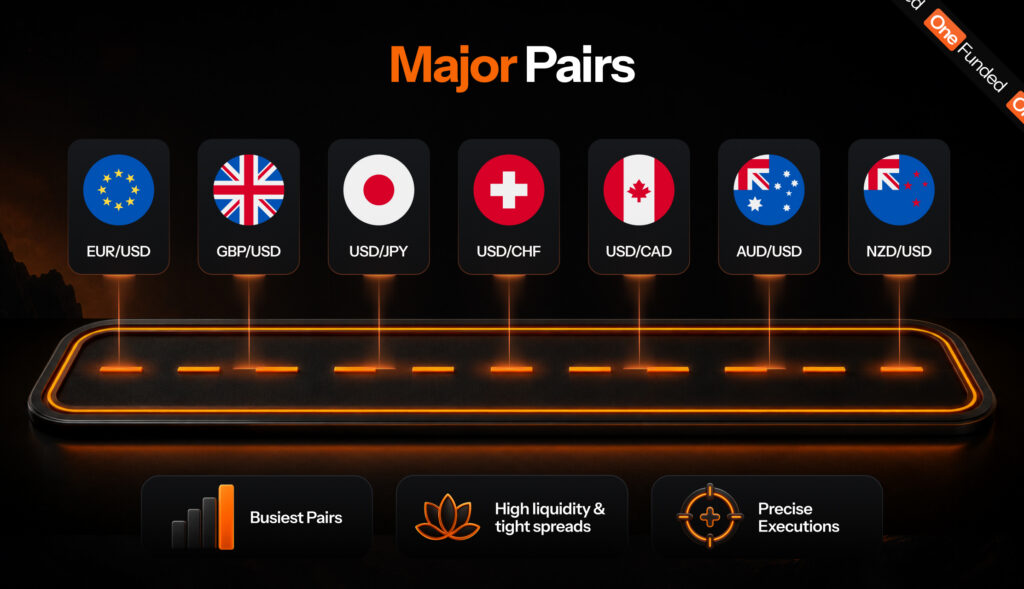
The 7 major pairs include: EUR/USD, GBP/USD, USD/JPY, USD/CHF, USD/CAD, AUD/USD, and NZD/USD. These pairs are the busiest on the market. They’ve got huge trade volume, and that results in tight spreads and stop losses that go very close to where you placed them.
Think of a spread as the toll booth you pay money at every time you go into a trade. During business hours in London, the toll on the EUR/USD is small and can come in at 0.2 to 0.4 pips. On the other hand, on an exotic pair like USD/TRY, tolls can rise to hit 30 pips or higher. Here’s why this comparison matters.
Let’s say the trade you place risks 25 pips. On the EUR/USD pair, the toll fee eats into 2% (or less) of your total risk. But on a USD/TRY pair, the toll you pay is bigger than the risk you’re taking. Thus, you’re losing before the trade kicks off.
So, what does OneFunded charge for every trade? It charges you for the spread without marking up anything. You’ll also need to pay a $4 fee for every trade lot. The $4 charge stays the same, regardless of what pair you’re trading. However, the spread isn’t fixed and will only fall on busy pairs during business hours.
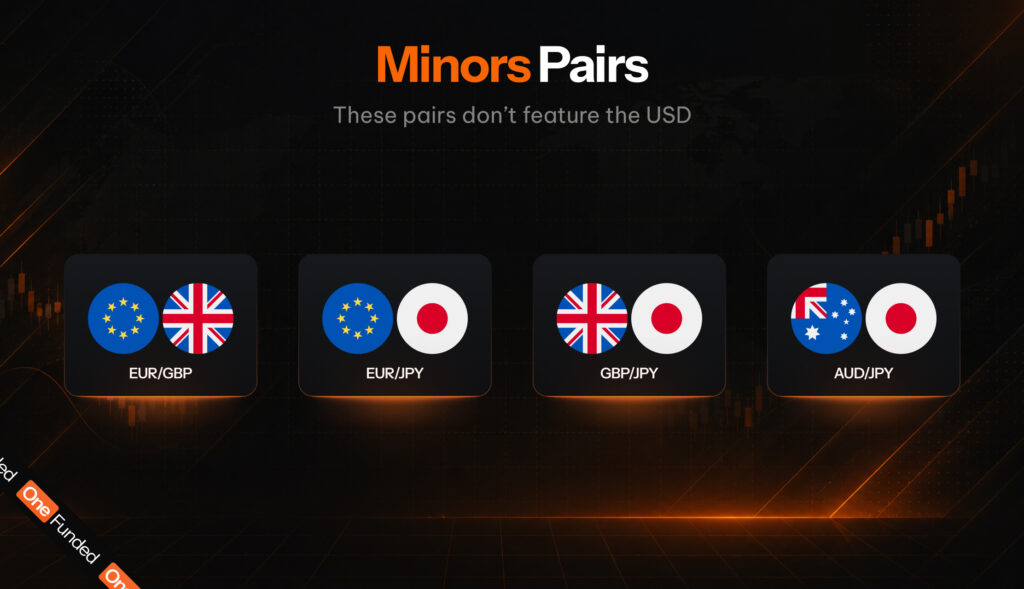
These pairs don’t feature the USD. Minors include EUR/GBP, EUR/JPY, GBP/JPY, and AUD/JPY.
The tolls on minors are higher than what you’d find on the majors. Pairs like the GBP/JPY are like a powerbike: fast and twitchy. And most of the time, it needs a stop two or three times wider than the EUR/USD on a similar setup.
A wider stop here means you get a smaller position if you’re looking for the same dollar risk. Forget to shrink your lot size, and one loss can see you go past your daily loss limit.

How to trade Forex on a prop firm also means knowing which currency pairs can put your challenge account at greater risk. They’re trending forex pairs: USD/ZAR, USD/MXN, and USD/TRY. Albeit popular, note that they’ve got three features that make them quicksand for OneFunded challenge accounts.
The first is the toll that can spread up to 50 times wider than EUR/USD. Exotics also have big interest rate gaps, so holding them all night can set you up for serious swap fees.
Lastly, exotics are tagged quicksand pairs because of the jumps. They can rise and fall all of a sudden due to local political news. And when this happens on your active USD/TRY pair, it can zoom past your daily loss limit.
But there’s a filter that can protect you from the negativity attached to exotic pairs. If you find a pair’s usual spread to be more than 10% of your typical stopping distance, avoid it completely.
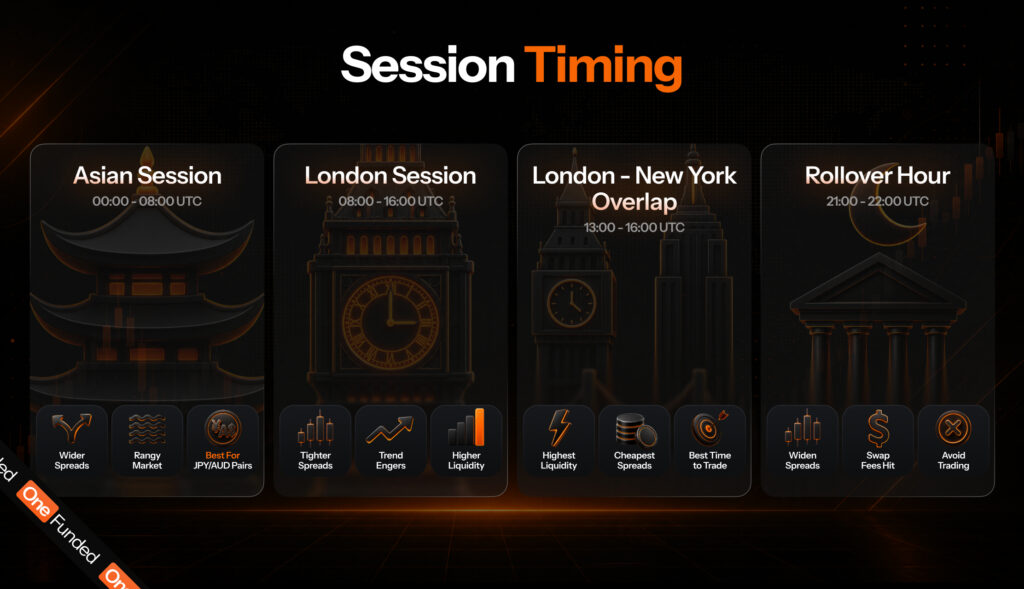
The forex market is active from Sunday evening all the way to Friday evening. But it isn’t the same market throughout the day. Spreads follow the crowd, and the crowd in turn, follows the sun.
Here are some important timelines you must know in the forex trading market:
Knowing how to trade Forex on a prop firm also means understanding the situations that can put your challenge at risk. Here are two traps most traders unknowingly fall into when their OneFunded challenge account is active:
This is one error even the most careful of traders make.
Here’s an example.
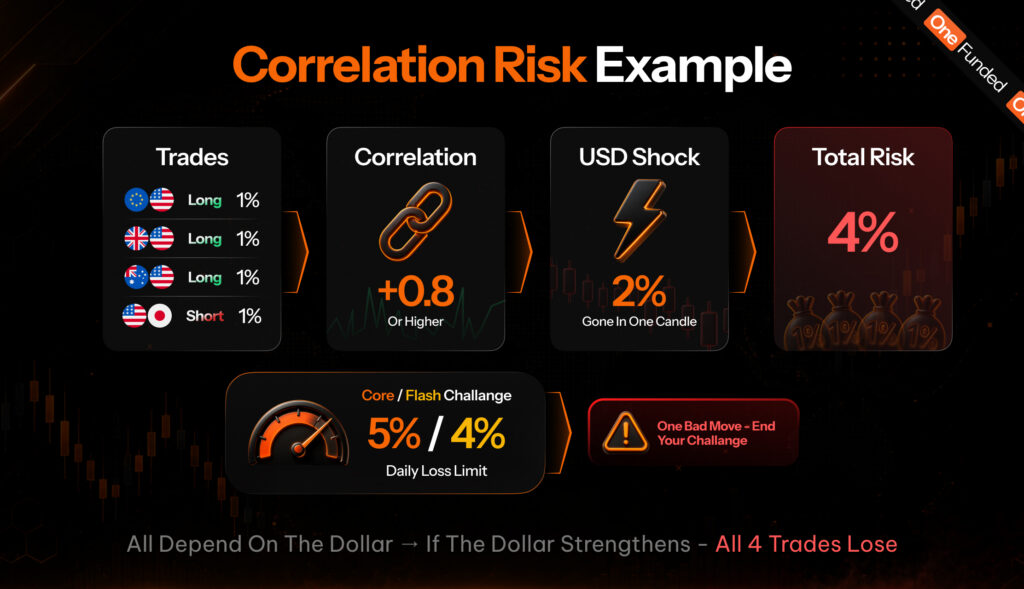
A trader risks 1% on EUR/USD long and another 1% on GBP/USD long. They think they’ve placed two unique trades on the market. But the reality is they didn’t; they just made the same play on a horse with two different colours.
Why? These pairs move in the same direction, and correlation is usually higher than +0.8% due to the fact the USD is on the same side of both pairs. A sudden US inflation print will result in two stops, one candle, and 2% gone.
More trades make it worse. Let’s say you make four trades: long EUR/USD, long GBP/USD, long AUD/USD, and short USD/JPY.
All four trades can only win if the dollar falls, so it’s a huge bet. If the dollar comes back up, they’ll all become losing trades. At 1% risk on each trade, you’ll lose 4%. This loss sits at the doorsteps of the 5% Core challenge daily loss limit and all of the Flash’s 4%.
But three habits can fix all these:
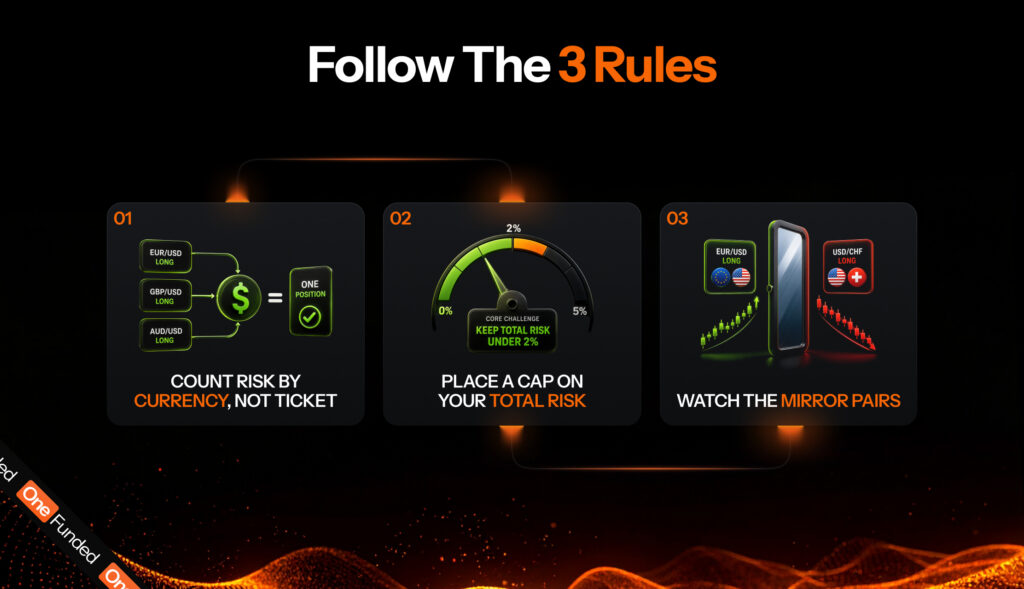
NOTE: For more information on the full sizing framework you can use for your forex trading, read our article on risk management for prop trading.
Numbers make things real. Meet a trader who just got a $50,000 Core challenge account. To get it, they spent $259.
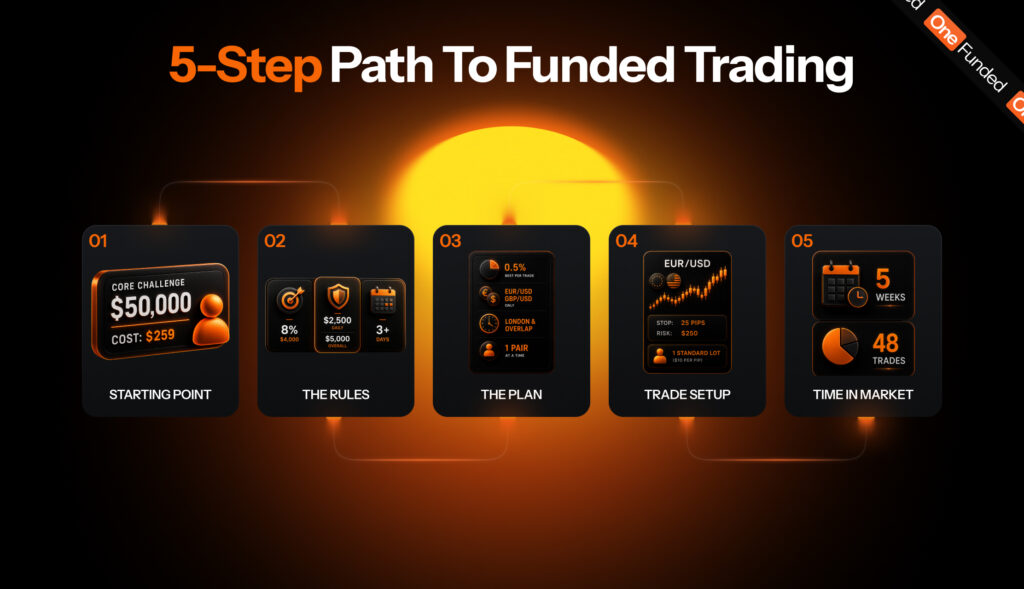
This trader doesn’t want to lose their account soon. As such, they set some ground rules. This includes making $4,000 in profit to move past phase one, not making losses that go over $2,500 daily (and $5,000 overall), and trading for at least three days.
Their plan looks boring, but in forex trading, that’s a huge compliment. Learning how to trade Forex on a prop firm is often less about finding exciting setups and more about following a consistent plan.
They go ahead to risk about 0.5% per trade. On this Core account, that’s $250. They trade EUR/USD and GBP/USD only, and they do this during London hours and the overlap. This trader doesn’t hold two pairs at the same time as they know they’re two sides of one coin. That said, their usual stop on the EUR/USD pair is set at 25 pips. And to risk $250 over this number of pips, they trade a one standard lot where each pip is valued at $10.
It’s now been five weeks since they got their Core account. Within this time, they’ve taken 48 trades; they only trade when the market looks right, all thanks to OneFunded’s unlimited clock rule on challenge accounts.
Out of the 48 trades placed, they won 22 trades. Each win pays out two times their risk, meaning they get back $500. The 26 trades they lost saw them lose $250 on each. If you add the numbers, you’d see that this trader got profits totalling $11,000 and losses summing up to $6,500. This is a net profit of $4,500.
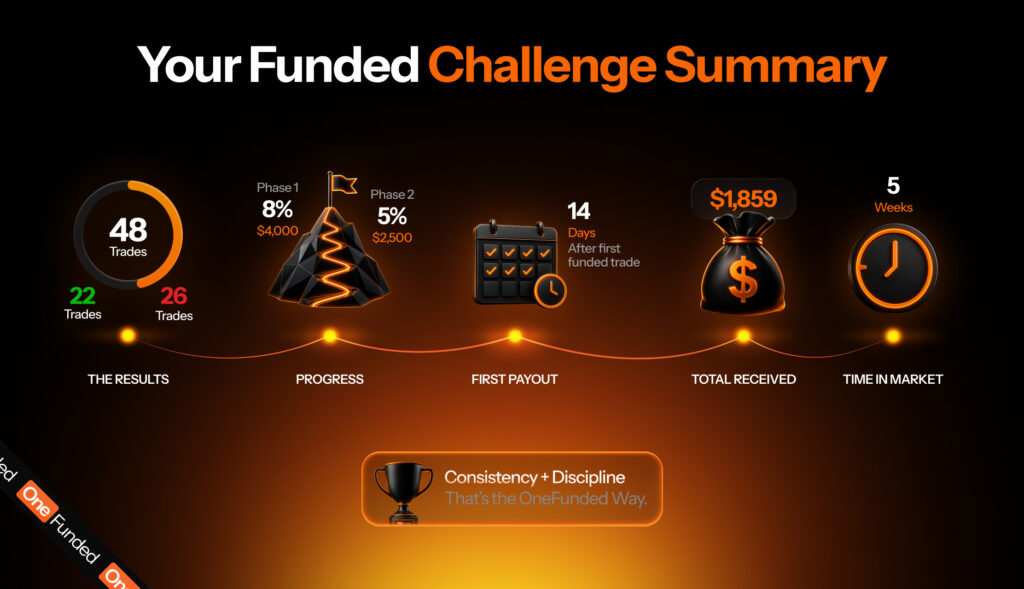
This profit margin means they’ve completed phase one. They lost $750 on their worst day, which is nowhere near the $2,500 daily loss target. As they unlock phase two, they’d need to hit a profit mark of 5%, and if they can replicate what they did in phase one, they’ll clear this level as well.
We’ve come to the part everyone’s waiting for. 14 days after their first funded trade, they make a profit of $2,000. They’re elated and request a withdrawal. At an 80% split, they’d get $1,600. They’ll also get the $259 they used in buying the Core challenge plan back.
What they get in total is $1,859 for a few weeks of intense work. This is testament to their consistency, as only traders who treat their challenge accounts as a job will succeed.
NOTE: Creating a plan that helps you to manage a challenge account on OneFunded to maturity isn’t something you can do half-heartedly. To get the full scope, read our guide on building a trading plan for a prop firm challenge.
You’ve learned how to trade forex prop firm? Congratulations. But to make decent returns on your trades, ask yourself the following questions before locking in a position:
By answering these questions, you can spot errors before they occur and breach your challenge account’s rules.


Join our mailing list today!
The best forex pairs for prop trading include big pairs such as the EUR/USD. This is because they’re safer with predictable sessions and have the smallest spreads.
On OneFunded, you can make trades during news. But trades placed 5 minutes before and 5 minutes after high-impact news are checked. If the platform finds out that you exploited these reports, they can disable your account.
They're at their lowest during the London and New York overlap which starts at 13:00 up to 16:00 UTC.
The platform you trade at logs them as two tickets. Both pairs follow the USD, though, and a bad run on this currency will hit both at once and double your drawdown risk.
Yes. Doing this will trigger swap fees that are based on the currency interest rates differences. These charges can rise fast on exotic pairs and can eat into the profits you've made on your challenge account as time goes on.

Each day, trillions of dollars in value change hands in global financial markets. But while individual investors and traders account...

If you’ve been trading long enough, you’ve likely experienced a familiar scenario: markets that were calm and placid suddenly experience...

In theory, there are thousands of potential forex currency pairs to trade, driven by the huge number of global currencies....
 Set Preferred on Google