

Crypto Prop Firms: How to Trade Crypto on a Funded Account

Crypto moves fast. That’s why Bitcoin can rise or drop significantly in a single day. These moves can make you money, but they can wipe out your capital.
Crypto prop firms give you another route to trade these tokens. You’re not putting all your capital on the line. Rather, you’re using the firm’s account. If you want to take this path, you must pass a test first. And if you do, you’d get a crypto funded account. When you make a profit on this account type, most of it is yours.
This guide will show you everything you need to know about crypto prop trading and how it differs from trading on an exchange. It’ll also showcase the T&Cs you must follow, using OneFunded’s rules as examples.
A crypto prop firm allows you to trade cryptocurrencies via its account instead of yours. In case you didn’t know, the long form of “prop” is “proprietary.” That’s just the fancy term for “the firm’s own.”
Here are the steps you’d need to take if you want to trade crypto with a prop firm:
At OneFunded, the funded trading account isn’t made up of real money but virtual cash. It follows market prices in real time.
You can fail the challenge if you breach rules. And if that happens, you lose your fee, not your entire capital. On OneFunded’s Flash, Core, and Value plans, you’ll get a fee refund alongside your third payout. But this will only happen if you pass.

The major difference between both activities is the money at risk. If you go the exchange route, you have to buy coins using your own money. If the price of the coin you bought drops, you’ll lose money. You get a profit if the reverse happens.
With crypto prop trading, you get to trade the price of a coin with virtual cash in the firm’s account. Coins aren’t yours in this setting, and you’d win if the price moves to wherever you guessed.
| Metric | Crypto Prop Firm (OneFunded) | Crypto Exchange |
| Money Risked | Virtual cash in the firm’s account | Your own capital |
| Most You Can Lose | The challenge fee (starts from $29). | Every dollar that you put in. |
| Size of Account | $5,000 to $200,000 | Whatever you can afford. |
| Leverage on Crypto | 1:2 across all trading platforms. | Set by each exchange. |
| Rules | Daily drawdown limit, maximum overall drawdown, consistency rule, max exposure rule, inactivity rule, news trading rule, overnight/weekend trading rule, EA and trading assistant rules, copy trading rules, and more. | No profit targets or drawdown limits. However, each exchange has terms and conditions that apply. This includes KYC checks, position limits, and liquidation rules. Note that some exchanges may temporarily or permanently ban your account for engaging in certain activity (e.g., hedging). |
| Trading Fees | No commission on crypto trades made on MetaTrader 5 (MT5), cTrader, and TradeLocker. | Set by each exchange. |
| Owning Coins | You don’t own coins; rather, you trade the price of available coins. | You own coins on a spot exchange. |
| Getting Paid | You can request payouts every 14 days (7 days if you purchased the Weekly Payouts Add-on), up to a 90% profit split. | You can request payouts whenever you want. However, note that most crypto exchanges impose a withdrawal fee when you want to make a payout request. This is usually a negligible, flat network charge. |
| Growing Your Account | You can scale your funded account by up to $1,000,000 via its structured scaling plan | Scaling only happens when you add money to your account |
Which is the right fit for you? It depends on your preferences. If you don’t have hundreds or thousands of dollars to pour into a crypto exchange, choose a prop firm. Doing this allows you to trade with a big account without breaking the bank.
But there’s a trade-off with using prop firms. You need to stick to the rules. If you break any, you’ll lose your account.
OneFunded lets users trade cryptocurrency pairs, including BTC/USD and ETH/USD. Each is paired with the US dollar, meaning you’re always trading coin prices in dollars.
But crypto isn’t the only thing you can trade. You can trade other instruments like forex, stocks, indices, and commodities on one account. Many traders mix crypto with one of these financial instruments to diversify their risk.
You can place trades using one of these three trading platforms:
OneFunded lists demo logins for all platforms in its help center. That way, you can see how each platform works before making any purchase.
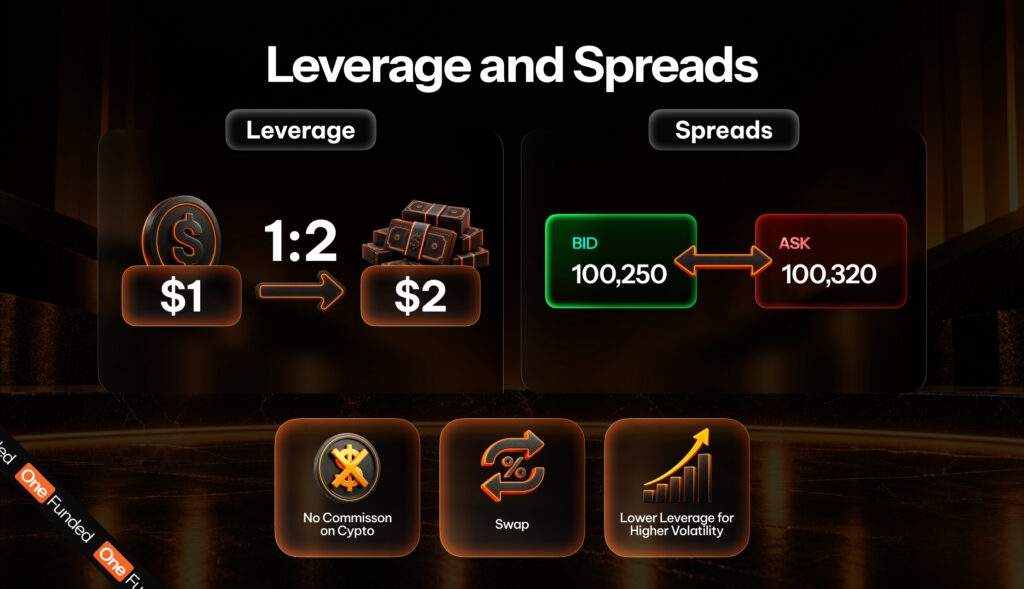
Leverage allows you to trade an amount bigger than what’s in your account. The crypto leverage at OneFunded is 1:2 on all trading platforms. For every $1 in your account, you can trade up to $2 worth of cryptocurrency.
So, if you get started with a $10,000 account, the most crypto you can hold in one go will be $20,000. Just for context, the leverage tied to forex on OneFunded is 1:100.
As you can see, crypto’s leverage is 50x tighter. It’s no mistake. The prop firm does this on purpose. Why? Crypto prices are volatile, meaning they can swing a lot. With lower leverage, one wrong move won’t end your account.
So, what’s a spread? It’s the tiny gap between the buy price and the sell price. You pay for this every time you open a trade. OneFunded’s crypto spreads mirror conditions in real markets, so they can get wider when things get busy.
But there’s good news. You won’t pay crypto trade commissions on OneFunded on TradeLocker, cTrader, or MetaTrader 5.
There’s one more thing you need to know about. If you keep a trade open through the night, you might have to pay a small charge called a swap. But this charge is minimal and won’t empty your account in one swoop.
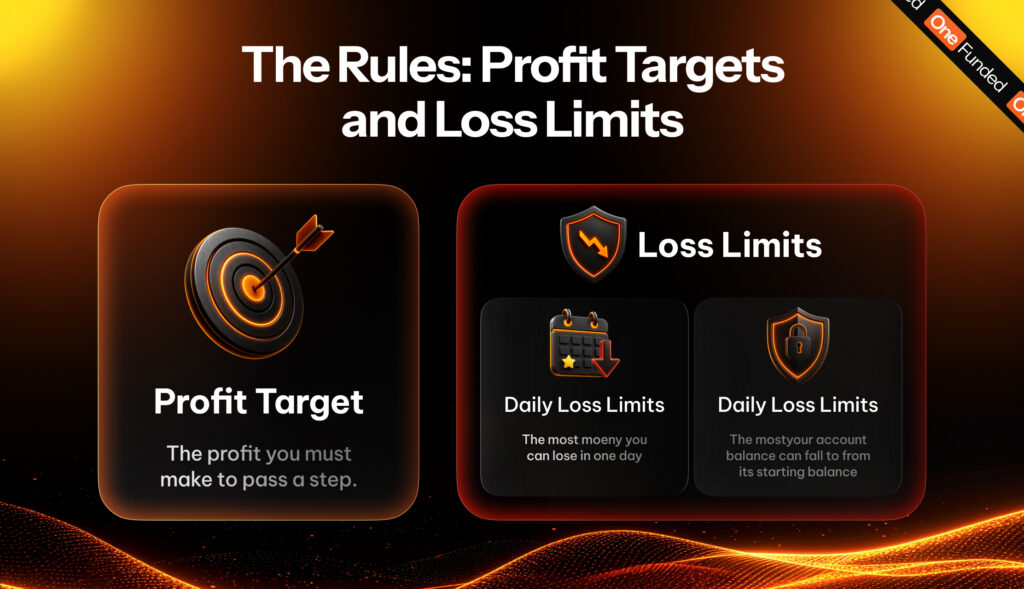
Every challenge at OneFunded has two major rules. One tells you how much you have to make. The other tells you how much you can lose. Here’s their one-liner explanation:
The table below highlights the loss limits and consistency rule on each plan. For profit targets, prices, profit splits, and minimum trading days, read our detailed prop firm rules guide.
| T&C | Flash | Core | Value | Instant |
| Daily Loss Limit | 4% | 5% | 4% | 3% |
| Overall Loss Limit | 6% | 10% | 8% | 6% |
| Consistency Rule | 50% | N/A | N/A | 15% |
Let’s say you buy a $10,000 Core Challenge:
The consistency rule that’s linked to the Flash and Instant plans means that one lucky day shouldn’t make up most of your profit.
OneFunded challenges have no time limits. This rule is great for crypto traders, as they can wait for a great setup rather than making rushed decisions that can breach their accounts eventually.
Volatility and crypto live on the same street. That’s why some tokens move 5% or more in 24 hours. On a crypto funded account, a wild day can see you go past your daily loss limit. That’s why your trade size is super important.
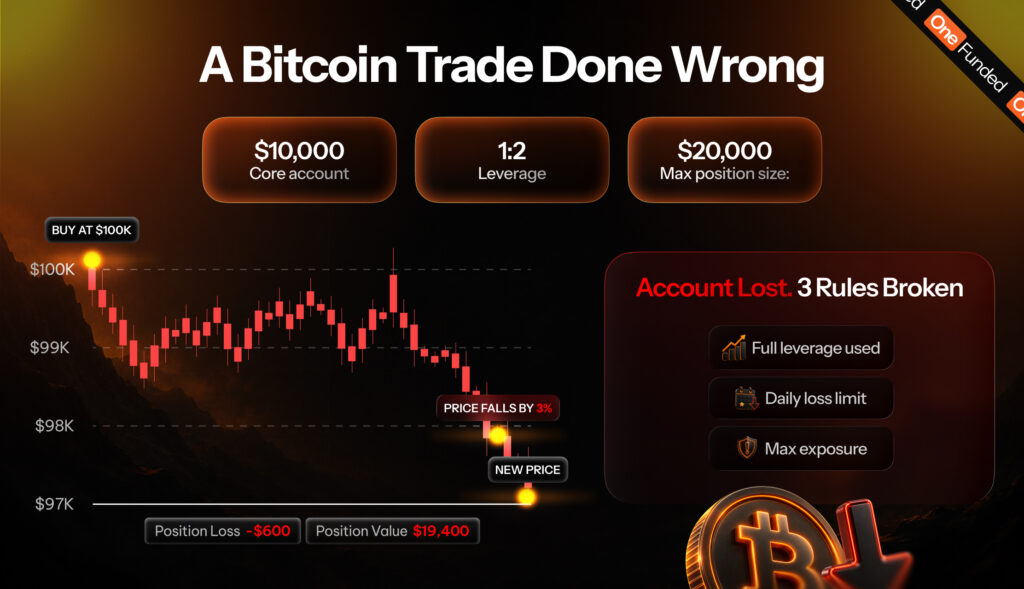
You’ve got a $10,000 Core account. Looking at the rules, you can lose $500 a day without breaching the rules.
Let’s say BTC costs $100,000 when you’re trading. You purchase $20,000 worth of it (0.2 BTC), and you don’t set a stop loss. Just so you know, a stop loss is an order that helps you close your trade if price falls to a level that you select.
Later that day, Bitcoin fell by 3%. It’s now at $97,000 instead of $100,000. Your $20,000 BTC is now $19,400, indicating a $600 loss. That’s $100 more than your daily loss limit; you’ve just broken a rule, so you’ll lose your account.
But this trade breaks another rule before the daily loss limits come into play. A $20,000 trade on a $10,000 account uses up all the leverage (1:2) you’ve got.
According to OneFunded’s max exposure rule, one trade idea can’t be more than 3% of your equity. On this account, that number is $300. With 0.2 BTC, you’ll lose $200 for every $1,000 Bitcoin falls by. So, when Bitcoin falls to $98,500, you’re already down $300. This breaks the max exposure limit way before the $500 daily loss limit.
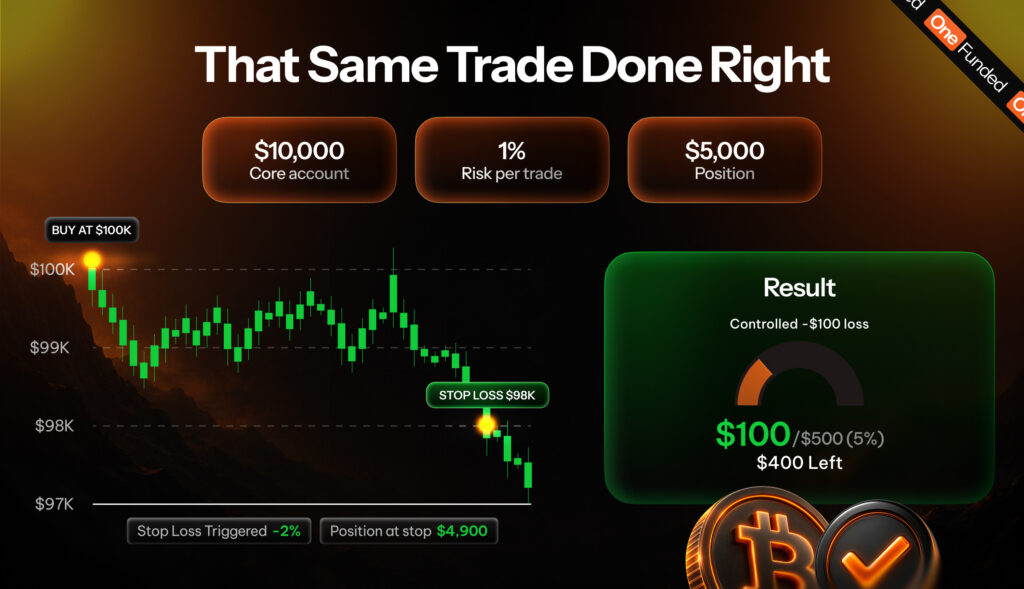
This time around, you plan your loss before making a buy. You risk 1% of your $10,000 Core account, which is $100. Your stop loss is set at $98,000, $2,000 below the coin’s $100,000 price.
This begs the question, how much BTC should you buy? If you bought 1 BTC and the price fell to $98,000, you’d be losing $2,000. This is 20x more than the $100 you wanted to risk. You don’t want this sort of loss. So, you opt for 1/20 of a Bitcoin instead. This is 0.05 BTC that’s valued around $5,000.
If the price falls to $98,000, your stop loss closes that trade automatically. Here, you lose $100, and not $600. You still have $400 left to lose before you hit your plan’s $500 daily loss cap.
The idea is straightforward. Select how much you feel that you can lose without issues. When you figure out that number, size your trade to match.
Forex and gold markets shut down on weekends. But it’s different for crypto, as related markets operate 24 hours a day, 7 days a week.
You can hold trades at OneFunded throughout the night and over the weekend. However, you might need to pay swap fees. And remember, your loss limits will still count during your holding periods.
Jake is a trader from the UK that trades gold most of the time. In his detailed interview, he says he added BTC to his prop trading mix because it continues to move during the weekend, a time when other markets are closed.
Jake had a profit target of 1% to 1.5% per day. After he hits this goal, he leaves the account. This strategy saw him net a $5,217 payout in a week (around $4,100 after the profit split was applied). Jake’s tale shows crypto can fit right next to whatever instrument you’re trading.
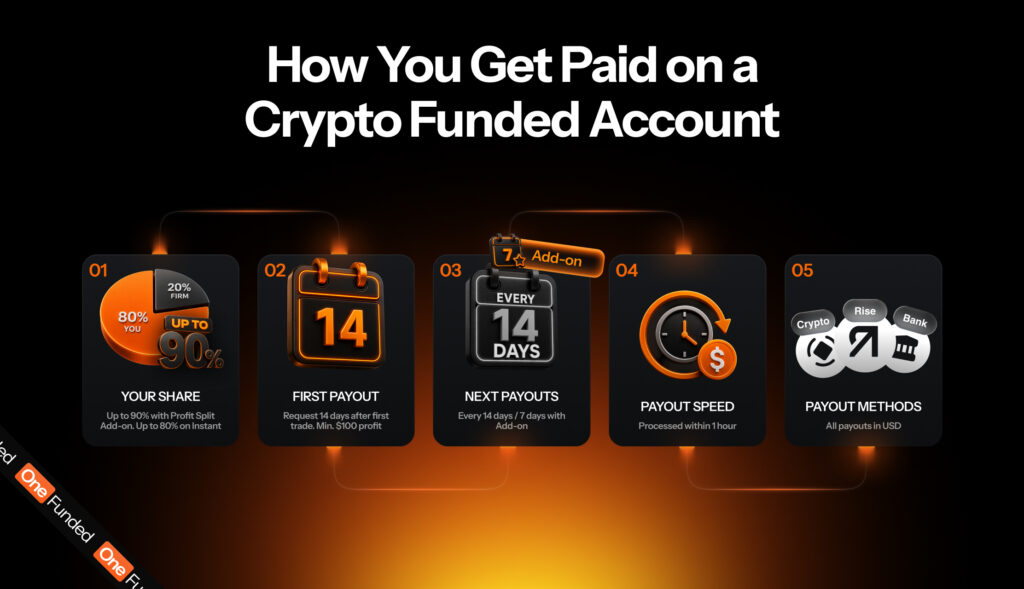
Once you have a crypto funded account, a portion of every profit you make is yours to keep. Here’s how payouts work at OneFunded:
If you can stay profitable for three consecutive payout cycles, with a minimum of 6% profit in every cycle, you can ask for a bigger account. At OneFunded, your account can grow up to a maximum balance of $1,000,000.

Here are three of the most common mistakes that most traders make on prop firm accounts:
Abhishek is a trader from India. He started trading BTC and ETH when the pandemic rolled around. But since crypto swings quicker than forex and he didn’t bother to manage his risk, he lost a lot of money.
In his interview, he said he moved to gold and makes sure that his losses every day don’t go past $100. As it stands, Abhishek has gotten three payouts on OneFunded.
Peter, a trader that started out with crypto, was $50 away from passing a challenge at another prop firm before joining OneFunded. As mentioned in his interview, he didn’t set a stop loss on one trade, and that move saw him lose the account.
There was a time when Jake was up by $600 but wanted to hit a $1,500 target. So, he kept trading. It didn’t end well, as his day turned red. Don’t get greedy; chasing huge profit margins can lead to losses.
Want to know how to choose a prop firm for crypto trading? Here are some must-check metrics:
OneFunded’s Core plan gives you more room than other plans when it comes to loss limits. There’s a 5% daily loss limit and 10% overall loss limit on it. Abhishek chose the Core plan for this leeway. He says that these bigger limits give him the space needed to learn and adjust accordingly.
Great crypto prop trading boils down to being able to stay in the game. You can’t make a profit on an account you’ve lost already.
Thomas’ first encounter with crypto trading came during the pandemic. Recently, he got an $8,100 payout from OneFunded.
Thomas, in his interview, said that huge errors pop up when you get funded. This is when traders get excited and make big trades. Thomas’ strategy is simple. He trades small and builds a cushion of profits. It’s at this point that he slowly moves on to bigger trades. According to him, if you’re inconsistent, you’re gambling.

You can trade crypto with a prop firm account. Many firms allow this. OneFunded lets you trade Bitcoin, Ethereum, and other pairs.
No. Most crypto prop firms, including OneFunded, provide you with access to a virtual account mirroring real price movements. When you get funded, you'll get real-money payouts.
It depends on the prop firm. OneFunded has a 1:2 crypto leverage. This means you can trade $2 worth of crypto for every $1 in your account.
OneFunded challenges start from $29 for a $5,000 Value account. The bigger the account, the bigger the fee. If you break a rule, you'll lose the fee you paid forever.

You’re at checkout. You’ve picked your challenge, and there’s one more choice to make: which platform? The cTrader vs MT5...
If you’ve ever looked for prop firm challenges, you have probably seen two options: 1-step vs 2-step prop firm challenges....

Every prop firm challenge has a unique set of rules. This includes profit targets, drawdown limits, and consistency demands. Most...
 Set Preferred on Google