

Instant Funding vs Challenge: Which Route Fits You?
When stepping into the financial markets for larger accounts, every serious trader has a strategy they trust to work. However, once this bit is sorted, they are often torn between paying more money to skip prop firm evaluations for a shot at instant funding or taking a challenge to first build consistency. Both options are available with a prop firm account, but their costs, targets, and trading conditions vary.
That’s why comparing instant funding vs challenge accounts goes beyond the entry fee. You must pay attention to drawdown limits, consistency rules, maximum exposure, and payout conditions. Let’s see how these work across OneFunded’s trading programs.
When comparing a challenge account and instant funding, the major difference is whether you are required to pass an evaluation before getting access to a funded trading account.
With instant funding, you can cut to the chase and get access to funds without any evaluation phase. Meanwhile, a prop firm challenge requires specific profit targets and risk limits before unlocking funding.
Neither guarantees successful trades or profits, as prop firms have strict rules that you must meet regardless of which route you choose. You also need to have an effective risk-management strategy that you can repeat as you trade.
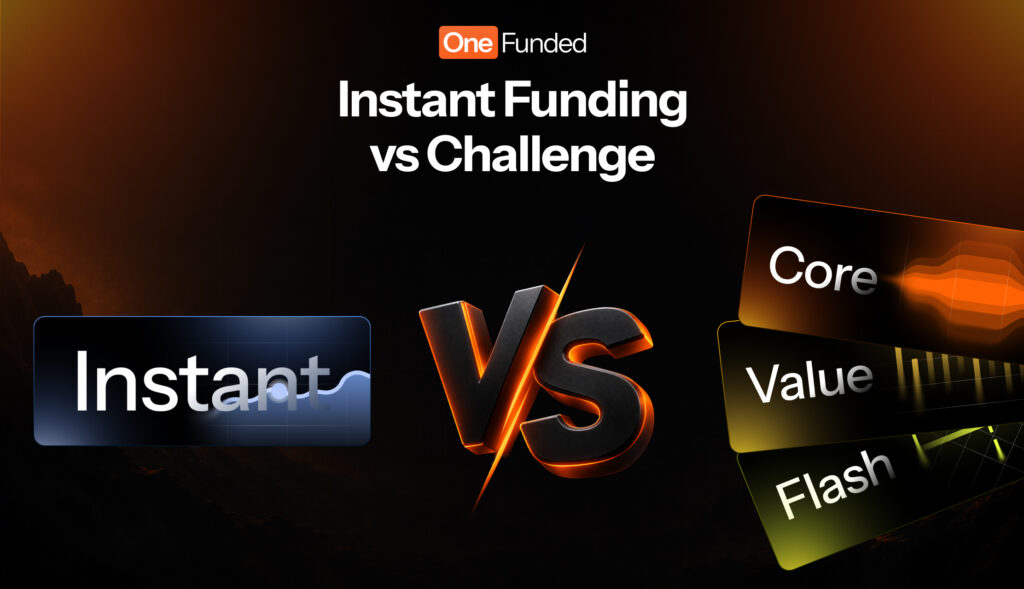
On OneFunded, you can access one instant funding model named “Instant,” with account sizes from $5,000 to $50,000. There are also three challenge options named “Flash,” “Core,” and “Value,” with up to $100,000 account sizes.
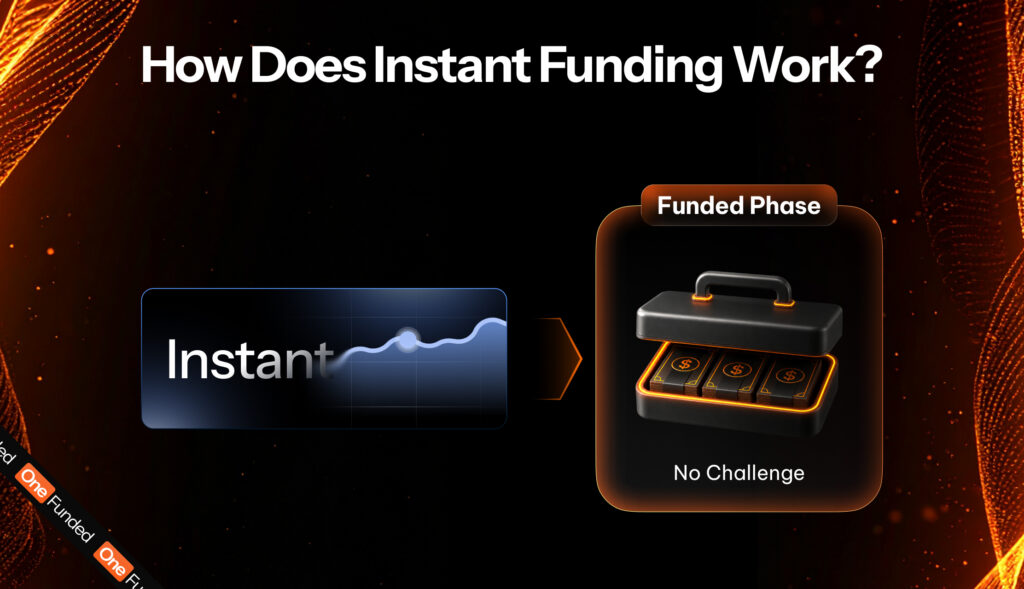
With instant funding at prop firms, traders only need to pay a program fee and access a trading account with funds immediately. That means no evaluation profit target is required.
However, there are still certain conditions and prop firm rules to meet, and they work in two different ways.
Breach one of these and the account is deactivated:
These don’t end the account, but they hold up your payout until you meet them:
So, instant funding is better suited to experienced traders who already have a tested strategy. A loss limit breach ends the account straight away, and there’s no evaluation stage to absorb the mistake.
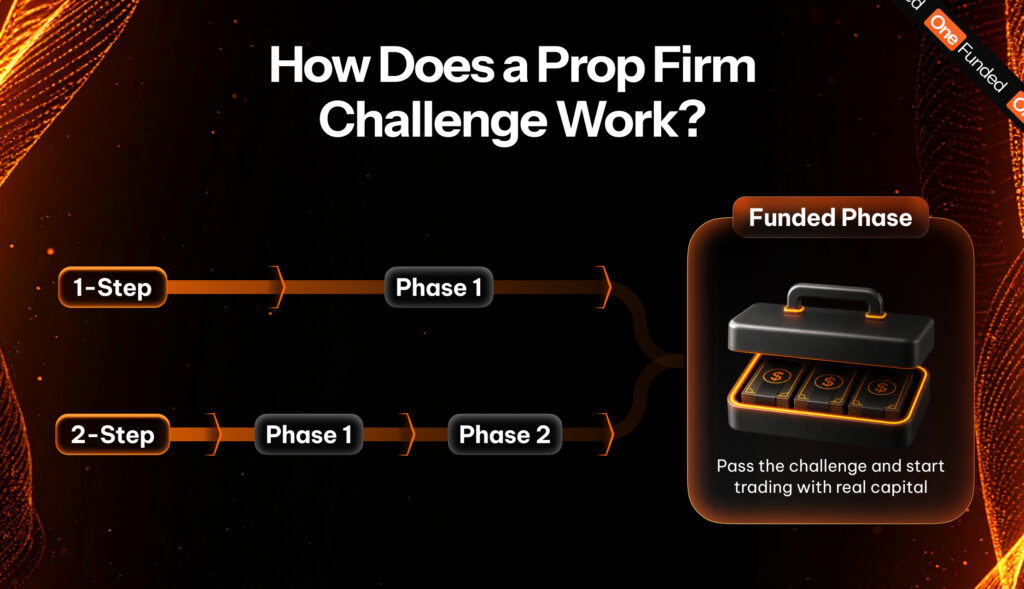
A prop firm challenge typically requires traders to show that they can trade and maintain profitability while sticking to defined risk limits. Different funding programs under this trading model come with evaluation phases that traders must complete.
One of the perks of prop challenges is that fees are lower than with instant funding. They usually come with higher profit splits and eligible add-ons. For instance, on OneFunded, challenges come with an 80% standard profit split that can be increased to 90% through eligible add-ons.
The trade-off is that traders must reach the required evaluation targets across one or two phases without blowing their accounts.
Let’s look at the four funding programs on OneFunded. The prices used in the illustration are for the $25,000 account size.
| Feature | Instant Funding | Flash (1-step) | Core (2-Step) | Value (2-step) |
| $25K price | $249 | $159 | $139 | $99 |
| Other Account sizes | 5K-50K | 5K-100K | 5K-100K | 5K-100K |
| Evaluation phases | None | 1 | 2 | 2 |
| Profit target | None | 10% | 8%/5% | 8%/6% |
| Daily loss limit | 3% | 4% | 5% | 4% |
| Maximum Loss | 6% | 8% | 10% | 8% |
| Consistency | 15% | 50% | None | None |
| Maximum exposure | 1% | 3% (2% on 100K) | 3% (2% on 100K) | 3% (2% on 100K) |
| Minimum trading days | None | 1 day | 3 days | 4 days |
| Standard profit split | 60% | 80% | 80% | 80% |
| Maximum profit split | 80% | 90% | 90% | 90% |
| Challenge fee refund | Not refundable | Yes | Yes | Yes |
The differences are worth looking at closely. Core has the highest overall loss allowance at 10%. Instant Funding removes evaluation targets but has the tightest maximum exposure limit. Value has the lowest $25,000 entry price, while Flash offers a single evaluation phase. Note that higher profit splits require applicable add-ons.
If you’re unsure about which prop firm account type to choose, here are some rules to guide your decision-making process:
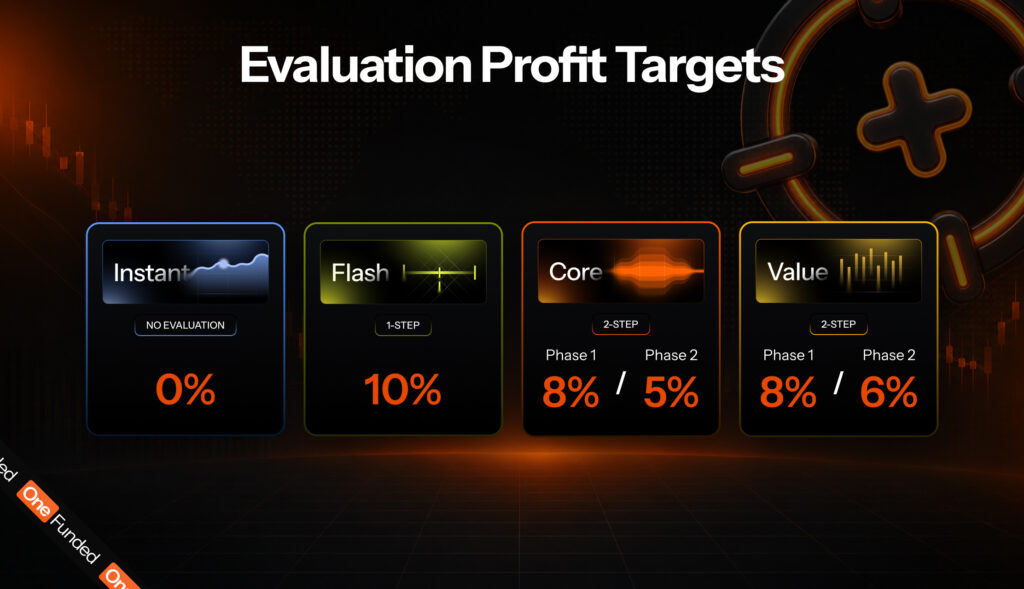
Instant Funding has no evaluation profit target. Meanwhile, Flash requires 10% in one phase, while Core requires 8% followed by 5%, and Value requires 8% followed by 6%.
While a one-step challenge like Flash has fewer evaluation stages, reaching a 10% target requires strong discipline. For instance, if a trader who normally risks a fraction of their capital per trade starts increasing position sizes because they are close to an evaluation target, they may lose the account.
Instant Funding removes that target-driven pressure, but it doesn’t remove the need to produce eligible profits. That means the evaluation vs instant funding decision comes down to how well you trade when a target is in front of you and not how fast you reach your target.
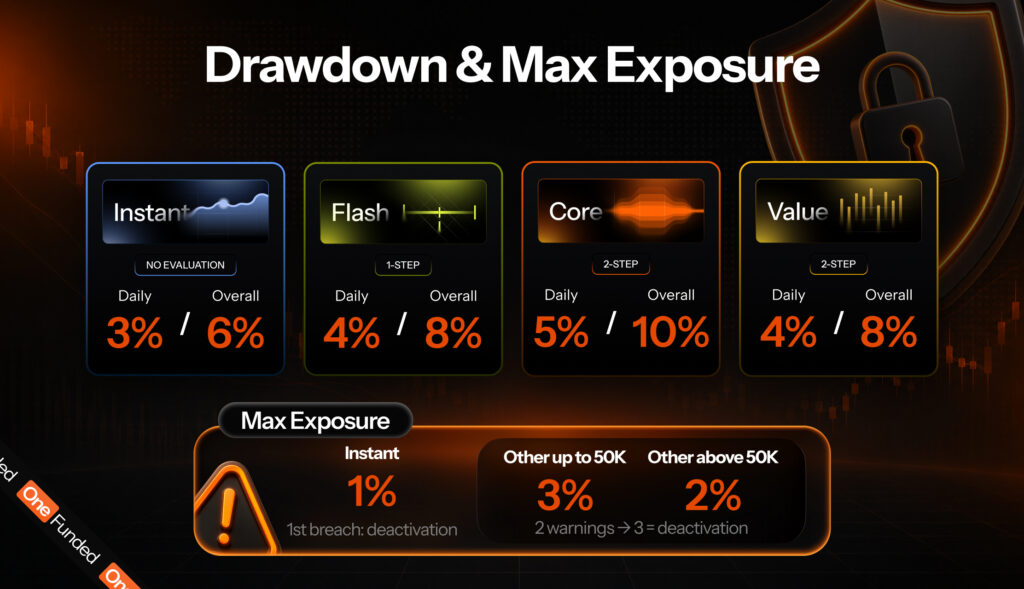
Your drawdown cap determines how much you can lose daily. Maximum exposure measures the combined floating loss on a trade idea.
Instant Funding has a 3% daily loss limit, 6% overall loss limit and 1% maximum exposure. Flash has a 4% daily and 8% overall loss limits. Core has 5% and 10%, while Value has 4% and 8%. Maximum exposure is 3% on challenge accounts up to $50,000 and 2% on larger ones.
For example, several gold positions in the same direction may count as one trade idea. OneFunded assesses their combined floating loss, so splitting an entry into smaller orders does not necessarily reduce your exposure.
The consequences of a breach also differ. Instant Funding accounts are deactivated immediately after a maximum exposure breach. Meanwhile, challenge accounts get trigger warnings after the first two breaches, and the third sanction is deactivation.
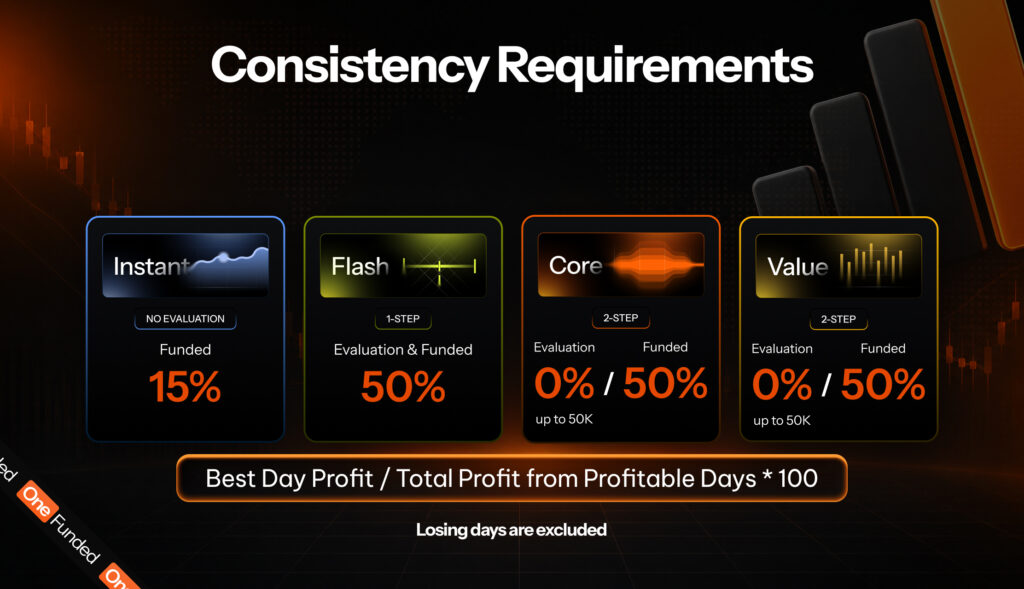
The consistency rule limits how much of your total profit can come from your best trading day. OneFunded calculates it as:
Best Day Profit ÷ Total Profit from Profitable Days × 100
For example, if you make $1,000 on your profitable days and $400 on your best day, your consistency figure is 40%. That is below the 50% cap. If your best day contributes $700, the figure rises to 70%, which exceeds the limit.
Instant Funding has a 15% consistency requirement. Flash applies a 50% cap during evaluation and once funded. Core and Value have no evaluation consistency requirement on accounts up to $50,000, but apply a 50% cap when funded.
Because losing days are excluded from the calculation, a profitable strategy can still take longer to qualify for a payout if most gains come from one session. Check how consistently you generate profits, not just your overall return.
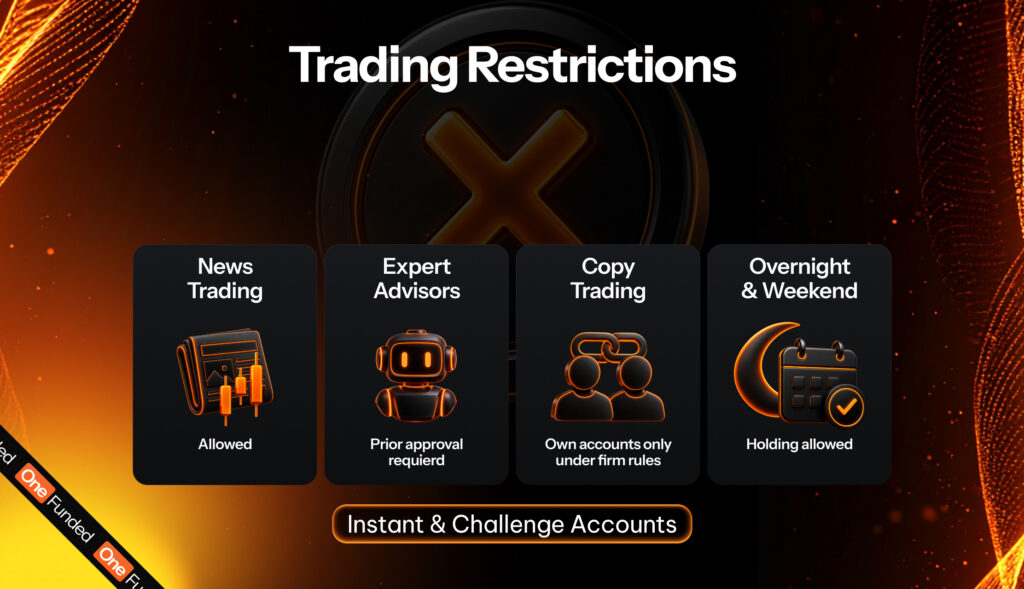
Skipping an evaluation does not mean you can use any trading strategy. OneFunded applies rules to both Instant Funding and challenge accounts, including:
At the $25,000 account size, the upfront prices are $249 for Instant Funding, $159 for Flash, $139 for Core and $99 for Value. However, repeated purchases change the breakdown:
| Funding Program | One Purchase | Two Attempts | Three Attempts |
| Instant | $249 | $498 | $747 |
| Flash | $159 | $318 | $477 |
| Core | $139 | $278 | $417 |
| Value | $99 | $198 | $297 |
These are full-price examples before discounts and add-ons. They illustrate possible purchase costs, not how many attempts a trader should expect to need.
If you’re working with a tighter budget, a challenge may be more practical. Two full-price Value purchases would cost $198, still less than one Instant Funding purchase of at least $249.
Passing an evaluation doesn’t automatically mean you can request a payout. Funded traders must generate eligible profits and meet the program’s payout conditions.
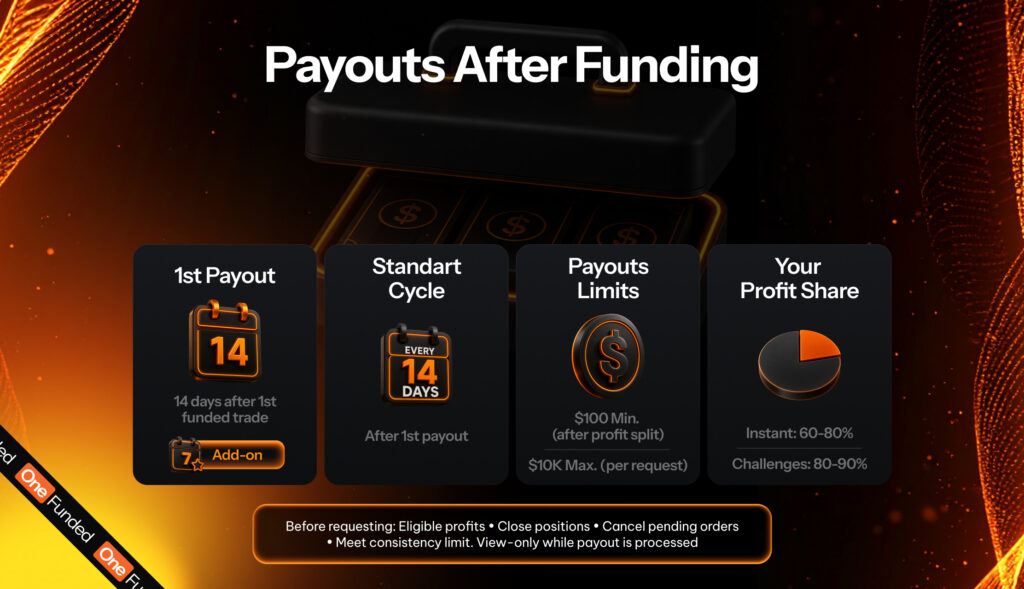
OneFunded’s first payout window opens 14 days after your first trade on the funded account. The Weekly Payouts add-on reduces this period to seven days. After the first payout, the standard cycle continues every 14 days. The minimum payout is $100 after the profit split has been applied, and the maximum is $10,000 per request.
Before submitting a request, you must close open positions and cancel pending orders. Your consistency ratio must also fall within the account’s limit. The account moves to view-only mode while the payout is processed.
The standard profit split is 60% for Instant Funding and 80% for Flash, Core and Value. Eligible add-ons can increase the Instant Funding split to 70% or 80%, and challenge program splits to 90%.
That difference may matter to traders who expect to make regular withdrawals. Challenge accounts offer a higher standard split, but traders must first pass the evaluation. Instant Funding provides access without an evaluation, but its standard split is lower and its consistency requirement is tighter.
A higher split doesn’t guarantee a larger payout. What matters is the profit you generate while meeting the program’s rules.
The program rules explain what traders must do. Their experiences show how difficult it can be to follow those rules consistently.
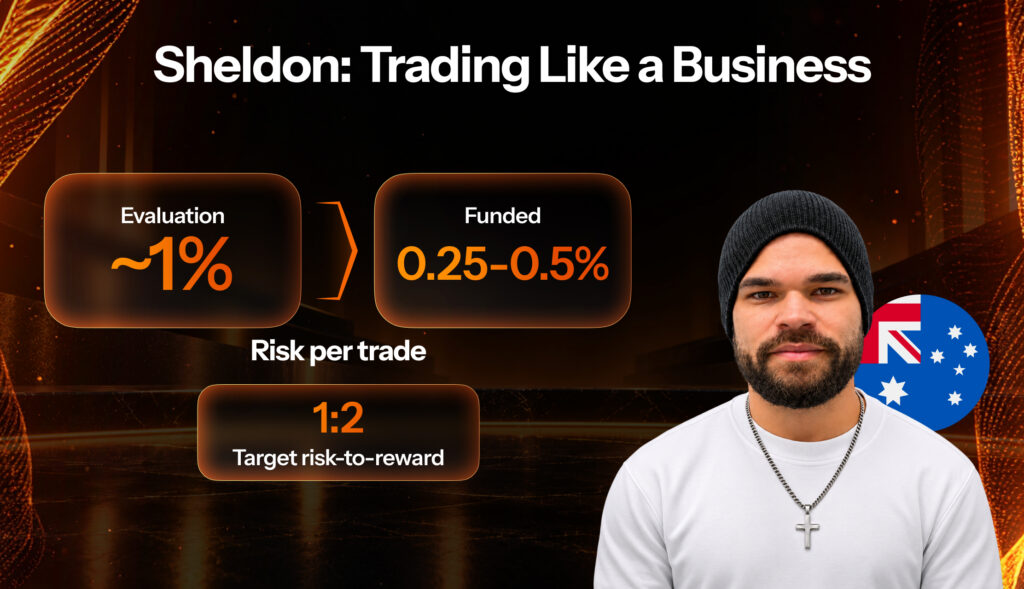
Sheldon, a 31-year-old trader from Australia, describes how he approaches gold scalping. He uses the 15-minute chart to establish directional bias and looks for entries on the five-minute chart, including small liquidity sweeps and an EMA 30 break.
He also explains how he adjusts his risk. During evaluation, he used around 1% risk. Once funded, he reduced that to approximately 0.25% to 0.5% per trade, with a target risk-to-reward ratio of around 1:2.
That adjustment is relevant to the funding decision. The conditions that apply during an evaluation may not be the same as those that matter when you start trading a funded account. A trader needs to understand those differences and adjust their approach rather than assume the same position size will work in every stage.
Sheldon also speaks about the trading psychology and the challenges he continues to manage, particularly greed and overtrading. Having a strategy doesn’t make it easy to follow. A winning streak can encourage overconfidence, while a losing trade can create the urge to recover quickly.
Watch Sheldon’s OneFunded trader interview.
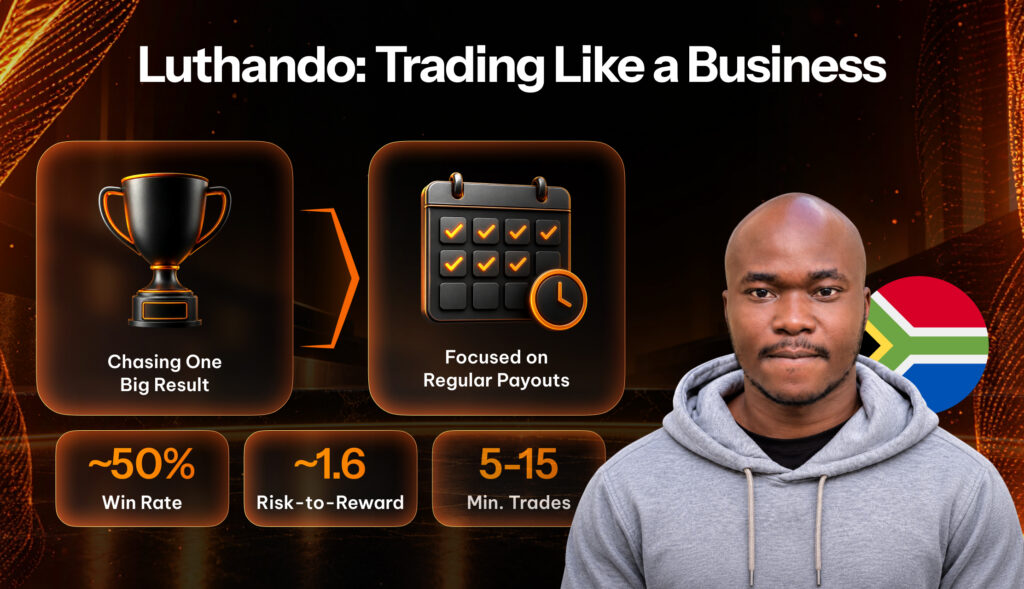
Luthando, also known as Limpson, is a South African trader who had been trading full-time for five years at the time of his interview. His journey included losing more than five accounts, sometimes just before reaching funding.
He trades the Asian session and scalps instruments including gold, US30 and GER30. He describes how greed and inconsistency affected his earlier attempts. Over time, he began treating trading like a business, focusing on regular payouts instead of chasing one large result.
His dashboard showed a win rate of around 50% and a risk-to-reward ratio of approximately 1.6. He also discussed keeping trades relatively short, often between five and 15 minutes.
Luthando’s experience is a reminder that repeated attempts don’t necessarily lead to progress if the underlying habits remain unchanged. A trader needs to understand why an account failed and make adjustments before trying again. That matters whether the next attempt is another evaluation or an instant funded account.
Watch Luthando’s OneFunded trader interview.
Neither interview proves that one funding route is better than another. Both offer useful lessons about managing risk, dealing with setbacks and developing a trading process that can hold up over time and potentially help you build a continually profitable trading business.
The four programs have different entry costs and trading conditions. Your choice should reflect the way you trade, not just the price or number of evaluation phases.
A program’s features only matter if they fit your current level of experience and trading habits.
A lower entry fee doesn’t make a program easier to pass, and immediate access doesn’t make an account easier to manage. Compare the conditions with your actual trading record before deciding.
Getting funded is a big achievement, but maintaining performance is what creates room for growth.
OneFunded’s free Scaling Plan is available to eligible traders on all funded accounts to grow the size of the account they trade. To qualify, you need three consecutive profitable payout cycles, each closing at 6% net profit or above.
An unprofitable cycle resets the count. Successful applicants can progress through five account levels, with increases of 20%, 25%, 30%, 35% and 40%, subject to the plan’s conditions, up to a maximum balance of $1,000,000
That means your ability to manage risk consistently matters more than the funding route you choose.
There isn’t one route that suits every trader. Instant Funding removes the evaluation but costs more upfront and comes with tighter exposure and consistency requirements. Flash offers one evaluation phase, while Core and Value spread their targets across two phases.
If you have a tested strategy and can manage Instant Funding’s tighter rules, paying more to skip the evaluation may make sense. If you prefer a lower entry cost or want to demonstrate your approach first, a challenge may be more suitable.


Instant funding provides access to a funded account without an evaluation. A prop firm challenge requires traders to meet profit targets and risk conditions before progressing to the funded stage. Instant funding usually costs more upfront, while challenges involve an evaluation.
Not necessarily. Instant funding may suit experienced traders who want to skip evaluation targets. A challenge may suit traders who prefer a lower entry fee and are comfortable proving their performance through one or two phases. Your budget, experience and risk management should guide the decision.
Yes. Eligible OneFunded Instant Funding traders can request performance-based payouts after meeting the program's conditions, including its 15% consistency requirement, minimum payout amount and payout schedule.
Flash, Core and Value fees are refundable with the third payout, subject to the program terms. Instant Funding fees are not refundable. Value also has a Progress Pass feature that can provide a replacement challenge if a trader reaches at least half of a phase's target before breaching it.
The cheapest prop firm isn’t always the one with the lowest entry fee. What you actually spend depends on how...

As a trader, you might have searched for prop firms that allow EAs or prop firms that allow news trading....

Are prop firms legit? While some are, some aren’t. However, you can tell whether they’re legit or not if you...
 Set Preferred on Google